Checklist for 2026 F1 Hybrid Power Compliance
Checklist of 2026 F1 hybrid power rules: 50/50 ICE-electric split, 350 kW MGU-K, MGU-H removal, 100% sustainable fuels, reduced fuel flow, budget and homologation limits.
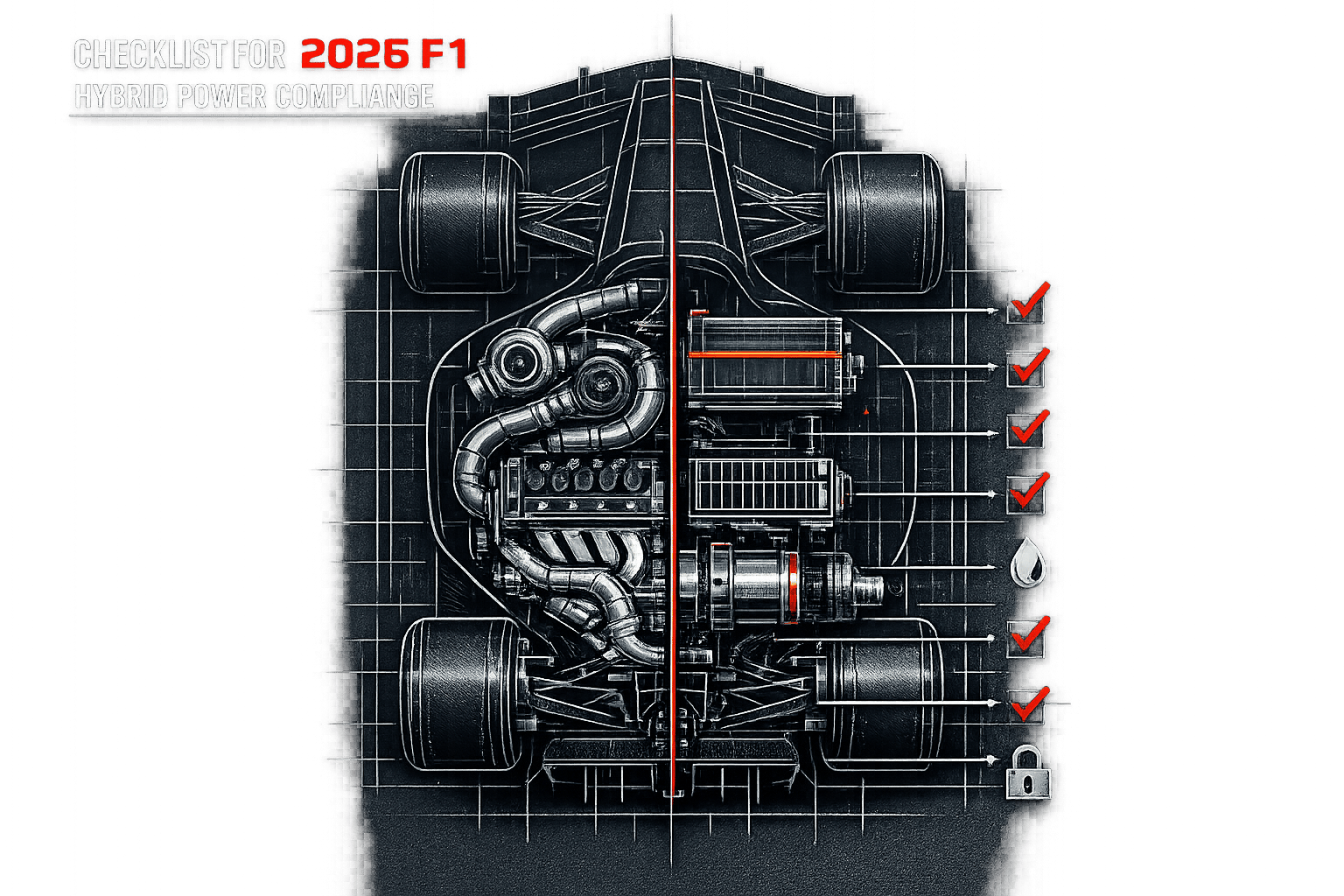
Formula 1 is entering a new era in 2026 with sweeping changes to its hybrid power unit regulations. These updates aim to balance performance with reduced costs and environmental goals. Here's what you need to know:
- 50/50 Power Split: Equal power from internal combustion (1.6L V6 turbo) and electric systems.
- MGU-K Upgrade: Power output jumps from 120 kW to 350 kW, enabling higher energy recovery (8.5 MJ per lap).
- MGU-H Removed: Simplifies design and reduces costs.
- 100% Sustainable Fuels: All teams must use fuels with at least 65% lower greenhouse gas emissions.
- Fuel Flow Limits: Reduced from 100 kg/hr to 75 kg/hr, prioritizing efficiency.
- Budget Cap: $215 million limit for power unit development, ensuring fair competition.
- Homologation Deadlines: Strict timelines for approval, with penalties for delays or non-compliance.
These changes demand precision in design and strategy, as teams integrate new technologies while meeting tighter restrictions. The 2026 regulations are set to reshape how F1 teams approach energy management and performance.
The Road to 2026: The Power Unit
Main Components of the 2026 F1 Hybrid Power Units
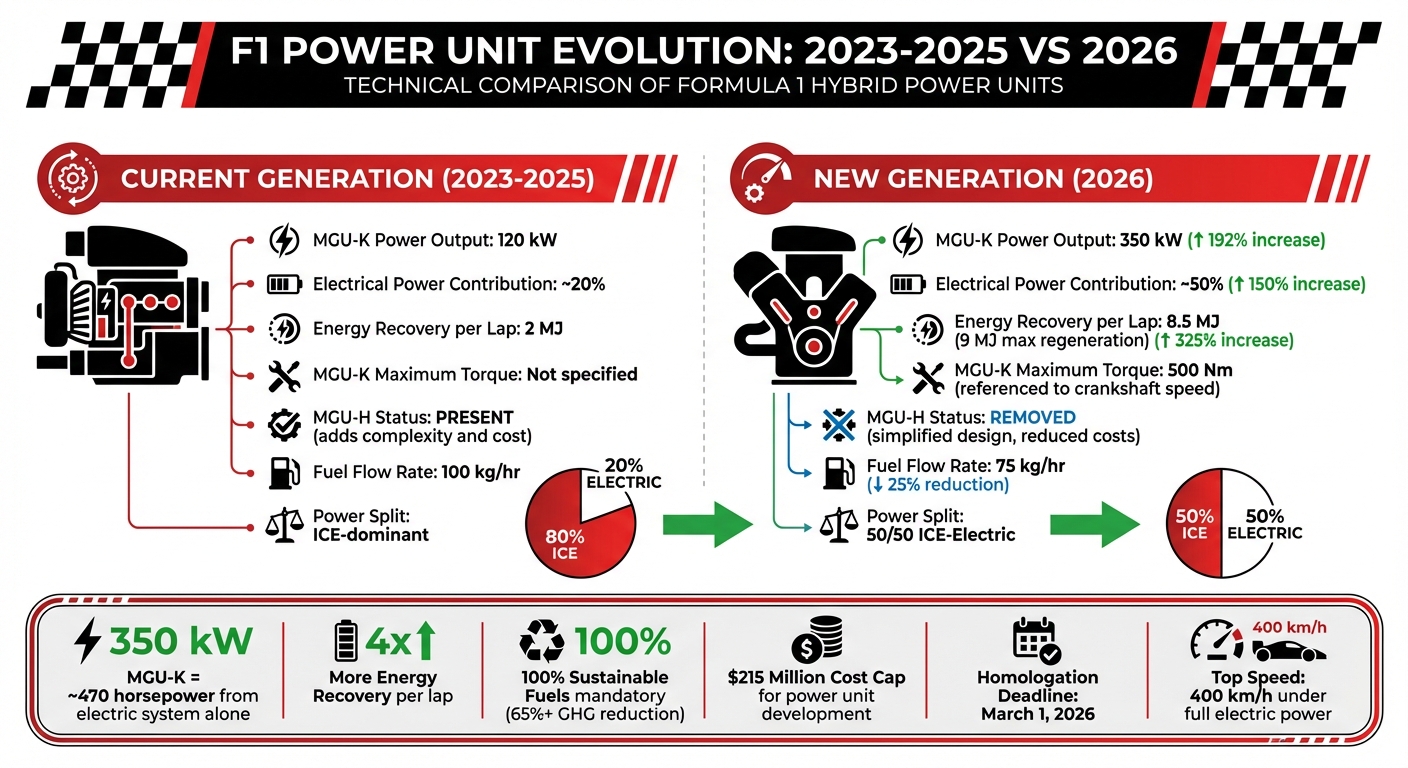
2023-2025 vs 2026 F1 Power Unit Specifications Comparison
The 2026 Formula 1 power units bring three key updates: keeping the 1.6L V6 engine, removing the MGU-H, and boosting the MGU-K. Manufacturers are required to implement these changes by March 1, 2026. Here's a closer look at how these updates will influence the design and performance of the power units.
1.1 Continued Use of 1.6L V6 Turbo Engines
The 1.6-liter V6 turbocharged engine remains the core of the power unit. To maintain consistency, the FIA has locked the architecture, ruling out any variations in cylinder count. One major adjustment is reducing the internal combustion engine (ICE) output to ensure a balanced 50/50 power split between thermal and electrical energy.
"Combustion power is no longer the primary determinant of performance. Instead, the engine is optimised for thermal efficiency, compatibility with sustainable fuels, and long-term reliability rather than absolute output." - Oliver Antony Felix, Technical Analyst
This shift means manufacturers must focus on improving the ICE's thermal efficiency and adapting it to run on fully sustainable fuels. These fuels differ chemically from traditional racing fuels, requiring precise adjustments to combustion speeds, knock resistance, and ignition timing.
1.2 Removal of the MGU-H
A major change in the 2026 regulations is the complete removal of the Motor Generator Unit-Heat (MGU-H). This decision stems from the MGU-H's reputation for adding cost and complexity to the power units.
"The MGU-H was a major source of complexity, cost, and reliability issues while providing minimal road-relevance. Its removal significantly lowers the barrier for new manufacturers entering the sport." - Larry W Jordan Jr., Technical Analyst
With the MGU-H gone, turbocharger systems will now rely solely on exhaust-driven operation, eliminating the need for electrical assistance. To make up for the loss of energy recovery from the MGU-H, teams will depend entirely on the enhanced MGU-K system.
1.3 Upgraded MGU-K Output to 350kW
The most dramatic change is the increase in MGU-K power output, jumping from 120kW to 350kW (around 470 horsepower). This upgrade is critical to achieving the required 50/50 power split between the ICE and the electrical system. The MGU-K can now recover up to 8.5 megajoules of energy per lap - though some circuits will limit this to 8 megajoules - compared to just 2 megajoules in the previous systems.
The upgraded MGU-K plays a larger role in energy recovery, capturing power during braking, coasting, and full-throttle scenarios like "super clipping". Drivers will also have access to new deployment modes, such as a "Boost Button" and "Overtake Mode", giving them tactical options on the track. However, activating the manual "Recharge Mode" (lift-off regeneration) will automatically disable the car's active aero devices, requiring careful coordination between energy and aerodynamic management.
| Feature | 2023–2025 Power Unit | 2026 Power Unit |
|---|---|---|
| MGU-K Power Output | 120kW | 350kW |
| Electrical Power Contribution | ~20% | ~50% |
| Energy Recovery per Lap | 2MJ | 8.5MJ (9MJ max regeneration) |
| MGU-K Maximum Torque | Not specified | 500Nm (referenced to crankshaft speed) |
Fuel Sustainability Requirements
As power units evolve, so do the fuel requirements that shape team strategies. The 2026 regulations demand 100% sustainable fuels, derived from sources like non-food biomass, municipal and forestry waste, and carbon capture technologies.
"The message is if you can eat it, don't burn it, so that it doesn't compete with the food source." - Matti Alemayehu, Global Motorsport Technology Manager, ExxonMobil
2.1 100% Sustainable Fuel Requirement
Under the new rules, all fuel blends must achieve a greenhouse gas (GHG) emission reduction of more than 65% compared to conventional petrol, considering the entire supply chain. To ensure compliance, every blend must undergo independent certification before being used in competition. For instance, ExxonMobil tested over 100 formulations and plans to certify a compliant fuel by the end of 2025. Adapting to these fuels will require teams to modify combustion parameters to match the unique chemical profiles of sustainable blends. These adjustments align with updated performance targets.
2.2 Fuel Flow Rate Limits
The regulations also reduce the fuel flow rate from 100 kg/hr to 75 kg/hr. This change means teams will only use about 70–80% of the total fuel allowed in 2025. Such constraints will significantly impact race strategies, forcing teams to prioritize fuel efficiency while leveraging new tools like the "Boost Button" and "Overtake Mode" powered by the upgraded MGU-K.
"If you think about what the regulation is asking for in 2026 versus 2025, it's pulling a lot from the hybrid side of the vehicle - 50 per cent of the power is coming from that, so there's less fuel utilization." - Matti Alemayehu, Global Motorsport Technology Manager, ExxonMobil
Fuel suppliers will now play a more central role as strategic technical partners. The development of drop-in fuels from waste streams requires close collaboration between power unit designers and fuel chemists to maximize thermal efficiency within the stricter flow limits. All fuel systems must meet these new standards ahead of the March 1, 2026 homologation deadline.
Technical and Safety Updates
The 2026 regulations bring a closer connection between the hybrid power unit and the car's aerodynamics. The power units now aim for a nearly equal split - about 50/50 - between the internal combustion engine and the electrical system. This is a big jump from the previous generation, where the electrical system contributed only around 20%. This shift also influences how aerodynamic systems handle energy recovery.
Under the new rules, aerodynamic components must work in tandem with the energy recovery system. For example, Active Aero devices will automatically deactivate during lift-off regeneration. This adjustment helps maximize energy recovery while maintaining stability on the track.
Budget Cap Changes for Power Unit Development
4.1 $215 Million Cost Cap
The 2026 regulations introduce a $215 million cost cap specifically for power unit manufacturers, which operates independently of the budgets for teams. This cap aims to curb excessive spending battles among manufacturers while also making it easier for new players, such as Audi and Red Bull-Ford, to enter the competition. To ensure compliance, manufacturers are required to submit detailed financial reports, with the FIA maintaining full authority to audit these submissions.
The regulations also impose strict limitations, such as capping the number of dyno hours available for testing and performance validation. Since power unit development is mostly frozen after the initial 2026 season, manufacturers face immense pressure to make accurate design choices early on. Bob Bell, Executive Director – Technical at Aston Martin Aramco, highlighted the complexity of this preparation:
"Preparing for 2026 is much broader than 'simply' building a new car. That's the tip of the iceberg. The stuff under the water is vast".
To manage costs effectively, teams are repurposing 2024 hardware to better align their budgets for 2026. Additionally, the regulations require manufacturers to factor in mandatory factory shutdown periods when planning their budgets and development schedules. Financial missteps are categorized into procedural violations, minor overspends, and material overspends, with penalties ranging from fines to championship point deductions or even restrictions on future development. These budgetary constraints aim to level the playing field while allowing tailored support systems for teams of varying sizes.
4.2 Effects on Smaller Teams
In addition to cost controls, the new regulations include provisions to help smaller teams stay competitive. One such mechanism is the ADUO system, which offers additional development opportunities to manufacturers falling behind the leaders. Under this system, manufacturers trailing by 2–4% receive one extra upgrade per season, while those lagging by more than 4% are granted two upgrades per season.
ADUO-eligible manufacturers also benefit from adjustments in their cost cap reporting, enabling them to allocate more funds toward development without incurring penalties. This adjustment provides smaller teams with more flexibility in managing their resources. While the main internal combustion engine (ICE) assembly will be frozen from 2027 to 2030, certain components - such as the flywheel - can still be developed and updated annually. This allows teams to focus on incremental improvements in specific areas.
Manufacturer Homologation and Compliance Deadlines
5.1 Homologation Timeline
The 2026 power unit regulations come with strict homologation cycles, locking in key design decisions early in the process. Manufacturers must submit battery systems and power unit architectures for FIA approval before the season kicks off. Once approved, the systems are essentially frozen, leaving no room for significant changes after homologation. This tight schedule puts immense pressure on teams to perfect their designs during the initial submission phase. Any errors or missteps at this stage can have long-lasting effects on performance since mid-season development is heavily restricted. To ensure compliance, the FIA has full audit authority, monitoring everything from dyno usage to research activities, and enforcing mandatory factory shutdowns. Deviating from this timeline leads to immediate and measurable consequences.
5.2 Penalties for Non-Compliance
Missing homologation deadlines or failing to meet compliance standards comes with steep penalties. Financial infractions - categorized as procedural, minor, or material overspends - can result in fines, development restrictions, championship penalties, and even grid penalties for exceeding component allocations. These penalties are closely tied to the cost cap and budget rules outlined earlier, emphasizing the importance of precision in early designs. Under the 2026 regulations, a failure in one area - such as late homologation or technical non-compliance - can ripple through the entire system, undermining overall performance. With no fallback options, these strict measures underscore the sport's focus on cost control and technical accuracy.
Conclusion: Getting Ready for the 2026 Hybrid Era
The 2026 regulations bring a sweeping transformation, requiring teams to rethink their entire systems engineering approach. Every part of the system matters now - whether it’s battery thermal management or fuel formulation - because even minor flaws can ripple through and affect overall performance. The introduction of a 50:50 power split between internal combustion and electric output, along with the elimination of the MGU-H, forces teams to adopt entirely new energy management strategies.
Getting a head start is non-negotiable. Take ExxonMobil's partnership with Red Bull Racing, for instance. Their early focus on fuel development paid off, with rigorous testing enabling them to deliver a certified sustainable fuel long before the season began. Teams that delay fuel development or underestimate the challenges of integrating the new 350 kW MGU-K could find themselves struggling. And thanks to strict homologation rules, fixing these issues mid-season isn’t an option.
As teams lay the groundwork, one of their biggest hurdles is ensuring their simulations align with real-world performance. With limited track testing, any mismatch between factory simulations and on-track results could leave teams at a permanent disadvantage. This is where vertical integration becomes a game-changer. Red Bull, leveraging the synergy between Red Bull Powertrains and Ford, is focusing on tightly integrating their chassis and power unit to handle the increased weight and thermal demands of the new systems.
Precision in energy deployment will also separate the leaders from the pack. In a world where a 50:50 power split is the norm, mastering the standardized energy modes will be critical. These include X-Mode for low drag on straights, Y-Mode for high downforce in corners, and Manual Override Mode for driver-controlled energy use. Teams that can seamlessly transition between these modes while maximizing the 9 MJ energy recovery will have a distinct advantage in the opening races. With top speeds expected to hit 400 km/h (about 249 mph) under full electric power, the room for mistakes is razor-thin.
FAQs
What impact will removing the MGU-H have on 2026 F1 power unit designs?
The decision to eliminate the MGU-H (Motor Generator Unit-Heat) from the 2026 F1 regulations represents a significant shift in how power units are designed. This change aims to simplify the systems and cut down on costs. Previously, the MGU-H played a key role by converting heat energy from the turbocharger into electrical energy, which could either be stored or used immediately. With its removal, teams will need to reevaluate how they design turbochargers and manage energy recovery.
This change puts more focus on the MGU-K (Motor Generator Unit-Kinetic) and the energy storage systems, which will now take on greater responsibility for ensuring efficient power delivery. Turbocharger designs may also evolve to address the absence of heat-to-electricity conversion. These adjustments are part of a broader effort to refine hybrid systems, encourage innovation, and align with F1’s push toward sustainability and cost management.
What does the 50/50 power split mean for F1 teams in 2026?
The 2026 F1 regulations introduce a 50/50 power split, meaning engine power will be equally shared between the internal combustion engine (ICE) and the hybrid energy recovery system. This balanced setup is intended to push advancements in both technologies, ensuring neither takes precedence over the other in terms of performance.
This change is geared toward boosting competition, increasing efficiency, and supporting F1's broader goals of lowering emissions and promoting more sustainable practices.
How will the 2026 fuel regulations affect team strategies in Formula 1?
The 2026 Formula 1 fuel regulations are set to shake things up, pushing teams to rethink their strategies. With the introduction of advanced sustainable fuels, the focus will shift to designing engines and power units that combine efficiency and reliability without sacrificing performance. This change will also alter how teams approach fuel management during races.
These updates align with the sport's broader sustainability goals, which include innovations like more agile cars and active aerodynamics. Teams will face the challenge of balancing enhanced performance with the demands of the new fuel standards. This means reworking car setups, adjusting race pacing, and refining energy recovery systems. The ultimate goal? To pave the way for closer competition on the track and a more environmentally friendly future for Formula 1.