Driver Input vs. Data: Balancing F1 Car Adjustments
How top F1 teams blend driver feel with telemetry to refine setups, diagnose handling issues, and maximize on-track performance.

Modern F1 cars generate massive amounts of data, but drivers remain key to understanding how a car performs on track. Telemetry provides precise measurements - like tire temperatures, brake pressures, and aerodynamic loads - but it can't explain the why behind performance issues. Drivers, on the other hand, offer nuanced feedback about handling, balance, and quirks that sensors miss.
The best teams combine both approaches. Telemetry identifies mechanical issues, while driver input provides context to refine setups. For instance, Max Verstappen’s ability to handle unstable cars led Red Bull to develop setups optimized for him but challenging for teammates. Similarly, Lewis Hamilton’s feedback on cockpit positioning led Mercedes to make aerodynamic changes in 2023.
The balance between data and driver feedback is critical to F1 success. Teams like Red Bull and Mercedes show that blending precise metrics with human insight drives better performance. Both are indispensable for achieving optimal results.
Driver Input: What Drivers Feel Behind the Wheel
How Drivers Sense Car Behavior
F1 drivers endure extreme physical forces, sometimes up to three times their body weight during cornering. These intense conditions sharpen their ability to sense even the smallest changes in a car's behavior. For example, drivers recognize understeer when the front tires lose grip and oversteer when the rear traction suddenly drops.
Brake instability is another issue drivers can identify. They might describe the car as feeling "nervous on entry" or notice a wobble while decelerating. This often points to a need for brake bias adjustments - the balance of braking force between the front and rear wheels. Typically, teams set this ratio at either 60:40 or 55:45 under dry conditions. Drivers also use terms like "pointy", "lazy", or even "diva-ish" to describe how the car behaves.
What makes driver input so valuable is their ability to adapt to the car's quirks, sometimes compensating in ways that telemetry alone can't detect. These sensory impressions, when shared with engineers, often reveal hidden issues that numbers might miss. This collaboration between driver and team is key to refining the car’s performance.
Adjustments Made from Driver Feedback
Driver feedback is crucial for fine-tuning a car’s performance. While telemetry provides hard data, drivers add context by explaining how the car feels on the track.
Teams often make adjustments based on this input. For instance, in March 2023, Lewis Hamilton pointed out that his forward cockpit position reduced his feel for rear-end stability, leading to a shift in the car's aerodynamic balance. Red Bull faced a different challenge during the 2019–2020 seasons. Max Verstappen’s feedback pushed the team to develop a car with quick rotation but nervous handling on entry. Verstappen managed this instability to gain lap time, but teammates Pierre Gasly and Alex Albon struggled with the same setup. This highlighted how tuning a car for one driver can sometimes limit its versatility.
Specific handling issues also prompt targeted fixes. If understeer is reported, engineers might increase the front wing angle or soften the front suspension. For oversteer, adjustments could include increasing the rear wing angle or altering the car’s rake. Brake instability often leads to shifting the brake balance forward. Additionally, teams use "Flow-vis" paint to visualize airflow over the car, verifying or challenging the driver’s observations.
Strengths and Weaknesses of Driver Feedback
Driver feedback provides insights that raw data simply can’t. As James Allison, Technical Director at Mercedes, explains:
"Data doesn't have much to say about the handling of the car. You could generate a channel that tells you whether the car is understeering or oversteering... but it doesn't tell you what an acceptable level of understeer might be".
This "acceptable level" varies widely among drivers. For example, Jenson Button has praised Max Verstappen’s ability to handle setups that wind tunnel data suggests are optimal, even if they feel unmanageable to most other drivers. This subjectivity is both a strength and a limitation of driver feedback - what works for one driver might be impossible for another.
Another challenge with feedback is its inconsistency. Drivers have different tolerances for instability and may describe the same issue in entirely different ways. A notable example occurred in November 2025, when Lando Norris asked McLaren to remove the "delta" time indicator from his steering wheel during qualifying. By the Mexico GP in October 2025, this change allowed him to focus more on track sensations, leading to a pole position and a race win. This highlights how small adjustments based on driver input can make a significant difference.
Telemetry Data: Measuring Car Performance with Sensors
What Telemetry Systems Measure
Modern Formula 1 cars are equipped with thousands of sensors that continuously stream data to the pit wall and team headquarters. During a single race, engineers handle terabytes of live data, tracking everything from tire temperatures to fuel consumption. And this data isn't just fast - it's lightning quick. Even from a race in Australia, it reaches a team's UK base in under 300 milliseconds.
These sensors monitor a wide range of metrics, including:
- Thermal data: Tire wear and brake temperatures.
- Dynamic data: Lateral forces and steering precision.
- Strategic metrics: Fuel usage, energy recovery, and GPS gaps.
- Mechanical behavior: Suspension geometry and spring performance.
In total, teams analyze over 300 performance metrics to assess both the car and the driver's performance. For instance, in 2023, Mercedes telemetry showed George Russell achieved 97% tire efficiency on medium compounds, slightly outperforming Lewis Hamilton's 94%. At the Monaco Grand Prix, telemetry revealed that Daniel Ricciardo's wet-dry lap time gap was 12% smaller than his competitors', showcasing his adaptability in mixed conditions.
This raw data forms the backbone of in-race analysis, enabling teams to make informed decisions on the fly.
Software and Analysis Tools
Live telemetry data is constantly compared against pre-race simulations to pinpoint performance gaps and identify strategic opportunities. Teams rely on AI-driven predictive models and digital twins to simulate race scenarios in real-time, projecting outcomes up to 50 laps ahead based on variables like tire degradation and fuel levels.
McLaren, for example, collaborates with AWS to run a machine learning-based driver evaluation program. This system analyzes 87 unique performance metrics alongside psychometric data to refine driver performance. Meanwhile, Mercedes has explored biometric tools like high-frequency eye tracking during wet-weather simulations to link visual scanning patterns with consistent lap times. These advanced tools allow teams to make razor-sharp decisions that could mean the difference between a podium finish and a disappointing mid-field result.
Of course, this cutting-edge technology comes at a price. An F1 steering wheel, which doubles as a critical data interface for drivers, costs around $77,000. Teams typically deploy about 60 engineers at the track and another 30 back at headquarters to manage this complex system. Geoff McGrath, Chief Innovation Officer at McLaren Applied Technologies, captures the essence of telemetry's role:
"We measure whatever we need to manage during the race, and then we model to get the predictive intelligence on how the cars are going to perform".
Strengths and Weaknesses of Telemetry Data
Telemetry data provides a wealth of objective measurements. James Allison, Mercedes' Technical Director, explains that while drivers may not feel the exact temperature of the radiator or know when tires are overheating, telemetry provides precise data on these factors. From temperatures to pressures and mechanical stress, the numbers don't lie.
However, telemetry has its blind spots. While it can tell engineers what the car is doing, it often can't explain why. For example, drivers might subconsciously adjust their driving style to compensate for an unbalanced car. The data might suggest the car is performing well, but the reality could be a driver struggling to maintain control.
Another limitation lies in defining subjective handling thresholds. Allison points out that while telemetry can show understeer or oversteer, it can't determine what level of understeer is acceptable. That judgment requires human input - something no sensor can replicate.
To unlock the full potential of telemetry, teams must combine this objective data with driver feedback, blending numbers with human insight to achieve peak performance.
F1 Telemetry - How the car performance translates to those wiggly lines
Driver Input vs. Telemetry Data: Direct Comparison
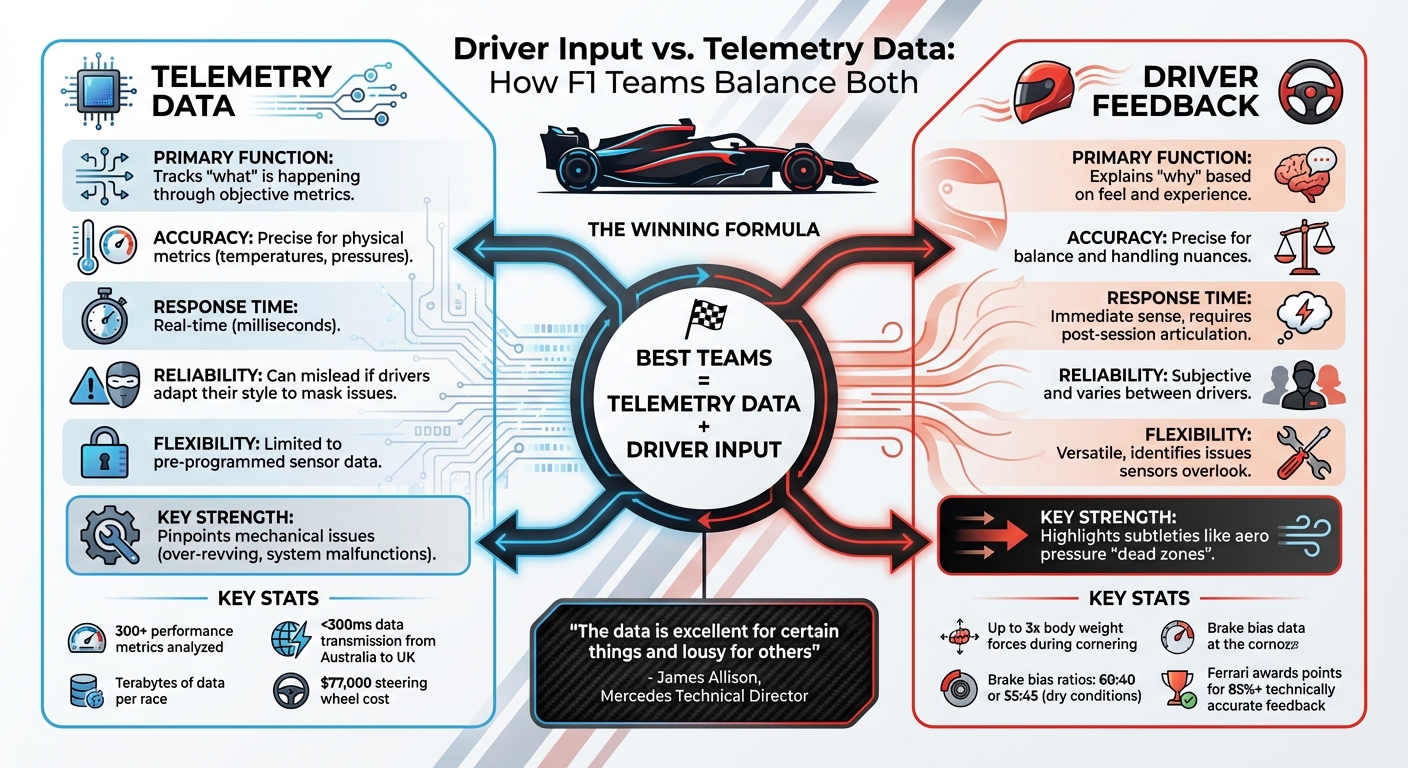
Driver Input vs Telemetry Data in F1: Key Differences and Strengths
This section delves into the relationship between driver input and telemetry data, detailing their individual roles, strengths, and how they work together to refine car performance.
Comparison Table: Key Differences
When teams adjust a car's setup, they rely on two distinct sources of information. Telemetry provides objective measurements, while driver feedback offers a subjective view of the car's behavior.
| Factor | Telemetry Data | Driver Feedback |
|---|---|---|
| Primary Function | Tracks "what" is happening through objective metrics | Explains "why" based on the driver's feel and experience |
| Accuracy | Precise for physical metrics like temperatures and pressures | Precise for evaluating balance and handling nuances |
| Response Time | Real-time, measured in milliseconds | Immediate sense, but requires post-session articulation |
| Reliability | Can mislead if drivers adapt their style to mask issues | Subjective and varies between drivers |
| Flexibility | Limited to pre-programmed sensor data | Versatile, identifying issues sensors might overlook |
| Key Strength | Pinpoints mechanical issues like over-revving or system malfunctions | Highlights subtleties like aero pressure "dead zones" |
Telemetry excels at capturing raw data, but it struggles to define subjective preferences like the "acceptable" level of understeer or oversteer. As James Allison, Mercedes' Technical Director, points out, while data can measure these traits, determining their ideal levels depends entirely on the driver's preference. Another challenge? Drivers often unconsciously adjust their style to compensate for car flaws, creating telemetry that appears fine even when the setup is flawed.
These differences underline why top teams blend both approaches to maximize performance.
Combining Both Approaches
The best teams don’t choose between telemetry and driver input - they integrate both. Experienced drivers and precise data carry equal weight when fine-tuning car setups.
Red Bull Racing provides a clear example of the risks of leaning too heavily on one side. Pierre Wache noted that Max Verstappen's unique ability to handle an unstable car led to a setup that telemetry identified as fastest. However, teammates Pierre Gasly and Alex Albon struggled to match Verstappen’s lap times because the setup was too demanding for other drivers. While the data suggested the car was optimal, it was only driveable for Verstappen.
McLaren took a different approach under Andrea Stella, prioritizing a balance between data and driver input. They embraced "accepting uncertainty", discarding upgrades that showed promise in wind tunnel simulations if they didn’t align with driver feedback and on-track performance. This strategy resulted in more consistent improvements compared to teams that relied solely on modeling. Ferrari has introduced natural language processing to analyze radio communications, even awarding extra points to drivers whose feedback is over 85% technically accurate.
The key, as James Allison explains, lies in understanding the strengths and limitations of each method: "The data is excellent for certain things and lousy for others". Teams use driver input to define performance thresholds and then rely on telemetry to ensure those expectations are met.
Case Studies: Teams Using Both Methods
Examples from racing highlight how combining driver insights with telemetry data can lead to better performance on the track.
Mercedes at the 2023 Hungarian GP
Mercedes showcased the power of blending driver feedback with telemetry data to deliver a standout performance. At the Hungarian Grand Prix, Lewis Hamilton ended a 33-race streak without pole position by beating Max Verstappen by just 0.003 seconds in qualifying. This success came from carefully analyzing practice session data and using Hamilton's input to fine-tune the car's setup.
However, race day brought challenges. George Russell reported battery overheating during the race, and telemetry confirmed the issue in real time. Starting 18th on the grid, Russell managed an impressive climb to 6th place, gaining 12 positions. Hamilton, on the other hand, slipped from 1st to 4th. Telemetry later identified a "cooling error" that forced both drivers to manage their car temperatures, ultimately affecting their pace.
The Hungaroring's track temperatures soared to 122°F (50°C), and with only 60% of the track requiring full-throttle running, limited airflow made cooling even harder. Team Principal Toto Wolff remarked:
"We had the second fastest car over the weekend".
This example highlights how telemetry helps diagnose technical issues, while driver feedback remains critical for adapting to unforeseen challenges during the race.
Red Bull's Setup Changes for Verstappen
While Mercedes wrestled with cooling issues, Red Bull relied on precise driver feedback to refine their car's performance. The team splits setup responsibilities: one engineer oversees electronic adjustments like differential and brake balance, while another focuses on physical elements such as wing angles and ride height. Each race weekend generates a staggering 2TB of telemetry data.
Max Verstappen's feedback zeroes in on specific handling concerns, such as entry stability and apex understeer. This allows engineers to fine-tune the car's rotation characteristics. Verstappen's unique ability to handle an unstable car has led the team to develop a faster, though more challenging, setup. As Technical Director Pierre Wache explained:
"He has an ability to control instability that would be impossible for some others. We know that sometimes, making a car on the edge in this way can create a quicker car".
This approach paid off for Verstappen, who maintained a 0.18-second pace advantage over Lando Norris across 63 laps at the 2025 Imola GP. However, this aggressive setup proved difficult for teammates Pierre Gasly and Alex Albon during the 2020 season. Eventually, Red Bull acknowledged they had "reached the ceiling" with this development path, underscoring the importance of balancing telemetry data with driver input to find the sweet spot for performance.
These case studies make it clear: blending data with driver insights is a cornerstone for achieving peak performance across racing teams.
Conclusion
In Formula One, the most successful teams understand one key principle: driver feedback and telemetry data must work hand in hand. While telemetry delivers precise measurements of a car’s mechanical performance, it lacks the human perspective that only a driver’s nuanced feedback can provide.
This synergy between human insight and technical data is at the core of F1 development. Experts like Adrian Newey and James Allison highlight that data can show what’s happening with the car, but only drivers can articulate how it feels and why certain handling quirks occur. This balance has become even more crucial in the ground-effect era, where the predictions made in wind tunnels often don’t align with what happens on the track.
The best teams use telemetry to identify mechanical issues while relying on drivers to set handling benchmarks. This creates a feedback loop where each informs the other, driving continuous improvement. Teams like Mercedes and Red Bull have proven that blending data-driven precision with driver intuition is the secret to achieving peak performance - a philosophy that lies at the heart of modern F1 car development.
FAQs
How do F1 teams decide when to rely on driver feedback instead of telemetry data?
F1 teams walk a fine line between relying on telemetry data and trusting driver feedback when tweaking car setups. Telemetry delivers precise, measurable details like shifts in downforce, tire temperature fluctuations, or potential mechanical problems - data that engineers can directly analyze and address. But sometimes, the driver's perspective becomes the deciding factor.
Drivers can feel subtle nuances that sensors might overlook - things like shifts in balance, variations in grip, or a lack of confidence in specific corners. This becomes especially important when telemetry doesn't paint a clear picture, track conditions change unpredictably, or a driver struggles to find their rhythm. By blending hard data with the driver's on-the-ground insights, engineers can fine-tune adjustments to enhance both the car's performance and the driver's comfort. This teamwork ensures the best possible decisions are made for race day.
What challenges do teams face when adjusting an F1 car to suit different drivers?
Adjusting an F1 car to suit a driver is a delicate mix of science and personal touch. Every driver has their own way of feeling the car's behavior - whether it’s the balance, grip, or overall feedback. Engineers take this input and turn it into specific tweaks, like altering the brake bias, adjusting suspension stiffness, or fine-tuning the aerodynamics. While telemetry data offers crucial insights, it’s often the driver’s detailed observations that uncover those subtle issues or highlight areas for improvement.
Modern F1 cars make this process even trickier with their highly sensitive ground-effect aerodynamics and complex tire behavior. A setup that works perfectly for one driver might completely throw off another, especially when you factor in changing track conditions or temperature. Engineers have to juggle the hard data with the driver’s instincts, running countless simulations and on-track tests to strike the right balance. It’s this constant back-and-forth between human input and cutting-edge technology that makes fine-tuning an F1 car such a demanding - and fascinating - task.
How are AI and machine learning transforming telemetry analysis in Formula 1?
AI and machine learning have completely transformed the way F1 teams process and interpret telemetry data. Sensors on the cars collect millions of data points - covering everything from tire temperature and brake wear to fuel flow. With AI, these raw numbers are turned into actionable insights, helping teams spot patterns and even predict potential failures. This means they can make real-time tweaks to critical systems like engine settings, cooling, or suspension to keep performance and reliability in check.
AI isn’t just about keeping the car running smoothly - it’s also a game-changer for strategy. By analyzing live race data, weather updates, and historical performance trends, AI can suggest optimal strategies, such as the best timing for pit stops or which tires to use. When combined with driver feedback, these algorithms help teams fine-tune car setups, adjusting things like brake bias or suspension with a level of precision that balances human intuition and data-driven predictions. This blend of technology and teamwork is redefining F1, making it a sport where smart, data-led decisions are at the heart of success.