Fangio vs. Ascari: Early F1 Rivalry Explained
Explore the 1950s rivalry that defined early Formula One—contrasting driving styles, decisive races, head-to-head stats, and lasting influence on the sport.
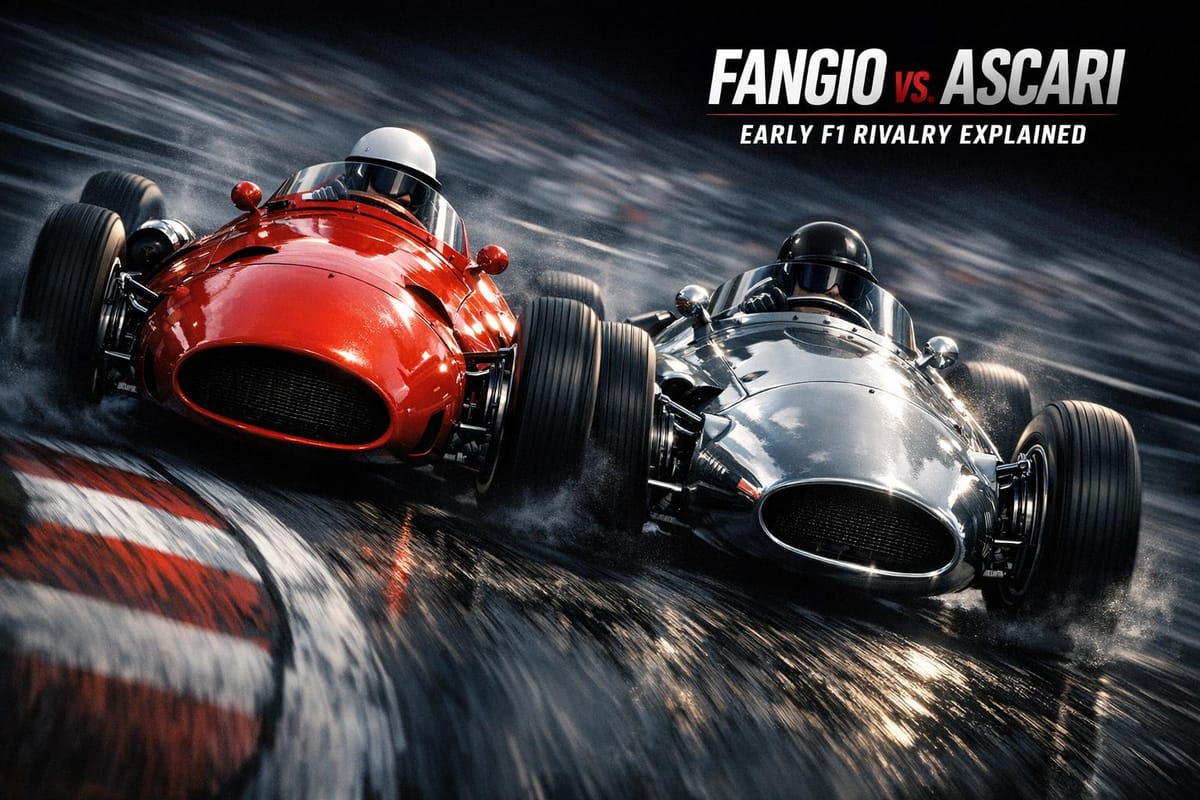
Fangio vs. Ascari defined the early years of Formula One, showcasing two of the sport's most dominant drivers. Between 1950 and 1955, they won 27 of 31 races they both competed in, leading over 66% of all laps during that time. Fangio, known for his precision and ability to master different cars, claimed five World Championships with four manufacturers. Ascari, Ferrari’s first champion, relied on consistency and led Ferrari to back-to-back titles in 1952 and 1953.
- Fangio: Excelled with adaptability, winning titles with Alfa Romeo, Mercedes, Ferrari, and Maserati. Known for his strategic racing style and ability to recover from setbacks.
- Ascari: Dominated with methodical precision, achieving nine consecutive wins and maintaining an unmatched level of control when leading races.
Their rivalry helped shape Formula One into the global competition it is today, blending technical innovation with intense competition. Fangio’s versatility and Ascari’s consistency remain benchmarks for modern drivers.
Quick Comparison
| Statistic | Juan Manuel Fangio | Alberto Ascari |
|---|---|---|
| World Championships | 5 (1951, 1954–1957) | 2 (1952, 1953) |
| Grand Prix Starts | 51 | 32 |
| Race Wins | 24 | 13 |
| Pole Positions | 29 | 14 |
| Career Win Percentage | 47.06% | 40.63% |
Their rivalry wasn’t just about wins - it set the tone for professionalism in Formula One, influencing the sport’s evolution and inspiring future generations.
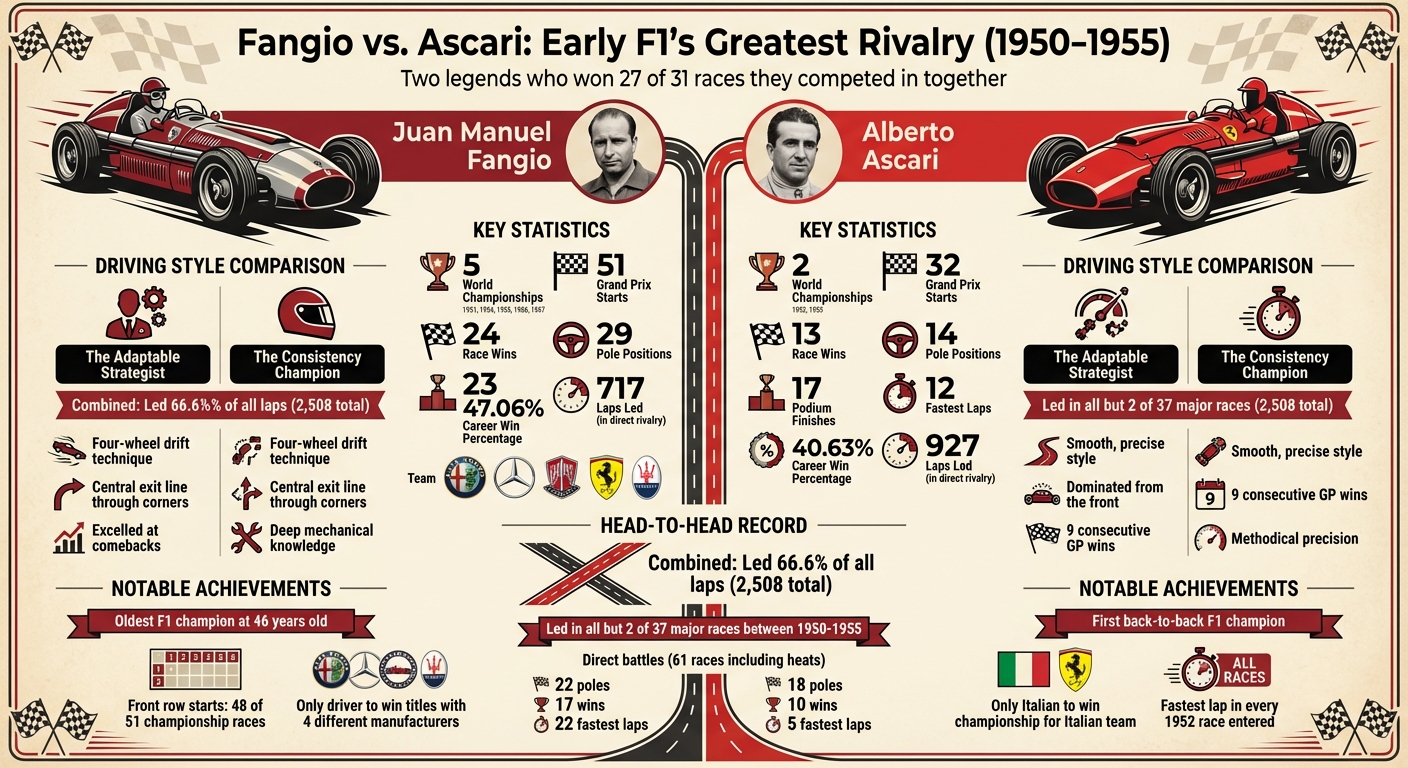
Fangio vs Ascari: Complete Career Statistics Comparison 1950-1955
Juan Manuel Fangio: Master of Multiple Teams
Fangio's Driving Style
Juan Manuel Fangio's driving was a masterclass in precision and control. Unlike many of his contemporaries, he preferred a central exit line through corners rather than an aggressive outside approach. This distinctive technique, highlighted by Enzo Ferrari, allowed Fangio to maintain exceptional exit speed while keeping the car under control. One of his trademarks was the "four-wheel drift", a controlled powerslide that optimized tire performance and showcased his unmatched finesse behind the wheel.
Fangio's deep understanding of mechanics played a crucial role in his success. With years of hands-on experience, he knew how to push his car to its limits. He worked closely with his mechanics, offering detailed feedback and even assisting with setup adjustments. This collaborative approach not only enhanced his car’s performance but also boosted team morale.
"He exhibited an unusual style: exiting curves from the middle with unmatched speed." - Enzo Ferrari, Founder, Scuderia Ferrari
Fangio also had an uncanny ability to anticipate danger and mechanical issues, a skill often described as a "sixth sense." Early in races, he would hold back, studying his competitors’ pace and tire wear before making his move at just the right moment.
Key Victories Over Ascari
One of Fangio's most pivotal victories came at the 1951 Spanish Grand Prix, where he secured his first world title against Alberto Ascari. Ascari started on pole, but Ferrari’s decision to use 16-inch rear wheels led to severe tire wear, forcing multiple pit stops. This misstep gave Fangio the edge he needed to clinch the win.
Another legendary performance unfolded at the Nürburgring during the 1957 German Grand Prix. After a disastrous pit stop left him trailing the Ferraris of Mike Hawthorn and Peter Collins by 48 seconds, Fangio staged an extraordinary comeback. He shattered the lap record multiple times, overtaking both drivers on the penultimate lap to claim victory - and his fifth world title - at the age of 46.
Fangio's Impact on Formula One
Fangio's career was a blueprint for excellence in Formula One. His ability to adapt and excel with different manufacturers was unparalleled, as evidenced by his five World Championships with four different teams: Alfa Romeo in 1951, Mercedes-Benz in 1954 and 1955, Ferrari in 1956, and Maserati in 1957. His win rate of 46.15% - 24 victories in just 52 races - remains the highest in the sport. He also started from the front row in 48 of his 51 championship races, earning 29 pole positions along the way.
Fangio's willingness to switch teams mid-season in pursuit of the best car redefined professionalism in the sport. Enzo Ferrari famously remarked that Fangio "did not remain loyal to any marque" but always sought the most competitive machinery. Stirling Moss echoed this sentiment, noting, "The cheapest method of becoming a successful Grand Prix team was to sign up Fangio".
At 46, Fangio became the oldest driver to win a world title, securing his final championship in 1957. His combination of mechanical expertise, strategic brilliance, and raw speed set the standard for what it means to be a complete racing driver. Fangio’s legacy not only shaped the sport but also laid the foundation for its enduring rivalries, including his memorable battles with Ascari.
Alberto Ascari: The Consistency Champion
Ascari's Driving Style
Unlike Juan Manuel Fangio's adaptable and precise approach, Alberto Ascari's racing style was defined by unmatched consistency. His method was all about smooth, calculated precision, executed so flawlessly that it left "barely a mark on the road". Instead of flashy maneuvers, Ascari focused on control and accuracy - a "neat style" that reflected his attention to detail.
Ascari's strategy often revolved around taking an early lead and maintaining control throughout the race. Enzo Ferrari famously described this approach as "playing the hare."
"Ascari had a precise and distinctive driving style... Alberto was secure when he was playing the hare. That was when his style was at its most superb." - Enzo Ferrari, Founder, Ferrari
His upright, forward-leaning posture and analytical mindset gave him exceptional control behind the wheel. However, Ferrari also observed that Ascari was less effective when forced to chase from behind.
Mike Hawthorn, the 1958 World Champion, offered high praise for Ascari's abilities:
"Ascari was the fastest driver I ever saw. And when I say that, I include Fangio."
Key Victories Over Fangio
Ascari's dominance reached its peak in the 1952 and 1953 seasons, a period when Fangio missed several races due to injury. In 1952, Ascari achieved a near-perfect season, winning every World Championship race he entered, except for the Swiss Grand Prix, which he skipped to compete in the Indianapolis 500. His victories that year included the Belgian, French, British, German, Dutch, and Italian Grands Prix.
One of his most remarkable accomplishments was a streak of nine consecutive Grand Prix wins, starting with the 1952 Belgian Grand Prix and continuing through to the 1953 Belgian Grand Prix. Early victories over Fangio in the 1951 German and Italian Grands Prix set the tone for this dominant run. At the 1953 Italian Grand Prix, Ascari led until a dramatic final-lap spin, and in 1954, he secured pole position in the new Lancia D50, outpacing Fangio by a full second.
Ascari's Impact on Formula One
As Formula One's first back-to-back World Champion in 1952 and 1953, Ascari set new standards of excellence. During the 1952 season, he recorded the fastest lap in every race he entered. With a career win ratio of 40.6% - which rose to 48% during his time with Ferrari - and 927 laps led between 1950 and 1955, Ascari became synonymous with consistency.
While Fangio thrived on adapting to different teams and cars, Ascari's strength lay in his unwavering steadiness. His "smooth" driving style became a template for future legends like Jim Clark and Jackie Stewart. Enzo Ferrari deeply valued Ascari not just for his speed, but also for his calm demeanor and detailed technical feedback, which played a critical role in developing early Ferrari Grand Prix cars like the 375 F1 and the 500.
Even Fangio acknowledged Ascari's brilliance, admitting that without him, championship victories felt less meaningful. Fangio admired Ascari's grace and supreme skill, calling him "a real champion".
To this day, Ascari remains the only Italian driver to win the World Championship for an Italian team. His legacy of precision, dominance, and consistency continues to stand as a benchmark in Formula One history, forever linked to his rivalry with Fangio.
Fangio vs. Ascari: Direct Comparison
Career Statistics Compared
During the early years of Formula 1, Juan Manuel Fangio and Alberto Ascari dominated the scene, combining for 27 wins out of 31 starts in their direct rivalry. Together, they led an astounding 66.6% of the 2,508 laps raced during this period, with at least one of them holding the lead in all but two of the 37 major races between Silverstone in 1950 and Monaco in 1955.
| Statistic | Juan Manuel Fangio | Alberto Ascari |
|---|---|---|
| World Championships | 5 (1951, 1954–1957) | 2 (1952, 1953) |
| Grand Prix Starts | 51 | 32 |
| Race Wins | 24 | 13 |
| Pole Positions | 29 | 14 |
| Podium Finishes | 35 | 17 |
| Fastest Laps | 23 | 12 |
| Career Win Percentage | 47.06% | 40.63% |
| Laps Led (Direct Rivalry) | 717 | 927 |
Fangio's career win percentage of 47.06% narrowly surpassed Ascari's 40.63%, but Ascari led more laps in their direct battles - 927 to Fangio's 717. Across their 61 head-to-head races (including heats), Fangio claimed 22 poles, 17 wins, and 22 fastest laps, while Ascari managed 18 poles, 10 wins, and 5 fastest laps. Fangio's consistency was legendary; he started from the front row in 48 of his 51 championship Grands Prix. These statistics reflect the fierce competition and mutual brilliance that defined their rivalry.
Their Greatest Battles
A few races stand out as iconic moments in the Fangio-Ascari rivalry. At the 1953 Italian Grand Prix in Monza, there were 19 official lead changes. Ascari led most of the race but spun at the Parabolica under immense pressure, allowing Fangio to seize the win with his calculated racecraft.
The 1951 Spanish Grand Prix was another pivotal showdown. Ascari started on pole, but Ferrari's decision to use 16-inch rear wheels backfired, leading to tire issues and multiple pit stops. Fangio capitalized on this misstep to secure both the race victory and his first world championship. Then, at the 1953 French Grand Prix at Reims - often called the "Race of the Century" - Fangio finished just one second behind Mike Hawthorn, while Ascari ended up in fourth place. The 1955 Monaco Grand Prix further highlighted the high stakes of their rivalry: Fangio retired due to mechanical problems, and Ascari's race ended in a crash.
These races showcased not only their immense talent but also their contrasting approaches to racing.
Comparing Their Abilities
Fangio's adaptability was unmatched - he won championships with four different manufacturers: Alfa Romeo, Mercedes, Ferrari, and Maserati. He had an extraordinary ability to adjust to each car's nuances, a skill that set him apart. Ascari, on the other hand, excelled with precision and dominance when leading from the front. As Enzo Ferrari once remarked:
"Alberto was secure when he was playing the hare. That was when his style was at its most superb. In second place, or further back, he was less sure."
Fangio thrived in challenging situations, never losing his composure regardless of his position. His philosophy of winning "at the slowest possible speed" allowed him to preserve his car while maintaining competitiveness. Meanwhile, Mike Hawthorn summed up Ascari's raw talent, saying:
"Ascari was the fastest driver I ever saw. And when I say that, I include Fangio."
Their rivalry continues to influence Formula 1 today, where success still hinges on a balance of adaptability, precision, and consistency.
The Lasting Impact of This Rivalry
How They Helped Formula One Grow
Between 1950 and 1955, the rivalry between Alberto Ascari and Juan Manuel Fangio played a crucial role in establishing Formula One as a credible and competitive sport. Their dominance brought much-needed star power, helping F1 evolve from its pre-war roots into a global stage for cutting-edge automotive technology. This era saw iconic manufacturers like Ferrari, Maserati, Mercedes-Benz, and Lancia rise to prominence, solidifying F1’s reputation as the pinnacle of motorsport.
But the impact of their rivalry wasn’t confined to the racetrack. Ascari’s tragic death in May 1955 drew an estimated one million mourners to his funeral in Milan, highlighting how deeply their competition resonated with fans and fueled national pride. Fangio’s growing international fame, bolstered by his ability to win with four different manufacturers, brought even more attention to the sport. Events like his dramatic 1958 kidnapping in Cuba only added to the global intrigue surrounding him and Formula One. Their legendary battles - such as the 1953 French Grand Prix, often called the "Race of the Century" - delivered the kind of high-stakes drama that cemented F1 as the ultimate motorsport spectacle.
This transformative period laid the foundation for many of the strategies and technologies that define Formula One today.
What Modern Racing Can Learn
The lessons from the Fangio-Ascari rivalry remain highly relevant for today’s teams and drivers. Fangio’s knack for strategic team moves - switching manufacturers at the perfect moments - underscored the importance of aligning with the right team to stay competitive. Modern research backs this up, showing that the driver-team relationship accounts for 30–40% of race success, compared to just 15% attributed to individual driver skill.
Their contrasting approaches to racing also hold valuable insights. Ascari, often likened to a "hare" for his dominance when leading, contrasted sharply with Fangio’s relentless determination to fight back from behind. This difference highlights the importance of adaptability in elite drivers. Enzo Ferrari once remarked that Ascari was "secure when he was playing the hare" but struggled when chasing, whereas Fangio "never gave in" regardless of his position.
Both drivers were also deeply involved in the technical side of racing, providing critical feedback that improved car performance. This collaborative approach between driver and engineers remains essential in today’s data-driven Formula One environment.
Conclusion
The rivalry between Fangio and Ascari not only defined the early years of Formula One but also set the tone for the sport's future. They embodied two distinct styles of elite driving: Fangio, the adaptable strategist capable of mastering any car, and Ascari, the precision driver who excelled at leading from the front. Their on-track battles were fierce, but their mutual respect off the track helped elevate Formula One’s professionalism during its formative years.
When Ascari passed away in 1955, Fangio expressed his admiration, saying:
"I have lost my greatest opponent. Ascari was a driver of supreme skill and I felt my title last year lost some of its value because he was not there to fight me for it."
Their influence persists in modern F1, from the emphasis on teamwork and technical feedback to the sport’s ability to adapt to evolving challenges. For those intrigued by how historical rivalries continue to shape Formula One, F1 Briefing (https://f1briefing.com) offers in-depth coverage of the sport's journey from its origins to its current technological advancements.
What made Juan Manuel Fangio GREAT
FAQs
How did the rivalry between Fangio and Ascari influence Formula One?
The rivalry between Juan Manuel Fangio and Alberto Ascari was a cornerstone in shaping the early days of modern Formula One. In the 1950s, their distinct driving approaches - Fangio's methodical precision versus Ascari's relentless consistency - set a new benchmark for what it meant to excel on the track. Between them, they achieved an incredible 27 wins each out of just 31 starts, pushing the boundaries of what was possible in the sport.
Their rivalry also underscored the importance of versatility. Both drivers found success across multiple manufacturers, including Ferrari, Alfa Romeo, Maserati, and Mercedes-Benz. These intense battles not only boosted Formula One's global popularity but also paved the way for the technical progress and fierce rivalries that are now hallmarks of the sport. Fangio and Ascari's influence endures, shaping how drivers today approach strategy, teamwork, and performance in the fast-paced world of Formula One.
How did Fangio and Ascari's driving styles differ in early Formula One?
Juan Manuel Fangio and Alberto Ascari approached racing in ways that highlighted their distinct strengths and personalities behind the wheel. Fangio was renowned for his incredible car control and strategic mindset. He had a knack for staying composed under pressure, managing races with a calculated and steady hand. His ability to adapt to unpredictable conditions and deliver consistent performances cemented his reputation as a master tactician.
Ascari, by contrast, brought a blend of smoothness and aggression to his driving. He paired technical precision with a relentless competitive spirit, thriving in close contests and pushing his car to its limits. His pursuit of perfection and unwavering determination made him a force to be reckoned with, even though his career was shorter than Fangio's.
In many ways, Fangio symbolized calm control and strategic mastery, while Ascari stood out for his precision and fierce intensity on the track.
What made Fangio more adaptable than Ascari in Formula 1 history?
Juan Manuel Fangio is often celebrated for his extraordinary ability to thrive with multiple teams and cars, even under constantly changing technical regulations. His career saw victories with iconic manufacturers like Mercedes, Alfa Romeo, Maserati, and Ferrari. This showcased his incredible flexibility in mastering different car designs, adapting to varied team dynamics, and excelling under diverse race conditions. Fangio’s knack for strategic race management and his consistency across a range of setups cemented his legendary status.
On the other hand, Alberto Ascari’s success was more closely tied to his tenure with Ferrari during the early 1950s, a period when the team was at its strongest. While Ascari’s talent as a driver is unquestionable, much of his dominance stemmed from Ferrari’s unparalleled performance at the time. Unlike Fangio, there’s less evidence of Ascari achieving similar success in varied environments. Fangio’s ability to conquer challenges across a wider range of scenarios firmly establishes him as one of the most adaptable drivers in Formula 1 history.