Front vs Rear Weight Distribution in F1 Cars
Front- vs rear-biased weight dramatically changes F1 handling: trade-offs in braking, cornering and acceleration, ballast tuning, and track-specific setup choices.
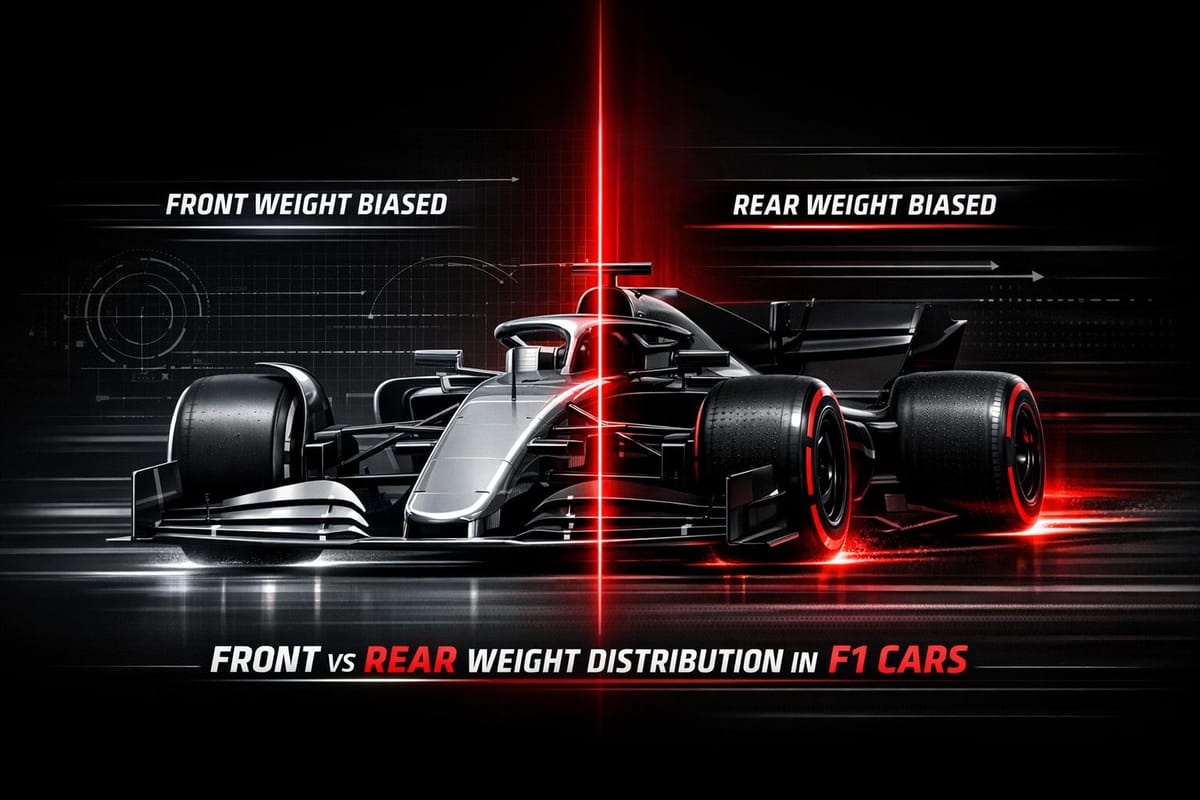
Weight distribution in Formula 1 cars is all about balancing performance. Modern F1 cars typically favor a rearward weight bias, with at least 44% of the car's weight required on the front axle by FIA regulations. Here's why weight distribution matters:
- Front-heavy setups improve braking and corner entry but can reduce rear traction, leading to slower exits and higher front tire wear.
- Rear-heavy setups enhance acceleration and corner exit speed but may cause oversteer and instability during braking.
Teams fine-tune weight distribution using ballast while adhering to regulations. The right balance depends on track characteristics, fuel loads, and tire management. For example, rear-heavy setups excel on technical circuits, while front-heavy setups perform better on high-speed tracks. Weight shifts during braking and acceleration also affect grip, making this an ever-changing challenge for engineers and drivers.
| Feature | Front-Heavy | Rear-Heavy |
|---|---|---|
| Handling Tendency | Understeer | Oversteer |
| Acceleration | Less traction, prone to spin | Superior traction |
| Braking Stability | Stable | Potential instability |
| Corner Entry | Sharp turn-in | Agile but riskier |
| Ideal Tracks | High-speed circuits | Tight, technical circuits |
Weight distribution is a key factor in lap times and race strategy. Success comes down to finding the precise balance for each track while navigating FIA rules and dynamic changes during a race.
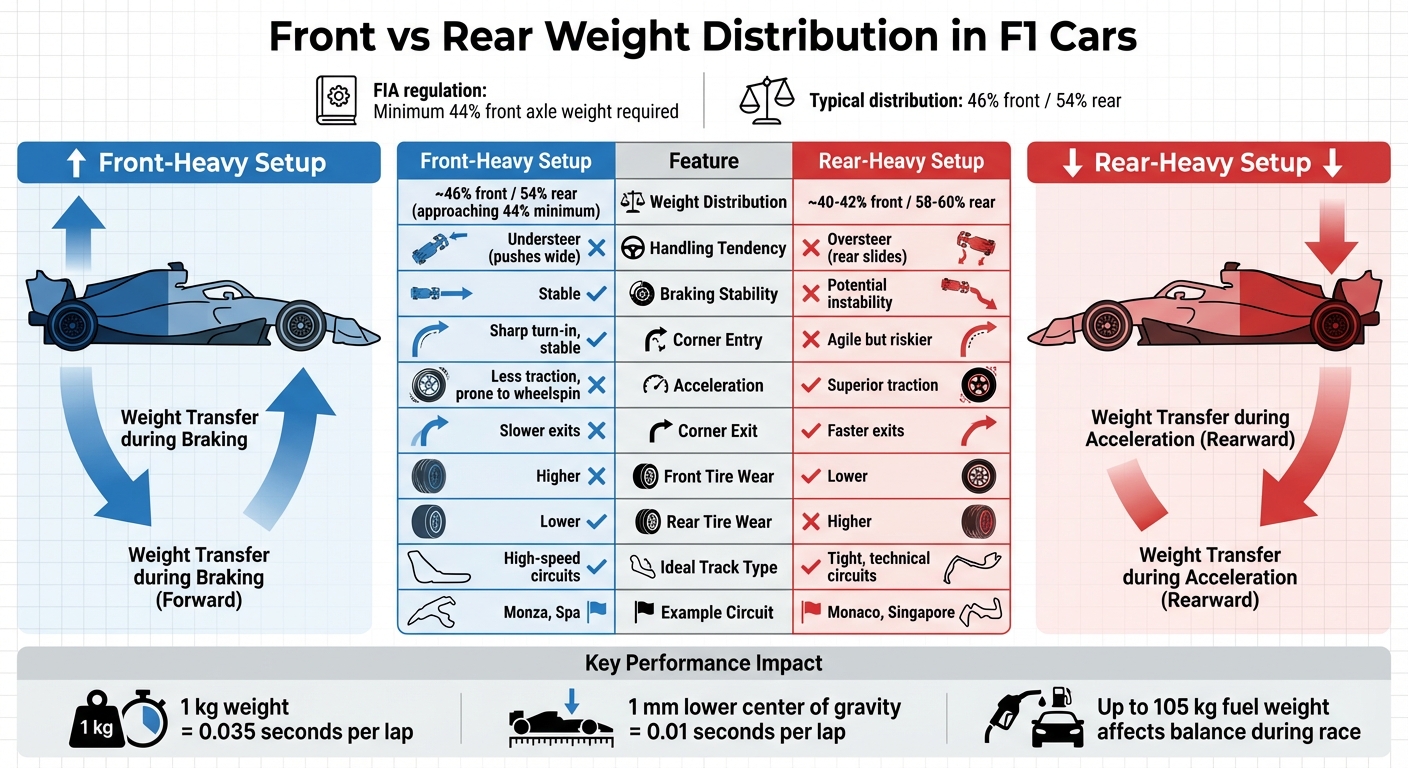
Front vs Rear Weight Distribution in F1 Cars: Performance Comparison
What Is F1 Car Weight Distribution?
Front-Heavy Weight Distribution
A front-heavy setup shifts more weight toward the front axle, approaching the FIA's 44% minimum front-axle requirement. This configuration increases the vertical load on the front tires, boosting braking performance, while reducing the load on the rear tires.
Characteristics of Front-Heavy Setups
When weight is concentrated over the front axle, the front tires experience a higher vertical load. This extra load improves their grip during braking and corner entry, making the car’s front end more responsive and ensuring sharp steering input when entering corners. Under braking, weight naturally shifts forward, and a front-heavy distribution amplifies this effect. The additional weight compresses the front suspension, maximizing the contact pressure of the front tires.
However, as the car accelerates and weight shifts rearward, a front-heavy setup can compromise rear grip. With the rear tires already carrying less static load, maintaining traction under throttle becomes more difficult. This means the car might perform exceptionally well entering corners but struggle on exits - a critical factor on tracks with long straights or heavy acceleration zones. These trade-offs highlight the balance required when employing a front-heavy configuration.
Benefits of Front-Heavy Setups
Front-heavy setups shine in high-deceleration zones and on tracks with tight, technical corners. They allow drivers to brake later and carry more speed into turns without the front end losing grip. This is especially advantageous on circuits like Monaco, where low-speed handling and precise turn-in are essential. In wet conditions, when speeds drop and aerodynamic downforce loses effectiveness, a forward weight bias helps maintain front-end grip. This ensures drivers retain steering control, even when visibility is poor and the track surface is unpredictable.
"Turn-in needs front-end authority. Mid-corner wants neutrality. Exit demands rear stability and traction." - Damien Magee, Motorsport Reporter
Drawbacks of Front-Heavy Setups
While front-heavy setups excel in braking and corner entry, they come with notable downsides. The most significant drawback is reduced rear traction during corner exits. With less weight pressing the rear tires into the track, the driven wheels often struggle to transfer power effectively. This can allow competitors with a rear-biased setup to accelerate earlier and harder out of corners. The issue becomes even more pronounced on power circuits, where exit speed has a direct impact on lap times.
Another challenge is the strain placed on the front tires. They must simultaneously manage steering, braking, and cornering forces while supporting a larger share of the car’s weight. This multitasking can lead to higher tire temperatures and faster wear, potentially degrading performance over a race stint. Studies on formula-style cars have shown that a 40:60 front-to-rear weight distribution tends to produce faster lap times than setups with excessive forward bias, emphasizing the performance cost of a front-heavy design.
Additionally, during heavy braking, a front-heavy setup can leave the rear tires underloaded, increasing the risk of instability or even spinning if the rear tires lose grip. This characteristic requires drivers to exercise precise throttle and brake control, particularly during trail-braking as the car transitions from deceleration to acceleration mid-corner.
Rear-Heavy Weight Distribution
A rear-heavy setup focuses more weight over the rear axle by using ballast, the naturally rearward power unit (weighing at least 145 kg), and fuel (up to 110 kg at the start of a race). This arrangement enhances rear traction during acceleration, as the added weight causes the rear suspension to compress in a "squatting" motion, improving the grip of the rear tires.
Characteristics of Rear-Heavy Setups
Shifting weight toward the rear increases the vertical load on the rear tires during acceleration, which helps the car grip better when exiting slow corners. However, this setup also introduces a tendency toward oversteer - when the rear tires lose traction, causing the back of the car to slide out during cornering or braking.
"Rearward weight enhances acceleration traction but risks oversteer in braking or cornering." - Motorsport Engineer
Braking becomes more challenging with this configuration. When decelerating, weight shifts forward, reducing the load on the rear tires. This can lead to instability and increase the likelihood of the car spinning. To handle these shifts, the rear suspension often requires a travel range of 70 to 80 mm, compared to just 20 mm at the front. These dynamic effects make rear-heavy setups particularly suited for certain track conditions.
Benefits of Rear-Heavy Setups
Rear-heavy setups shine on tracks with slow, traction-limited corners, allowing drivers to get on the throttle earlier for quicker exits. In wet conditions, the extra weight over the rear tires helps reduce wheelspin, even when downforce is lower.
Professional racing cars often adopt weight distributions around 44% front and 56% rear, with some setups reaching a 40/60 split to optimize acceleration performance. In Formula 1, every kilogram of weight can impact lap times by about 0.035 seconds on a typical circuit, highlighting the importance of precise weight distribution. Teams often adjust rear-end grip to counteract oversteer and stabilize the chassis during transitions.
Drawbacks of Rear-Heavy Setups
Despite their advantages, rear-heavy setups come with trade-offs. During hard braking, the forward weight shift can destabilize the rear, requiring drivers to brake earlier and more cautiously to maintain control.
High-speed corners also pose a problem. The oversteer that aids in slow corners becomes a disadvantage at higher speeds, where rear-end stability is crucial. The car's sensitivity to aerodynamic balance changes can further complicate matters. For instance, when following another car and experiencing "dirty air", a loss of front wing performance can disrupt the balance, forcing drivers to slow down significantly to navigate the corner. To address this, teams often use asymmetric anti-squat geometry, which helps manage torque reactions and keeps the rear diffuser level with the road during acceleration.
Front-Heavy vs Rear-Heavy Setups
Handling Differences
When it comes to weight distribution, the main difference between front-heavy and rear-heavy setups lies in how the car behaves when traction limits are reached. In a front-heavy setup, the front tires lose grip first, leading to understeer. This means the car tends to push wide through corners, making it harder to stay on the intended line. On the other hand, rear-heavy setups are more prone to oversteer, where the rear tires lose grip, causing the back end to slide out.
Weight transfer plays a big role in amplifying these tendencies. For instance, when braking, the weight shifts forward. This stabilizes a front-heavy car but can make a rear-heavy car feel unstable as the rear becomes lighter. During acceleration, the opposite happens: weight shifts to the rear. This benefits rear-heavy setups by improving traction, while front-heavy cars may struggle with wheelspin. Additionally, rear-heavy cars, with their mass concentrated closer to the center, can change direction more quickly. However, once they lose grip, they can be harder to control. In contrast, front-heavy cars are more stable but respond more slowly to steering inputs.
These handling characteristics directly influence how cars perform on different types of tracks.
Performance on Different Track Types
On high-speed circuits, stability is king. Front-heavy setups shine here because their predictable handling helps maintain control through fast, sweeping corners. The car’s center of gravity aligns closely with the aerodynamic center of pressure, further enhancing balance at high speeds.
In contrast, rear-heavy setups dominate on tight, technical circuits. Their agility and strong traction allow for rapid direction changes and powerful corner exits. A great example of this advantage comes from the 2004 Formula 1 season. Renault’s chassis featured a rear-biased weight distribution (around 40/60 or 42/58). This setup gave Fernando Alonso an edge, letting him accelerate out of corners earlier than his rivals. At the 2004 Chinese Grand Prix, Ralf Schumacher of Williams even admitted he couldn’t match Renault’s corner-exit performance due to their superior traction.
Today, Formula 1 regulations restrict how much teams can adjust weight distribution, requiring a minimum of 44% at the front and 54% at the rear. These rules limit how much freedom teams have when balancing grip and stability. However, starting in 2026, new rules will introduce active aerodynamics. These will allow teams to adjust wing angles in real time, giving them more flexibility to manage balance regardless of static weight distribution.
Comparison Table: Front vs Rear Weight Distribution
| Feature | Front-Heavy Setup | Rear-Heavy Setup |
|---|---|---|
| Primary Handling Tendency | Understeer (pushes wide) | Oversteer (rear slides) |
| Acceleration Performance | Prone to wheelspin; less traction | Superior traction; better exits |
| Braking Stability | Stable under braking | Rear instability possible |
| Corner Entry | Stable but slower rotation | Agile with sharper turn-in |
| Tire Wear Focus | Higher front tire wear | Higher rear tire wear |
| Ideal Track Type | High-speed circuits | Tight, technical tracks |
| Polar Moment Effect | Predictable and stable | Agile but harder to control |
Real-World Examples of Weight Distribution
Looking at how teams manage weight distribution in real-world scenarios gives us a deeper understanding of how they fine-tune performance on the track.
Case Studies from F1 History
Take the 2004 Renault R24, for example. This car showcased the benefits of a rear-biased weight setup, with an estimated 40/60 to 42/58 front-to-rear split. This configuration offered incredible traction in slow corners, which became especially evident during the 2004 Chinese Grand Prix. Ralf Schumacher, driving for Williams, even admitted that his car - with its more powerful BMW engine - couldn’t match the Renaults’ corner-exit performance.
Of course, not all weight distribution experiments have gone smoothly. In 1984, Tyrrell Racing faced disqualification for the entire championship after officials discovered they were adding lead shot to fuel tanks during pit stops to meet minimum weight requirements. Similarly, in 2005, BAR was handed a two-race suspension for concealing an 11.4 kg auxiliary fuel tank, allowing their car to run illegally light. These incidents highlight how some teams have pushed - or outright broken - the rules in their pursuit of better weight balance.
Current Weight Distribution Strategies
Today’s teams operate under strict FIA regulations, which mandate at least 44% front and 54% rear weight distribution. Most teams aim for a 46/54 split, achieved through careful placement of ballast. Positioning ballast low in the chassis is key, as lowering the car’s center of gravity by just 1 mm can shave off approximately 0.01 seconds per lap.
A recent example of the impact of weight distribution comes from Red Bull Racing’s 2022 season. Early in the year, Max Verstappen described handling issues caused by the car’s excess weight:
"The car was very overweight. [The weight] was in the wrong place of the car as well, so that's why it was understeering a lot more and prone to front locking."
Red Bull addressed this by removing weight from the front, shifting the balance rearward. By the French Grand Prix in July, the changes had transformed the RB18’s handling. Verstappen’s results spoke volumes - he won 11 races by September, compared to Charles Leclerc’s 3. The improved balance allowed for a more aggressive front-end setup, giving Red Bull a clear edge.
Weight management doesn’t stop there. Teams also deal with "balance migration" as fuel burns off during a race. With up to 105 kg (231 lbs) of fuel onboard at the start, cars naturally shift from being rear-heavy to more front-heavy as the race progresses. This dynamic change requires constant adjustments to maintain optimal handling.
Evolution of Weight Distribution Rules
Over the years, weight distribution strategies have evolved alongside changing regulations. When hybrid power units were introduced in 2014, the minimum car weight rose to 1,523 lbs (691 kg). By the time the 2022 ground-effect regulations came into effect, the minimum weight had increased further to 1,759 lbs (798 kg) - a total gain of 284 lbs (129 kg) from 2009 to 2018.
In 2019, the FIA introduced the 80 kg (176 lbs) driver equivalency rule to prevent teams from pressuring drivers to maintain dangerously low body weights for competitive advantages. The current 44% front / 54% rear minimum mass distribution requirements were formalized under the 2022 technical regulations (Article 4.2).
Looking ahead to 2026, new regulations will allow for active aerodynamics, enabling teams to adjust wing angles in real time. This could reduce the reliance on static weight distribution, giving engineers new ways to manage balance dynamically throughout a lap, opening the door to entirely new strategies.
Conclusion
Weight distribution in Formula 1 is a delicate balancing act, shaped by the competing demands of different track layouts and car dynamics. A front-heavy setup can enhance braking and improve turn-in response, but it risks causing understeer due to the increased load on the front tires. On the other hand, a rear-heavy configuration delivers excellent traction when accelerating out of corners - especially on circuits like Monaco, where sharp, low-speed turns dominate. However, this setup can lead to oversteer and instability during braking. These trade-offs mean teams must fine-tune their approach for each unique circuit.
There’s no one-size-fits-all solution. High-speed tracks demand stability, while technical circuits reward nimble handling. Modern regulations, with their tight constraints, push teams to be precise in how they position ballast to adapt to shifting conditions, such as how fuel burn affects the car’s balance during a race.
Ultimately, the principle is simple: a lighter car is a faster car. As Lucas di Grassi succinctly put it:
"When you add weight, it's always a negative thing".
The teams that excel in weight distribution - balancing the laws of physics, the rulebook, and the unique challenges of each track - gain those critical fractions of a second that often separate victory from defeat. Fine-tuning these strategies is essential for unlocking peak lap performance across the diverse demands of the Formula 1 calendar.
FAQs
How does weight distribution impact tire wear in Formula 1 cars?
Weight distribution is a key factor in how a Formula 1 car handles tire wear. It directly impacts how load shifts during braking, acceleration, and cornering. For instance, a setup that leans toward being front-heavy places more static weight on the front tires. During braking, this load increases significantly, causing the front tires to heat up faster and wear down more quickly. On the other hand, a rear-heavy setup shifts more weight to the rear tires, which endure greater stress during acceleration, leading to quicker rear tire degradation.
In cornering, the weight naturally shifts toward the outer tires, increasing their load. This added stress can cause those tires to overheat and wear unevenly. To combat this, teams aim for a balanced setup - often around a 40% front and 60% rear static weight distribution. This balance helps maintain even tire temperatures and reduces wear. Engineers fine-tune this distribution using adjustments to ballast, suspension, and aerodynamics, ensuring the car can maximize tire life and maintain consistent performance throughout the race.
Why do some F1 tracks favor front-heavy setups while others work better with rear-heavy setups?
Different Formula 1 circuits call for tailored weight distributions to maximize performance. Tracks with long straights and heavy braking zones, like Monza or Baku, usually favor a rear-heavy setup - something like 40% front and 60% rear. This setup boosts traction during acceleration and provides greater stability when braking hard. Plus, the extra weight at the rear helps reduce drag and keeps the car balanced in high-speed corners.
On the other hand, circuits with lots of tight, low-speed corners, such as Monaco or Singapore, work better with a front-heavy setup. Shifting the car's weight forward improves grip on the front tires, making it easier to turn into sharp corners. To get the perfect balance for each track, teams tweak weight distribution by adjusting ballast, moving components, and fine-tuning suspension geometry. These adjustments are crucial for squeezing out the best lap times.
How does ballast affect weight distribution in F1 cars?
Ballast is a movable weight that F1 teams use to meet the FIA's minimum weight requirement - set at 809 kg for the 2025 season - and to fine-tune the car's weight distribution. By strategically shifting ballast forward, backward, or sideways, teams can adjust the car's center of gravity, which directly affects how weight is distributed between the front and rear axles. Even a minor tweak, like moving 1 kg by a few centimeters, can shave 0.02–0.04 seconds off lap times.
Teams carefully position ballast to achieve specific handling goals. Common strategies include:
- Placing it low and central to maintain a low center of gravity.
- Positioning it ahead of or behind the axle line to influence handling - more front ballast encourages understeer, while more rear ballast promotes oversteer.
- Offsetting it laterally to adapt to track-specific challenges, such as circuits with more right or left-hand turns.
These adjustments allow teams to tailor the car's behavior to their preferred handling characteristics. For instance, a front-heavy setup can enhance stability during braking, while a rear-heavy configuration can boost traction.