How ERS Affects Overtaking in F1
How ERS and Active Aero replace DRS in 2026, adding Boost and Overtake modes that force strategic battery management and change overtaking tactics.
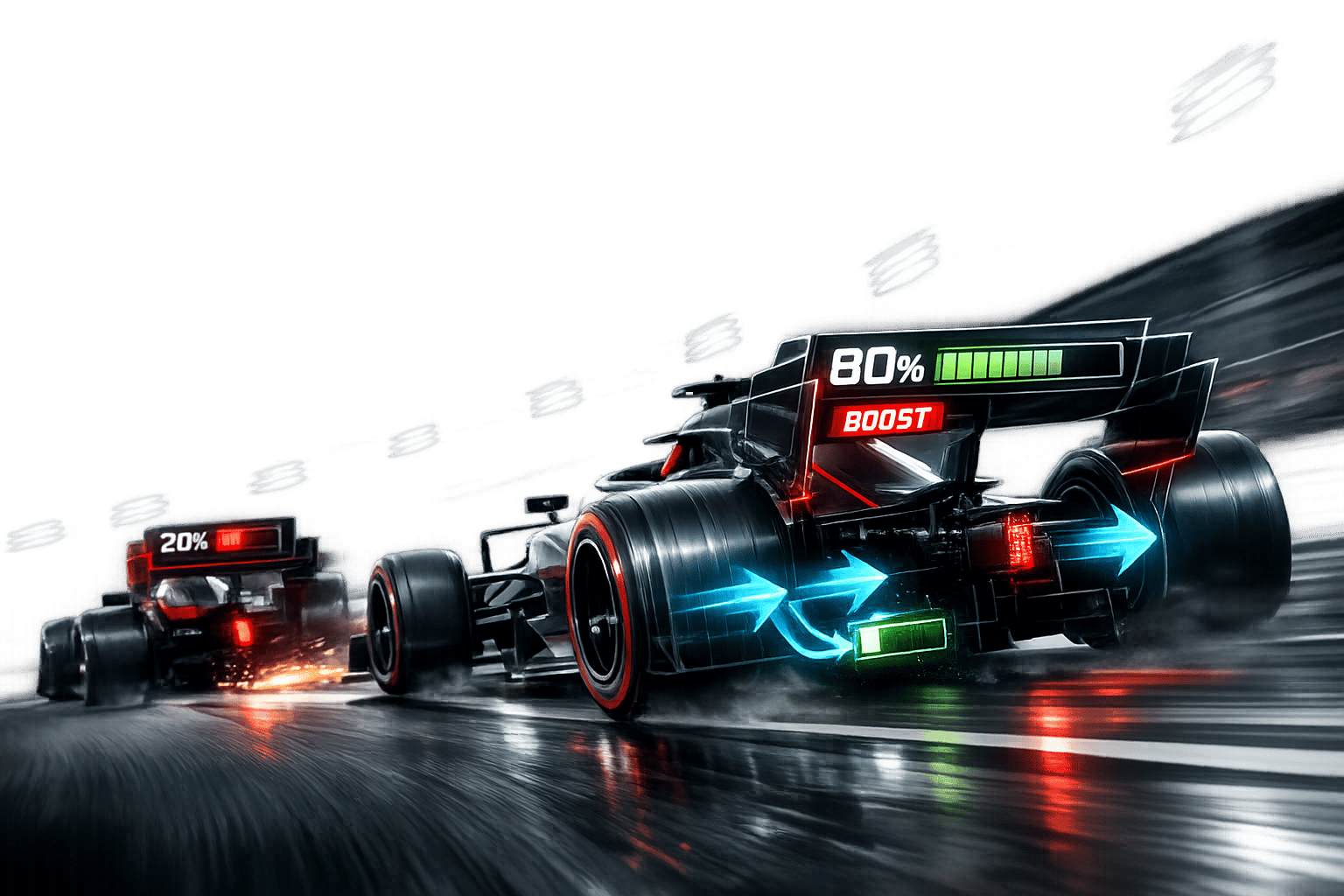
The Energy Recovery System (ERS) is a game-changer in Formula 1, offering drivers extra power for overtaking and defending. By capturing energy from braking and exhaust gases, ERS provides up to 160 additional horsepower. Unlike the simpler Drag Reduction System (DRS), ERS requires careful energy management throughout the race.
In 2026, new rules will eliminate the MGU-H, double the MGU-K’s power output to 350 kW (469 hp), and introduce modes like "Overtake Mode" and "Manual Override." These updates will make overtaking more tactical, focusing on timing and energy use rather than predictable aerodynamic boosts. Drivers must balance deploying power for overtakes while conserving battery charge for defense.
Key changes include:
- Boost Modes: Allow energy use anywhere on the track.
- Speed Limits: Power tapers off at higher speeds for safety.
- Active Aero: Replaces DRS, combining aerodynamic benefits with ERS boosts.
This shift will make overtaking less predictable and more skill-dependent, rewarding drivers who excel at energy management and timing.
1. ERS Deployment
Activation Conditions
ERS deployment is all about timing. Unlike DRS, which activates automatically when a driver is within one second of the car ahead, ERS requires careful planning to maximize battery efficiency throughout the lap. Drivers need to choose the right moments to deploy energy for the best results.
Under the 2026 rules, ERS offers three distinct modes:
- Boost Mode: Can be used anytime, provided the battery has enough charge.
- Overtake Mode: Activated when within one second of the car ahead, giving an extra 0.5 MJ of energy per lap.
- Manual Override: Delivers a powerful 350 kW boost, allowing the chasing car to hit speeds of up to 221 mph, while capping the leading car at 211 mph.
These modes give drivers the tools to strategically use ERS, especially when trying to overtake.
Strategic Advantages
ERS adds a whole new layer to racing strategy. It allows drivers to create a speed advantage, even on tracks where slipstreaming and aerodynamic effects are less pronounced. The extra power from ERS deployment can make all the difference on long straights, like those at Monza or Spa, where timing energy usage perfectly can set up critical overtaking moves.
But it’s not just about raw speed. The real advantage lies in how drivers manage their energy. As Andy Cowell, Aston Martin’s Team Boss, put it:
There will be surprises... overtaking will be more frequent, and it may well be happening in places where passing is not so common right now.
Jon Noble echoed this, highlighting the importance of precision:
If a pursuing driver times the activation of their override mode perfectly, they could well enjoy a couple of seconds more boost than their rival whose power is declining.
This tactical use of ERS introduces an exciting new dynamic to racing.
Limitations
The biggest challenge with ERS is battery management. Overusing high-power modes can drain the battery in just two laps, while recharging it may take up to four laps of more conservative driving. Even in Harvest mode, drivers still consume about 1 MJ of energy per lap.
The 2026 regulations also introduce speed-dependent power limits. Standard ERS power starts to taper off at 290 km/h (180 mph) and drops to zero at 345 km/h (214 mph). In Overtake Mode, full power lasts until 337 km/h (209 mph) before gradually reducing, cutting off entirely by 355 km/h (221 mph). These limits not only enhance safety by curbing excessive speeds but also force drivers to carefully balance their energy deployment with their car’s top speed.
Impact on Overtaking
ERS has redefined the art of overtaking by adding a layer of power management to traditional racing skills. Drivers who can manage their battery reserves effectively have the ability to execute overtakes in spots that were once considered impossible. At the same time, ERS can be used defensively, forcing opponents to burn through their energy reserves and leaving them vulnerable later in the lap.
The 2026 rules emphasize the importance of blending energy strategy with core racing techniques. As Nikolas Tombazis, FIA Single-Seater Director, explained:
The core skill of a driver... should still be about braking late, reaching the grip limit, hitting the apex... we don't want Formula 1 to be all about how much energy you've got left.
Ultimately, ERS doesn’t just add speed - it reshapes the way races unfold, rewarding drivers who can think strategically while still mastering the fundamentals of racing.
2. DRS Usage
Activation Conditions
Since its introduction in 2011, DRS (Drag Reduction System) has been a game-changer for overtaking in Formula 1, allowing drivers within one second of a rival to reduce rear wing drag and gain a speed advantage. However, the 2026 regulations will replace DRS with a more advanced system called Active Aero. This new system offers two configurations: Straight Mode, which minimizes drag for higher speeds, and Corner Mode, which maximizes downforce for improved handling. Alongside this, ERS (Energy Recovery System) Overtake Mode continues to provide an additional boost, creating a seamless blend of aerodynamic and electrical strategies on the track.
This evolution marks a significant shift in how overtaking is approached, integrating aerodynamic setups with energy management for a more dynamic racing experience.
Strategic Advantages
The partnership between ERS and Active Aero takes overtaking strategies to the next level. By combining reduced drag on straights with enhanced acceleration out of corners, drivers can better navigate the challenges of "dirty air" when closely following another car.
Under the new rules, Active Aero can cut drag by about 40%. Additionally, a Manual Override Mode delivers a powerful 350 kW boost to drivers within one second of their rivals, enabling speeds of up to 209 mph (337 kph). As James Vowles, Team Principal at Williams Racing, explains:
The overtaking will be different, but it will happen. It'll just be in a different way to what you're used to now... there's a very different way of optimising it as a solution.
This collaboration between aerodynamic and electrical systems creates a more nuanced and tactical approach to overtaking.
Limitations
Despite their advantages, both Active Aero and ERS systems can be disabled in specific conditions, such as low visibility, low grip, or during safety car periods. The 2026 regulations also introduce a new layer of complexity to overtaking. Instead of the straightforward DRS activation we see today, overtaking will rely on what James Vowles calls a "tactical energy exchange" between attacker and defender.
Both drivers will have access to offensive and defensive electrical modes, turning overtaking into a battle of timing and strategy. George Russell of Mercedes-AMG Petronas F1 Team highlighted this shift:
The 2026 regs will offer better racing... you will see more overtakes next year, but more overtakes in obscure locations.
This evolution demands precision and timing, as drivers must carefully manage their energy reserves to execute or defend against passing maneuvers.
Impact on Overtaking
The interplay between DRS and ERS fundamentally redefines how overtakes will happen. In the current system, DRS provides a predictable advantage in designated areas. Starting in 2026, overtaking becomes a dynamic exchange where both drivers actively manage their aerodynamic setups and energy reserves.
The key difference lies in how power is delivered. While DRS relies purely on mechanical adjustments, the new Overtake Mode demands strategic energy management. Drivers must decide when to deploy their electrical boost while anticipating a potential counterattack from their rival’s Boost mode - provided their opponent has enough battery charge.
This shift transforms overtaking into a tactical duel, rewarding those who excel at balancing aerodynamic configurations with energy deployment. By merging these elements, the new system ensures that energy management remains at the heart of overtaking strategies in Formula 1.
When Do F1 Drivers Deploy ERS For Overtaking?
Pros and Cons
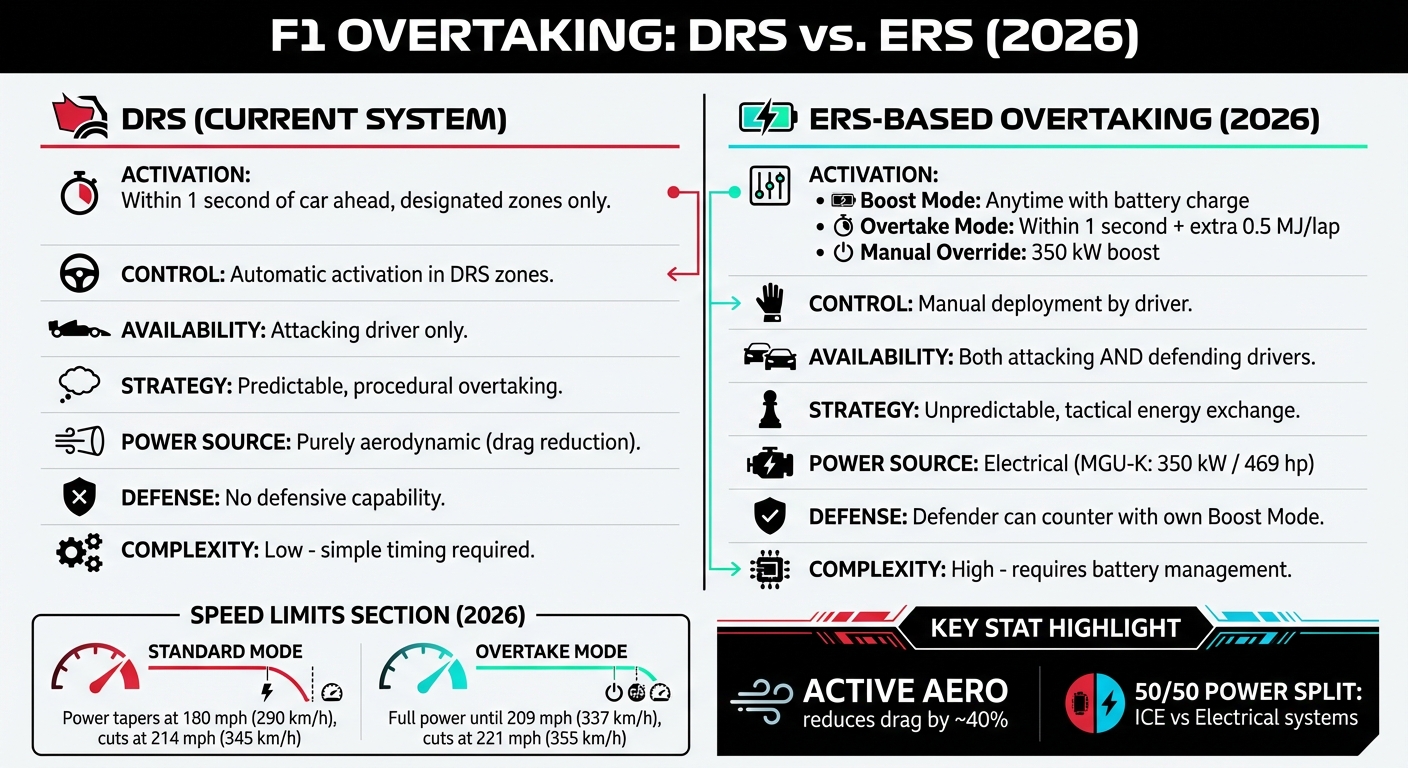
DRS vs ERS Overtaking Systems in Formula 1: 2025 vs 2026 Comparison
The transition from DRS to ERS-based overtaking in 2026 is set to redefine how drivers approach passing on the track. Each system brings its own strengths and challenges, reshaping race strategies in unique ways.
With DRS, overtaking relied on a straightforward formula: the chasing car could activate it in designated zones when within one second of the car ahead. This created a predictable dynamic, offering a clear offensive advantage with little room for defensive tactics. ERS, on the other hand, introduces a whole new layer of complexity with its Boost Mode. Unlike DRS, both drivers - whether attacking or defending - can deploy Boost Mode anywhere on the circuit, as long as they have enough battery charge to do so. Pablo Elizalde from Motorsport Magazine captures the essence of this shift:
The DRS era made overtaking predictable, even procedural. The 2026 era might make it a lot more unpredictable, less frequent at times, but in a way more creative.
This unpredictability opens up fresh tactical opportunities, adding new dimensions to racing strategy.
ERS also introduces the powerful Overtake Mode, which delivers a 350 kW boost that lasts longer at high speeds compared to the standard mode. This allows attacking drivers to sustain momentum over extended straights while still harvesting an additional 0.5 MJ of energy per lap. However, this added power comes with a catch: effective battery management becomes critical. Drivers now need to master the art of balancing energy harvesting and deployment across the entire lap. As James Vowles of Williams Racing explains:
The overtaking will be different, but it will happen. It'll just be in a different way to what you're used to now... you can almost fill the entire battery in one braking zone, but you can deplete it in one straight.
This makes overtaking less of a straightforward advantage and more of a tactical battle. A defending driver, if they've managed their charge wisely, can counter an attack using their own Boost Mode.
The strategic contrast between the two systems is striking. While DRS required little more than timing the activation, ERS demands a constant balancing act. Drivers must weigh when to harvest energy and when to deploy it, turning overtaking into a high-stakes chess match on wheels.
Conclusion
The transition from DRS to ERS-based overtaking in 2026 marks a significant change in Formula One's approach to wheel-to-wheel racing. Starting that year, the familiar DRS system will be replaced by two new tools: "Overtake Mode" (Manual Override) and "Active Aero", both accessible to all drivers, regardless of their position on the track.
This overhaul shifts the emphasis from aerodynamic tweaks to a more strategic use of power. Overtake Mode provides full MGU-K power up to 221 mph, while standard mode begins tapering power at 211 mph. This change flips the current dynamic, making overtaking less about exploiting a predictable aerodynamic boost and more about skillfully managing energy reserves. Essentially, it transforms passing maneuvers into a chess match of battery management, aligning with Formula One’s broader push toward electrification.
The new regulations also highlight a balanced approach to power. With a mandated 50/50 split between the internal combustion engine and electrical systems, these hybrid power units redefine the technical landscape of F1. As Nikolas Tombazis, FIA Single-Seater Director, explains:
The core skill of a driver should not be and should not become who's the best strategist with their energy... It should still be about braking late, reaching the grip limit, hitting the apex.
Drivers are already anticipating how this will change the dynamics on track. Mercedes' George Russell believes this shift will bring overtakes to unexpected parts of the circuit:
I think you will see more overtakes next year, but more overtakes in obscure locations - in locations where we've never seen overtakes before.
FAQs
How will removing the MGU-H change F1 race strategies?
The Motor-Generator Unit-Heat (MGU-H) has played a key role in Formula 1's hybrid power units since 2014, transforming exhaust heat into electrical energy to either power the car or recharge its battery. However, with the 2026 regulations, the MGU-H will be removed, leaving the MGU-K as the only system for harvesting and deploying electrical power.
This change will force teams to rethink how they manage energy on the track. Drivers will have to make the most out of the limited energy collected by the MGU-K, carefully deciding when to deploy it - whether in an aggressive mode like Overtake Mode or a more balanced setting. Strategies will likely shift toward conserving energy during critical moments, maximizing tire performance to extend stints, and timing pit stops to coincide with battery recovery opportunities. Without the MGU-H, energy management will become a crucial tactical factor, where precise usage could mean the difference between overtaking a rival or holding onto a position.
What’s the difference between DRS and Active Aero in Formula 1?
Drag Reduction System (DRS) is a technology that’s been part of racing since 2011. It uses a movable flap on the rear wing to cut down on drag, boosting top speed. However, there’s a catch - it can only be activated in designated zones and when a driver is within about one second of the car ahead. While DRS has played a pivotal role in racing strategy, it’s set to be retired in 2026.
Enter Active Aero, a game-changer coming with the 2026 regulations. This system adjusts both the front and rear wing angles, allowing cars to seamlessly switch between low-drag settings for straights and high-downforce settings for corners. Unlike DRS, Active Aero isn’t tied to the proximity of another car, offering more consistent and adaptable aerodynamic performance.
To sum it up, DRS is a proximity-based system focused solely on the rear wing, while Active Aero provides independent, all-around aerodynamic adjustments for better performance across different track conditions.
How does ERS influence a driver's defensive strategy in F1?
The Energy Recovery System (ERS) gives drivers the ability to tap into stored electrical energy for a short burst of extra power. This can be a game-changer, especially when it comes to defensive driving. Whether it's helping a driver accelerate quickly out of a corner or reach higher speeds on a straight, the ERS makes it tougher for a pursuing car to execute an overtake.
When used wisely, ERS becomes a powerful tool for strategy. Drivers can time their deployment to counter moves during critical moments, like entering DRS zones or defending in high-speed sections. This well-timed use of ERS often becomes a deciding factor in holding onto track position during intense on-track battles.