How F1 Teams Manage Traction Loss in Corners
How F1 teams limit traction loss with throttle technique, suspension and differential tuning, aerodynamic balance and telemetry to improve corner exits.
Traction loss in Formula 1 happens when a tire exceeds its grip limits due to combined forces from cornering, braking, or acceleration. Drivers and teams tackle this challenge using a mix of driving techniques, car setups, and data analysis. Here’s a quick breakdown:
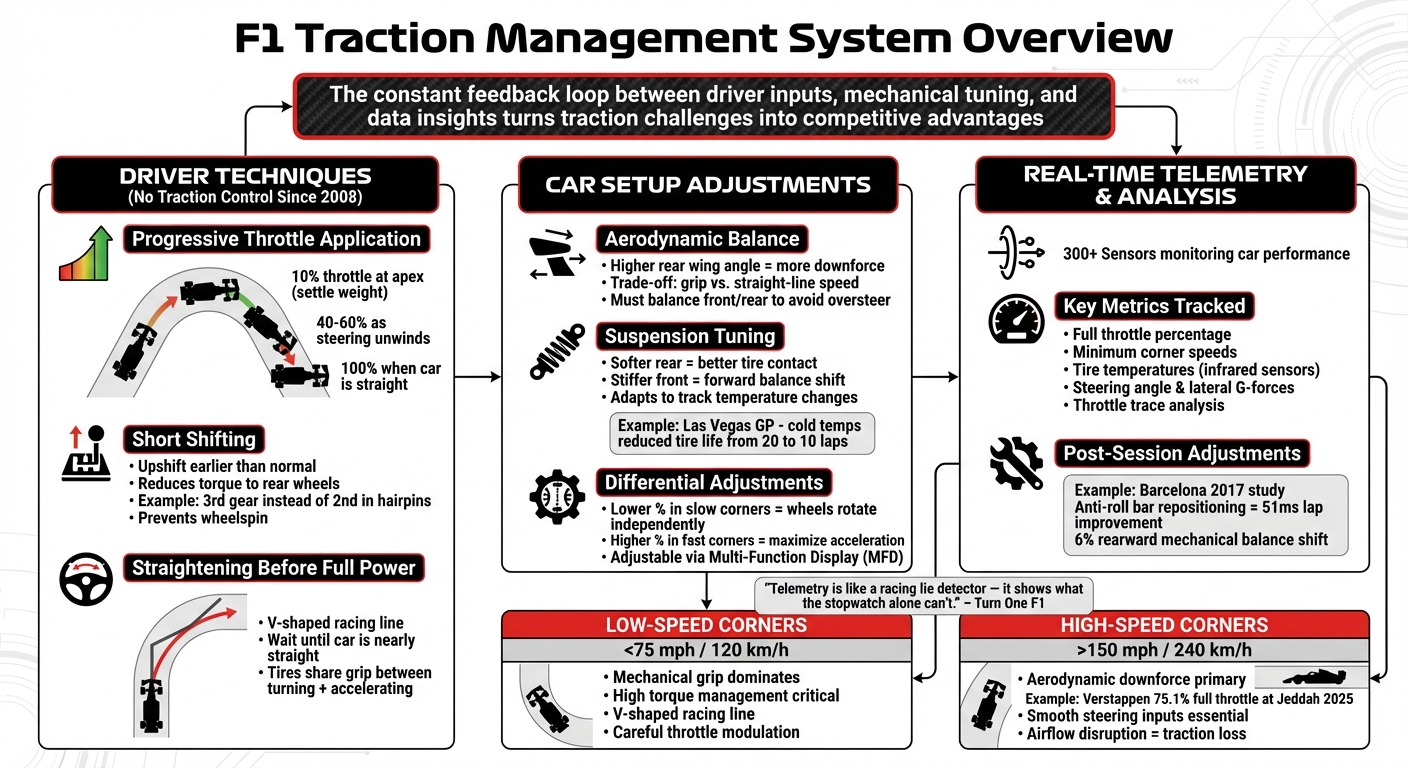
- Driver Techniques: Progressive throttle application, short shifting to reduce torque, and straightening the car before full acceleration are key methods to maintain control and speed through corners.
- Car Setup Adjustments: Teams fine-tune suspension, aerodynamic balance, and differential settings to improve grip. For instance, softer rear suspensions help maintain tire contact, while adjusting the differential can stabilize power delivery.
- Data Analysis: Real-time telemetry tracks metrics like throttle usage, corner speeds, and tire temperatures. Engineers use this data to make precise changes between sessions to optimize performance.
F1 drivers rely on skill to manage torque in low-speed corners, where mechanical grip dominates, and on aerodynamic setups for high-speed turns. The balance between driver input, car configuration, and telemetry insights ensures maximum traction and faster lap times.
F1 Traction Management: Driver Techniques, Car Setup, and Data Analysis
Driver Techniques for Managing Traction Loss
F1 drivers face a unique challenge: they can't rely on electronic traction control, which has been banned since 2008. Instead, they depend on precise driving techniques to prevent rear tire spin and maintain control, especially in low gears where the turbo-hybrid engines deliver immense power.
Progressive Throttle Application
Managing traction begins with carefully modulating the throttle. Drivers gradually apply pressure, starting at the apex of a corner and increasing as the car straightens out. This process is often broken into three stages: around 10% throttle to settle the car's weight, 40–60% as the steering wheel unwinds, and full throttle once the car is nearly straight. For instance, during the May 2025 qualifying session, Ferrari's SF25 struggled with traction in slow corners due to suboptimal tire temperatures, forcing drivers to limit their use of full throttle. By progressively applying power, drivers can minimize rear tire slip, ensuring a smoother and faster exit from corners.
Short Shifting Methods
Short shifting is another effective way to manage traction. This technique involves upshifting earlier than usual to reduce the torque sent to the rear wheels. By selecting a higher gear - such as shifting into third instead of staying in second through a tight hairpin - drivers can apply more throttle without risking wheelspin. If the rear tires begin to lose grip during acceleration, a quick upshift can stabilize the car and restore control. This method is particularly useful in low-speed turns, wet conditions, or when tires aren't fully warmed up, helping drivers achieve a cleaner and quicker exit.
Straightening Before Full Power
F1 tires have a finite amount of grip, which must be shared between turning and accelerating forces. Because turning uses up a portion of the available grip, drivers wait until the car is almost straight before applying full throttle. In slow corners, they often adopt a V-shaped line to point the car straight earlier, allowing for a faster transition to full power. A great example of this was seen during the May 2025 Jeddah qualifying session, where Oscar Piastri’s McLaren MCL39 demonstrated excellent stability in medium-speed corners, enabling him to accelerate earlier than his competitors. However, the car's lower aerodynamic efficiency limited its straight-line speed compared to Red Bull. Additionally, applying full throttle while still turning can cause the inside and outside rear wheels to rotate at different speeds - a situation the differential may not always resolve effectively. The key takeaway? Straighten the car first, then accelerate, to ensure maximum traction and optimal corner exit speed.
Car Setup Adjustments to Reduce Traction Loss
While driver skill plays a key role, F1 teams meticulously adjust their car setups to minimize traction loss. These behind-the-scenes tweaks give drivers greater confidence when powering through corners.
Aerodynamic Balance Optimization
Teams fine-tune rear wing angles to increase rear-end grip by pushing the car harder onto the track surface. Higher angles generate more downforce, stabilizing the rear and reducing wheelspin, though this comes at the expense of straight-line speed. The tricky part is balancing the front and rear aerodynamics - running a smaller rear wing for better top speed requires reducing front downforce to avoid creating an oversteer-prone car.
Take Ferrari's SF21 at the June 2021 French Grand Prix as an example. The team introduced a refined front wing with a narrower adjustable flap and redesigned footplate. However, due to limited engine power, they had to use a smaller rear wing, restricting how much front downforce they could safely apply. This careful balancing act helped maximize rear grip while keeping oversteer in check.
Once aerodynamic forces are dialed in, teams shift focus to mechanical adjustments to further enhance grip.
Suspension Tuning
Suspension settings determine how well tires stay in contact with the track surface. Softer rear suspension helps tires maintain grip over bumps, reducing wheelspin. On the other hand, stiffening the front suspension relative to the rear shifts the car's balance forward, improving stability during acceleration.
"Adjusting your rear suspension to be softer, or your front suspension to be stiffer will help manage wheel spin. This works by helping to keep your rear wheels in contact with the track."
– Rich, Founder, SimRacingSetups.com
A real-world example of this came during the November 2024 Las Vegas Grand Prix practice sessions. Oracle Red Bull Racing and Max Verstappen struggled with grip due to unusually cold atmospheric temperatures. The track's low surface temperature altered the Pirelli tires' optimal performance window, cutting their lifespan from the expected 20 laps to just 10. Using simulation data, the team adjusted their suspension setup to adapt to the low-grip conditions. This underscores how suspension tuning must evolve with changing track conditions - what works on a warm day may fall short in the cold.
Beyond suspension, differential adjustments play a vital role in managing power delivery through corners.
Differential Adjustments
The on-throttle differential determines how power is distributed between the rear wheels during acceleration. In low-speed corners, the inside rear wheel covers a shorter distance than the outside wheel. A high-percentage differential forces both wheels to spin at the same speed, which can cause the inside wheel to lose traction and spin, leading to oversteer. Lowering the differential setting allows the wheels to rotate more independently, reducing wheelspin and improving corner exit stability.
Drivers can tweak this setting on the car's Multi-Function Display (MFD) throughout a race weekend. For slow hairpins, they lower the differential by a few percentage points to improve traction on corner exits. In high-speed sections, they increase it to maximize forward acceleration since wheel travel differences are less pronounced. During the 2025 season, Ferrari's SF25 struggled with traction out of slow corners compared to the Red Bull RB21. This gap likely stemmed from differences in differential tuning and overall mechanical setup.
Low-Speed vs High-Speed Corner Approaches
Traction management in Formula 1 is all about adapting to the speed of a corner. At lower speeds, where downforce is limited, mechanical grip from the tires and suspension takes center stage. At higher speeds, however, aerodynamic downforce becomes the key to keeping the car stable and maintaining grip. F1 teams fine-tune their setups to handle these contrasting demands. For slow corners (under 75 mph or 120 km/h), traction relies heavily on mechanical grip, while high-speed turns (over 150 mph or 240 km/h) lean on aerodynamic forces to keep the car planted on the track. Let’s dive into how drivers manage torque in slow corners and how aerodynamic grip dominates high-speed turns.
Managing Torque in Slow Corners
Hairpins and chicanes present a unique challenge for drivers. The high torque generated by turbo-hybrid engines can easily overwhelm the available grip in low-speed corners, where aerodynamic downforce is minimal. To combat this, drivers carefully modulate throttle input to prevent rear-wheel spin. A common technique is to use a "V" shaped racing line - delaying the apex to straighten the car earlier - allowing for smoother and earlier throttle application without losing traction.
"In slow corners, rotation and early throttle beat raw minimum speed every time."
– Meathead Sim Racing, Technical Guide
Precise throttle control is critical in these scenarios, as even small errors can lead to costly wheel spin or a loss of momentum.
On the other hand, high-speed corners require a completely different approach, with aerodynamic grip taking the spotlight.
Using Downforce in High-Speed Turns
When speeds climb above 150 mph (240 km/h), the game changes. Aerodynamic downforce becomes the primary source of grip, as the increased air pressure pressing down on the car expands the "traction budget." This allows drivers to maintain aggressive throttle application through sweeping bends. For example, during qualifying at the 2025 Saudi Arabian Grand Prix, Max Verstappen spent 75.1% of his lap at full throttle, demonstrating the stability provided by aerodynamic forces in high-speed corners.
In these situations, smooth and precise steering inputs are crucial. Abrupt movements can disrupt the airflow over the car’s wings and floor, leading to a sudden loss of traction. George Russell’s performance at Jeddah further highlights the importance of downforce management. He achieved the highest minimum speeds in both the slowest and fastest corners, showcasing how effective aerodynamic setups can maximize grip across varying conditions.
Team Data Analysis and Recovery Methods
Formula 1 teams rely heavily on sensors embedded within the car to monitor every aspect of its performance. Each F1 car is outfitted with over 300 sensors that continuously send data to the pit wall and team headquarters. This constant stream of information allows engineers to identify traction issues as they occur and make precise adjustments between sessions to recover any lost performance.
Real-Time Telemetry Monitoring
Using data from these sensors, teams can immediately interpret critical performance metrics. Engineers analyze live telemetry to detect traction problems. One key metric is full throttle percentage - if a driver spends less time at full throttle compared to competitors, it often signals difficulties in putting power down, especially when exiting slow corners. For example, the Ferrari SF25 struggled with traction in slow corners, spending the least amount of time at full throttle among the top teams.
"Telemetry is like a racing lie detector - it shows what the stopwatch alone can't."
– Turn One F1
Other metrics, like minimum corner speed data, help identify areas where grip is being lost. Infrared sensors monitor tire tread temperature in real time, identifying graining - a condition where mismatched tread and core temperatures cause sliding and worsen traction. Additionally, engineers track steering angle and lateral G-forces, comparing steering inputs to the car's actual path to catch oversteer or four-wheel drifts.
Post-Session Analysis and Adjustments
Once a session concludes, the focus shifts to detailed data analysis. Post-session telemetry is essential for refining car setups. For instance, throttle trace analysis can reveal whether a driver is applying power too aggressively, leading to wheelspin. In such cases, teams might suggest "short shifting", where the driver changes gears earlier to lower torque and reduce wheelspin in the lower gears.
In a notable example, Canopy Simulations conducted a study in September 2017 at the Barcelona circuit. By repositioning the rear anti-roll bar pickup slightly upward and rearward, they achieved a 51ms lap time improvement. This adjustment shifted the mechanical balance 6% rearward in low-speed mid-corners, enhancing front grip and reducing understeer, while maintaining the original balance in high-speed sections like Turn 9.
Differential settings are another area of focus. Adjusting the on-throttle differential to allow the rear wheels to rotate more independently can be crucial for maintaining traction, especially in wet conditions or on worn tires. Teams also compare telemetry from current laps to reference laps, identifying exactly where traction is being lost and applying targeted solutions. These precise adjustments play a key role in recovering traction and strengthening the strategies discussed earlier.
Conclusion: Key Takeaways on Managing Traction Loss
Regaining traction in F1 corners boils down to three main factors: driver skill, car setup, and real-time data analysis. Each plays a unique role in ensuring optimal performance. A driver’s expertise lays the groundwork, relying on techniques like progressive throttle control, short shifting, and precise braking. These actions are particularly critical when managing the immense torque delivered by hybrid power units in lower gears. But skill alone isn’t enough - car setup and telemetry play equally vital roles in this equation.
The second piece of the puzzle is the car’s setup. Teams fine-tune differential settings to give the rear wheels more freedom in low-grip scenarios, adjust suspension geometry to balance mechanical grip, and optimize aerodynamic downforce for specific cornering conditions. For tight hairpins, where downforce has less impact, mechanical grip takes center stage. On the other hand, in high-speed corners, aerodynamic load becomes the deciding factor. These adjustments, however, are only as good as the data backing them.
This is where data analysis becomes indispensable. Engineers keep a close eye on telemetry, tracking metrics like full throttle percentages, minimum corner speeds, and tire temperatures. These insights help pinpoint exactly where traction is being lost and how to address it. Telemetry also provides a window into how different teams perform under similar conditions, often exposing which setups deliver the best grip.
"The ability to consistently pick up chunks of performance like this [54ms] is what separates the great teams from the rest."
– Canopy Simulations
The process doesn’t stop there. Throughout a race, drivers and teams adapt in real time. A driver might shift brake bias forward to improve front grip or tweak the on-throttle differential as tires degrade. After the session, telemetry data informs further refinements, such as adjusting anti-roll bar geometry or fine-tuning gear ratios. This constant feedback loop - where driver inputs, mechanical tuning, and data insights work together - turns traction challenges into opportunities to gain an edge on the competition.
FAQs
How do F1 teams determine the best car setup for different track conditions?
F1 teams blend cutting-edge simulations, real-time data, and predictive tools to perfect car setups for each track. Engineers dive into the specifics of the track layout, surface characteristics, and weather to pinpoint key performance factors like downforce, grip, and tire temperature. With the help of advanced simulators, they experiment with suspension settings, wing angles, and tire compounds to strike the right balance for the demands of a particular circuit.
On race weekends, telemetry data becomes the backbone of decision-making. Metrics like tire pressure and temperature are closely monitored to keep the car within its ideal grip range. Adjustments to aerodynamic load, brake bias, and suspension stiffness are made on the fly to adapt to changing conditions. Predictive models also play a critical role, simulating how the car is likely to respond during the race. This ensures teams can maximize grip while minimizing tire wear, giving drivers the best chance to perform at their peak.
How do F1 teams use telemetry to improve traction during a race?
Telemetry is a game-changer for F1 teams when it comes to managing traction during a race. By pulling in real-time data from the car's sensors, teams can keep a close eye on critical factors like tire grip, suspension dynamics, and throttle inputs. This wealth of information allows engineers to fine-tune the car's setup and give drivers actionable advice to adapt their approach as conditions evolve.
For instance, telemetry might show that a car is struggling with grip in certain corners. Armed with this insight, the team can tweak suspension settings or adjust the differential to improve handling. Drivers can also get precise feedback on throttle control and braking points, helping them optimize traction while reducing tire wear. This steady stream of data is key to maintaining peak performance and staying in the fight for top positions throughout the race.
Why isn’t electronic traction control allowed in F1?
In Formula 1, electronic traction control is prohibited to highlight driver skill and make managing the cars a true challenge. Without this technological aid, the FIA ensures that victories are shaped by the drivers' talents rather than automated systems doing the heavy lifting.
This ban also plays a role in maintaining fairness across teams. Electronic aids could potentially give wealthier teams an edge, creating an uneven playing field. On top of that, it prioritizes safety by keeping control in the hands of the drivers, relying on their judgment during the intense, high-speed action of a race.