How Intra-Team Battles Impact F1 Title Races
How intra-team rivalries shape F1 titles — risks, rewards and management lessons from historic clashes to McLaren's Papaya Rules.
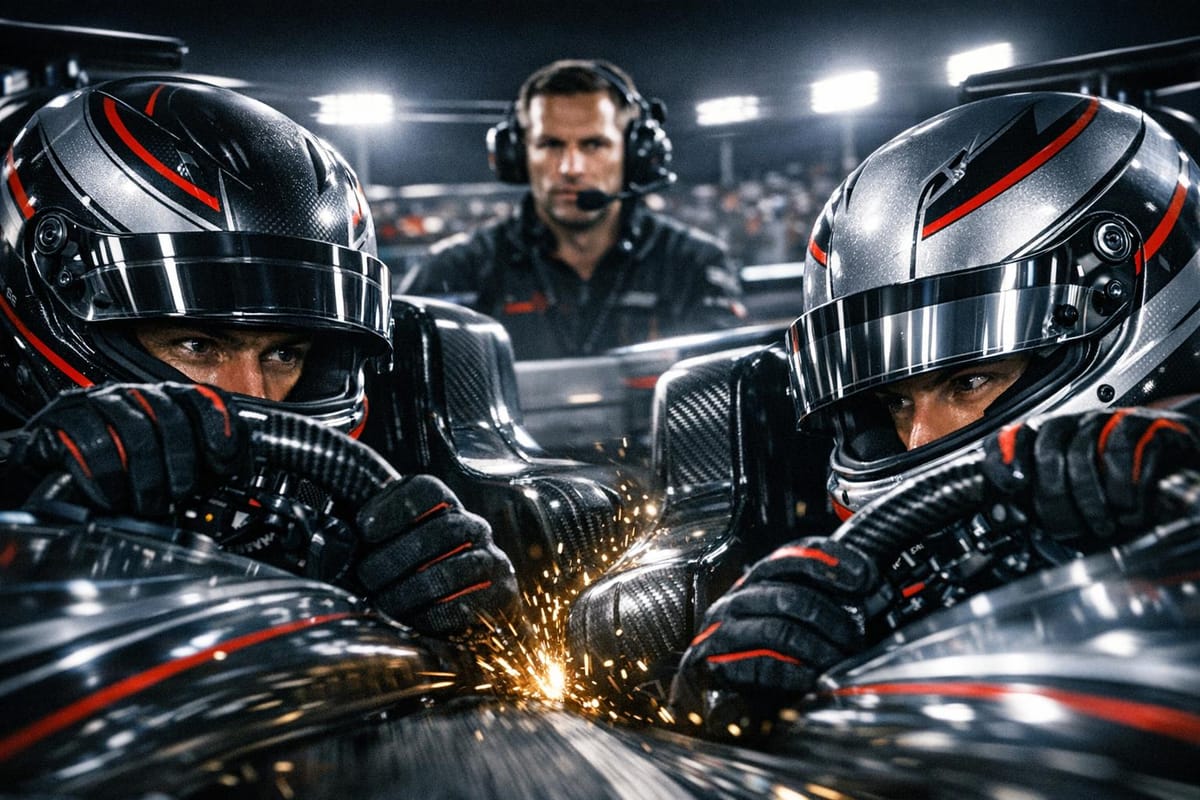
In Formula 1, teammates often compete as fiercely against each other as they do against rival teams. These intra-team battles can define championship outcomes, as seen in iconic rivalries like Senna vs. Prost, Hamilton vs. Rosberg, and more recently, Norris vs. Piastri. While such rivalries can push teams to perform better, they can also lead to costly collisions, communication breakdowns, and fractured team dynamics if not managed well.
Key Takeaways:
- Senna vs. Prost (1988-89): A rivalry that highlighted the dangers of poor team management, culminating in a championship-deciding collision at Suzuka.
- Hamilton vs. Alonso (2007): Intense competition at McLaren cost the team a potential title.
- Vettel vs. Webber (2010-13): Red Bull's dominance was marred by on-track clashes and defiance of team orders.
- Hamilton vs. Rosberg (2014-16): Mercedes introduced strict "Rules of Engagement" to manage escalating tensions.
- Norris vs. Piastri (2024-25): McLaren's structured approach, called "Papaya Rules", ensured both drivers competed effectively while maintaining team harmony.
Quick Insight: Strong leadership and clear rules are essential to turning intra-team rivalries into a competitive edge rather than a liability. Teams like McLaren and Mercedes have shown that balancing individual ambition with team goals can lead to championship success.
The Biggest F1 Teammate Rivalries of All Time Explained in 13 Minutes
1. Senna vs. Prost at McLaren (1988-1989)
The 1989 season at McLaren is often remembered as one of the most intense and destructive intra-team rivalries in Formula 1 history. What began as a promising partnership between two legendary drivers - Ayrton Senna and Alain Prost - quickly spiraled into what team insiders referred to as a "civil war", threatening to tear the team apart from within. This breakdown in teamwork became a case study in how rivalries can derail even the most successful teams.
At the heart of the conflict was the immense pressure of having two championship-caliber drivers sharing resources like engineering meetings, team briefings, and race strategies - all while competing directly for the title. McLaren's management struggled to set boundaries, leaving the drivers to navigate a tense and competitive environment on their own. Prost later reflected on the situation, pointing out the critical elements that were missing:
"The most important things are transparency and authority. Both drivers have to know that you are being honest with them, but they also need to buy into the rules of engagement. You cannot have a civil war".
The lack of clear rules not only fueled the rivalry but also severely disrupted team strategy. With no unified approach, both drivers often acted in ways that undermined the team's overall goals.
The fallout from this rivalry extended well beyond the 1989 season, becoming a cautionary tale for teams across the sport. Modern McLaren leadership has taken these lessons to heart, emphasizing transparency and trust as core principles in team management. The Senna-Prost era remains a pivotal example of how internal conflicts can shape, and sometimes reshape, the way teams operate today.
2. Hamilton vs. Alonso at McLaren (2007)
McLaren's history of internal rivalries flared up again in 2007, echoing the infamous Senna–Prost era. This time, the drama unfolded between two‐time World Champion Fernando Alonso and rookie sensation Lewis Hamilton. Both drivers had nearly identical machinery, making their battle even fiercer. Reflecting on this rivalry, former McLaren test driver Pedro de la Rosa remarked:
"I always think the new generations are stronger. So it's nothing against Senna/Prost... but that level – Fernando/Lewis – was amazing. I remember looking at their data and thinking, 'these guys are from a different planet'".
The tension between the two quickly spilled onto the track, creating moments of controversy. One of the most infamous incidents occurred during qualifying at the Hungarian Grand Prix. After Hamilton ignored team orders during a fuel-burning phase, Alonso retaliated by deliberately holding Hamilton in the pit box for over 10 seconds, effectively ruining his chance to set a final flying lap. This act led to a furious Ron Dennis, a five-place grid penalty for Alonso, and intervention from the FIA. The animosity continued at the Belgian Grand Prix, where Alonso forced Hamilton off the track at the La Source hairpin during the opening lap.
3. Vettel vs. Webber at Red Bull (2010-2013)
Red Bull's dominance from 2010 to 2013 was accompanied by an intense rivalry between teammates Sebastian Vettel and Mark Webber. During their time together, the pair competed in 94 races, racked up 35 wins, and stood on the podium 80 times, all while securing four consecutive Constructors' Championships for the team. But beneath the glittering achievements lay a turbulent relationship filled with clashes, defiance, and legal disputes that often left team management scrambling. The tension only grew with each passing season.
One of the earliest and most dramatic incidents occurred at the Turkish Grand Prix in May 2010. While leading both the race and the championship, Vettel attempted to overtake Webber, resulting in a collision that ended his race. This moment not only strained their partnership further but also influenced Red Bull's race strategies moving forward. Fast forward to the Brazilian Grand Prix in November 2012, where Webber pushed Vettel toward the pit wall at the start of the race. This maneuver set off a chain reaction that saw Vettel spun by Bruno Senna. Though Vettel managed to recover and clinch the championship, Christian Horner later pointed to this incident as a turning point in their relationship.
The rivalry hit its peak during the Malaysian Grand Prix in March 2013. Red Bull issued a team order known as "Multi 21", instructing Vettel to stay behind Webber and allow him to win. With 13 laps left, Vettel disregarded the directive, overtook Webber, and claimed the victory. This act of defiance led to legal disputes, with Vettel's team challenging the order as a breach of contract. In an effort to quell the fallout, Red Bull resorted to paying first-place bonuses to both drivers, a move Webber later described as financially awkward.
Christian Horner later reflected on the immense pressure of managing such a volatile dynamic within the team. The Vettel-Webber rivalry has since become a cautionary tale in Formula 1, often referenced by modern team principals like McLaren's Andrea Stella, who emphasize the importance of trust and transparency to prevent similar conflicts. Interestingly, despite their fiery history, Vettel and Webber reconciled after retiring from the sport.
4. Hamilton vs. Rosberg at Mercedes (2014-2016)
The rivalry between Lewis Hamilton and Nico Rosberg during their time at Mercedes from 2014 to 2016 remains one of Formula 1’s most heated team battles. Hamilton clinched the championship titles in 2014 and 2015, while Rosberg took the crown in 2016 before unexpectedly retiring from the sport. Those three seasons were filled with drama, including on-track collisions, communication breakdowns, and immense pressure on team management to maintain control. These challenges pushed Mercedes to take measures that were almost unheard of in the sport.
The 2014 Belgian Grand Prix at Spa-Francorchamps was a pivotal moment in their rivalry. On just the second lap, the two collided at Les Combes, forcing Hamilton to retire from the race. In response, Team Principal Toto Wolff and Technical Director Paddy Lowe imposed a strict five-day communication blackout. During this period, neither driver was allowed to contact their engineers or access post-race data. This was followed by intense meetings at the team’s Brackley headquarters. Reflecting on the incident, Wolff said:
"Spa was the defining moment of the year. We knew from history that internal rivalry can destroy teams. And we were determined not to let that happen".
Despite the tension, Mercedes went on to secure the Constructors' Championship by the Russian Grand Prix, achieving a series of dominant one-two finishes.
To manage the escalating rivalry, Motorsport Strategy Director James Vowles introduced a formal "Rules of Engagement" document. This set guidelines for how the drivers could compete while safeguarding team interests. The rules emphasized sportsmanship, with Vowles cautioning both drivers:
"You can win a world championship but if you've done something unsportsmanlike, you will regret it for the rest of your life. It will be sullied, it won't be pure".
Mercedes also committed to full transparency, ensuring both drivers had equal access to equipment and data to avoid any perception of favoritism. However, even with these protocols, the rivalry boiled over again in 2016 at the Spanish Grand Prix. On the opening lap, Hamilton and Rosberg collided, resulting in a double retirement. Reflecting on the incident, Vowles said:
"Everyone will remember 2016 in Barcelona. It still sticks in my mind today, because you're taking two of these sportsmen who are just constrained in their boxes and got frustrated".
By the end of the 2014 season, the relationship between the two drivers had deteriorated to the point where, during technical debriefs, they reportedly avoided eye contact despite sitting across from each other. These moments highlight the delicate balance teams must strike between optimizing performance and managing the human dynamics within the garage.
This intense period at Mercedes also had a lasting impact on Hamilton. It shifted his mindset from chasing victory in every race to focusing on consistent podium finishes as a pathway to championships - a direct result of the team’s interventions. The lessons learned during this era have since become a reference point for modern team principals, like McLaren’s Andrea Stella, who use these experiences to build environments rooted in fairness and open communication from the start.
5. Norris vs. Piastri at McLaren (2024-2025)
The rivalry between Lando Norris and Oscar Piastri at McLaren during the 2024-2025 seasons stands out as a masterclass in team management. Unlike the chaotic intra-team battles of the past, McLaren's leadership, under Team Principal Andrea Stella and CEO Zak Brown, introduced the "Papaya Rules" framework. Built on fairness and transparency, this system allowed both drivers to compete aggressively yet respectfully, avoiding unnecessary clashes while adhering to team orders.
The approach proved effective. McLaren clinched the 2025 Constructors' Championship with six races to spare, and Norris secured the 2025 Drivers' Championship in a dramatic finale at Abu Dhabi, outlasting Max Verstappen and Piastri in a three-way title fight. However, the journey wasn't without its hiccups. Collisions at the Canadian Grand Prix in June and the US Grand Prix sprint in October cost the team valuable points. Norris’s swift apologies after these incidents helped maintain team cohesion.
McLaren's commitment to fairness also shone through in their strategic decisions. At the 2024 Hungarian Grand Prix, Norris was pitted first to counter an undercut attempt by Lewis Hamilton, which unintentionally gave him the lead over Piastri. Following tense radio exchanges with race engineer Will Joseph, Norris returned the lead to Piastri with just two laps remaining. Similarly, during the 2025 Italian Grand Prix, a slow 5-second pit stop for Norris dropped him behind Piastri. The team later ordered a position swap to restore the original running order, reinforcing their balanced approach.
Despite the high stakes, the relationship between Norris and Piastri remained professional. Both drivers embraced the idea that cooperation could be a competitive edge. Andrea Stella summed it up best:
"We are McLaren Racing. We are here to race… but this needs to be done within the principles… Fairness, sportsmanship, and respect for one another".
Fernando Alonso also commended McLaren’s leadership, remarking:
"The credit has to go for Andrea and Zak that they created a winning structure and car, but they were also able to manage the drivers for the benefit of the team".
As the 2025 season concluded, McLaren's handling of this rivalry laid the groundwork for their future. Though both drivers were treated equally, Norris’s championship win positioned him as the team’s long-term leader heading into the 2026 regulation changes. Journalist Edd Straw captured the stakes perfectly:
"This battle matters not only because there's a championship at stake, but because it's a fight for McLaren's future. Whoever loses will convince themselves they can turn the tables next year… but history tells us it rarely works like that".
McLaren's success during this period highlights how strong leadership and clear communication can manage two championship-caliber drivers without descending into destructive rivalries. Their approach not only preserved team harmony but also shaped the championship landscape.
Advantages and Disadvantages of Intra-Team Battles
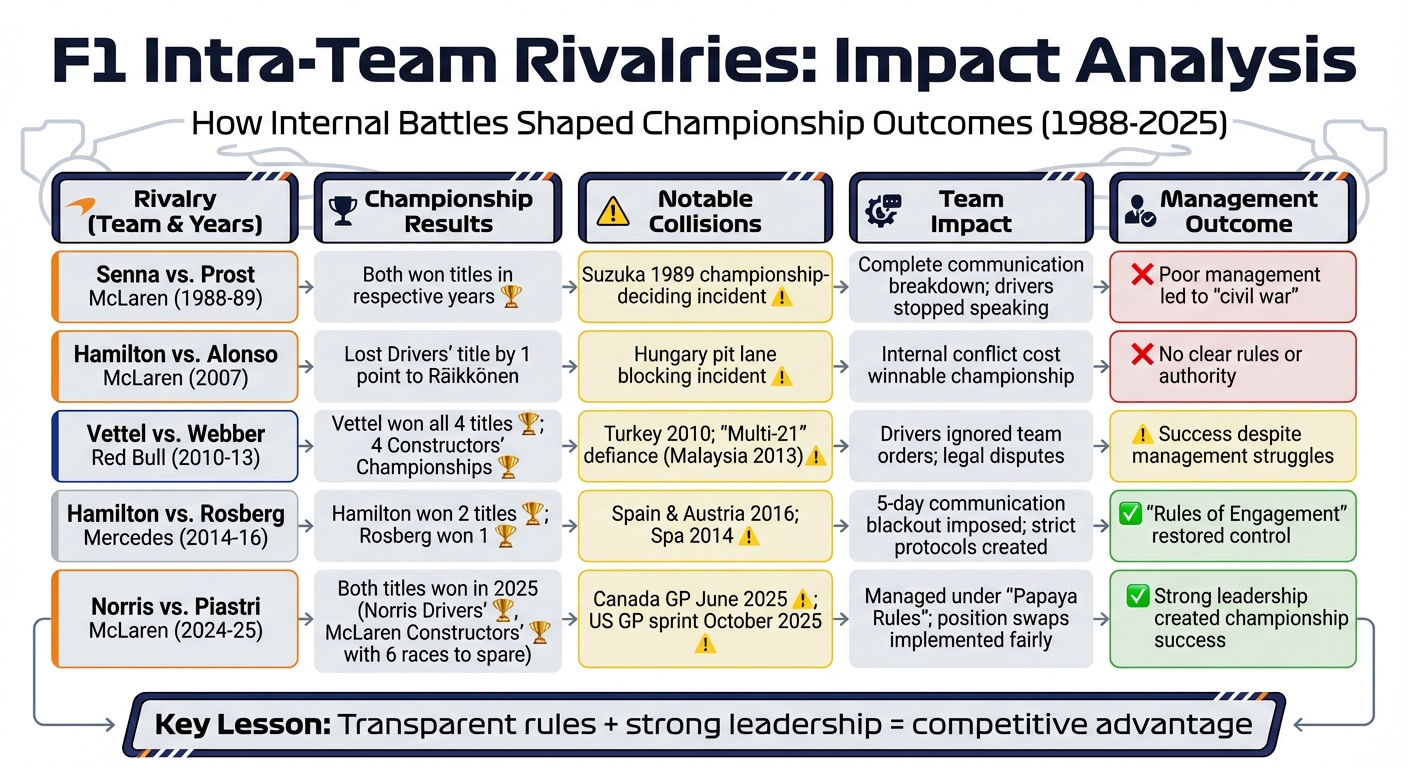
F1 Intra-Team Rivalries: Championship Impact Comparison 1988-2025
Intra-team rivalries can be a double-edged sword. When handled well, they push drivers to squeeze every ounce of performance from their cars. These rivalries can elevate overall team results, as both competitors strive for perfection. A perfect example? McLaren's dominance in the 2025 season. With both Norris and Piastri consistently delivering high scores, the team clinched the Constructors' Championship six races before the season ended. Additionally, having two top-tier drivers opens up strategic options, such as split pit strategies or defensive maneuvers against competitors - an edge single-leader teams often lack. However, while these internal battles can be a boon, they come with risks that, if mismanaged, can spiral into costly consequences.
On the downside, on-track collisions are a glaring issue. Mismanagement of rivalries can lead to drivers clashing, which is exactly what happened to McLaren in 2025. Collisions at the Canadian Grand Prix in June and the United States Grand Prix sprint race in October cost both drivers critical race finishes. A similar scenario unfolded at the 2024 Italian Grand Prix, where Charles Leclerc capitalized on the McLaren drivers' infighting to secure a win.
Another major pitfall is communication breakdowns. When rivalries turn toxic, drivers may defy team orders, withhold technical insights, and even fracture team cohesion as engineers take sides. Mercedes faced such a crisis after the infamous 2014 Spa incident. The team responded by imposing a five-day blackout, cutting both drivers off from engineering teams and race data. This drastic measure helped restore order, resulting in five one-two finishes in the next six races. However, it underscores how internal conflicts can derail championship campaigns if left unchecked.
| Rivalry | Championship Results | Notable Collisions | Team Impact |
|---|---|---|---|
| Senna vs. Prost (1988–89) | Both drivers won titles in their respective years | Suzuka 1989 incident that decided the championship | Complete communication breakdown; drivers stopped speaking |
| Hamilton vs. Alonso (2007) | Lost the Drivers' title by 1 point to Kimi Räikkönen | Hungary pit lane blocking incident | Internal "civil war" cost a winnable championship |
| Vettel vs. Webber (2010–13) | Vettel won all four titles | Turkey 2010 collision; "Multi-21" incident | Drivers ignored team orders entirely |
| Hamilton vs. Rosberg (2014–16) | Hamilton won two titles; Rosberg won one | Incidents in Spain and Austria (2016) | Imposed strict internal rules and a communication blackout |
| Norris vs. Piastri (2024–25) | McLaren won both Drivers’ and Constructors’ titles in 2025 (Norris as World Champion) | Collisions at Canadian GP (June 2025) and U.S. GP sprint race (October 2025) | Managed under "Papaya Rules", allowing position swaps after strategic changes |
The table highlights how clear protocols can turn internal rivalries into a competitive advantage, rather than a liability.
Across these rivalries, one recurring lesson stands out: strong leadership and transparent rules are essential. McLaren's "Papaya Rules" framework is a prime example of this. By allowing aggressive racing within defined boundaries, the team maintained unity and still achieved championship success in 2025. This shows that, with proper management, intra-team battles can fuel success instead of tearing a team apart.
Conclusion
Intra-team rivalries have always been a hallmark of Formula One, shaping the sport's history in ways that can either drive a team to success or lead to its downfall. Iconic pairings like Senna and Prost, Hamilton and Alonso, Vettel and Webber, Hamilton and Rosberg, and more recently, Norris and Piastri, illustrate that the outcome of these rivalries hinges on how well they are managed - not on their intensity. McLaren's 2025 season is a prime example of this: despite on-track clashes, the team claimed the Constructors' Championship with six races left, and Lando Norris secured the Drivers' title in Abu Dhabi. Their success was built on strong leadership and open communication, proving that disciplined management often outweighs raw competition.
When teammates push each other to the limit, the entire team benefits from elevated performance. However, this competitive edge can only be harnessed if clear rules are in place to prevent conflicts from spiraling out of control. Mercedes' response to the Spa collision highlighted the need for swift action, while McLaren's "Papaya Rules" showcased a more balanced approach - allowing drivers to race hard but within boundaries that safeguard the team's goals.
For teams to thrive, fairness must be enforced, disputes resolved quickly, and collective objectives prioritized above all else. When handled correctly, these rivalries not only create champions but also define legendary periods in F1 history. With the right leadership and clear guidelines, internal battles can become the driving force behind championship glory.
FAQs
How do rivalries between teammates affect F1 teams?
Rivalries between Formula 1 teammates can be a double-edged sword for team performance. On the bright side, a bit of healthy competition can push drivers to their limits, often resulting in better overall outcomes for the team. When handled properly, these rivalries can spark motivation and even drive innovation, all while keeping team harmony intact.
But there’s a flip side. When rivalries get too heated, they can spiral into internal conflicts, leading to costly mistakes on the track and disrupting team dynamics. Take the well-known clashes between Lewis Hamilton and Nico Rosberg at Mercedes as an example. Their rivalry, while thrilling to watch, sometimes hurt both the team's immediate results and its long-term unity. To strike the right balance, teams need clear rules and strong leadership to ensure that competition doesn’t get in the way of chasing championship success.
How can F1 teams effectively handle conflicts between drivers?
Managing conflicts between drivers plays a crucial role in keeping the team united and performing well throughout the championship. To minimize misunderstandings during races, teams often implement clear communication protocols and firm team orders. These guidelines help drivers understand when to put the team's objectives ahead of their own ambitions, which helps reduce unnecessary friction.
Building a culture of respect and cooperation is equally important. Open communication and mediation by experienced team leaders can help drivers address disagreements in a constructive way. Effective leadership ensures that rivalries stay healthy and push the team forward, rather than causing disruptions. This keeps everyone focused on the ultimate goal: winning the championship.
Striking the right balance between a driver’s competitive edge and the need for teamwork is essential to maintaining high performance and team unity.
What role did McLaren's 'Papaya Rules' play in their 2025 success?
McLaren's 'Papaya Rules' played a key role in their 2025 triumph, fostering a strong sense of teamwork between drivers Lando Norris and Oscar Piastri. By emphasizing collaboration and reducing internal friction, the team was able to stick to clear, consistent race strategies and maintain a unified front throughout the season.
This cooperative environment gave both drivers the freedom to push their performance to the edge while keeping the team's objectives front and center. The result? A formula that proved essential in reaching their championship goals.