How Lotus Ground Effect Changed F1 Teams
Venturi tunnels and sliding skirts revolutionized F1 aerodynamics, forcing rivals to overhaul chassis, suspension and cooling from 1977 to 1981.
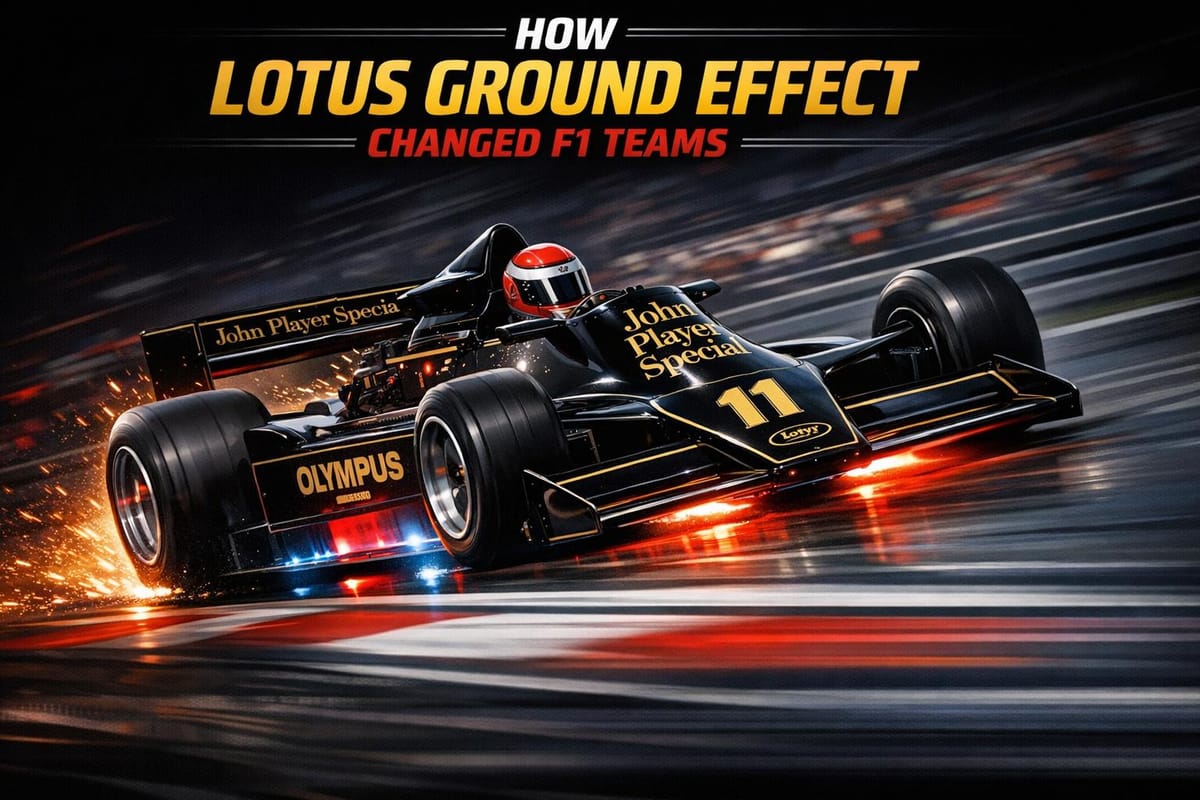
Lotus transformed Formula 1 in 1977 with the introduction of ground effect aerodynamics via the Lotus 78. This innovation used venturi tunnels and sliding skirts to create a vacuum under the car, significantly increasing downforce without adding drag. By 1978, the Lotus 79 refined this concept, dominating the competition and forcing rival teams like Ferrari, Williams, and Brabham to rethink their designs.
Key points:
- Lotus 78/79: Introduced venturi tunnels and sliding skirts, delivering ~15% more downforce.
- Ferrari's Struggles: Their wide flat-12 engine limited ground effect implementation.
- Williams FW07: Improved upon Lotus's design, achieving greater structural rigidity.
- Brabham BT46B Fan Car: Used a fan to generate downforce but was banned after one race.
Ground effect was banned in 1983 due to safety concerns but returned in 2022 to improve racing dynamics. Lotus's approach reshaped F1 engineering, leaving a lasting impact on car design and competition.

F1 Ground Effect Evolution: Lotus 78 vs 79 vs Competitor Approaches (1977-1979)
The evolution of ground effect in F1: using the collection at Classic Team Lotus.

How Lotus Ground Effect Changed F1
Lotus revolutionized Formula 1 by transforming how cars generated downforce, turning the sidepods into inverted wings. The design relied on venturi tunnels - specially shaped channels where air entered through a wide opening, sped through a narrow "throat", and expanded into a rear diffuser. This setup used Bernoulli's principle to decrease air pressure under the car, effectively creating a vacuum that pulled the car closer to the track. Designer Ralph Bellamy described the pivotal moment of discovery:
"When we ran that [with a seal], the downforce figures just went off the scale. We realised then that what we had to do was seal off the gap between the wing edge and the road".
From this breakthrough, Lotus refined its approach, with the sealing mechanism becoming a critical element of ground effect. The Lotus 78 initially used nylon brushes as skirts to seal the gap, but they proved ineffective. The Lotus 79 introduced a more reliable solution: spring-loaded sliding skirts with ceramic rubbing tips that maintained constant contact with the track, even as the car maneuvered through corners. This innovation forced competitors to rethink their designs. Peter Wright, Lotus's head of R&D, explained:
"The real breakthrough came when we put ceramic tips on the skirts and made them suck down instead of up by sealing all the time".
Lotus engineers also made bold changes to optimize the venturi tunnels. Inspired by the WWII De Havilland Mosquito, they relocated the radiators to the sidepods and centralized fuel storage. The Lotus 79 also shifted the aerodynamic center of pressure rearward compared to the Lotus 78. This adjustment enabled the use of a smaller, lower-drag rear wing while still achieving significant downforce. It was a direct response to one of the Lotus 78's main weaknesses, as Mario Andretti put it: the car "was a slug" on straightaways despite dominating in corners. These design changes not only improved performance but also set the stage for further mechanical innovations.
Ground effect delivered an incredible 15% increase in downforce without the drag penalty of traditional wings. Engineers at Imperial College London conducted 400 hours of wind tunnel testing using a moving-floor setup, revealing extreme suction effects in early trials. This wasn’t just a small improvement - it was a complete overhaul of aerodynamic strategy, forcing every competitor to rethink or abandon their designs to stay competitive.
The new aerodynamic philosophy also required entirely different mechanical setups. Initially, teams used soft suspension with spring rates around 500–550 lbs. However, ground effect demanded a consistent ride height to keep the skirts sealed. By 1979, spring rates had skyrocketed to 2,000 lbs to handle the increased aerodynamic loads and ensure proper sealing. Race engineer Nigel Bennett reflected on the challenge:
"We were running the cars very high and with soft suspension deflection and made it doubly difficult job for the skirts to follow the ground".
This shift in chassis dynamics underscored how Lotus's groundbreaking ideas transformed F1 car design from top to bottom.
1. Lotus 78/79
Aerodynamic Design
The Lotus 78 introduced Formula 1 to the concept of the wing car, revolutionizing aerodynamics. Its sidepods were crafted as inverted wings, creating a venturi effect that massively boosted downforce during wind tunnel tests at Imperial College London. Designer Ralph Bellamy described the breakthrough moment:
"When we ran that [cardboard seal], the downforce figures just went off the scale. We realised then that what we had to do was seal off the gap between the wing edge and the road."
However, early tests revealed a flaw. At Hockenheim, Mario Andretti noted that the brush skirts used to seal the gap were blown out on straights, weakening the effect. The Lotus 79 improved on this by introducing spring-loaded sliding skirts with ceramic tips. These stayed in consistent contact with the road, even on bumpy tracks and through corners.
Another issue with the 78 was its aerodynamic imbalance. The center of pressure was too far forward, which forced engineers to use a larger rear wing to stabilize the car - adding drag in the process. The Lotus 79 addressed this by repositioning the venturi tunnels toward the rear, creating a more balanced downforce distribution. This allowed for a smaller, more efficient rear wing and a redesign of the fuel system. The 79 replaced the 78's three-tank layout with a single large tank positioned behind the driver, further improving weight distribution.
Performance Impact
The Lotus 78 made its dominance clear early on. At the 1977 Belgian Grand Prix in Zolder, Mario Andretti’s qualifying lap was a staggering 1.54 seconds faster than the next competitor. The car delivered approximately 15% more downforce than traditional designs, giving it superior grip in corners without the drag penalties associated with conventional wings.
The Lotus 79 took this performance to new heights in 1978, securing six victories and earning a 1–2 finish in the Drivers' Championship for Mario Andretti and Ronnie Peterson. Its enhanced front-end grip and excellent cornering traction allowed drivers to push the car to its limits. Despite these successes, engine reliability issues had cost Andretti the 1977 championship, even though he led more laps than any other driver that season.
Engineering Challenges
While the Lotus 78 and 79 were engineering marvels, they came with their share of challenges. Maintaining the ground effect seal was a major hurdle. The original plastic and nylon skirts wore out quickly, prompting engineers to develop ceramic rubbing strips for greater durability. Suspension tuning also proved critical. Initially, the team used soft springs (500–525 lb), which caused excessive ride height variation and compromised the skirts' effectiveness. Race engineer Nigel Bennett reflected:
"We were really nosing around in the dark really... The following year when we really started working it out we were running 2,000 lb springs!"
The Lotus 79’s narrow monocoque design optimized the venturi effect but introduced structural weaknesses. Peter Wright, head of R&D at Lotus, admitted:
"The structure of the car was a bit flakey."
The chassis lacked the torsional stiffness of the 78's aluminum honeycomb design, and packaging compromises led to persistent overheating issues. Nigel Bennett also noted that the car struggled with a "terrible" exhaust system prone to overheating and detachment, along with subpar brakes. Moving the radiators into the sidepods to make room for the venturi tunnels further complicated cooling.
Here’s a quick comparison of the key design changes between the Lotus 78 and 79:
| Feature | Lotus 78 | Lotus 79 |
|---|---|---|
| Sealing Method | Brushes (initially), then skirts | Spring-loaded sliding skirts with ceramic tips |
| Chassis Material | Aluminum honeycomb sandwich | Narrower monocoque, lighter construction |
| Fuel Tank Layout | Three tanks (central + two side tanks) | Single large tank behind the driver |
| Aero Balance | Forward-biased; required a large rear wing | Balanced; utilized a smaller, low-drag rear wing |
| Result | 5 wins; 2nd in Constructors' | 6 wins; World Championship Double |
Regulatory Influence
The Lotus team also had to navigate FIA regulations banning "moveable aerodynamic devices." They successfully argued that sliding skirts were sealing mechanisms, not aerodynamic devices, citing earlier examples from Brabham and McLaren. This clever interpretation opened the door for other teams to experiment with ground effect designs. However, as cornering speeds skyrocketed, the FIA eventually banned ground effect skirts entirely in 1983.
2. Ferrari 312T Series
Aerodynamic Design
Ferrari hit a major roadblock when Lotus introduced their groundbreaking ground effect technology - their flat-12 engine. This engine, while powerful, was too wide to leave room for the venturi tunnels in the sidepods, which were key to Lotus's innovative design. In contrast, Lotus's narrow Cosworth V8 engine provided ample space for these aerodynamic channels, giving them a significant advantage. Stuck with their engine architecture, Ferrari had to stick to more traditional solutions, like over-body wings and mechanical grip, throughout the 1977 season.
In an attempt to catch up, Ferrari built a Lotus 78 replica at Pininfarina. However, their wind tunnel lacked a rolling road, which meant they couldn't accurately simulate real-world airflow. Peter Wright, Lotus's head of R&D, later remarked:
"We heard that when the type 78 came out Ferrari built an equivalent version and tested it in a tunnel in Italy... without a rolling road, and they said, 'Ah, it doesn't work'."
By 1979, Ferrari introduced the 312T4, a car that adapted ground effect principles as much as the flat-12 engine would allow. This compromise paid off, as the car won both championships that year. However, the story changed in 1980 with the 312T5, which struggled to compete against rivals like Williams. Williams had fully embraced ground effect technology, something Ferrari's wide engine simply couldn't accommodate. This limitation highlighted the growing gap between Ferrari's design and the evolving demands of the sport.
Performance Impact
Even with its aerodynamic challenges, the 312T2 delivered results, clinching the 1977 World Championship with Niki Lauda. Meanwhile, Lotus's 78 was rewriting the rules of aerodynamics, generating about 15% more downforce than conventional cars. At the Belgian Grand Prix, it was a staggering 1.54 seconds faster during qualifying. However, Ferrari's edge came from reliability. While Mario Andretti's Lotus 78 often led races, frequent engine failures derailed his championship hopes, even though he led more laps than anyone else that season.
The game changed further in 1979 when Williams debuted the FW07, a car purpose-built to maximize ground effect. It outpaced competitors, including Ferrari. Recognizing the limitations of the flat-12 engine, Ferrari finally abandoned the 312T series and switched to the 126C turbo V6. This narrower engine design allowed for proper venturi tunnels, marking a major shift in their technical approach. While Lotus initially set the standard, Ferrari's eventual pivot demonstrated how even the most successful teams had to rethink everything to stay competitive in the ground effect era.
3. Williams FW07
Aerodynamic Design
Patrick Head, the designer behind the Williams FW07, took a deliberate and calculated approach to ground effect. Unlike other teams rushing to replicate Lotus's breakthrough, Head held off until he had a thorough grasp of the physics behind it. This patience paid off when the FW07 made its debut in 1979. Often referred to as a "Mk2 version" of the Lotus 79, the FW07 took the venturi tunnel and skirt system pioneered by Lotus and addressed its key flaws. Williams improved the car's structural rigidity and enhanced the sealing mechanisms, avoiding the trial-and-error setbacks that Lotus faced, particularly with their overly ambitious Lotus 80. These precise upgrades gave the FW07 a distinct edge on the track.
Performance Impact
The FW07's refined design translated into consistent and dominant race performance. By the time Williams entered the ground effect arena, they had decoded the secrets of Lotus's closely guarded technology. The result was a car that generated reliable downforce without the instability and "porpoising" issues that plagued earlier designs. Ron Tauranac summed it up perfectly:
"Of course, the trouble with being inventive is that others can do the Mk2 version without having wasted time on the Mk1. And that's exactly what Williams did".
With its sliding skirts and venturi tunnels working flawlessly, the FW07 ruled the racetrack until regulations in 1981 imposed a 6 cm (about 2.4 in) ground clearance. This regulation change, however, came only after the FW07 had solidified its legacy as a championship-winning machine.
4. Brabham BT46/BT46B Fan Car
Aerodynamic Design
Brabham took inspiration from Lotus's groundbreaking ground effect system but approached the challenge differently. The Alfa Romeo flat-12 engine in their car was too wide, blocking the airflow needed for venturi tunnels. To work around this, Gordon Murray, Brabham's design chief, came up with an ingenious solution: a large rear-mounted fan. This fan actively sucked air from beneath the car, creating a suction effect that pinned the car to the track surface. Unlike Lotus, which relied solely on speed to generate downforce through its tunnels, the BT46B's fan system produced downforce regardless of how fast the car was moving. Side skirts helped seal the low-pressure area, but it was the fan that did most of the work, revolutionizing how downforce could be achieved.
Performance Impact
The performance improvement was immediate and undeniable. At the 1977 Belgian Grand Prix at Zolder, Mario Andretti's Lotus 78 lapped a full 1.54 seconds faster than John Watson's Brabham-Alfa. However, when the fan car made its debut, it completely erased this gap, proving that active downforce could rival Lotus's passive system.
Regulatory Influence
Despite its impressive debut, the BT46B quickly ran into trouble with regulators. After just one race, protests from rival teams forced Brabham to withdraw the car. Shortly afterward, the FIA banned "air suction cups" and other moveable aerodynamic devices, effectively outlawing Murray's innovative fan system. But Murray wasn't done. In 1981, when the FIA introduced a 6 cm (about 2.4 in) ground clearance rule, he found another way to push the limits. He designed a hydropneumatic suspension that complied with regulations in the pits but lowered the car to the track during races. This constant battle between Brabham's creativity and regulatory oversight became a hallmark of the ground effect era.
Pros and Cons
Each team's approach to ground effect aerodynamics came with its own set of trade-offs. Here's a breakdown of the technical achievements and compromises they encountered.
Lotus gained a massive edge in speed and downforce. However, these benefits came with challenges. The experimental Cosworth engines in the Lotus 78 were prone to failures, and the car suffered from high drag on straightaways. Designer Ralph Bellamy reflected on the missed opportunities, saying:
"The 78 should have won the championship in 1977 but Colin stuffed it. Not content with having aerodynamically the best car on the track... he had to go off to Cosworth and do a deal to get development engines. But development engines blow up."
Ferrari faced a different kind of obstacle. Their flat-12 engine's width made it impossible to implement effective venturi tunnels in the sidepods, limiting the aerodynamic gains from ground effect. Instead, Ferrari leaned on mechanical reliability and more conventional designs. While this meant they couldn't fully capitalize on ground effect technology, their consistent performance was instrumental in clinching the 1979 championship.
Williams took a more calculated route. Patrick Head spent two years analyzing Lotus's designs before debuting the FW07 in 1979. This car was a sturdier, more refined version of the Lotus 79. By entering the ground effect era later, Williams avoided early missteps but gave up the advantage of being a pioneer. The FW07's rigid chassis handled aerodynamic loads well, but the suspension had to be run "rock-solid" to maintain the low-pressure seal, making the ride extremely uncomfortable for drivers.
Brabham went bold with its BT46B "fan car", designed by Gordon Murray. The car used a rear-mounted fan to actively extract air from underneath, creating downforce regardless of speed and bypassing the packaging issues of traditional designs. Though the BT46B won its sole race at the 1978 Swedish Grand Prix, it was withdrawn after regulatory protests. Later, Brabham experimented with hydropneumatic suspension in 1981 to navigate the 6 cm (about 2.4 in) ground clearance rule.
The table below summarizes the key advantages and disadvantages each team faced:
| Team | Key Advantage | Major Disadvantage |
|---|---|---|
| Lotus | 1.54-second lap time advantage; ~15% more downforce | Engine unreliability; high drag; structural flex |
| Ferrari | Mechanical reliability; 1979 championship win | Flat-12 engine blocked effective venturi tunnels |
| Williams | Refined, rigid chassis | Late entry; harsh, "rock-solid" suspension |
| Brabham | Instant downforce with the fan car | Withdrawn after one race; high regulatory risk |
Conclusion
Lotus's groundbreaking ground effect design completely reshaped the way Formula 1 teams approached car engineering. When the Lotus 78 debuted in 1977, it showcased a performance edge so powerful that it forced competitors to rethink their entire design philosophies. By shifting the focus from traditional wing-based downforce to an underfloor aerodynamic approach, the Lotus 78 challenged teams to overhaul critical elements like chassis stiffness, suspension geometry, and even the placement of cooling systems and fuel tanks. To keep up, rivals adopted stiffer materials such as aluminum honeycomb and refined their suspensions to preserve the all-important "seal" between the car's underbody and the track surface.
This innovation didn’t just change car design - it set a new standard for the sport. As Ralph Bellamy, the designer behind the Lotus 78, famously said:
"From that moment forward, motor racing was changed forever."
The technology was so effective that it was banned in 1983 due to concerns over dangerously high cornering speeds . But its influence never disappeared. Even during the flat-bottom era that followed, teams found ways to use rear diffusers to generate localized ground effect. And when Formula 1 reintroduced full ground effect tunnels in 2022, the goal was to reduce aerodynamic turbulence and improve close-quarters racing - further proof of the lasting impact of Lotus's innovation.
Today, the principles introduced by Lotus nearly five decades ago continue to shape Formula 1 car design. Modern cars still rely on the same Venturi-based concepts that revolutionized the sport, marking a shift from a focus on mechanical grip to a new era where aerodynamic precision defines success. The legacy of ground effect is undeniable - it forever changed Formula 1.
FAQs
How did Lotus's ground effect revolutionize F1 car design?
Lotus revolutionized Formula 1 car design in the 1970s with its pioneering use of ground effect aerodynamics. By crafting the underside of the car into a venturi tunnel and adding side skirts to seal the airflow, they created a low-pressure zone beneath the car. This generated enormous downforce while keeping drag to a minimum. The Lotus 78 introduced this concept, and it was perfected with the Lotus 79, allowing the car to grip the track like never before and dominate its rivals.
Fast forward to today, and modern F1 cars still rely heavily on these principles. Advanced underfloor designs, diffusers, and side-pod geometries all aim to recreate that low-pressure effect. In fact, the 2022 regulations brought ground effect aerodynamics back to the forefront, a direct nod to Lotus's influential innovations. This groundbreaking approach continues to define the way teams tackle aerodynamic performance in Formula 1.
Why was ground effect banned in 1983 and brought back in 2022?
Ground effect technology was banned after the 1982 Formula 1 season due to serious safety concerns. The immense underbody downforce, combined with movable skirts, allowed for incredibly high cornering speeds but made cars dangerously unstable, especially when ride height changed unexpectedly. These risks prompted the FIA to prohibit the use of ground effect starting in 1983.
Fast forward to 2022, and ground effect made a comeback under a new set of regulations aimed at making it safer and more competitive. Instead of movable skirts, the updated rules introduced fixed venturi tunnels and imposed strict limits to maintain stability. This modern design improves aerodynamic grip, encourages closer racing with better overtaking opportunities, and helps create a more level playing field among teams.
What challenges did F1 teams face when adapting to ground effect technology?
When Lotus introduced the game-changing ground effect concept with the Lotus 78, it left many rival teams scrambling to figure out how to make it work. The principle was simple in theory: use the underside of the car as a venturi tunnel to create a low-pressure zone, effectively sucking the car to the track. But in practice, it was anything but simple. Teams struggled to seal the airflow properly, a critical step in making the concept effective. Lotus cracked the code with side skirts that stopped air from escaping, but for competitors, replicating this breakthrough was far from straightforward.
Even once teams grasped the basics, the technical challenges were immense. Keeping the car at a consistent ride height was essential to maintain the ground effect, but Formula 1's open-wheel designs and suspension movement made this a daunting task. On top of that, the increased downforce required stronger chassis, and wind-tunnel testing became far more intricate as teams worked to fine-tune their designs. The need for major redesigns, combined with limited budgets and resources, meant that only a handful of teams managed to implement ground effect successfully in its early days.
To complicate matters further, the absence of clear regulations on underbody geometry and side skirts created an atmosphere of uncertainty. Teams faced the risk of pouring time and money into a technology that could be banned or heavily restricted at any moment. This hesitation slowed progress for many constructors. Still, despite these hurdles, the innovations driven by ground effect technology laid the groundwork for the aerodynamic advances we see in modern Formula 1 today.