Pit Stop Decision Support with Live Race Data
Pit-stop calls hinge on live pace, tire life, traffic, and weather—pick the lap that minimizes total race time.
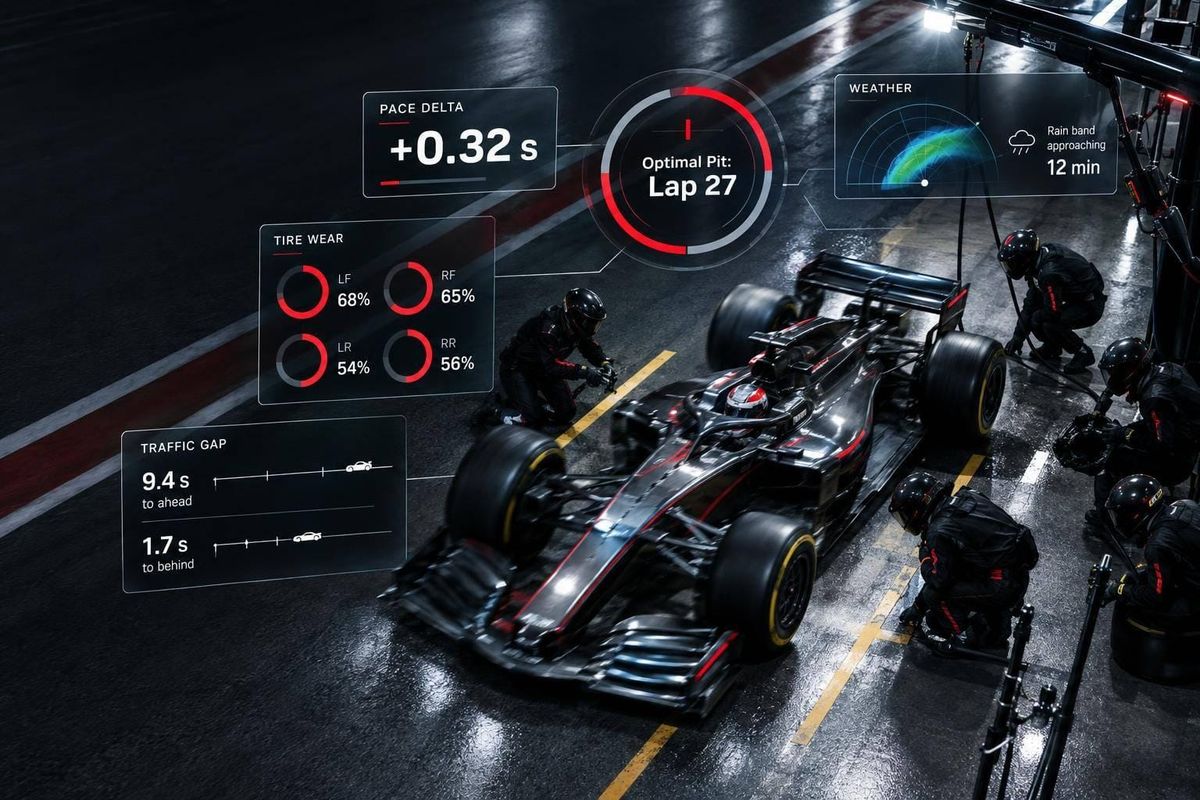
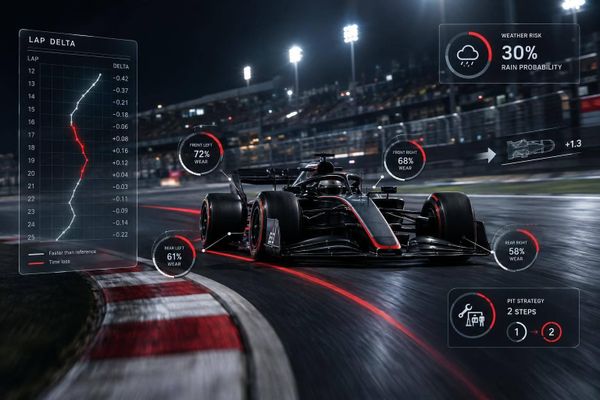
The best pit lap depends on total race time - not one slow lap. Teams compare stopping now with staying out, using live pace, tire condition, traffic, weather, and rival stops. A 2.5-second tire change is only part of the cost: pit entry, lane travel, and exit also affect where the car rejoins.
The decision comes down to four checks:
- Time and tires: Estimate the full stop loss, tire warm-up, and pace through the finish.
- Traffic and conditions: Compare stopping before or after a rival, then account for rain, Safety Cars, and Virtual Safety Cars.
- Readiness: Confirm the tire choice meets the rules, the crew is ready, and the car can deliver the needed pace.
- Review: Compare the forecast with race data, judging the call by what was known before pit entry - not finishing position alone.
Live data keeps changing the answer. The pit wall’s job is to turn those updates into a clear call before the driver commits to pit entry.
Live Data That Changes the Pit Window
With the pit terms set, the pit wall must decide which live signals change the window on this lap.
Treat recorded lap times as evidence. Treat tire life, rain timing, and rival intent as probabilities. Timestamp every input and display the pit window as a range, not a single lap. If a feed arrives late, use sector gaps and driver reports as backups - not exact replacements.
| Data stream | Question it answers | Key uncertainty | Effect on the pit call |
|---|---|---|---|
| Lap and sector times | Is underlying pace dropping? | Traffic, errors, fuel load, energy use | Bring the stop forward if the decline continues |
| Tire condition and driver feedback | Is grip getting harder to maintain? | Temperature does not reveal exact remaining life | Shorten the window or extend cautiously |
| Traffic gaps and rival stops | Where will the car rejoin? | Changing gaps, rival pace, stops made to cover another car | Stop, cover a rival, or wait for clear track |
| New-tire out-laps | How fast are new tires working now? | Compound warm-up and traffic | Stop early if measured pace supports it; otherwise wait |
| Radar, wind, and track temperature | Will conditions change tire performance? | Forecast delays and localized showers | Adjust stop timing and compound choice |
| Brake, fuel, and energy status | Can the driver deliver the required pace? | Public timing may not show these limits | Reject a stop the car cannot take advantage of |
Next, weigh which signals should change the call fastest.
Lap Times and Tire Condition
Compare recent sectors with the driver’s clean-air baseline, teammate pace, and fuel-adjusted target. Repeated losses on corner exits can point to rear-tire trouble, but check wheelspin, traffic, and energy deployment first. One slow sector caused by a driving error should carry less weight than repeated losses across comparable laps.
Tire age, compound, surface and carcass temperatures, pressure behavior, and sliding help explain the pattern. Driver reports of front-end washout, unstable braking, or poor traction can challenge a model that otherwise looks healthy. Forecast the performance trend, not an exact expiry lap. Temperatures alone cannot tell you how many competitive laps remain.
Traffic Gaps and Rival Pit Stops
Once the pace loss is clear, check whether the car can rejoin in clean air. Start with pit loss, then project each car to its rejoin point using compounds, pace, and likely stops. Count the expected out-lap once, without double-counting entry or exit loss.
Find the first clear racing lap - not just the gap at pit exit. A rival’s stop to cover your car can close that opening, while slow new-tire warm-up can favor waiting. Cover the rival only if the new-tire gain and the rival’s lost time can overcome the pit-stop deficit.
Weather, Track Grip, and Car Limits
Timestamp radar readings, record their location and confidence level, then check them against wind, sector grip reports, and tire choices already on track. Track temperature helps refine warm-up expectations, but localized rain can make a circuit-wide forecast misleading.
Compare options in seconds, not lap counts. Use the applicable pit-lane limit - usually about 50 mph (80 km/h) - and account for realistic entry braking rather than a full-speed approach. Before committing, check whether brake condition, fuel targets, and available energy allow the car to deliver the in-lap and out-lap times needed for the undercut or overcut.
sbb-itb-7c68254
Modeling When to Pit
As live data updates the model, compare stopping now with staying out for one or more laps. Project each option through the finish to find the best stop lap. Give each scenario an available tire option, including its compound and age, and check whether it requires another stop. In dry races, confirm that the planned tire sets meet the event’s compound rule. Report a range of race times, not one fixed prediction.
Start with the time cost. Then check whether the car would rejoin in a suitable traffic gap.
Estimate Pit Loss and Rejoin Position
Use the same reference for every comparison: the car’s projected race time and track position if it stays out versus its time and position after stopping. Pit-lane transit time is not pit loss. Subtract the time a car staying on track takes to cover the corresponding section, and count entry, service, and exit losses only once.
Hypothetical calculation - not race data: Assume entry loss of 2.0 seconds, pit-lane transit of 17.5 seconds, stationary service of 2.5 seconds, and exit loss of 5.0 seconds. These separate components total 27.0 seconds, with approximately ±1.5 seconds of forecast uncertainty.
A simplified illustrative gap chart could show:
Car Before stop Estimated outcome after stop Rival A 2.4 seconds ahead Ahead by roughly 24–27 seconds Stopping car P6 P8–P9 Rival B 6.8 seconds behind May pass during the stop cycle Rival C 12.0 seconds behind Usually behind
Compare the Undercut and Overcut
Test both rival responses: stopping immediately or staying out. Compare the stopping car’s full out-lap and next lap with the rival’s in-lap and response lap. Both cars’ in-laps and out-laps matter, and the advantage shifts with each lap.
| Option | Suitable conditions | Live indicators | Main risk |
|---|---|---|---|
| Undercut | Fast warm-up, high degradation, clean rejoin | New-tire sectors beat the rival’s old-tire pace | Traffic or cold tires erase the gain |
| Overcut | Slow warm-up, limited degradation, improving grip | Strong old-tire pace; rival’s weak out-lap | Current tires lose performance suddenly |
| Wait for neutralization | Uncertain rain or possible neutralization | Radar updates, yellow flags, changing gaps | Rival builds a gap that cannot be recovered |
Account for Rain, Safety Cars, and VSCs
Neutralizations change the calculation, but not always in the same way. Run the stop-versus-stay-out comparison again for three options: stopping during the neutralization, staying out, and stopping after it ends.
Safety Cars and VSCs can reduce pit loss. But queues, restart timing, and cars staying out can wipe out that saving. Check pit access and event-specific rules before assuming a stop is available.
For rain, compare a range of crossover laps. Include another stop if intermediates would only cover a short shower. Give track position more weight when passing is difficult, tire warm-up is slow, or the car would rejoin in traffic.
From Live Data to the Pit Call
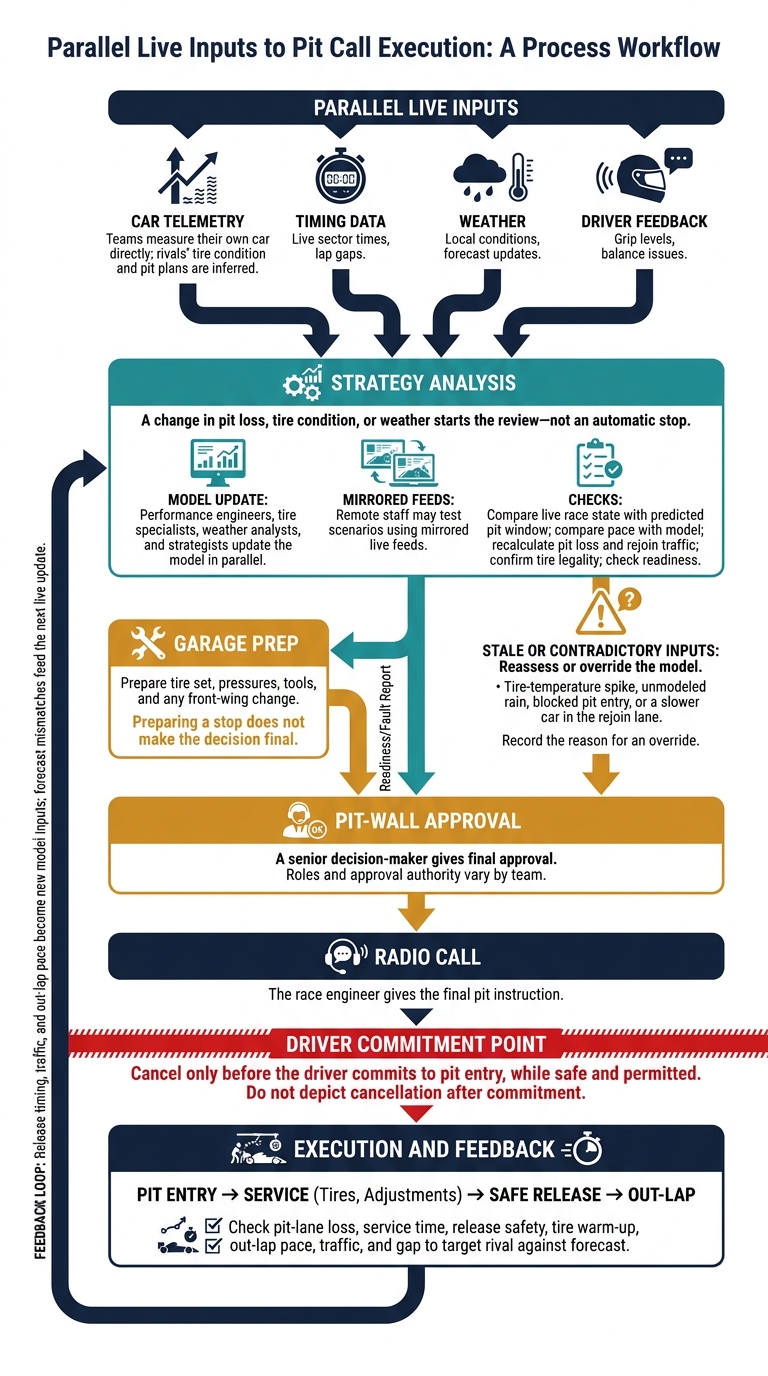
How Live Race Data Becomes a Pit Stop Call
Once the pit window is set, the team has seconds to turn the model’s forecast into a stop call.
Car telemetry, timing data, race-control messages, and driver feedback reach the pit wall in real time. Teams can measure their own car directly, but they must infer rivals’ tire condition and pit plans. The task is to turn those inputs into a call at the right moment.
Who Analyzes Data and Prepares the Stop
Performance engineers, tire specialists, weather analysts, and strategists update the model in parallel. The race engineer explains the car’s behavior to the driver, while a senior decision-maker gives final approval. Remote staff may test more scenarios using mirrored live feeds. Roles and approval authority vary by team.
The garage prepares the tire set, pressures, tools, and any front-wing change, then reports readiness or a fault to the pit wall. Preparing a stop does not make the decision final.
Telemetry, timing, weather, and driver feedback → strategy analysis → garage prep → pit-wall approval → radio call → pit entry, service, release, and out-lap.
Approve the Call Before Pit Entry
A change in pit loss, tire condition, or weather starts the review - not an automatic stop. The team checks the live race state against the predicted pit window and compares pace with the model. It then recalculates pit loss and rejoin traffic, confirms tire legality, and checks readiness before approval.
The model can be overridden when inputs are stale or contradictory, such as a tire-temperature spike, unmodeled rain, a blocked pit entry, or a slower car in the rejoin lane.
Recording the reason helps with later review. But the handoff only matters if the pit wall updates the forecast with the next lap’s data.
Relay the Call and Track Execution
The race engineer gives the final pit instruction. The team can cancel only before the driver commits to pit entry, while cancellation remains safe and permitted under race and pit-lane procedures. Once the driver commits, the focus shifts to clean entry, service, and safe release.
Engineers then check pit-lane loss, service time, release safety, tire warm-up, out-lap pace, traffic, and the gap to the target rival against the forecast. Release timing, traffic, and out-lap pace become new model inputs. Any mismatch between the forecast and execution feeds the next live update.
Conclusion: Judge the Call and the Result
A pit call weighs live pace, tire life, traffic, weather, and neutralization risk in one coordinated decision. The driver, race engineer, strategists, weather analysts, performance engineers, and pit crew all contribute.
Once the race is over, ask whether the live forecast matched what happened lap by lap.
Compare Forecasts With Race Data
Judge the call using only what was knowable before pit entry. Support the comparison with official timing data. Don't present reconstructed forecasts as internal team data.
| Metric | Predicted before the call | Actual race data | Difference | Assessment |
|---|---|---|---|---|
| Tire degradation | Estimated seconds per lap | Lap-by-lap pace corrected for fuel, traffic, and interruptions | Estimate vs. observed trend | Was tire loss understated or overstated? |
| Out-lap pace | Expected warm-up effect on lap time | Actual first competitive lap after the stop | Predicted vs. actual | Did cold tires or traffic reduce the gain? |
| Pit-stop loss | Modeled pit-entry-to-exit time | Official timing and timing-line data where available | Estimated vs. measured loss | Did entry, stationary time, or pit-lane traffic add time? |
| Rejoin position | Projected position and gap | Position, gap, and traffic at pit exit | Forecast vs. outcome | Did traffic or rival pace change the result? |
| Strategic result | Expected gain or protection | Positions, points, and race-time effect | Projected vs. realized | Did the call outperform the alternative? |
Build a lap-by-lap timeline using timing data, radio, race-control records, and team explanations. Label each number as measured, derived, estimated, or unknown. Note whether rain, a Safety Car, or a VSC arrived before or after the call.
Compare the chosen stop with at least one alternative pit lap. Finishing order alone doesn't tell you whether the decision was sound. Use the timeline to keep measured facts separate from inferred strategy.
Public evidence can't reveal a team's internal models or thresholds, so check race-specific claims against primary evidence. End the review with one concrete improvement: a better traffic forecast, more warm-up margin, a revised weather trigger, or cleaner execution.
FAQs
How do teams separate tire wear from fuel effects?
Teams use live telemetry to track fuel levels, fuel consumption, tire temperature, and balance. Strategy software keeps projected race times up to date, helping engineers distinguish between tire wear and the car getting lighter as fuel burns off. Engineers then compare those estimates with driver feedback on grip to fine-tune their models and understand why performance changes.
How much uncertainty makes an undercut too risky?
An undercut becomes too risky when doubts about traffic, tire wear, and track conditions outweigh the possible pace gain. A pit stop costs about 24 seconds, so strategists need a high level of confidence before committing. Rejoining in heavy traffic can wipe out the advantage of new tires. When radar, lap deltas, and driver feedback send mixed signals, teams often play it safe rather than attempt an undercut too soon.
What happens when driver feedback contradicts the pit model?
Teams use driver feedback on grip and tire balance to check sensor data and fine-tune simulations. If a driver reports good traction even when the data suggests otherwise, the team may extend the stint. But reports of overheating or sliding, backed by rising tire temperatures in telemetry, can lead to an earlier pit stop. Engineers weigh driver feedback alongside other signals before changing strategy.