Study Review: Recycling Systems at F1 Venues
Examines F1 venue waste reports, shows why bin counts don’t prove recycling, and outlines requirements for verified reporting.
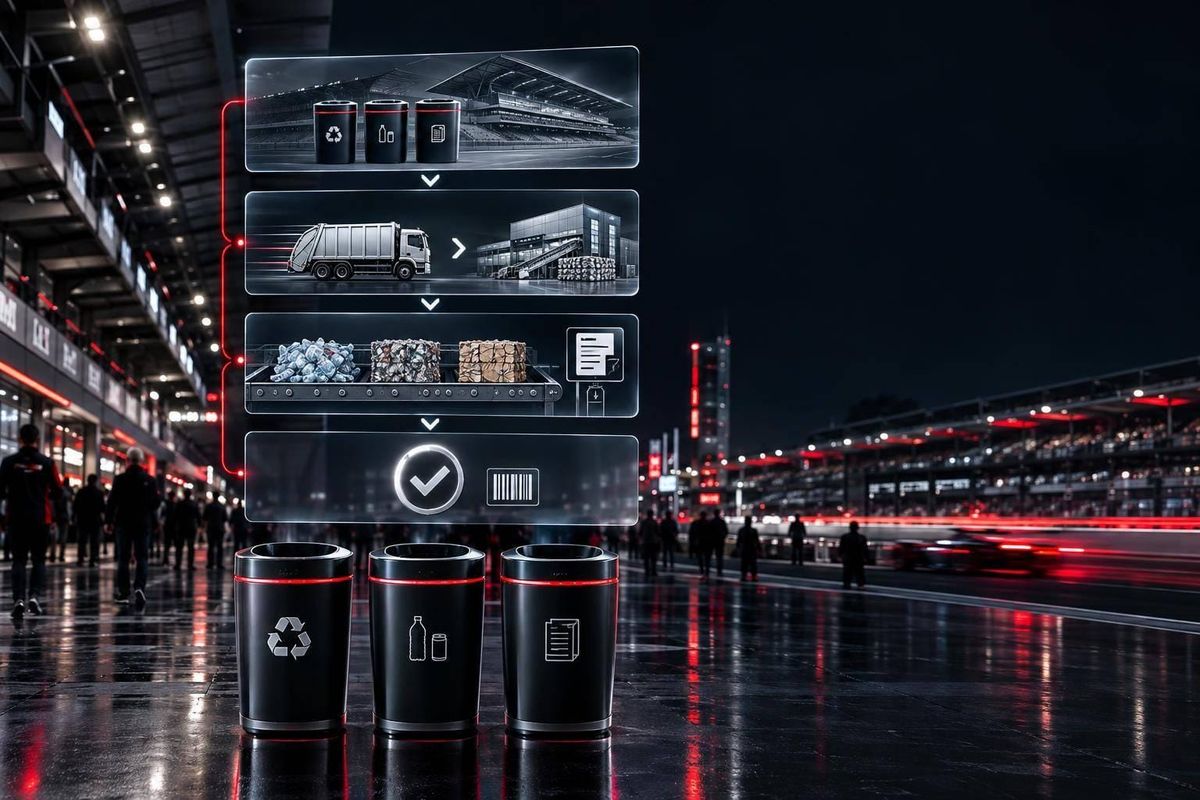
Recycling bins at F1 venues do not prove that waste gets recycled. Checking results means tracing waste from collection through sorting to final treatment - and separating recycling from reuse, composting, and energy recovery.
Reports available through November 25, 2026, show why venue figures need context:
- Suzuka: Reports a 46.8% recycling rate, but does not fully define the waste total used to calculate it.
- Hungaroring: Reports 164.6 short tons of waste removed in 2026, mostly sent for energy recovery - not material recycling.
- Silverstone: Reports 37.5% recycling in 2023 across the site for the year, not just the race weekend.
- Lusail: Describes sorting stations and other waste systems, but provides no verified venue-wide recycling rate.
These figures are not a venue ranking. F1 sets baseline guidance, while local teams and contractors handle delivery. A fair comparison needs matching reporting periods, waste weights, contamination data, and records showing where materials went and how much was recycled.
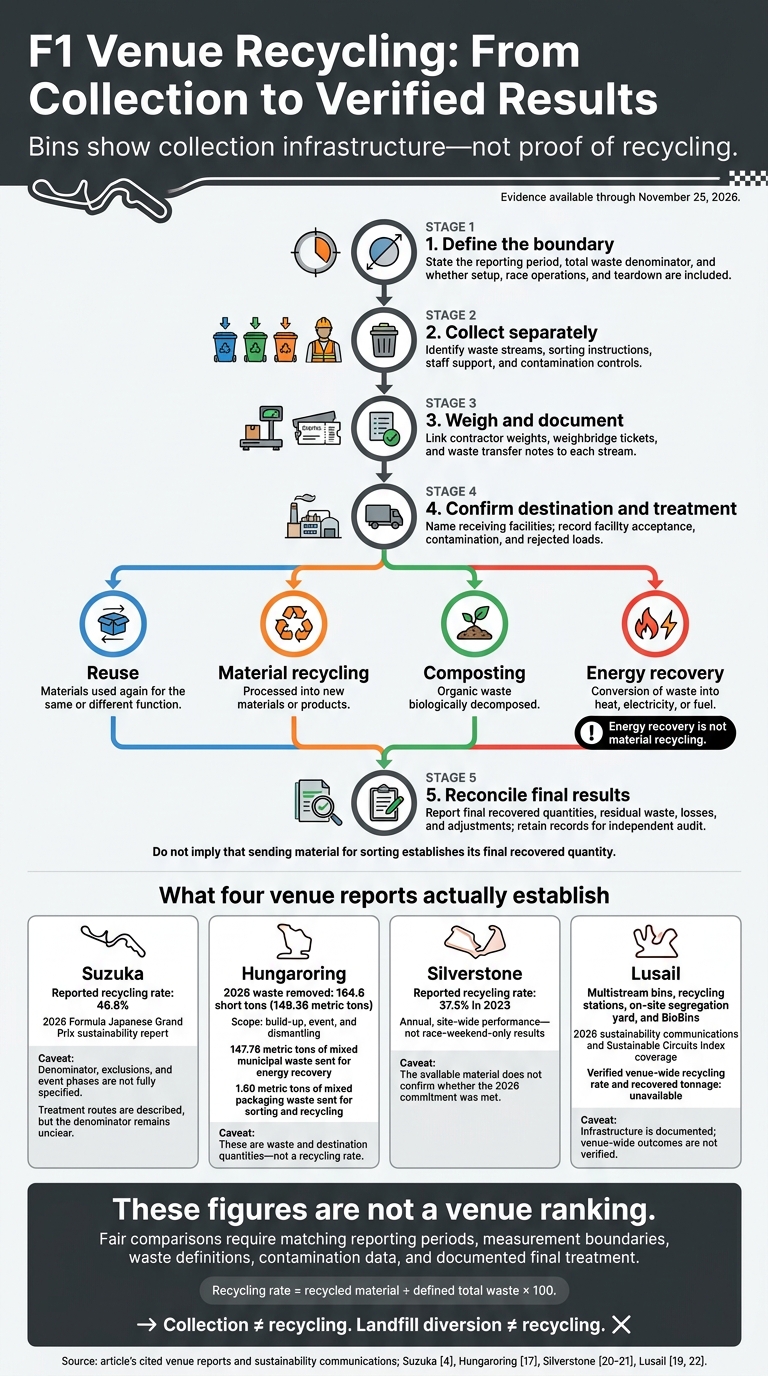
F1 Venue Recycling: From Collection to Verified Results
2. F1 Waste Policies and Venue Duties
Formula 1’s Net Zero 2030 plan includes waste reduction. But recycling figures still require separate, documented diversion data. Any claimed emissions saving also needs a documented calculation and a defined accounting boundary.
At each venue, the test is whether these policies translate into visible systems for collecting, sorting, and treating waste.
Staff Duties, Circuit Audits, and Waste Controls
Formula 1’s promoter guidance covers reducing single-use plastics, reusable cups, water-refill stations, recycling streams, and reusing or repurposing race-weekend materials. Its Green Champions program, launched in 2023, audits waste and recycling provision, water-refill access, and accessibility across the Fan Zone and Formula 1 Paddock at each race.
Separately, FIA Environmental Accreditation uses an independent, qualified auditor to assess environmental management across 17 criteria. Accreditation recognizes management practices; it is not a venue recycling rate.
Formula 1 sets the framework, while promoters handle local delivery. Circuit operators manage site facilities, vendors influence packaging and sorting at the bin, and contractors collect and process waste. These roles describe how the work gets done - not a contractual division of duties that applies everywhere. Each venue claim should name the documented organization, including the contractor when disclosed, rather than crediting Formula 1 with every task.
Check the whole collection process: bins near food outlets, clear sorting instructions, staff assistance, regular servicing, and controls for contamination after collection. Reusable cups need return points and return-rate records. Packaging changes need a treatment route that can handle the new material.
Policy Goals Versus Reported Results
Who handles each task affects whether a policy produces a measurable waste result. The table distinguishes commitments, installed controls, and reported outcomes.
| Policy commitment | Control or system in place | Reported outcome | Responsible organization | Reporting period | Evidence type |
|---|---|---|---|---|---|
| Reuse, recycle, or compost all event waste; eliminate single-use plastics | Later reporting describes recycling streams and measures to reduce single-use materials | Target; completion not established by the cited evidence | Formula 1; local delivery through promoters | Announced in 2019 with a 2025 deadline | Strategy and February 2022 ESG briefing |
| Reduce single-use materials | Refill stations, more recycling facilities, or refillable cups | More than 80% of promoters reported introducing these measures; this measures participation, not recycling | Participating promoters; reported by Formula 1 | 2022 | Self-reported participation figure |
| Divert surplus food | Leftover food donated to a local food bank | More than 4,200 pounds (approximately 1.9 metric tons) donated; not a packaging-recycling result | Silverstone; reported by Formula 1 | 2021 event period | Reported donation quantity in February 2022 briefing |
| Waste-control package | Ban on single-use plastic bottles, free water fountains, improved fan recycling facilities, and food donation | FIA three-star accreditation; no venue recycling percentage was published | Bahrain International Circuit; FIA accreditation | November 2024 | Accreditation announcement and description of waste controls |
sbb-itb-7c68254
3. Waste Collection and Processing
A recycling bin starts the waste trail. It doesn’t prove that the waste was recycled. The evidence covers separation at spectator bins, contractor collection, sorting, and waste transfer notes for dry mixed recycling, food waste, and glass. Before any material counts as recycled, records must document its final treatment and link each waste stream’s contractor weights, sorting, and destination.
Sorting Methods and Treatment Routes
| Method or route | Role in the waste trail |
|---|---|
| Source separation | Separates waste at spectator bins to reduce contamination |
| Staff-supported sorting | Helps separate materials during collection and sorting |
| Downstream sorting | Sorts material after contractor collection |
| Documentation | Uses weight records and waste transfer notes to track each stream |
| Final treatment | Uses destination and treatment records to establish what was recycled |
The evidence does not document local processing capacity, acceptance rules, or rejected loads for either venue. These gaps matter in the case studies below: reported totals depend on how each venue documented collection, sorting, and destination.
Collection Design at Suzuka and Silverstone
| Venue | Collection design and documentation |
|---|---|
| Suzuka | Staff-supported sorting is mentioned, but no event-level operating record is provided. |
| Silverstone | No venue-specific collection design or implementation record is provided. |
The evidence cannot support a performance comparison between Suzuka and Silverstone without event dates, accepted-material lists, staffing records, and contamination data. These missing records limit the venue results below to descriptions of infrastructure and collection design where recycling outcomes cannot be verified.
4. Venue Case Studies and Reported Results
These case studies use different measurement boundaries and waste definitions. Read them as venue-specific reports, not a ranking. Only material published by November 25, 2026, is eligible. Each case follows Section 3’s chain: collection, sorting, treatment, and documentation.
Some venues report recycling rates, others report only waste tonnage, and others describe infrastructure without verified results.
| Venue | Reported system | Measured result | Reporting period | Measurement boundary | Original document and data limits |
|---|---|---|---|---|---|
| Suzuka | Separate collection and treatment for grass clippings, branches, wood scraps, organic waste, cardboard, cans, PET bottles, used cooking oil, and resin. | Reported recycling rate: 46.8%. The report also cites a 19.3% Japanese national average. | 2026 Formula Japanese Grand Prix sustainability report. | Site recycling rate; the denominator, exclusions, and event phases are not fully specified. | The national figure is not directly comparable until its year, definition, and denominator are confirmed. |
| Hungaroring | Contractor-managed collection and removal during build-up, the event, and dismantling; mixed packaging waste sent for sorting and recycling. | Waste removed: 137.0 short tons (124.3 metric tons) in 2025 and 164.6 short tons (149.36 metric tons) in 2026. | 2025 and 2026 Hungarian Grand Prix reports. | 2025: event weekend. 2026: build-up, event, and dismantling. | Different reporting periods and terms prevent direct comparison. These totals are not recycling rates. |
| Silverstone | Separate waste streams, reuse, recycling, and composting. | Reported recycling rate: 37.5% in 2023; later targets appear below. | 2023–2024 reports; targets through 2026. | Annual, site-wide performance - not race-weekend-only results. | The available material does not confirm whether the 2026 commitment was met. |
| Lusail | Multistream bins, recycling stations, an on-site segregation yard, BioBins for organic waste, and recycling installations for fans. | Venue-wide recycling rate and recovered tonnage: unavailable. | 2026 sustainability communications and Sustainable Circuits Index coverage. | Infrastructure and engagement only; no verified event-wide waste account. | The material provides no verified venue-wide recycling rate, contamination rate, or final destination records. |
Suzuka: Recycling Rates and Material Destinations
Suzuka provides the clearest link between a reported recycling rate and destinations for individual waste streams. Its 2026 sustainability material describes composting grass clippings, branches, wood scraps, and organic waste. Cardboard goes to waste-paper material recycling, cans to steel-scrap recycling, and PET bottles to bottle-to-bottle recycling. Used cooking oil becomes raw material for liquid soap, while plastics go to resin material recycling.
The report lists these 2026 quantities, shown here with approximate U.S. weight equivalents:
| Waste stream | Reported weight | Approximate U.S. equivalent |
|---|---|---|
| Grass clippings, branches, and wood scraps | 52,970 kilograms | 116,778 pounds |
| Organic waste | 14,320 kilograms | 31,570 pounds |
| Cardboard | 19,110 kilograms | 42,130 pounds |
| Cans | 3,817 kilograms | 8,415 pounds |
| PET bottles | 201 kilograms | 443 pounds |
| Used cooking oil | 300 kilograms | 661 pounds |
| Plastics | 1,550 kilograms | 3,417 pounds |
These stream-level figures support the recycling claim, but the denominator remains unclear.
Hungaroring: Waste Totals and Recycling Records
Hungaroring’s 2025 report says approximately 137.0 short tons (124.3 metric tons) of waste were removed during the Hungarian Grand Prix weekend. Detailed stream breakdowns and recycling destinations were still pending from the contractor.
The 2026 report covers a longer period: build-up, the event, and dismantling. It records 164.6 short tons (149.36 metric tons) removed, including 147.76 metric tons of mixed municipal waste sent for energy recovery and 1.60 metric tons of mixed packaging waste sent for sorting and recycling. Because the reporting periods differ, the 2025 and 2026 totals cannot be compared directly.
Silverstone: Recycling Targets and Waste Treatment
Silverstone reported a 37.5% recycling rate in 2023, beating its 35% target. The same report set a 50% recycling target for the end of 2024 and committed to reusing, recycling, or composting 100% of waste by 2026.
The 2024 report says storms saturated cardboard recycling and that the site-wide target was missed by approximately 4%. Waste-to-energy must be counted as energy recovery, not material recycling.
Lusail: Recycling Stations and Fan Activities
Lusail’s available material describes how waste is collected rather than verified results. It documents recycling infrastructure and fan activities, but provides no verified venue-wide waste outcome.
5. Conclusion: Findings and Reporting Needs
The case studies show a clear pattern: venues usually document their infrastructure, but not verified end-of-line treatment.
Waste Metrics and Missing Data
Across Suzuka, Hungaroring, Silverstone, and Lusail, the evidence tells us more about collection systems than verified end treatment. Collection, diversion, and recycling measure different things. Reporting them as one headline figure blurs those differences.
| Metric | Definition and limit |
|---|---|
| Collection volume | Weight collected during the stated event or site period. Shows how much waste was handled, not how much was recycled. |
| Recycling rate | Recycled material divided by total waste generated or collected. Venues must use matching denominators for comparisons. |
| Landfill diversion | Material kept out of landfill through recycling, composting, reuse, or energy recovery. Diversion does not mean recycling. |
| Material recovery | Material sent to a documented facility for reuse, recycling, or processing, ideally reported by stream and weight. |
These measurement differences make venue reports hard to compare. Material quality and reporting scope remain the main gaps. The table below shows where the evidence falls short of verification.
| Evidence area | Available evidence | What remains missing or inconsistent |
|---|---|---|
| Contamination | Collection quality varies, but stream-level contamination and rejected-load data are still missing. | Contamination rates, rejected-load weights, and residual waste for each stream |
| Processing destinations | Suzuka describes treatment routes, while Hungaroring provides some destination information. | Consistently named facilities and final recovered weights |
| Contractor verification | Hungaroring cites contractor reports and delivery notes. | Public, independent checks that link collection weights to facility acceptance |
| Setup and teardown | Hungaroring’s reporting covers build-up, the event, and dismantling. | Separate totals for each phase and equivalent coverage across venues |
What Verifiable Recycling Reports Need
Accessible sorting points, controlled food-service packaging, and staff oversight can improve separation. Contractor traceability helps verify where materials go. But large collection totals and visible recycling stations do not prove recycling. Reports need stream weights, contamination and rejection figures, named receiving facilities, and final recovered quantities.
To close these reporting gaps:
- Set a consistent event boundary, with separate totals for setup, race operations, and teardown.
- Report reuse, composting, recycling, and energy recovery separately.
- Document contaminated streams, name receiving facilities, and provide missing recovery totals.
- Make results independently auditable: retain weighbridge tickets, transfer notes, and facility acceptance records, then reconcile collected weights with processed outputs.
- Report losses and adjustments.
FAQs
How can fans help prevent recycling contamination?
At Formula One events, put only clean, empty, and dry recyclables in recycling bins. Keep food waste, soiled packaging, and other non-recyclable items out, and follow the venue’s local sorting rules. Contamination can make an entire batch of recyclables impossible to recover.
Would waste per attendee make venue comparisons fairer?
Yes. Measuring waste per attendee would likely make venue comparisons more balanced by accounting for crowd size. Event attendance has more than doubled since 2018, so total waste figures alone can be misleading.
This metric also fits the standardized data collection promoted by the F1 Constructors' Circularity Handbook. The handbook encourages tracking materials coming in and going out to pinpoint actions within sustainability regulations.
How can fans verify a circuit’s recycling claims?
Look for clear waste management data in official venue sustainability reports. Check specific figures, such as waste diversion rates, rather than broad claims. Public data from circuits often provides less detail than the standardized material tracking used by F1 teams.
When assessing a venue’s impact on the environment, separate actual reduction efforts from offset-based metrics.