Senna vs. Prost: The Rivalry That Shaped F1
Explore the intense rivalry that transformed Formula One through contrasting styles, key moments, and lasting impact on the sport.
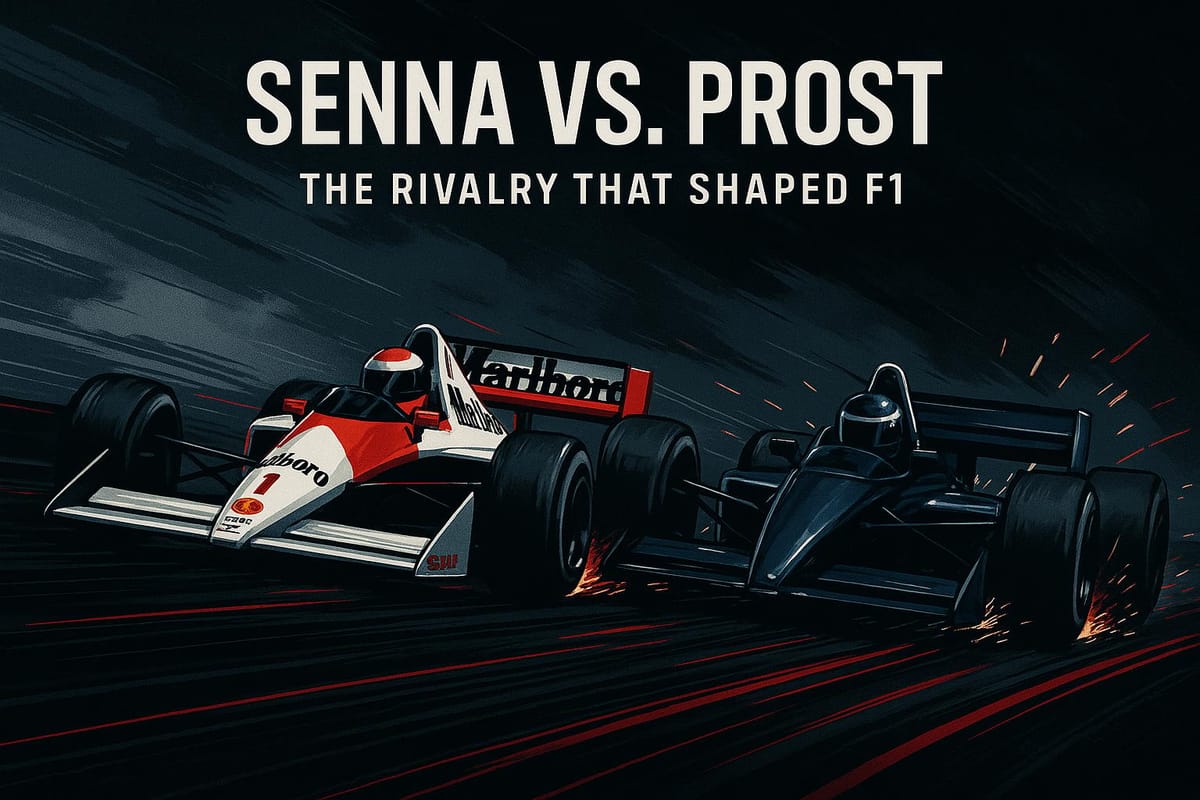
Ayrton Senna and Alain Prost changed Formula One forever. Their rivalry from the late 1980s to early 1990s wasn’t just about winning races - it was a battle of personalities, philosophies, and approaches to racing. Together, they won 7 championships and dominated the sport, but their clashes - on and off the track - redefined F1's competitive landscape.
Key Takeaways:
- Different Styles: Senna was aggressive and instinct-driven, while Prost was strategic and calculated.
- Historic Moments: Suzuka 1989 (collision, Prost wins title) and Suzuka 1990 (intentional crash by Senna) remain iconic.
- Impact on F1: Their rivalry led to stricter rules, reshaped team strategies, and attracted global audiences.
- Legacy: Future rivalries like Hamilton vs. Rosberg drew comparisons, and their influence is still felt in modern F1.
Their story is more than a rivalry - it’s a tale of conflict, transformation, and respect that continues to inspire fans and drivers alike.
Senna vs Prost – Talking F1 Rivalries with Alain Prost! | Nico Rosberg | Podcast #22
Different Driving Styles and Approaches
The rivalry between Ayrton Senna and Alain Prost wasn't just about two drivers competing for wins - it was a clash of philosophies that shaped the very essence of Formula One during their era. Their distinct approaches to racing not only defined their careers but also fueled one of the sport's most intense rivalries. Every on-track battle, every overtaking move, and every championship strategy reflected their contrasting mindsets.
Senna: The Aggressive Driver
Ayrton Senna's driving was all about instinct, raw speed, and an unrelenting desire to win - qualities that often left his competitors in awe or fear. Even Prost admitted:
"At times, I was frightened by him; he was prepared to do anything".
Senna's determination to succeed was laser-focused, with Prost observing:
"I came to realize that Ayrton's primary motivation, almost his sole motivation, was to focus on me and achieve victory".
His ability to make split-second decisions and find speed where others couldn't made him a force to be reckoned with. But this aggressive approach came with risks. Whether it was breathtaking overtakes or controversial incidents, Senna's style often sparked debate. A prime example is the infamous 1990 Japanese Grand Prix at Suzuka, where Senna intentionally collided with Prost on the first lap. He later admitted it was a deliberate move.
Prost: The Smart Racer
Alain Prost, nicknamed "The Professor", approached racing with precision and strategy. Every move was calculated, every decision carefully planned. His performance at the 1988 French Grand Prix at Paul Ricard showcased this methodical mindset. Prost led from the start, relying on superior preparation, only to lose the lead after Senna's quicker pit stop.
Prost prioritized consistency over risk-taking, which paid off in the long run. His steady approach helped him secure the 1989 championship with a 16-point lead over Senna. After the controversial collision at Suzuka in 1990, Prost expressed his disbelief:
"Whatever he thinks of me, I can't believe he would risk his own safety on the first lap of a Grand Prix, and with the whole field behind us".
How Their Differences Created Conflict
When Senna and Prost became teammates at McLaren in 1988, their clashing styles quickly led to tension. One of their first major confrontations occurred at Estoril, where Senna aggressively pushed Prost toward the pit wall. Prost was left questioning his teammate's judgment and ethics. This incident was just the beginning of a rivalry that would escalate over time.
Another flashpoint came during the 1989 San Marino Grand Prix at Imola. The two drivers had agreed not to battle until after Tosa corner, but Senna broke the agreement, dive-bombing Prost after a race restart. Prost was so furious he threatened to quit, forcing McLaren boss Ron Dennis to mediate between the two.
Their differing approaches also shaped their broader strategies. Senna's willingness to take extreme risks often created opportunities Prost might have missed, but it also led to dramatic failures. On the other hand, Prost's cautious, calculated style avoided unnecessary risks but sometimes cost him in moments requiring bold action.
These clashes not only redefined team dynamics but also sparked debates about sportsmanship, safety, and the evolving nature of competition in Formula One. Their rivalry even influenced future F1 regulations, as the psychological and tactical battles between them highlighted the fine line between competitive spirit and ethical racing.
| Aspect | Ayrton Senna | Alain Prost |
|---|---|---|
| Primary Approach | Instinct-driven, aggressive | Data-driven, strategic |
| Risk Management | Extreme risks accepted | Conservative, calculated |
| Race Philosophy | Victory at any cost | Consistency and points focus |
| Decision Making | Split-second, intuitive | Methodical, analytical |
| Psychological Tactics | Intimidation and aggression | Diplomatic, questioning ethics |
| Championship Strategy | Individual race heroics | Long-term planning |
Key Races and Controversial Moments
Three seasons stand out as the most intense in the legendary Senna-Prost rivalry, featuring dramatic clashes that left an indelible mark on Formula One.
1988: McLaren’s Reign and Rising Tensions
In 1988, Senna and Prost found themselves as teammates at McLaren, piloting the dominant MP4/4. McLaren swept the season, winning 15 out of 16 races. Senna claimed 8 victories, while Prost took 7. The Canadian and French Grands Prix saw both drivers pushing their cars - and each other - to the limit, each determined to establish dominance within the team.
With no real competition outside their garage, every race became a personal battle. This dynamic set the tone for the fierce rivalry that would escalate in the seasons to come.
1989: Suzuka Collision and a Controversial Title
The 1989 season escalated the tension to a breaking point. Earlier in the year at the San Marino Grand Prix, the two had agreed not to overtake before the Tosa corner after a race restart. Senna, however, broke the agreement, arguing his move was completed before the corner. Prost felt betrayed, and the fallout was so severe that McLaren boss Ron Dennis had to step in to mediate.
The drama reached its peak at the Japanese Grand Prix in Suzuka. A collision between the two drivers ended both their races, but the aftermath was even more dramatic. Prost was declared the champion by a 16-point margin over Senna. The incident polarized fans and media alike, highlighting the deeply personal nature of their rivalry and its impact on the championship.
1990: Suzuka and Senna’s Retaliation
If 1989 was heated, 1990 took the rivalry to an explosive level. At Suzuka, Senna - still driving for McLaren - collided with Prost, who was now racing for Ferrari. The crash, which Senna later admitted was intentional, guaranteed his championship victory by a slim 7-point margin. Senna justified his actions as retribution for what he saw as unfair treatment the previous season.
The incident raised serious concerns about sportsmanship and safety in Formula One. While Senna secured the title, the deliberate nature of the collision left a stain on the sport, showing how personal vendettas could overshadow the competition.
| Year | Location | Key Incident | Championship Outcome |
|---|---|---|---|
| 1988 | Canada/France | Intense teammate battles | Senna crowned champion |
| 1989 | Suzuka | Controversial collision | Prost wins title by 16 points |
| 1990 | Suzuka | Deliberate collision at first turn | Senna secures title by 7 points |
These seasons didn’t just decide titles - they redefined rivalries in Formula One. The mix of on-track aggression, broken promises, and deliberate actions created a dramatic template that still influences the sport today.
Impact on Formula One Teams, Rules, and Sport
The intense rivalry between Ayrton Senna and Alain Prost didn't just electrify the racetrack - it reshaped Formula One as a whole. Their battles forced teams to rethink strategies, led to changes in racing regulations, and captivated global audiences like never before.
McLaren: Internal Conflict and Technical Advancements
McLaren faced an unprecedented challenge managing two fiercely competitive drivers. Between 1988 and 1989, the team was embroiled in what Ron Dennis, McLaren's boss, described as a "full-on civil war". Tensions hit a boiling point after the controversial 1989 San Marino Grand Prix, prompting Dennis to call an emergency meeting at Pembrey Circuit to address the escalating discord.
Despite the internal strife, the rivalry drove McLaren to new heights in engineering. Senna and Prost's relentless pursuit of dominance pushed the team to continually enhance car performance, reliability, and strategy. Innovations in aerodynamics, engine management, and pit-stop efficiency became critical. For instance, at the 1988 French Grand Prix, Senna's faster pit-stop enabled him to snatch the lead from Prost, showcasing the importance of these advancements.
These turbulent years taught McLaren vital lessons in handling superstar drivers. The team developed protocols and communication strategies that not only helped them navigate the rivalry but also influenced their operations for years to come. Many of those approaches are still reflected in the way modern F1 teams manage their drivers and resources.
Rule Changes and Driver Conduct
The aggressive nature of Senna and Prost's clashes brought driver conduct into sharp focus. Key incidents, such as Senna's bold overtaking move at Estoril in 1988 and the infamous collisions at Suzuka in 1989 and 1990, forced Formula One to reexamine its rules on sportsmanship and intentional collisions.
These high-profile controversies led to stricter regulations aimed at curbing unsportsmanlike behavior. The sport began enforcing tighter controls on driver actions, setting a precedent that still shapes how Formula One governs on-track conduct. Beyond the rulebook, these changes also fueled debates about ethics in racing, with the Senna-Prost rivalry serving as a case study for balancing competitive spirit with fairness.
Media Frenzy and Global Attention
The rivalry's impact extended far beyond the track, as the media latched onto the drama. Coverage became increasingly focused on the personalities of Senna and Prost, highlighting their contrasting styles and frequent clashes. Public disputes, like Prost's criticism following the 1990 Japanese Grand Prix, only added fuel to the fire.
This media-driven narrative drew massive television audiences, pulling in casual fans who were captivated by the drama. Iconic moments, such as their final shared podium in Australia in 1993, became enduring symbols of their rivalry and eventual mutual respect.
The intense spotlight also changed how teams approached public relations. Managing driver personas and handling media scrutiny became as important as engineering a fast car. These lessons from the Senna-Prost era continue to influence how modern Formula One teams operate, both on and off the track.
Legacy of the Senna-Prost Rivalry
The rivalry between Ayrton Senna and Alain Prost may have ended on the track, but its impact on Formula One remains undeniable. Decades later, their intense battles still shape how drivers compete, how teams handle internal dynamics, and how fans engage with the sport's drama. The lessons from their rivalry continue to echo in today’s F1, influencing its competitive spirit and culture.
Influence on Modern F1 Rivalries
Since the 1990s, many Formula One rivalries have been compared to the iconic Senna-Prost showdown. Take the fierce competition between Lewis Hamilton and Nico Rosberg from 2013 to 2016. It wasn’t just about speed; it was a mix of teammate tension, psychological tactics, and championship-defining moments. Similarly, the strained relationship between Sebastian Vettel and Mark Webber at Red Bull Racing mirrored the internal conflicts that defined the Senna-Prost era at McLaren.
Modern drivers know that rivalries go beyond the track. Success often hinges on the ability to outthink and outmaneuver opponents, both mentally and strategically. The lessons from Senna and Prost’s clashes - on and off the track - have pushed drivers to see the psychological game as just as important as raw speed.
Their controversial on-track incidents also led to a reassessment of racecraft. Tighter regulations and harsher penalties for dangerous driving today are direct outcomes of the challenges raised during their time. Race officials now operate under guidelines shaped by those early lessons.
Mutual Respect and Reflection
What makes the Senna-Prost story even more powerful is how their relationship evolved over time. Despite their fiery rivalry, it eventually gave way to mutual respect. A defining moment came at the 1993 Australian Grand Prix, Prost’s final race. Senna, in a rare gesture, invited Prost to join him on the top step of the podium - a symbolic end to their intense competition.
After Senna’s tragic death in 1994, Prost often reflected on their rivalry, acknowledging how it pushed both of them to reach extraordinary heights. He once remarked:
"There isn't a day when someone I know doesn't talk about Ayrton and me: it means that we have done something, that something has endured."
Their story demonstrates that even the fiercest competition can evolve into genuine admiration, offering a model for how modern rivalries might mature over time.
Lasting Impact on Fans and Drivers
The Senna-Prost rivalry didn’t just change the sport; it redefined how fans and drivers perceive Formula One. Their battles showed that racing isn’t just about speed - it’s also about personality, drama, and the human element. This shift laid the groundwork for the narrative-driven coverage that dominates modern F1 media.
For drivers, Senna and Prost remain icons. Their skill, determination under pressure, and ability to thrive in the most intense situations inspire both veterans and newcomers. Many young drivers study their strategies - and even their mistakes - as part of their own development.
For fans, the Senna-Prost era encapsulates everything Formula One stands for: technical brilliance, psychological battles, and unforgettable human drama. Their influence isn’t just historical - it’s woven into the very fabric of the sport, shaping team strategies, regulations, and the way F1 is experienced today. Their legacy remains a benchmark, ensuring that their story continues to inspire every new generation of drivers and fans alike.
FAQs
How did the Senna-Prost rivalry shape Formula One's rules and regulations?
The fierce competition between Ayrton Senna and Alain Prost left an enduring mark on Formula One, especially when it came to shaping the sport's rules and regulations. Their heated on-track duels, including the infamous collisions at Suzuka in 1989 and 1990, underscored the need for clearer guidelines on driver behavior and overtaking.
As a result, Formula One began implementing stricter penalties for reckless driving and introduced more comprehensive rules to promote fair play. This rivalry also pushed officials to fine-tune how race incidents were handled, setting the stage for the way driver disputes are managed today. The Senna-Prost saga not only defined a golden era of racing but also played a key role in evolving the governance of the sport.
How did the rivalry between Senna and Prost influence McLaren's strategies and team dynamics in Formula One?
The fierce competition between Ayrton Senna and Alain Prost left an indelible mark on McLaren, influencing how the team approached both management and race strategies. Their vastly different driving styles and relentless rivalry pushed McLaren to fine-tune car performance to meet the unique needs of each driver. This often led to breakthroughs in engineering as the team worked to give both competitors the best possible tools on the track.
At the same time, the rivalry created significant internal challenges. McLaren had to carefully navigate team dynamics, ensuring that personal tensions didn’t overshadow the ultimate goal: winning championships.
This iconic rivalry didn’t just raise McLaren’s game - it redefined how Formula One teams manage multiple elite drivers, finding the delicate balance between internal competition and teamwork to achieve success.
How does the Senna-Prost rivalry continue to shape modern Formula One rivalries and driver behavior?
The intense rivalry between Ayrton Senna and Alain Prost has become one of Formula One's most iconic narratives, showcasing the perfect mix of raw determination and strategic precision. Their battles on and off the track redefined what it meant to compete in the sport, leaving a lasting blueprint for how rivalries are navigated in F1 even today.
In modern Formula One, echoes of the Senna-Prost rivalry can still be felt. Drivers continue to test the boundaries of sportsmanship, all while juggling the complexities of team politics and the relentless gaze of the media. This historic competition also reshaped the way teams handle internal dynamics, emphasizing the need to strike a delicate balance between fostering teamwork and encouraging healthy competition to achieve success.