Why F1 fuel switch costs more than planned
Why 2026 F1 fuel costs far more: strict non-fossil rules, extensive testing, limited suppliers and season-long supply needs.
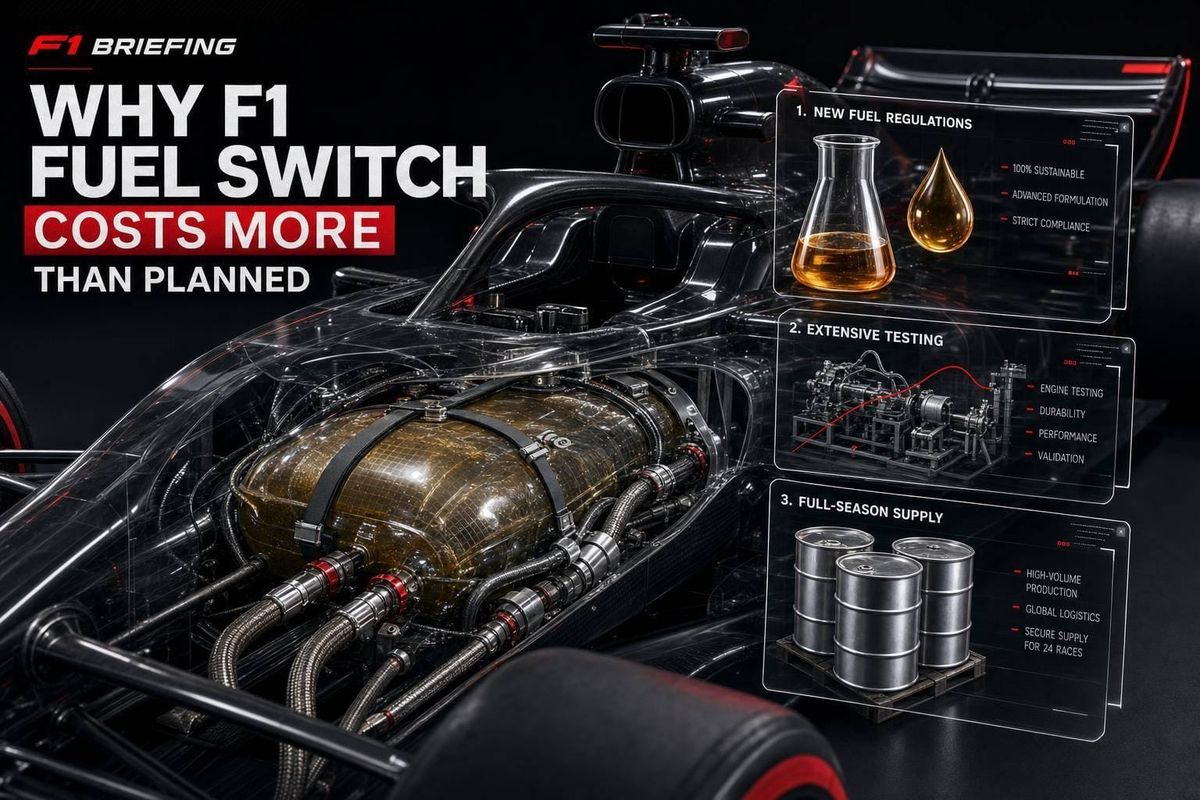
The short answer: 2026 F1 fuel costs more because teams need fuel that is both race-fast and 100% non-fossil, in full-season volume, with strict proof, testing, and delivery rules.
I’d sum it up like this: current E10 race fuel sits around $22 to $33 per liter, while 2026 race-ready fuel is now expected at about $170 to $225 per liter. That gap comes from more than raw materials. It also comes from verification, dyno work, engine tuning, small production runs, and limited supplier capacity.
Here’s the core point in plain English:
- Performance targets are strict
- Carbon-source rules are strict
- Supply is still tight
- Full-season delivery is much harder than a one-off batch
- Teams end up paying for testing, storage, transport, and paperwork too
A useful contrast: demo fuel has been cited at roughly $4 to $5 per liter, but race-ready fuel can cost about 5x more because it must meet much tougher standards, at scale, every time.
| Fuel type | Estimated cost per liter | Main reason for cost |
|---|---|---|
| Current E10 F1 fuel | $22–$33 | Known process, mature supply |
| Demo low-carbon fuel | $4–$5 | Small-use case, less race-grade burden |
| 2026 race-ready fuel | $170–$225 | Rule compliance, testing, proof, and limited volume |
My takeaway: the issue is not whether this fuel can be made. It can. The issue is that making enough of it, to race standard, across a full calendar, still costs a lot.
That’s the big picture behind the higher 2026 fuel bill.
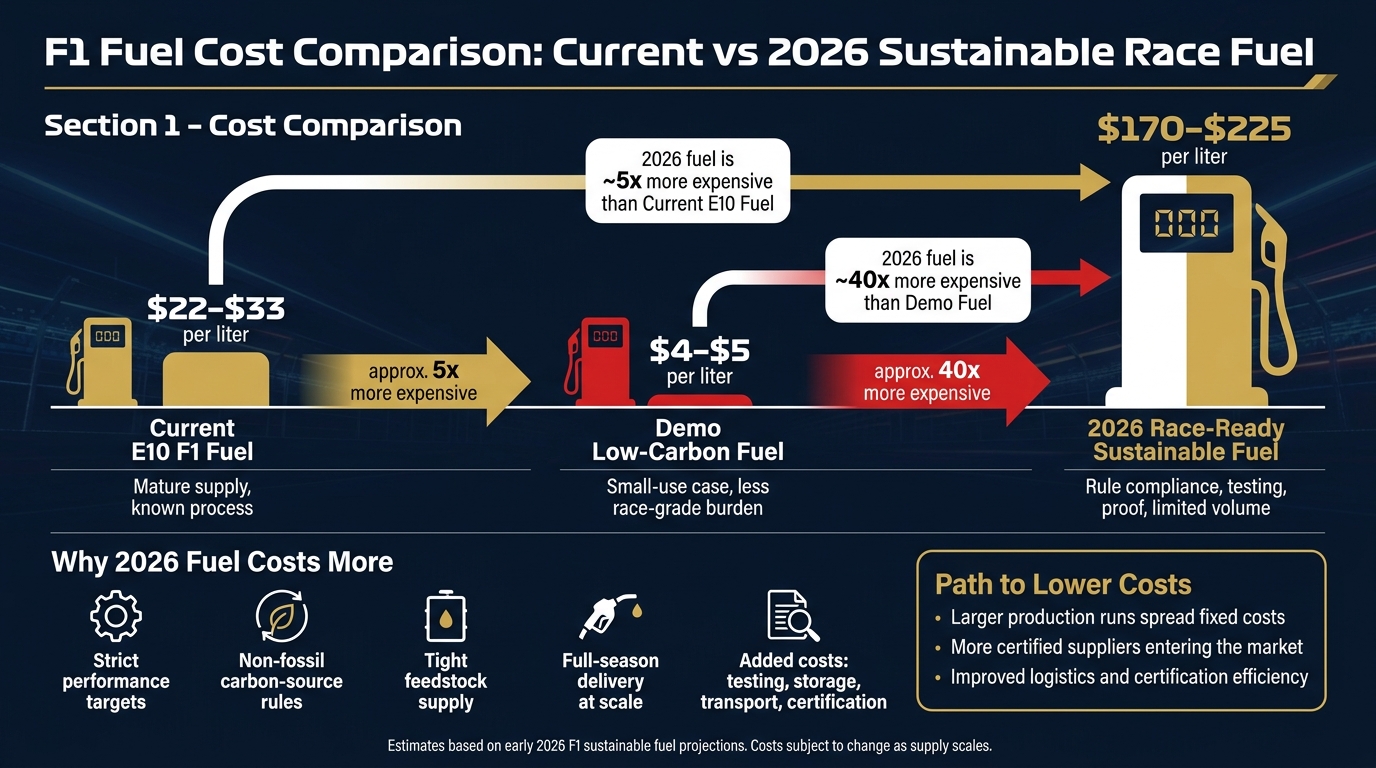
F1 Fuel Costs 2026: E10 vs Sustainable Race Fuel Price Breakdown
F1's Messy 'Sustainable Fuel' Situation Explained
sbb-itb-7c68254
Why 2026 F1 fuel costs more than expected
2026 sustainable fuel costs more because it has to do two jobs at the same time: be fully sustainable and be ready for racing. That leaves almost no space for low-cost conventional inputs. Every ingredient needs to meet the rules and still perform under the demands of Formula 1, which cuts down the list of usable options and pushes the price up. The fuel can be made, yes, but it isn't cheap.
The fuel must meet both performance and carbon targets at once
This fuel has to deliver the performance modern hybrid power units expect while also coming from sustainable, non-fossil feedstocks. That's the hard part. Low-carbon feedstocks rely on limited renewable inputs, and when those inputs are in short supply, the final fuel gets more expensive.
Early paddock estimates missed the full cost stack
At first, some budget planning focused on the big idea of sustainable fuel and not the full production chain behind it. That sounds fine on paper, but the bill gets longer fast.
Early budgets missed costs tied to:
- losses from high-purity blending
- certification
- transport
- contamination-proof storage
- repeated quality control and laboratory testing
Those costs stay high until production reaches more scale. And there's another bottleneck: volume. Even when the chemistry is working, supply is still too limited to push prices down fast.
What makes sustainable fuel harder to produce at scale
The biggest hurdle isn’t inventing the fuel. It’s getting enough verified low-carbon feedstock and enough production capacity to make it in volume.
And that’s where things get tight. The same low-carbon inputs used for fuel are also in demand for electricity and heating. So fuel makers aren’t working in a vacuum. They’re competing for a limited pool of supply. The chemistry may be ready, but the supply chain can still lag behind. That’s why scale is the part that keeps costs up.
Low-carbon feedstocks are costly to source and verify
Before a single drop of sustainable fuel reaches an F1 engine, the feedstock has to be traced, verified, and certified. That extra verification work adds cost at every step, and it cannot be skipped - race-legal fuel requires a documented chain of custody from source to tank.
In plain terms, it’s not enough for a supplier to say the feedstock is low-carbon. They have to prove it, document it, and keep that paper trail intact all the way through delivery. That adds time, admin work, and more checks across the process.
Dyno testing and engine calibration add another layer of cost
The 2026 power-unit package adds more dyno time and calibration, because the fuel must work in the new hybrid split. Even when the fuel passes testing, small production runs keep unit costs high.
That matters because fuel doesn’t just need to burn cleanly. It has to perform the same way, lap after lap, inside a new engine setup. More dyno hours mean more lab time, more tuning, and more money spent before the fuel is ready for race use.
Current E10 fuel vs. 2026 sustainable fuel: a side-by-side comparison
Once the formula is proven, the next bottleneck is having enough supply to cover a full season.
That’s why volume, not chemistry, is still what keeps prices high.
Why limited supply is keeping prices high across the grid
Season-long supply is harder than producing a one-off batch
Once the lab tests and dyno sessions are done, the next choke point is supply. Making enough fuel for a full F1 season is a very different job from putting together a one-off demo batch. Race-legal fuel has to meet tighter technical standards and it has to be made at much higher volume.
That gap shows up in the price. Sustainable fuel used for demonstration runs has been priced at around $4 to $5 per liter, while the race-ready fuel is still about five times more expensive.
Few suppliers are ready to meet race-level demands
Right now, only a small group of suppliers can make, certify, and deliver fuel at race volume. So even if demand is there, the market still doesn't have the scale to push prices down.
On top of that, production slots are limited and certification rules are tight. For teams trying to lock in enough fuel for a full season, there just aren't many places to turn. That means fuel costs stay high before a car even rolls out for a race, and that pressure lands straight on team budgets.
How teams are absorbing the cost and what could bring prices down
Higher fuel bills create real budget trade-offs
With supply still tight, higher per-liter prices hit team budgets directly. Teams can absorb those fuel bills, but it still hurts. And that matters, because every extra dollar spent on fuel puts more pressure on the rest of the operating budget.
This is the kind of trade-off every team feels. If fuel costs more, that money has to come from somewhere else. So even if teams can carry the added expense, the budget squeeze is still there.
Scale is the main path to lower costs
The clearest path to lower prices is scale. Put simply: making more fuel on a steady basis brings the cost per liter down.
Why? Because larger production runs spread fixed costs across more liters, including:
- Certification
- Testing
- Logistics
That doesn't make fuel cheap overnight. But it does make the math work better over time.
Conclusion: the fuel is worth having, but the near-term cost is real
The 2026 fuel shift helps support F1's carbon goal. At the same time, teams are set to carry higher costs in the near term, at least until production ramps up and prices settle.
FAQs
Why were early 2026 fuel cost estimates so low?
Early 2026 fuel cost estimates came in low because they didn't fully account for how hard synthetic fuel sourcing and manufacturing would be.
The 2026 rules require fuels made from specific Advanced Sustainable Components, including non-food biomass and municipal waste. Hitting those standards took a lot of lab work. Teams had to test 100-plus formulations and lean on highly specialized molecular engineering expertise.
What makes race-ready fuel more expensive than demo fuel?
Race-ready fuel costs more because the 2026 FIA rules require components made entirely from complex feedstocks such as municipal waste and second-generation non-food biomass.
That alone makes the process harder than making demo fuel. You're not just mixing something that runs in a test setting. You need a fuel that can meet tight performance, thermal, and rule-based targets for the 2026 power units.
And that's where the price climbs.
Teams and suppliers have to spend more on research, lab testing, and scaling production. In plain English: the fuel has to work under race conditions, fit the rules, and be made from tougher source materials. That combination pushes costs up fast.
When could 2026 F1 fuel prices begin to fall?
Prices should come down over time as 100% sustainable fuels move from early rollout to broader production and use.
As use spreads beyond Formula 1 into sectors like aviation and shipping, larger-scale output should help bring costs down. Right now, though, R&D work and specialized molecular engineering are still keeping prices high.