Sustainable Fuel in F1: Role of Supplier Commitments
How long-term supplier partnerships, strict certification and testing make F1's 2026 100% sustainable fuel race-ready.
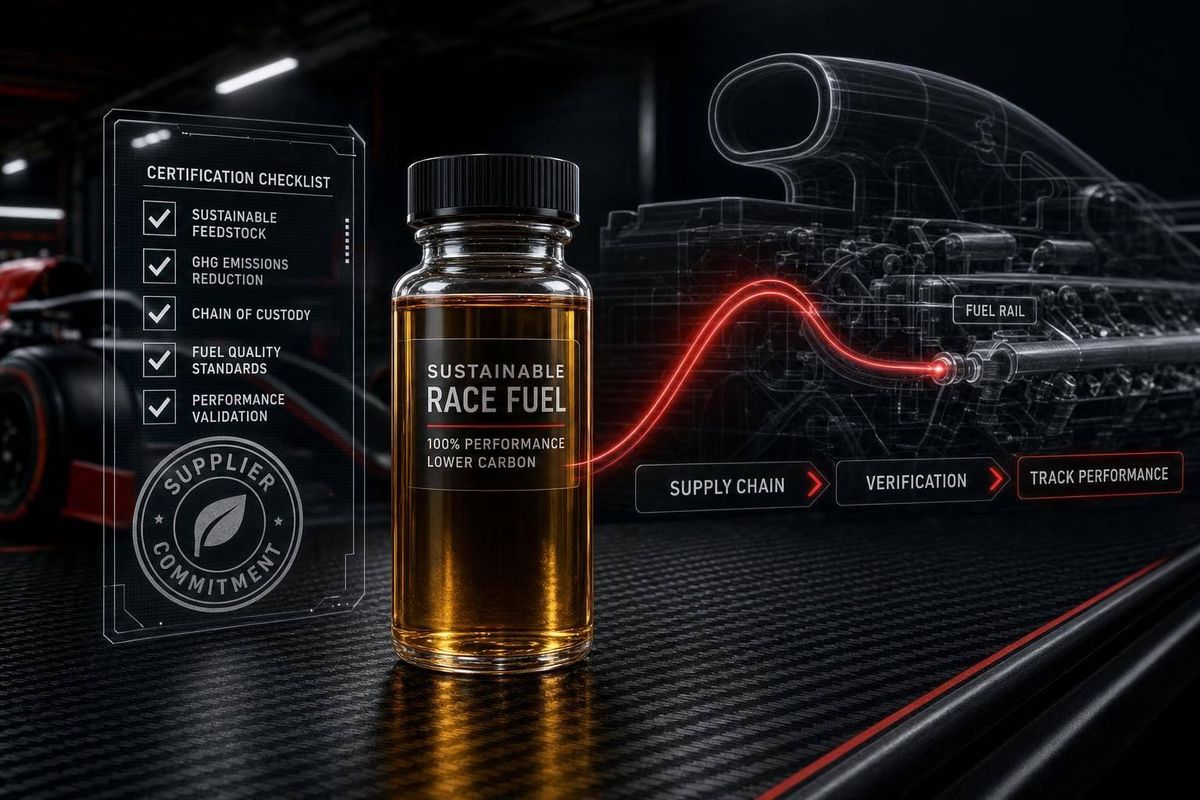
F1’s 2026 fuel rule is simple on paper: every car must run on 100% non-fossil fuel. The hard part is getting fuel suppliers locked in early enough to make that happen.
Here’s the short version: I see supplier commitments as the part that turns the FIA rule into something teams can actually use. The fuel has to match race-engine demands, pass supply-chain checks, fit the 3,000 MJ/h energy cap, and clear third-party approval. That takes years of lab work, dyno time, and audits.
If you want the core points fast, they’re these:
- The FIA rule alone isn’t enough. Teams need long-term fuel partners to build and test legal 2026 blends.
- Fuel approval is strict. The SRFAS process checks feedstock origin, blend makeup, and lifecycle GHG data.
- Timing matters. ExxonMobil, bp/Castrol, Petronas, and Aramco all show that multi-year work is the norm.
- Scale matters too. Publicly shared programs include nearly 100 formulations at Red Bull Powertrains and 400+ pilot fuels plus 200+ engine tests at Audi/bp.
- Cost stays high. Low-carbon production, renewable power use, and full chain tracking add time and expense.
- The upside for motorsport is clear. F1 gives suppliers a high-stress test bed for fuels that may later help road transport, freight, and aviation.
Why F1’s 2026 Sustainable Fuels Matter More Than You Think
sbb-itb-7c68254
Quick comparison
| Supplier / Program | Time Frame | Publicly Shared Work | Main Role |
|---|---|---|---|
| ExxonMobil / Red Bull Powertrains | 2023–2026 | Nearly 100 formulations | Fuel built with engine work from the start |
| bp (Castrol) / Audi | 2023–2026 | 400+ pilot fuels, 200+ blend tests, 240,000+ liters delivered | Joint fuel and power-unit work |
| Petronas / Mercedes | Multi-year | Homologated 2026 fuel and supply-chain approval | Supports Mercedes plus customer teams |
| Aramco / F2 & F3 | 2023–2025 | 100% non-fossil fuel in feeder series | Data and race use before F1’s 2026 change |
My takeaway is straightforward: the teams with early supplier buy-in are in a far better spot than teams trying to do this late. In F1, fuel is no longer just a fluid in the tank. It’s part chemistry program, part audit trail, and part engine-development tool.
The regulatory framework behind F1's sustainable fuel rules
The rulebook sets the target. The next step is defining what fuel counts and how the FIA checks it.
What the 2026 fuel rules require
The 2026 regulations require every power unit to run on 100% sustainable fuel, with no crude-oil-derived components. In plain English, that means the fuel itself becomes a main compliance item, not just the engine. This replaces the E10 blend used through 2025.
Advanced Sustainable Components (ASCs) must come from non-food biomass, municipal waste, or renewable non-biological feedstocks like captured CO2. Food-based crops are clearly ruled out.
Two limits make this a tough job for fuel suppliers.
- The fuel must stay chemically close enough to gasoline to work in existing engines without modifications.
- The FIA now uses a 3,000 MJ/h energy cap instead of a mass-based fuel-flow limit.
That second change matters a lot. Sustainable fuels can have different caloric values than fossil fuels, so the FIA looks at each fuel's reference profile and uses the car's electronic control unit to calculate energy density in real time. On top of that, production must use renewable energy. If the manufacturing process runs on fossil power, the fuel does not qualify.
Those limits sound strict on paper. They only work, though, if the FIA can check them the same way for every supplier.
How FIA fuel assurance and certification works
The FIA's Sustainable Racing Fuel Assurance Scheme (SRFAS), developed with Zemo Partnership, turns those rules into a system the sport can verify. It checks the full supply chain through three pillars: chain of custody, fuel composition, and GHG performance.
| Verification Pillar | Focus Area |
|---|---|
| Chain of Custody | Tracing the origin and movement of feedstocks to ensure sustainability and GHG disclosure |
| Fuel Composition | Analyzing the final blend to verify the traceability and accuracy of ASCs |
| GHG Performance | Measuring and verifying actual GHG performance against FIA sustainability targets |
Certification now includes physical inspections of production facilities by an external body, and one missing certification for any sub-component can stop the fuel blend from being homologated.
"The FIA has delegated certification to an external body tasked not only with analysing the final product, but also with verifying the entire production process." - Roberto Chinchero, Journalist
Because the check covers the full chain, suppliers have to commit early. That means feedstock tracing, production changes, and repeated testing. At race weekends, scrutineers take random fuel samples and compare them with the certified reference profile. The car's electronic control unit then uses that same profile to calculate energy density in real time, which helps enforce the 3,000 MJ/h cap across fuels with different chemical compositions.
How supplier partnerships shape F1 fuel development
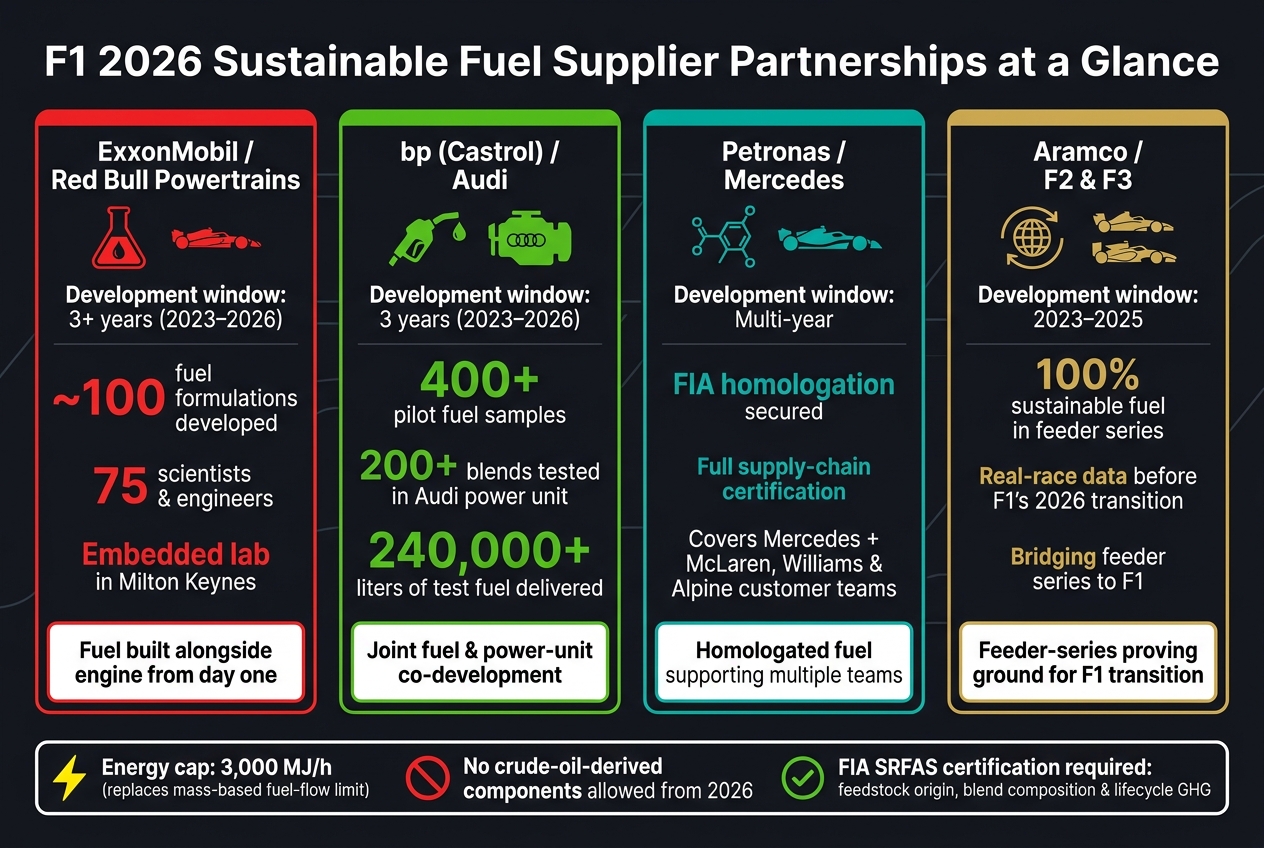
F1 2026 Sustainable Fuel Supplier Partnerships: Scale & Commitment
Major supplier commitments across the grid
Once the rules are in place, the edge shifts to suppliers that have deep lab access, plenty of test time, and close ties to engine teams. The certification load is heavy, so teams can't just buy fuel late in the process and hope it fits. In F1, that approach doesn't fly. For 2026, fuel partnerships across the grid look more like long-term engineering programs than sponsor deals, with embedded labs, dedicated staff, and years of trial and rework behind them.
You can see that in the biggest fuel programs already tied into 2026 engine work.
The ExxonMobil and Red Bull Powertrains deal is one of the clearest cases. Red Bull and ExxonMobil work side by side in a dedicated Milton Keynes lab, where a team of 75 scientists and engineers developed nearly 100 fuel formulations before settling on the 2026 race blend.
bp's partnership with Audi's 2026 program follows the same path, but with even closer joint work. bp and Audi engineers in Neuburg worked side by side instead of trying to fit a fuel around an engine that already existed. Over three years, bp developed more than 400 pilot fuel samples, tested over 200 blends in the Audi power unit, and delivered more than 240,000 liters of test fuel to the facility.
"What we're doing here is developing a brand-new fuel together with the hybrid power unit from scratch. That's very different to developing a fuel for an existing engine." - Luc Jolly, bp Motorsport Fluids Technology Lead
Petronas secured homologation for its 2026 sustainable fuel, including production and supply-chain certification. That's a big deal because the same fuel supports Mercedes and customer programs such as McLaren, Williams, and Alpine. Aramco supplied 100% sustainable fuel in F2 and F3 in 2025, which gives teams feeder-series data as F1 moves into the new fuel era.
Why multi-year contracts change the pace of fuel development
Sustainable fuel work in F1 takes time. The chemistry has to work, the certification has to pass, and the fuel has to match the engine.
ExxonMobil spent three years developing nearly 100 formulations. bp's Audi program went even further, with more than 400 pilot fuels and over 200 blend tests. That kind of progress only happens through constant iteration: dyno testing, re-testing, and then locking in a certified fuel "fingerprint" that engine mapping can rely on.
The 2026 rules make that job even tougher. Fuel flow is now capped by energy instead of mass, with a hard limit of 3,000 MJ/h. Since sustainable feedstocks often start with lower energy density than fossil fuels, suppliers have to tune each blend through heavy testing.
Different teams are working at different scales, but the pattern is the same: early access, repeat testing, and locked supply. Here's the documented scale of the main partnerships heading into 2026.
| Partnership | Development Window | Scale of Work |
|---|---|---|
| ExxonMobil / Red Bull Powertrains | 3+ years (2023–2026) | Nearly 100 formulations; embedded lab at Milton Keynes |
| bp (Castrol) / Audi | 3 years (2023–2026) | 400+ pilot fuels; 200+ blends tested; 240,000+ liters delivered |
| Petronas / Mercedes | Multi-year | FIA homologation; supply chain certification for Mercedes and customer programs |
| Aramco / F2 & F3 | 2023–2025 | 100% sustainable fuel supply; feeder-series data for F1 transition |
These are engineering partnerships, not branding deals. Suppliers sit inside the development process, respond to engine changes fast, and use frequent samples to keep the fuel compliant while engine mapping stays stable. That's how supplier commitment turns into measurable fuel progress.
R&D pathways, performance targets, and measured outcomes
The main fuel development routes under study
With partnerships set, the next issue is simple: which fuel chemistry can hit the 2026 target?
Suppliers are working on two main routes for the 2026 rules: synthetic e-fuels and second-generation, waste-based biofuels.
E-fuels combine captured CO₂ with green hydrogen made using renewable electricity. The result is a high-purity fuel, but it takes a lot of energy to make and costs a lot to produce. Second-generation biofuels come from feedstocks such as municipal waste, agricultural residue, manure, and non-food crops like switchgrass. Their appeal is clear: they use waste streams that already exist. The catch is approval. Suppliers have to prove the feedstock is non-food and sourced in a way that meets FIA rules. And both routes are expensive to scale, especially with F1's 2026 performance and certification limits.
| Pathway | Feedstock | Key Advantage | Main Challenge | Road Relevance |
|---|---|---|---|---|
| Synthetic E-Fuels | Captured CO₂, renewable hydrogen | High purity; carbon-neutral potential | High energy input; expensive production | High for aviation and high-performance ICE |
| Advanced Biofuels | Non-food biomass, agricultural waste, manure | Uses existing waste streams | Complex chain-of-custody verification | High for heavy freight and passenger fleets |
The FIA's food-supply rules shrink the list of usable feedstocks. That forces suppliers into repeated formulation testing. And that kind of trial-and-error only happens when supplier backing gives teams enough time and budget to keep testing until a blend clears certification.
What suppliers are optimizing in the lab and on track
Once a fuel route is picked, the work shifts from feedstock choice to dyno and track validation.
Sustainable fuels can hold less energy per liter than fossil blends, so suppliers are trying to keep combustion stable and thermal efficiency high while still getting as much performance as they can. At the same time, the fuel-flow rule moves from a mass-based limit to an energy-based cap of 3,000 MJ/h, which makes the target even tighter.
In the lab, suppliers screen individual molecules, study distillation profiles, and measure octane numbers and knock resistance. On the dyno, they run those blends with the actual power unit, often chasing gains of only 0.5 to 1 kilowatt. That's a tiny margin, but in F1, tiny margins are the whole game. ExxonMobil's Matti Alemayehu described the pace of that work this way:
"This season demands that we achieve more with fewer available molecular options, and that challenge has driven significant innovation in our approach."
Trackside testing finishes the loop. Technicians may pull up to 90 fuel and lubricant samples per race weekend to meet FIA rules and see how the fuel behaves under race conditions. Lubricant compatibility matters too. Motor oils have to be bespoke-formulated for each specific sustainable fuel chemistry. Each step ties back to the same point: supplier commitment makes the repeated testing cycles possible, and those cycles are what get a fuel certified.
| Testing Phase | Primary Location | Key Metrics & Activities |
|---|---|---|
| Lab Research | Supplier HQ / power-unit facility | Molecular blending, distillation profiles, octane rating, and detergent testing |
| Dyno Validation | Power unit factory | Power output, thermal efficiency, knock resistance, and fuel-lubricant compatibility |
| Trackside Testing | Race circuit | Up to 90 fuel and lubricant samples per weekend, plus real-world validation |
| Certification | Supply chain and production sites | Third-party audits of feedstock origin, chain of custody, and lifecycle GHG emissions |
Measured outcomes and certification
Performance means little until independent certification confirms the fuel's supply chain and emissions profile.
Zemo audits turn supplier claims into homologation by tracing feedstocks, processing, and lifecycle emissions from source to finished fuel. That process has already shown how tough the new standard is. F1's total carbon emissions were down 26% by the end of 2024 versus a 2018 baseline, before the 2026 fuel rules took effect. The sustainable-fuel mandate is meant to push that number lower, and independent verification is what turns years of development spending into fuel that can actually be used on race weekend.
Conclusion: What supplier commitments mean for F1's net-zero roadmap
Across the grid, one thing stands out: early, long-term supplier commitment is what makes sustainable fuel work in F1. Rules set the target. Supplier commitment turns that target into fuel a car can actually race on. The FIA defines the standard, but suppliers do the hard work of building the fuel through years of formulation testing, supply-chain certification, and iterative dyno work that a short deal simply can't support.
That matters beyond a single season. It shapes how advanced drop-in fuels develop under real pressure, not just in a lab. F1 gives suppliers a proving ground where they have to deal with combustion limits, efficiency tradeoffs, and extreme performance demands all at once. In plain English, it pushes fuel development at full throttle and shortens the path from concept to use in other high-demand sectors.
Put it all together, and the picture is pretty direct. Sustainable fuel stays expensive because the feedstock, energy input, and certification chain all need to be low-carbon. That cost barrier isn't some separate side issue. It's built into how this fuel gets made and tested. The rules define the destination; long-term supplier backing is what makes the fuel usable, certifiable, and able to scale.
FAQs
Why do F1 teams need fuel suppliers locked in so early?
F1 teams and fuel suppliers need to move early for 2026. The new fuel rules are complex, and FIA certification can take years. On top of that, suppliers must go through independent audits across the entire supply chain, from raw feedstocks all the way to the final blend.
There’s also a hard technical reason for the early push. Once a fuel is homologated, its characteristics are locked in. That means suppliers need enough time to develop and test blends that match a team’s power unit needs while also meeting strict sustainability rules.
How does the FIA verify that 2026 fuel is truly sustainable?
The FIA checks 2026 fuels under the Sustainable Racing Fuel Assurance Scheme (SRFAS). It built this system with the Zemo Partnership.
The scheme relies on independent third-party audits that follow the fuel’s chain of custody from feedstock extraction all the way to final delivery. In plain terms, that means the FIA doesn’t just look at the finished fuel. It tracks where it came from, how it moved, and whether each step matches the rules.
Accredited auditors inspect facilities and verify supplier certifications. At the same time, FIA-approved labs confirm that the fuel contains at least 99% Advanced Sustainable Components and matches the certified reference “fingerprint.”
Will sustainable fuel change F1 engine performance in 2026?
Yes. In 2026, fuel choice will have a major effect on F1 engine performance because teams will need to build their power units around custom fuel and lubricant packages to keep power where it needs to be.
The reason is pretty simple: these fuels can vary in energy density. So instead of sticking with mass-based fuel flow limits, the FIA is moving to a 3,000 MJ/h energy limit.
Fuel chemistry also shapes how the engine behaves in practice. It can change combustion, ignition timing, and durability.