Latin America Drives F1 Rights Growth: 6 Reasons
Latin America's audience scale, live-TV habits, streaming reach, sponsors and local drivers are driving higher F1 media-rights value.
Latin America is becoming a bigger F1 media-rights market because it combines scale, live TV demand, streaming reach, sponsor money, local driver interest, and multi-country deals. I’d sum it up like this: F1 can reach 150+ million fans, ESPN’s deal runs through 2028 across 18 markets, and even one Brazilian rating point in Greater São Paulo equals 205,377 viewers and 76,557 households.
If you want the short answer, here it is:
- Big audience: the region gives broadcasters a large fan base in one part of the world
- Live sports habit: fans still show up for Sunday races on TV
- Streaming adds more reach: TV is only part of the picture now
- Sponsors follow attention: live races give brands strong ad windows
- Local drivers move numbers: a name like Gabriel Bortoleto can pull more viewers across the full weekend
- Regional deals are simpler: one package can cover many markets at once
I see the main point as simple: this is not just about one race or one country. It’s about how audience size, viewing habits, and deal structure work together to push rights fees higher over time.
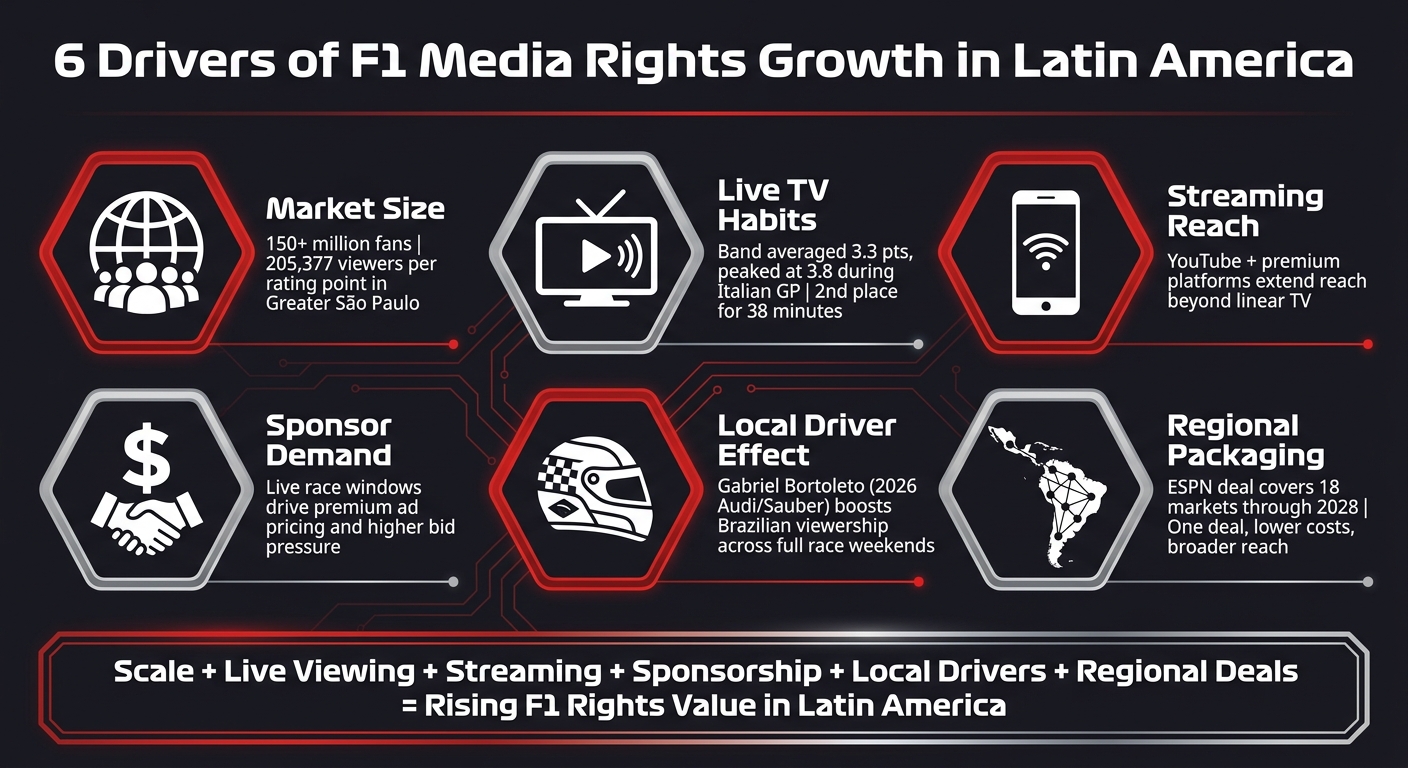
6 Drivers of F1 Media Rights Growth in Latin America
Quick Comparison
| Driver of growth | What it does |
|---|---|
| Market size | Gives broadcasters large reach across major cities and countries |
| TV sports habits | Keeps race-day viewing steady on live TV |
| Streaming growth | Adds digital viewers and more ad space |
| Sponsor demand | Helps broadcasters sell race coverage at higher rates |
| Local driver interest | Pulls extra attention during practice, qualifying, and races |
| Cross-border rights | Lets sellers and buyers cover many markets in one deal |
So when I look at the region, the case is clear: Latin America gives F1 scale, attention, and simpler rights packaging in one market group.
sbb-itb-7c68254
1. Market Size Makes the Region Commercially Relevant
Audience Scale
The region’s size shows up in hard audience numbers that matter to broadcasters and advertisers. In Brazil, Greater São Paulo is the national TV benchmark: one rating point equals 205,377 viewers and 76,557 households.
That kind of reach matters even more when it turns into live viewing and stronger ad pricing.
Distribution Value
During the Italian Grand Prix, Band averaged 3.3 points and peaked at 3.8, briefly reaching second place in the national ratings. When a broadcaster can use F1 rights to push against established market leaders, that says a lot about the business value of the sport.
Those spikes are the moments advertisers want most.
Advertiser Appeal
For advertisers, F1 offers a mix that’s hard to ignore: steady reach and sharp live attention during crashes, restarts, and podium scenes. The sport brings in millions of focused viewers across large urban markets, which gives brands a stable platform during live broadcasts.
Rights Efficiency
Audience concentration in major hubs lets broadcasters buy targeted rights and still hit viewers at national scale, which can improve ROI. Latin America’s geography and audience concentration also make cross-market rights packages easier to monetize. That helps explain why the region keeps drawing multi-country deals.
Scale is only the starting point; live sports habits decide how much that scale is worth.
2. Strong TV Sports Habits Support Live Race Viewing
Audience Scale
In Latin America, live sports still feel like appointment TV. People plan around them, especially on weekends. That matters for Formula 1, because Sunday morning races can still pull strong attention even when they're up against well-known TV programming.
A good example came in September 2021. Band's broadcast of the Italian Grand Prix began at 9:30 AM local time on a Sunday and averaged 3.3 audience points in Greater São Paulo.
Distribution Value
That audience didn’t just show up. It changed the rankings in the middle of the broadcast. During the race window, Band moved into second place for 38 minutes, passing SBT.
The biggest spike came during the Lewis Hamilton-Max Verstappen collision, when the broadcast hit 3.8 points. That says a lot about live F1: when the drama hits, people stay glued to the screen.
Advertiser Appeal
That’s part of what makes live F1 so attractive to advertisers. Crashes, title battles, and turning-point moments keep attention tight, which can make ad spots during those windows worth more.
For broadcasters, it creates a short, high-attention stretch that’s hard to fake with taped programming.
That same live-viewing habit also helps explain why streaming rights are going up next.
3. Streaming Growth Adds to Rights Value
Audience Scale
TV ratings show only part of the picture. In Brazil, broadcasters don't stop at linear coverage. They also use YouTube and premium streaming services, which expands reach before and after the race. That added reach creates more ad inventory too, and that makes the business case stronger.
Advertiser Appeal
For advertisers, the mix of linear and digital reach is a clear step up. Sponsors get more touchpoints across the same race weekend, which turns one rights deal into a multi-platform presence with more inventory to sell.
Rights Efficiency
Digital platforms keep fans tuned in before and after the race with live speed data and standings updates. That pushes up the value of the rights package because it reaches fans across linear TV, YouTube, and premium digital access. More screens mean more inventory, and more inventory pushes rights value higher.
4. Sponsor Demand Strengthens the Commercial Case
Audience Scale
As TV and digital reach grows, sponsor interest tends to grow right alongside it. In Latin America, that audience concentration gives brands efficient reach, even when ratings shift only a little.
Distribution Value
That scale gives sponsors premium visibility during live race windows. And that visibility is what turns audience numbers into sponsor value.
Advertiser Appeal
Live race battles and local-driver storylines help hold attention across the full race window. For advertisers, that creates a steady platform built on full-race viewing, not just a few peak moments. The payoff is stronger pricing power for rights holders.
Rights Efficiency
A single rights deal can create several high-value ad windows across one race weekend. When you add measurable ratings data from Kantar Ibope Media, sponsor demand puts more pressure on rights prices across the region.
5. Local Driver Interest Drives Audience Spikes
Broad market demand matters. But local drivers are what create the biggest jumps in attention.
When a Brazilian driver is on the grid, F1 gets a local angle that can lift interest across the full season, not just on Sunday. Gabriel Bortoleto's 2026 season with the Audi/Sauber team has boosted Brazilian interest in F1 coverage in a way that general market growth alone can't match. His presence gives broadcasters a running storyline through practice, qualifying, and the race, which opens up more high-value moments across every race weekend.
That lift can give smaller broadcasters unusual leverage. During the Italian GP broadcast, Band reached second place for 38 minutes in Greater São Paulo. For a smaller network, that's a strong commercial result, and it's the kind of outcome that can make rights talks more competitive. Ratings are part of it. But just as important, broadcasters get a story that sponsors can track from the first session to the final lap.
Bortoleto's top speed in Spanish Grand Prix qualifying gave Brazilian coverage a clear performance angle. The teammate battle added another steady thread, which helped keep viewers tuned in across sessions instead of showing up only for the race. For sponsors, that kind of continuity means more touchpoints and a stronger case for premium ad spend.
Local-driver interest also lifts the value of practice, qualifying, and race coverage by increasing the number of sellable windows. And when steady ratings data from sources like Kantar Ibope Media backs up that engagement, broadcasters have the proof they need to argue for higher rights fees. More reach, more engagement, and a stronger local story can push rights value up across the whole weekend. That effect gets even bigger when rights are sold in multiple markets.
6. Cross-Border Rights Packages Cover More Ground at Lower Cost
The last commercial edge here is scale. Regional rights packages cut friction for both rights holders and broadcasters.
Single-market deals tend to be clunky. They split rights into too many separate deals and add more back-and-forth than most sellers or buyers want.
Regional packages fix that. When Latin American markets are bundled into one deal, F1 can reach more viewers with fewer negotiations and lower transaction costs.
For broadcasters, the upside is just as clear. One rights package can be sold across multiple markets, which gives advertisers a larger and simpler live-sports buy.
It also makes sponsor sales easier. Instead of building a different pitch for each country, broadcasters can sell one sponsor story across several markets.
Rights Efficiency
Cross-border deals also help F1 package local-driver storylines for multiple markets at the same time. Gabriel Bortoleto's 2026 season with the Audi/Sauber team is a clear example: one driver story can support coverage and sponsorship that carries across the region. A regional broadcaster can turn that interest into revenue through one package, and that's the main efficiency gain of cross-border rights.
The commercial takeaway is straightforward: regional packaging cuts costs and opens the door to a larger revenue base.
Commercial Snapshot Table
The table below shows how each factor shapes revenue, viewership, and deal terms.
| Factor | Commercial Impact | Audience Effect | Rights Implication |
|---|---|---|---|
| Market Size | High ad-revenue potential | 205,377 viewers and 76,557 households per rating point in Greater São Paulo | Regional anchor for Latin American deals |
| TV Sports Habits | Stable, recurring revenue | Weekend races still draw appointment viewing. | Reliable floor for long-term contracts |
| Streaming Growth | Multi-platform sponsorship upside | Reaches younger, mobile-first audiences | Extra digital revenue alongside free-to-air coverage |
| Sponsor Demand | Higher sponsor fees and ad packages | Stronger brand recall during peak race moments | Supports higher bid prices from broadcasters |
| Local Driver Interest | Very high: drives audience spikes and premium ad slots | Peak ratings when regional drivers compete | Main force behind rights growth and premium pricing |
| Cross-Border Rights | Cost-efficient pan-regional buys | One package, multiple markets. | Lower overhead and a broader revenue base. |
Conclusion
Latin America’s F1 rights growth comes from a simple pattern: scale, live viewing, streaming, sponsorship, local drivers, and regional packaging all build on each other.
When those pieces line up, regional interest turns into lasting rights value. Local drivers such as Gabriel Bortoleto add one more reason for fans to tune in. And that matters. Broadcasters get reach, while rights holders gain leverage in talks.
That’s why Latin America stands out as a durable F1 rights-growth market.
FAQs
Why is Latin America so valuable for F1 media rights?
Latin America matters for F1 media rights because it brings together a large audience, strong TV viewing habits for sports, and growing use of streaming.
It also gives F1 steady demand for premium sports content, more sponsor interest linked to local drivers, and reach across many countries at once. Put simply, the region gives F1 room to grow its business and build deeper fan interest.
How do local drivers increase F1 viewership?
Local drivers can give Formula 1 viewership a big lift because they turn the sport into something personal. Fans aren’t just watching cars go around a track. They’re watching one of their own compete on a global stage.
Media coverage plays a big part here. Local drivers are often framed as representatives of their country, and that national angle helps pull more people in. It adds pride, emotion, and a clear reason to care.
When a country has a well-known driver, more fans tend to tune in. Race weekends can start to feel like major national events, not just another stop on the F1 calendar. Over time, that bond helps build deeper engagement and a loyal audience.
Why do cross-border rights deals matter so much?
Cross-border rights deals matter because they help Formula 1 reach more people and bring in more revenue. Put simply, they open up ways to watch F1 beyond the usual regional TV setup.
They also put F1 content inside larger digital ecosystems, where fans already spend time. That can make the sport easier to access, keep people engaged throughout the year, and create a more consistent viewing experience across markets.
There’s another upside too: these deals can give Formula 1 cross-market audience data. That kind of insight can help the sport appeal to younger, tech-savvy fans and meet them where they already are.