2014 F1 Hybrid Power Units: Turbo Return
How the 2014 switch to 1.6L turbo V6 hybrids, ERS and a 100 kg fuel limit rewrote F1 priorities - efficiency, integration and team gaps.
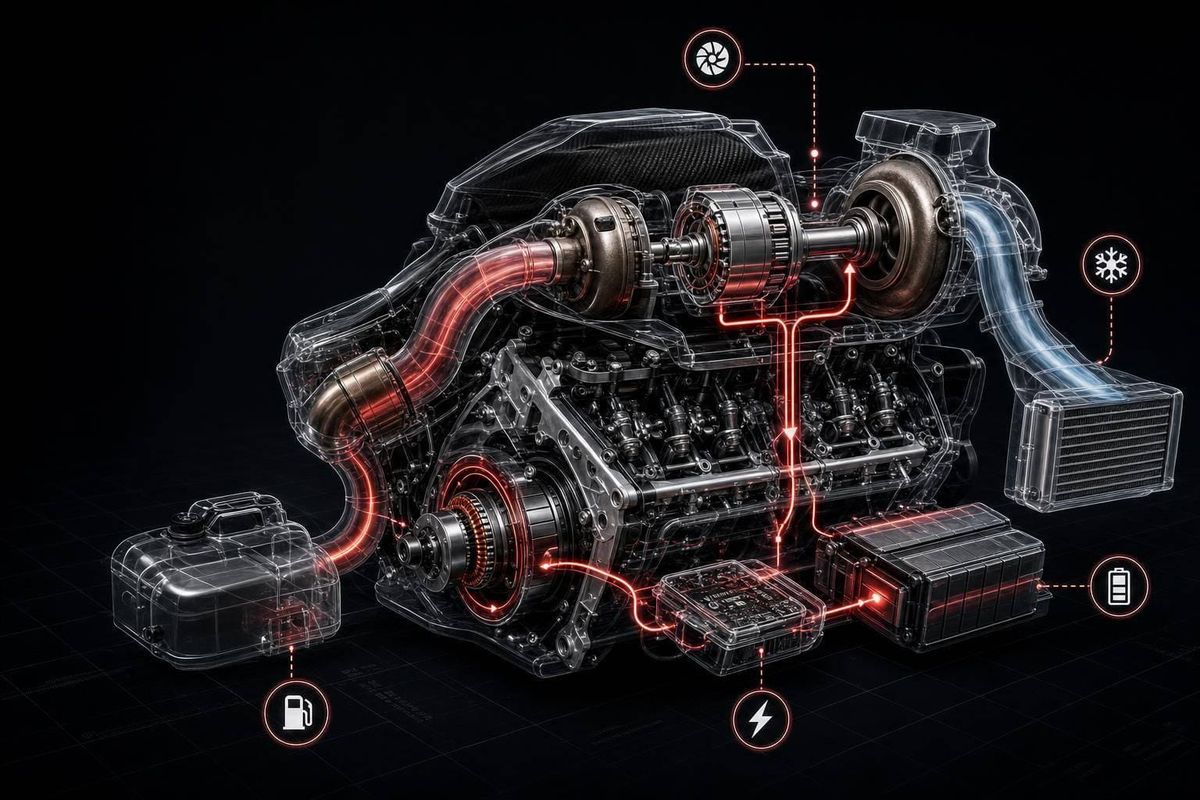
F1 brought back turbo engines in 2014 for one main reason: to get more performance from less fuel. I’d sum it up like this: the sport moved from a 2.4 L V8 to a 1.6 L turbo V6 hybrid, added energy recovery, and capped fuel at 100 kg per race. That shift changed how teams found lap time, which manufacturers had the edge, and why some cars were far ahead from day one.
If you want the short version, here it is:
- Old setup: 2.4 L naturally aspirated V8, simpler layout, less focus on fuel use
- New setup: 1.6 L turbo-hybrid V6, more parts, more heat, more system work
- Big rule change: 100 kg fuel limit made fuel use part of race pace
- Key hardware: MGU-K and MGU-H added electric energy recovery
- Early result: Mercedes looked strong early, while others had power and reliability trouble
- Main trade-off: better fuel use and road-car alignment, but higher cost and more complexity
The core point: this was not just an engine swap. I see it as a full change in F1’s priorities, from loud revs and simple packaging to turbo power, battery use, thermal control, and tight car-wide integration.
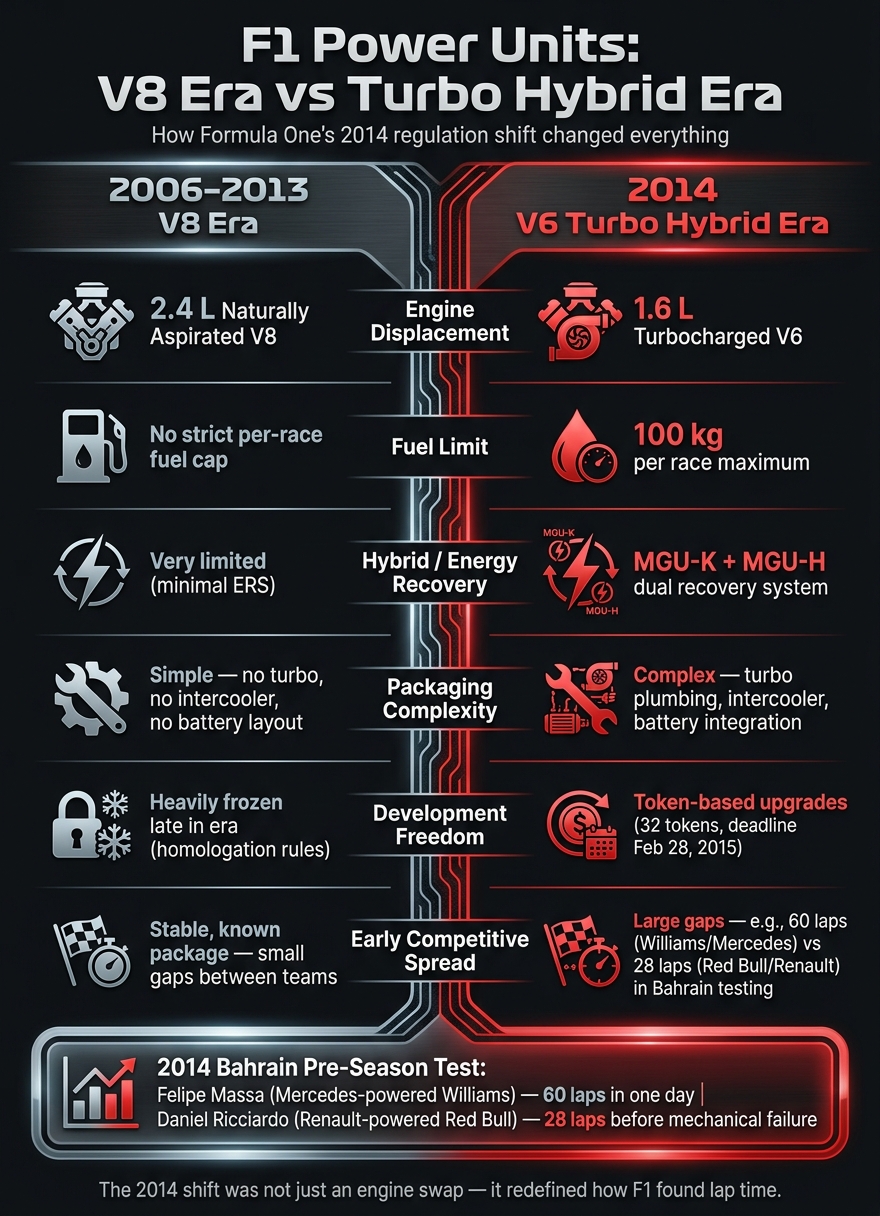
F1 Power Units: 2006–2013 V8 vs 2014 V6 Turbo Hybrid
2014 F1 Engine - ERS - Explained
sbb-itb-7c68254
Quick Comparison
| Area | 2006–2013 V8 | 2014 V6 Turbo Hybrid |
|---|---|---|
| Engine | 2.4 L NA V8 | 1.6 L turbo V6 |
| Fuel focus | Low | High |
| Hybrid system | Very limited | MGU-K + MGU-H |
| Packaging | Simpler | Harder to fit and cool |
| Development | Heavily frozen late in era | Token-based upgrades |
| Early 2014 form | Stable, known package | Big gaps in pace and reliability |
One stat says a lot: in Bahrain testing before the 2014 season, Felipe Massa completed 60 laps in one day in a Mercedes-powered Williams, while Daniel Ricciardo managed 28 laps before a Renault-related failure stopped his run. That gap showed the new formula was about more than horsepower alone.
So when I look at F1’s turbo return, the answer is simple: the sport wanted efficiency, hybrid power, and closer ties to road-car engine trends, even if that meant more cost, more parts, and a bigger gap between teams at the start.
1. 2.4 L Naturally Aspirated V8 Powertrains
Engine Architecture
The 2.4 L naturally aspirated V8 defined Formula One from 2006 through 2013. Late in that period, teams had far less freedom to chase more power because a development freeze and homologation rules boxed them in.
By 2013, engine work was capped so tightly that most lap-time gains came from aerodynamics, not the power unit. That made the V8 era more predictable. It also made its ceiling hard to ignore.
Fuel Use and Packaging
The V8 rules were stable, but they put little weight on fuel efficiency or energy recovery. Put simply, the formula wasn't built to hit the fuel-saving goals F1 wanted. With almost no pressure to improve efficiency, teams found performance in the chassis and aero rather than the engine.
There was also a packaging upside. The V8 was easier to fit into the car than the turbo-hybrid unit that followed. No turbo plumbing. No intercooler. No battery layout to work around. That simplicity was nice while it lasted, but it also showed why the 2014 turbo-hybrid rules shifted hard toward efficiency and energy recovery.
Team Response to the V8 Era's End
The move away from the V8 didn't get a warm welcome across the paddock. The new rules changed the whole engineering pecking order, and there was internal pressure within Ferrari to use veto power to block the switch to the V6 turbo formula.
Briatore called the switch a leap in the dark.
That reaction says a lot. Teams weren't just facing a new engine. They were staring at a much more complicated package, which set the stage for the 2014 V6 hybrid era.
2. 1.6 L Turbocharged V6 Hybrid Power Units
Engine Architecture
The new rules did more than make the engine smaller. They changed how F1 found speed. In 2014, teams moved to a 1.6 L turbocharged V6 power unit in what many saw as a "leap in the dark" for manufacturers.
This setup combined a turbocharger with the MGU-K and MGU-H. In plain English, that meant a two-part energy recovery system that the old V8 era simply didn't have. And that changed the game fast. The teams that got the integration right pulled ahead almost at once, while others were left chasing both power and reliability.
Packaging and Team Response
All that extra hardware, from the turbo to the intercooler to the hybrid systems, created a packaging headache. Teams had to cram far more into a tight space, and one result was the awkward nose designs that got hammered by fans and drivers alike.
"I think we need to be honest with our fans and with ourselves. These cars aren't good enough because people are looking for the best in motorsport, aerodynamics, performance, and technology in F1. And when you see the front of these cars, it's hard to see any excellence." - Fernando Alonso, F1 Driver
Preseason testing in Bahrain made the gap hard to miss. During the February 2014 test, Felipe Massa in the Mercedes-powered Williams completed 60 laps in a single day. Daniel Ricciardo, driving the Renault-powered Red Bull, stopped after 28 laps because of a mechanical failure.
That kind of split told the story early. One maker looked ready. Another looked stuck in survival mode. When performance gaps show up that soon, pressure builds fast to keep development from getting out of hand.
That helps explain why the FIA used a token system. Manufacturers received 32 development tokens for power unit upgrades, and the first homologation deadline was set for February 28, 2015.
Why Formula One Returned to Turbo Engines in 2014
Formula One brought back turbo engines because the sport wanted power units that lined up with road-car trends and put efficiency at the center of performance, not off to the side.
During the V8 era, the focus was high-revving combustion and mechanical simplicity. The 2014 rules changed that. Formula One moved to smaller engines, turbocharging, and hybrid energy recovery. The 100 kg fuel limit turned fuel use into part of the lap-time equation, not just a box to check. That shift changed the sport right away, because it affected which car makers saw Formula One as worth their time.
Honda came back to Formula One as McLaren's works supplier for 2015 because the turbo-hybrid formula matched its road-car strategy. That tells you a lot. The point of the new rules wasn't just to make the cars different. It was to build the whole package around efficiency and energy recovery, not raw combustion output alone.
You can think of it like this: the V8 era leaned on engine speed and simplicity, while the 2014 package tied combustion, turbocharging, and energy recovery into one system. It was much more complex, yes, but it followed the same direction road-car engineering was taking at the time.
That rule change shifted the meaning of top-level performance in Formula One. It wasn't only about revs or engine sound anymore. It became about efficiency, integration, and how well a team could deploy energy. The tension sat right there: more road relevance on one side, more complexity on the other.
Trade-Offs of the Turbo-Hybrid Shift
Those gains came with clear costs. Compared with the V8 era, the new formula gave up simplicity in exchange for efficiency.
The 2014 turbo-hybrid shift improved efficiency and made the engines line up more closely with what major car makers cared about. But there was a catch: costs went up, the hardware got far more complex, and the gap between teams grew.
The V8 was much easier to package. There was no turbo plumbing, no intercooler, and no battery layout to work around. The turbo-hybrid era changed that fast. Teams now had to fit and manage all of those parts, and the ones that failed to integrate the system early lost ground almost right away.
Closing that gap wasn't easy. Token rules slowed how much teams could change, so early mistakes stuck around longer than many hoped. At the same time, the development fight heated up as Ferrari and Renault pushed to exploit regulatory openings while Mercedes held a commanding lead.
Smaller teams felt the pressure most. Power unit costs became a serious burden, to the point that there was even talk of Formula One Management stepping in to cover engine bills.
Bernie Ecclestone was openly critical of the new formula, arguing that Mercedes' dominance had hurt the show and pushing for louder, simpler engines. So while the regulations aimed to make Formula One fit modern engineering more closely, they also made the championship less competitive in the short term.
Conclusion
Formula One’s 2014 turbo return wasn’t about nostalgia. It was a clear move toward engineering relevance, with the sport lining itself up with where the car world was headed. That’s exactly why the V8-to-V6 comparison matters.
The 1.6 L V6 hybrid package asked far more from teams than raw power. It demanded fuel discipline, smart ERS use, thermal control, and tight chassis-engine integration. Early testing made one thing plain: some teams had solved that puzzle, and others hadn’t.
That early 2014 testing gap wasn’t just about horsepower. It came down to packaging, reliability, and energy management too. The teams at the front understood that the power unit had to work as one connected system, not as an engine bolted into the back of the car.
For manufacturers, this was a systems problem from top to bottom, not a simple engine swap. In 2014, results came from managing the whole package well: combustion, turbocharging, energy recovery, and packaging.
FAQs
Why did F1 switch from V8s to turbo-hybrids in 2014?
Formula 1 switched from naturally aspirated V8s to turbocharged V6 hybrid power units in 2014 mainly to improve energy efficiency and cut emissions.
The change was a big one. Thermal efficiency went from 29% in the V8 era to more than 50% today. And thanks to energy recovery systems like the MGU-K and MGU-H, these power units also produce 20% more power while cutting CO2 emissions by 26% and using less fuel.
That’s the part many fans miss at first glance: the hybrid era wasn’t just about going smaller. It was about getting more out of every drop of fuel.
What did the 100 kg fuel limit change?
The 100 kg fuel limit, introduced in 2014, put engine efficiency front and center. Teams suddenly had to get more out of every kilogram of fuel, which meant fine-tuning their power units to keep pace without burning through their allotment.
That shift changed a lot. Race fuel use fell from about 160 kg in 2013 to 100 kg, yet lap times still got faster. It also pushed manufacturers to balance combustion power with energy recovery, cutting fuel consumption by 26% compared with the V8 era.
Why was Mercedes so far ahead early in 2014?
Mercedes jumped out in front early in 2014 because its new V6 turbo power unit was more complete and more reliable than what its rivals had. That gave the team better pace from the start, plus more useful testing mileage as Formula 1 moved into the new hybrid era.
At the same time, other teams using Mercedes power didn't get as much from the package. And the Renault-powered teams lost time to mechanical problems.