F1 Car Development: Alloy Choices Through History
Materials—not density—drive F1 design: how alloys moved from steel frames to carbon-fiber cars and now serve heat, wear, and safety roles.

The lightest alloy doesn’t always make the lightest F1 part. When I compare materials, I look at the finished part: its weight, stiffness, heat resistance, durability, and ability to meet safety rules.
F1’s material story comes down to three shifts:
- Steel frames: Metal carried the car’s main structural loads.
- Aluminum monocoques: The 1962 Lotus 25 showed how a load-bearing skin could cut weight while resisting twisting.
- Carbon-fiber chassis: A composite, not an alloy, carbon fiber took over the main shell, while metals kept jobs involving heat, wear, and concentrated loads.
For 2026, MGU-K output rises from 120 to 350 kW - about a 192% increase - while the MGU-H disappears. That changes cooling and packaging demands, not just power delivery.
My takeaway: <u>choose the material for the job, not density alone</u>. Aluminum, steel, titanium, magnesium, and nickel alloys each earn their place through a balance of weight, cost, reliability, and FIA rules.
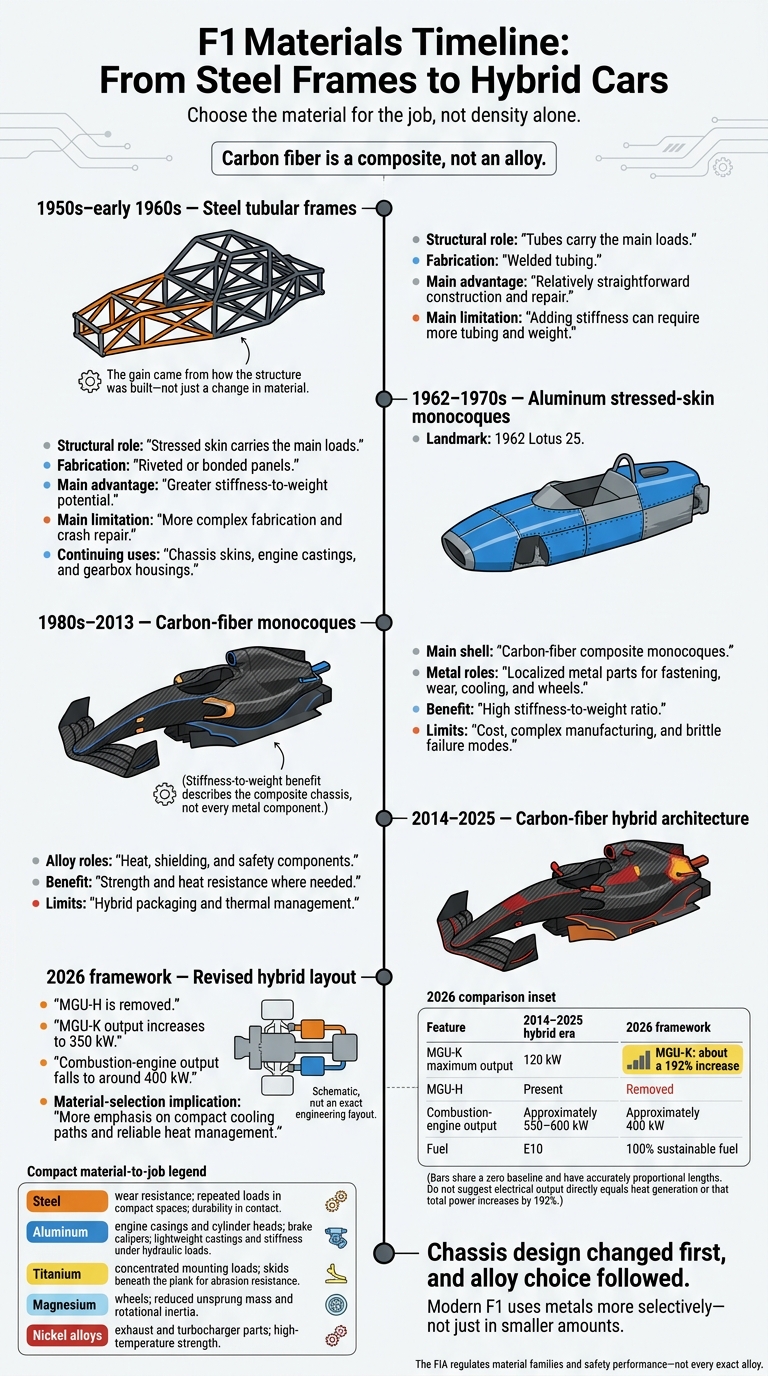
F1 Materials Timeline: From Steel Frames to Hybrid Cars
From Steel Frames to Carbon-Fiber Chassis
1950s–1960s: Steel Frames and Aluminum Monocoques
Steel-tube frames carried the chassis loads. Then the 1962 Lotus 25 changed how those loads traveled through the car. Colin Chapman’s aluminum stressed-skin monocoque used the body itself to carry structural loads, rather than a separate tubular frame. The gain came from how the structure was built - not just a change in material.
| Comparison | Steel-tube frame | Aluminum monocoque |
|---|---|---|
| Structural role | Tubes carry the main loads | Stressed skin carries the main loads |
| Fabrication | Welded tubing | Riveted or bonded panels |
| Main advantage | Relatively straightforward construction and repair | Greater stiffness-to-weight potential |
| Main limitation | Adding stiffness can require more tubing and weight | More complex fabrication and crash repair |
This shifted the focus of alloy choice from the main frame to the body shell.
1960s–1970s: Aluminum Engines and Gearbox Housings
Aluminum’s role extended beyond chassis skins and body panels. Engine and gearbox parts made from aluminum cut mass and reduced the need for separate supports. As downforce increased, designers needed more torsional stiffness - resistance to twisting - without adding too much weight. Fatigue and fabrication complexity still limited aluminum construction.
1980s Onward: Metal’s Role in Carbon-Fiber Cars
As carbon fiber took over the chassis, alloys shifted from the primary structure to specific components. Carbon-fiber monocoques carried the stressed-skin principle forward, offering greater stiffness-to-weight potential. Metals still provided secure attachments, heat protection, and damage tolerance.
Threaded inserts, suspension attachments, and heat shields retained localized roles; steel wishbones remained useful because they tolerated contact damage better than carbon-fiber parts.
| Period | Primary chassis construction | Continuing alloy roles |
|---|---|---|
| 1950s–early 1960s | Steel tubular frames | Main structural loads |
| 1962–1970s | Aluminum stressed-skin monocoques | Chassis skins, engine castings, and gearbox housings |
| 1980s onward | Carbon-fiber composite monocoques | Localized suspension attachments and heat shields |
From here, alloy choice becomes component-specific.
sbb-itb-7c68254
What Is An F1 Car Made Out Of? | F1 Car vs Road Car | Aramco
Alloy Properties and Uses
Longer engine-life targets pushed teams toward more stable parts, tighter manufacturing tolerances, and materials that could withstand higher mileage.
Those demands helped determine which metals stayed in the smallest, hardest-working parts.
Steel for Wear Resistance, Nickel Alloys for Heat
Suspension shows why steel can be the better choice when parts face repeated contact, outlasting more fragile materials.
Gordon Murray said ferrous wishbones would be cheaper and more durable in contact than carbon-fiber ones, which can shatter and leave debris after a bump; he also noted that ferrous suspension parts would cut down on the expensive aerodynamic development of complex wishbone shapes.
Steel also resists wear in moving parts under heavy loads, while nickel-based alloys retain strength in hot exhaust components.
Hybrid-Era Alloys and the 2026 Rules
Once carbon-fiber monocoques took over, alloy selection focused on the parts where metal still mattered most. As metal use became more localized, regulations shifted toward component-by-component rules. The FIA regulates material families and safety performance - not every exact alloy.
Metal Components and Material Rules
| Component | Material family | Main selection reason | Regulatory requirement versus team practice |
|---|---|---|---|
| Survival-cell metal interfaces | Titanium or high-strength steel | Concentrated mounting loads | Crash-load compliance is required; the exact insert alloy is not mandated. |
| Wheels | Magnesium alloy | Reduced unsprung mass and rotational inertia | Standard-supply magnesium wheels are used within FIA limits. |
| Brake calipers | Aluminum alloy | Stiffness under hydraulic loads | Aluminum is required; aluminum-lithium grades face restrictions. |
| Suspension hardware | Steel or titanium | Repeated loads in compact spaces | Teams balance durability and packaging. |
| Exhaust and turbocharger parts | Nickel alloys | High-temperature strength | Nickel-based alloys remain critical for these parts. |
| Engine casings and cylinder heads | Aluminum alloy | Lightweight castings | Aluminum remains the main family; exotic metal matrix composites are restricted. |
| Skids beneath the plank | Titanium | Abrasion resistance | Titanium skid requirements cover placement and dimensions. |
The FIA sets the allowed material families and required load tests. Teams then choose grades within those limits, working with less packaging space than they had in the V8 or V10 eras.
Crash Safety, Heat, and Hybrid Packaging
Impact tests, survival-cell requirements, and homologation limit how much weight teams can remove. Titanium or high-strength steel can handle concentrated loads at suspension pickup points and power-unit mounting faces. The energy store and MGU-K also need careful protection.
The 2026 power-unit layout changes both heat management and packaging. The MGU-H is removed, MGU-K output increases to 350 kW, and combustion-engine output falls to around 400 kW. That puts more emphasis on compact cooling paths and reliable heat management. Alloy choice is now as much about fitting parts into the car as choosing the right material.
| Architecture feature | 2014–2025 hybrid era | 2026 framework | Effect on material selection |
|---|---|---|---|
| MGU-K maximum output | 120 kW | 350 kW | Greater electrical output changes cooling and integration demands. |
| MGU-H | Present | Removed | Simplifies packaging, but turbocharger heat remains. |
| Combustion-engine output | Approximately 550–600 kW | Approximately 400 kW | Changes the balance of heat flow and power density. |
| Fuel | E10 | 100% sustainable fuel | Changes combustion behavior and heat-management demands. |
Tight packaging makes high-strength aluminum mounts useful around the energy store and related parts.
Weight, Stiffness, and Reliability
Lighter wheels reduce unsprung mass. Where that mass sits matters, too: mass farther from the axle has a greater effect on rotational inertia.
Weight savings only help if a part survives repeated heat and loads between inspections. Earlier long-life engine rules doubled the required running distance, forcing teams to use more stable materials and manufacturing processes.
Conclusion: How Alloy Roles Changed
In every era, chassis design changed first, and alloy choice followed. Steel, aluminum, and carbon fiber took on the jobs each handled best. As chassis layouts evolved, alloys shifted toward parts that had to handle concentrated loads, wear, and heat.
As F1 cars became faster and more complex, alloys moved from the main structure to supporting parts, then to more precise roles. The choice wasn’t simply about finding the lightest metal. Modern F1 uses metals more selectively - not just in smaller amounts.
| Era | Chassis construction | Primary alloy roles | Main benefit | Limits |
|---|---|---|---|---|
| 1950s | Steel spaceframe | Frame structure and engine castings | Durability and ease of repair | Weight and limited torsional rigidity |
| 1960s–1970s | Aluminum monocoque | Stressed-skin structure and lightweight housings | Lower mass and greater stiffness | Manufacturing complexity and impact protection |
| 1980s–2013 | Carbon-fiber monocoque | Localized metal parts for fastening, wear, cooling, and wheels | High stiffness-to-weight ratio | Cost, complex manufacturing, and brittle failure modes |
| 2014–2025 | Carbon-fiber hybrid architecture | Heat, shielding, and safety components | Strength and heat resistance where needed | Hybrid packaging and thermal management |
| 2026+ | Current carbon-fiber hybrid chassis | Steel suspension arms, energy-store shielding, and high-heat alloys | Durability and potential cost savings | Weight targets and complex packaging |
FAQs
Why hasn’t titanium replaced aluminum in F1?
Titanium hasn’t replaced aluminum in F1 because teams must balance weight, structural integrity, and cost. Titanium suits high-stress safety components like the halo. Aluminum remains common in chassis and engine applications where its strength, weight, and manufacturing properties meet the demands.
Titanium is denser than aluminum, so using it in more parts can make weight control, packaging, and heat management harder. Teams choose materials to suit each application rather than replace aluminum entirely.
How do teams prevent failures where metal meets carbon fiber?
Teams design strong load paths, reinforce attachment points, and check them through FIA-style crash and load testing. They also follow strict rules for integrating materials.
For example, the Halo uses aerospace-grade titanium and attaches to the chassis at three points. The structure around those points is reinforced to withstand extreme loads - up to 116 kN vertically and 93 kN laterally (about 26,100 and 20,900 pounds-force, respectively). This helps prevent loosening or harmful stress transfer into carbon-fiber areas.
Will the 2026 rules favor heat resistance over weight savings?
The provided sources don’t give enough detail to say whether the 2026 F1 rules will favor heat resistance over weight savings. They cover materials and safety structures, including a titanium Halo, but don’t explain the direction of the 2026 rules or spell out a tradeoff between heat resistance and weight reduction.