F1 Circularity Handbook: Key Supply Chain Lessons
Steps to measure material flows, verify supplier recovery, design reuse systems, and assign owners to improve material circularity.

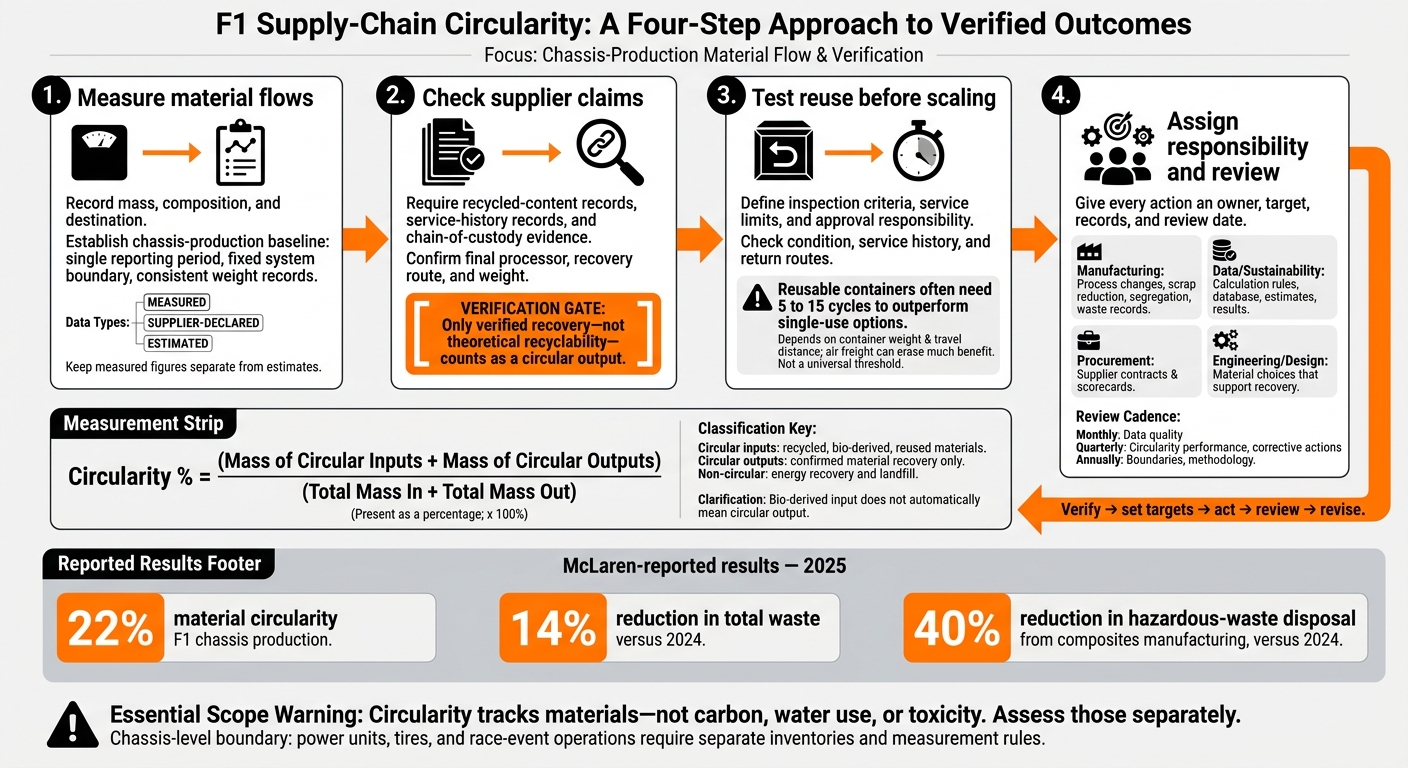
My main takeaway: track where materials go - not just whether they could be recycled. Start with a chassis-production baseline, require supplier records, and count recovery only when the destination is confirmed.
I’d put the handbook’s lessons into four steps:
- Measure material flows: Record mass, composition, and destination. Keep measured figures separate from estimates.
- Check supplier claims: Require records for recycled content, service history, and final recovery.
- Test reuse before scaling: Set inspection rules and check return routes. Reusable packaging may need 5–15 cycles to outperform single-use options.
- Assign responsibility: Give each action an owner, target, and review date, then use the results to cut waste and guide design.
McLaren reported 22% material circularity for F1 chassis production in 2025. But I’d keep one limit clear: <u>a circularity score tracks materials - not carbon, water use, or toxicity</u>. Those need separate checks.
F1 Circularity: From Material Tracking to Verified Recovery
Inside F1's first-ever recycled carbon fibre trial #USGP
sbb-itb-7c68254
Measure Circularity With Verified Data
Once you’ve mapped material flows, use those same waste streams to build a verified mass baseline.
Published in January 2024 by the FIA, McLaren Racing, and Deloitte, the FIA F1 Constructors’ Circularity Handbook covers supply chains, manufacturing, and end-of-life recovery routes. Its mass-based Circularity Metric is:
Circularity % = (Mass of Circular Inputs + Mass of Circular Outputs) / (Total Mass In + Total Mass Out)
Classify Material Inputs and Recovery Routes
Use the handbook’s categories to distinguish circular inputs from verified recovery. Bio-derived material counts as a circular input. But only verified recovery - not theoretical recyclability - counts as a circular output.
| Category | Source and manufacturing use | End-of-life route | Required evidence | Treatment |
|---|---|---|---|---|
| Recycled input | Post-consumer or post-industrial material used in components | Material recycling | Supplier recycled-content records and batch weights | Circular input |
| Bio-derived input | Renewable biomass used in fibers or resins | Depends on the material and available facilities | Origin and composition records; separate recovery evidence | Circular input, not automatic circular output |
| Reused input | Existing components used again | Reuse or refurbishment | Inventory and service-history records | Circular input |
| Recyclable output | Production offcuts or retired components | Confirmed material recycling | Transfer records and processor confirmation | Circular output only when recovery is confirmed |
| Energy recovery | Non-recyclable polymers or consumables | Incineration with heat or power capture | Treatment and energy-recovery records | Non-circular |
| Landfill | Residual manufacturing waste | Disposal | Disposal records and weights | Non-circular |
Calculate the Baseline and Record Data Gaps
Calculate the baseline using one reporting period, a fixed system boundary, and consistent weight records. Separate verified supplier weights from estimates so gaps remain visible. For every entry, label mass, composition, and destination as measured, supplier-declared, or estimated.
Use this baseline to set supplier rules and check recovery claims.
Set Supplier Rules and Track Materials
Define Supplier Records and Reporting Rules
Make material reporting a contract requirement. Require third-party-certified inputs and chain-of-custody records at every supplier tier, including subcontractors and downstream processors.
Standardize reports using the baseline fields from the measurement section: mass, composition, and destination. Apply one material classification scheme across all suppliers so they report mass, composition, and recovery route the same way.
Score Suppliers and Verify Recovery Claims
Once reporting is required, score suppliers on proof, not promises. Use a scorecard that weighs record completeness, service life against engineering requirements, confirmed recovery, transport distance and load weight, and open noncompliance issues.
Track recovery separately, with records confirming the final processor, route, and weight. These verified records also show which materials can move into returnable packaging and reuse loops.
Build Reuse Systems From Factory to Circuit
Design Returnable Packaging and Set Reuse Rules
Verified material records give teams a basis for deciding which assets can return to service. Only materials with a confirmed condition, service history, and recovery route should enter reuse loops.
Before reusable race assets and returnable packaging go back into service, set clear approval rules. Define inspection criteria, service limits, and who can sign off.
Use sensor data on temperature, pressure, wear, and run history to decide whether a component stays in circulation or is retired. Base that decision on performance and service life. Before race use, restore reusable materials through scrubbing or similar refurbishment steps.
With those rules in place, the return route determines whether reuse makes sense at scale.
Assess Return Logistics and Resource Impacts
Compare reusable packaging with single-use options across the entire route, accounting for transport distance and mode. Reusable containers often need 5 to 15 cycles to outperform single-use options, depending on their weight and travel distance. Air freight can erase much of that benefit.
Use these thresholds to guide the implementation plan that follows.
Implementation Plan and Key Lessons
Set Priorities, Owners, and Review Dates
Use the verified baseline to control material flow - not just measure it. Start with hazardous and avoidable waste, test reuse options, tighten supplier reporting, and turn findings into design changes that use less material and improve recovery.
Give each team clear responsibilities. Manufacturing should own process changes, scrap reduction, material segregation, and waste records. Data or sustainability teams should set calculation rules, maintain the material-flow database, document estimates, and calculate results. Procurement should put circularity requirements into contracts and supplier scorecards.
Logistics should manage reusable packaging, return schedules, tracking IDs, and transport records. Engineering and design teams should choose materials that support recovery. Give every action an owner, target, records, and review date.
Review data quality monthly. Check circularity performance and corrective actions quarterly, and review boundaries and methodology annually. Appoint a senior program owner to resolve conflicts and report progress to management. At the circuit, race operations, facilities teams, waste contractors, and logistics partners verify material outcomes.
The FIA frames the handbook as a chassis-level circularity measurement method. Power units, tires, and race-event operations need separate inventories, boundaries, and measurement rules.
Track Results and State the Limits
With roles assigned, track results within the same boundary. Cover circularity, waste by stream and destination, hazardous disposal, reuse and return rates, recycled content, supplier reporting coverage, data completeness, and verified recovery routes. Report both absolute mass and waste per chassis or production hour. Keep measured figures separate from estimates.
McLaren reported a 22% material-circularity metric for F1 chassis production in 2025, a 14% reduction in total waste, and a 40% reduction in hazardous-waste disposal from composites manufacturing versus 2024, supported by improved waste segregation, better material-flow visibility, and targeted manufacturing changes.
Repeat the cycle: verify data, set targets, act, review, and revise. Publish the denominator, exclusions, and data coverage with each score. Circularity metrics show material progress; they don't, on their own, show lower ecological impact. Pair the results with life-cycle, carbon, water, toxicity, and logistics assessments where decisions have material consequences.
FAQs
Can higher circularity increase an F1 team’s carbon footprint?
Greater circularity doesn’t automatically increase an F1 team’s carbon footprint. The F1 Constructors’ Circularity Handbook outlines ways to cut waste and emissions by reusing materials, tracking emissions across their lifecycle, and choosing lower-emission logistics options, such as sea freight and biofuels.
McLaren, for example, reduced greenhouse gas emissions per race by 23% in 2024 through these types of circularity and efficiency measures.
How can teams reuse parts without compromising safety?
F1 teams use advanced material testing and precise lifecycle tracking to check parts before and during use. Simulations, telemetry, and non-destructive testing track structural stress, heat, and wear. These checks help ensure reused components meet strict safety and regulatory standards.
Recycled carbon fiber can retain up to 85% of the original material’s strength, making it suitable for specific uses, such as cockpit branding panels.
How should teams handle missing supplier recovery data?
Treat circularity reporting as incomplete when recovery figures are missing. Leave those figures out of material circularity calculations rather than guessing, and flag the gap for follow-up during the next factory traceability cycle.
McLaren uses the Circularity Handbook framework to measure and trace materials across lifecycle stages, then uses those measurements to find areas for improvement. Missing data should lead to corrective measurement - not assumptions.