2026 Aero-Chassis Integration: Lessons from Top Teams
How top F1 teams balanced aerodynamics, packaging, energy harvesting and cooling under the 2026 rules, and the trade-offs that followed.
In 2026, Formula 1 teams face unprecedented challenges due to sweeping regulation changes. These updates redefine power units, aerodynamics, and chassis dimensions, forcing teams to rethink car designs from scratch. Key changes include:
- Flatter floors and larger diffusers replacing Venturi tunnels, reducing downforce by 15–30%.
- Active aero modes (Z-mode for corners, X-mode for straights) replacing the DRS system.
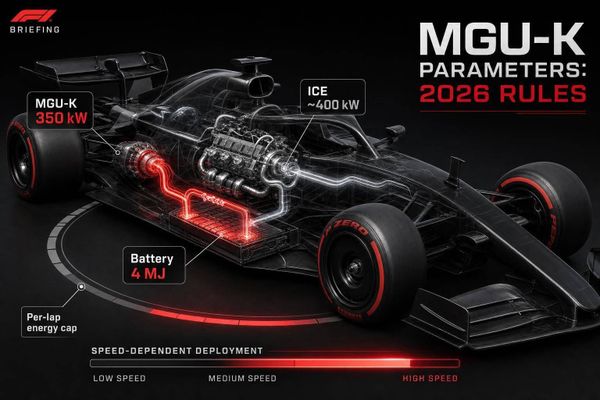
- A 50:50 power split between combustion engines and electric systems, with a 350kW electric boost in Overtake Mode.
Every top team has taken a unique approach to tackle these challenges:
- Red Bull: Compact car layout maximizes underfloor airflow but struggles with front-tire wake.
- Ferrari: Focuses on stability with a diffuser extension but faces rigidity in mid-season adjustments.
- Mercedes: Prioritizes energy efficiency and acceleration but requires earlier braking for energy recovery.
- McLaren: Short wheelbase aids weight compliance and agility but limits downforce.
Each strategy highlights the trade-offs between aerodynamics, weight, energy management, and thermal constraints. Success in 2026 depends on how well teams balance these factors while managing the risks of active aero synchronization errors.
The Ultimate Guide To The 2026 F1 Cars
sbb-itb-7c68254
Red Bull's Tight Packaging Approach

Red Bull's 2026 car design revolves around one key principle: keeping everything compact to let the airflow do its magic. By positioning the cockpit and front axle 250mm closer together compared to competitors, Red Bull creates a higher nose that directs clean air to the underfloor. This approach is crucial in a season where ground-effect tunnels have been eliminated, leading to a 15–30% downforce loss due to new floor regulations. Feeding clean, high-volume air to the underfloor becomes a priority, and this compact design not only improves airflow but also introduces complex packaging challenges.
Flow Quality Through Compact Car Layouts
Red Bull takes full advantage of the 3,400mm wheelbase to maximize floor area and generate downforce. However, this extended floor length requires every component, from the power unit to the cooling systems, to fit into a tightly packed rear section.
The 2026 regulations also enforce an inwash aerodynamic philosophy, preventing teams from pushing front tire wake outward as they used to. Red Bull's forward cockpit placement adds another layer of difficulty, as it must manage turbulent wake from the front tires. To handle this, the team uses anti-dive suspension geometry, angling the wishbones downward toward the rear to direct the front wing's wake into the floor.
By the time of the 2026 Miami Grand Prix, Red Bull had implemented the "Macarena" rear wing design - an idea originally introduced by Ferrari - to boost aerodynamic efficiency at the rear. This highlights the collaborative evolution of aerodynamic strategies among teams. However, this design also requires advanced suspension systems to better manage front tire wake.
On top of aerodynamic challenges, Red Bull must also navigate thermal and safety constraints, which further complicate the car's design.
Cooling vs. Safety Trade-Offs
The removal of the MGU-H increases the engine's operating temperature, putting more strain on Red Bull's compact sidepod cooling system. Stricter safety regulations also add weight, creating a broader 64kg challenge. Red Bull must integrate these safety-related weight increases without compromising airflow. Structural stiffness remains non-negotiable for safety, so the team focuses on finding weight savings through tighter tolerances, lightweight materials, and smarter integration of components. As Motor Sport Magazine pointed out:
"The clearest advantage for works teams in 2026 will not be that packaging suddenly matters – it always has – but that the new rules magnify the consequences of early architectural choices".
Red Bull's approach, which carefully balances airflow, cooling, and safety, showcases the intricate challenges of designing a 2026 Formula 1 car.
Ferrari's Approach to Mechanical and Aero Balance
Ferrari places a strong emphasis on maintaining platform stability and mechanical precision. With the SF-26, the team has engineered a car that delivers predictable aerodynamic behavior, whether it's navigating heavy braking zones or tackling high-speed corners.
Chassis Geometry and Weight Distribution
One of Ferrari's standout mechanical decisions for 2026 was reverting to a conventional front pushrod suspension layout, moving away from the pullrod system used in previous seasons. The upper wishbones feature chassis-side pickup points deliberately offset in height. This adjustment enhances "anti-dive" and "anti-squat" geometries, reducing pitch during braking and squat under acceleration, which helps sustain aerodynamic stability.
At the rear, Ferrari has taken full advantage of the 60 mm rear differential positioning allowed by regulations. By angling the drive shafts steeply, they’ve extended the rear bodywork to enhance the diffuser’s expansion ramp. Grand Prix Editor Mark Hughes explains:
"Ferrari has found a way of having bodywork aft of [the diffuser] and shaped it in a way which continues the diffuser's expansion ramp. Even if technically, the diffuser ends where the regulations say it must... the air sees the combined thing as just a bigger diffuser."
This combination of mechanical precision and aerodynamic innovation sets the foundation for Ferrari's stability-focused design philosophy.
Tire Management and Aero Efficiency
Ferrari’s active aerodynamics system optimizes performance by switching between two modes: Z-mode for high downforce in corners and X-mode for low drag on straights. The front wing’s main plane and flaps, along with the rear wing, operate in sync through the ECU to transition seamlessly between these modes. Additionally, Ferrari has tested a rear wing capable of swiveling upside down in straight-line mode, delivering a more aggressive drag reduction than traditional DRS systems.
While rivals have pushed for aggressive front wing designs to maximize downforce, Ferrari has taken a more measured approach. Motorsport journalist Maria Lombardi highlights this strategy:
"Ferrari has instead entrusted overall aerodynamic stability primarily to the floor... creating a platform that should, in theory, be less sensitive to ride-height changes and turbulent air".
This stability-focused design philosophy not only improves tire longevity but also enhances race pace and provides greater strategic flexibility during long stints. By prioritizing consistency over raw aerodynamic force, Ferrari aims to maintain an edge in race conditions.
Mercedes' Structural and Aero Efficiency Strategy

While Ferrari emphasizes floor stability and Red Bull focuses on compact designs, Mercedes has taken a different route for 2026. Their W17 car is built around a strategy that prioritizes structural ingenuity and airflow optimization. Every design element is calculated to deliver maximum aerodynamic performance, starting with the way the nose connects to the front wing.
Frontal Area Reduction and Energy Packaging
Mercedes has made a bold design choice with the nose of the W17. Instead of attaching the angled nose to the bottom main plane of the front wing - like most teams - Mercedes stops the nose short and mounts it to the middle front wing element. This approach channels high-energy airflow more effectively to the underfloor, boosting aerodynamic efficiency.
"Mercedes has enhanced the volume of airflow being fed to the underfloor by stopping the downward-sloping nose short enough to mount it to the middle element of the front wing." - Mark Hughes, Grand Prix Editor
Another clever feature is the low-mounted steering rack, positioned behind the front suspension. This placement generates a downwash effect that improves airflow at the front edge of the floor, further enhancing performance.
But Mercedes' innovation doesn’t stop at aerodynamics. The team has also made strides in energy management. During pre-season testing in Bahrain (February 2026), drivers George Russell and Kimi Antonelli adopted a unique braking strategy. By braking earlier than their Red Bull and Ferrari competitors, they were able to harvest electrical energy for rapid acceleration out of corners.
"The Mercedes was able to generate terrific acceleration out of the turns. George Russell and Kimi Antonelli were typically braking much earlier than the Red Bull and - especially - the Ferrari, harvesting some electrical energy which was then used to devastating effect out of the corners." - Mark Hughes, Grand Prix Editor
This dual focus on aerodynamics and energy efficiency sets Mercedes apart, but their approach also extends to the structural aspects of the car.
Keeping Stiffness While Reducing Weight
The 2026 regulations, which include a reduced minimum weight and a shorter maximum wheelbase of 3,400 mm (133.9 in), pose significant engineering challenges. Mercedes has opted to use the full 3,400 mm wheelbase, prioritizing floor area and downforce over the potential weight savings of a shorter chassis.
This decision adds complexity, as a longer car is harder to keep within the weight limit. To address this, Mercedes has optimized internal packaging. For example, a streamlined air scoop has been designed to balance cooling needs with drag reduction. As a works team, Mercedes has another advantage: the ability to fully integrate power unit cooling, battery placement, and exhaust routing into the car’s design. This integration works seamlessly with the W17's active aero modes - X-mode for low drag and Z-mode for high downforce - offering a level of sophistication that customer teams cannot achieve.
McLaren's Flexible Aero Platform
McLaren has taken a bold step by opting for a shorter wheelbase to gain a competitive edge. While Mercedes and Ferrari stuck with the maximum 134 in. (340 cm) wheelbase, McLaren's MCL40 measures just 128 in. (325 cm). This makes it the shortest car on the grid - 6 in. (15 cm) under the regulatory limit and a full 14 in. (35 cm) shorter than its predecessor, the MCL39. This reduction isn't just about size; it opens up opportunities for innovative packaging and dynamic aerodynamic adjustments.
"The wheelbase reduction was achieved by moving the rear axle closer to the chassis... This reduction positions the rear axle closer to the chassis, promising track-wide performance gains." - Giorgio Piola, Technical Illustrator
Chassis Design for Aero State Changes
To make this compact design work, McLaren had to rethink several components. The gearbox casing, spacer assembly, and cooling systems were redesigned. They swapped out narrow, long radiator cores for wider, shorter, and more inclined ones. These updated radiators fit snugly within a closed engine cover, which now features a central rear cooling exit.
The car's front suspension is another standout feature. McLaren introduced a multilink system with dual arms, replacing the traditional wishbone design. This setup allows for real-time adjustments to camber, toe, and ride height, stabilizing the aero platform during transitions between Z-mode and X-mode. The rear packaging and suspension geometry were also reworked, further enhancing the car's aerodynamic efficiency. Additionally, a low-mounted steering rack positioned behind the suspension in the cockpit improves airflow at the floor's leading edge.
Mark Temple, McLaren's Performance Technical Director, highlighted how these changes reduce the car's sensitivity to aero fluctuations:
"You don't have the extreme sensitivity to ride height that we had in the previous years. There will be a little bit more freedom to manipulate the car attitude to suit, to affect the handling without just simply making the car go slower." - Mark Temple, Performance Technical Director, McLaren
Qualifying Pace vs. Race Consistency
The shorter wheelbase also simplifies weight management. For context, saving 10 kg can shave 0.2–0.4 seconds off a lap. However, this comes with a downside: the reduced floor area limits underbody downforce. Temple explained the aerodynamic balance McLaren is aiming for: "Efficiency is still very much the most important thing aerodynamically, but there's a change because the straight mode... reduces the drag of the car significantly. So it then becomes more about the amount of downforce you have in corner mode versus the drag that you have in straight mode."
Another key feature is McLaren's "Macarena" rear wing, first introduced in Montreal. This wing smooths transitions between aerodynamic states but adds complexity, especially during Sprint weekends, where limited practice time makes fine-tuning more challenging.
Here’s a quick breakdown of McLaren's design choices and their impacts:
| Design Choice | Benefit | Trade-off |
|---|---|---|
| 128 in. (325 cm) wheelbase | Easier weight compliance | Reduced floor area limits downforce |
| Multilink front suspension | Better tire management and aero stability | Increased mechanical complexity |
| "Macarena" rear wing | Smoother aero-state transitions | Configuration sensitivity during Sprints |
| Closed engine cover/repositioned radiators | Compact packaging | Thermal management challenges |
Comparing Design Priorities and Trade-Offs Across Teams
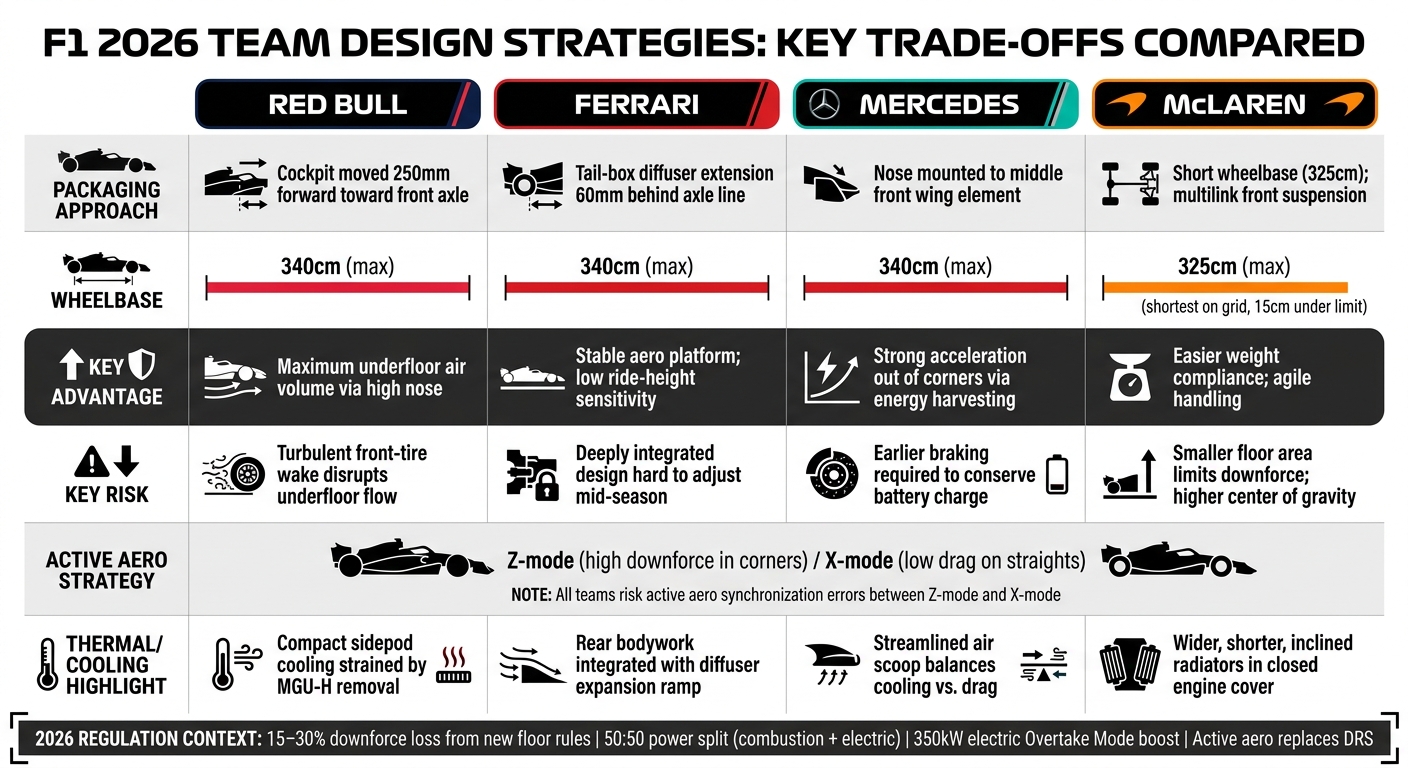
F1 2026 Team Design Strategies: Key Trade-Offs Compared
Looking at how each team approaches the 2026 rulebook, it’s clear that their strategies are as distinct as they are ambitious. Each team has made bold design choices, embracing specific strengths while accepting the risks that come with them. Let’s break down how these priorities play out and the trade-offs they bring to the table.
For Red Bull, the decision to move the cockpit forward creates more room for underfloor airflow, boosting aerodynamic efficiency. But this comes at a cost - turbulent wake from the front tires can disrupt the airflow under the car, potentially destabilizing it at high speeds. On the other hand, Ferrari has focused on the rear, integrating a "tail-box" diffuser extension that sits 2.4 inches (60 mm) behind the axle line. This design makes their car less sensitive to ride-height changes and turbulence. However, this deeply integrated architecture means competitors can’t easily replicate it mid-season, and Ferrari itself would struggle to adjust it if needed.
Mercedes has taken a different route, centering its design on energy harvesting. The team’s unique nose-to-middle-wing attachment channels high-energy airflow to the floor, enabling stronger acceleration out of corners. But there’s a catch - drivers like George Russell and Kimi Antonelli must brake earlier to conserve battery charge, which can be a disadvantage in wheel-to-wheel racing. Meanwhile, McLaren has prioritized weight compliance above all else, opting for a short wheelbase and multilink front suspension. This approach improves agility and handling but limits floor area for generating downforce and raises the car’s center of gravity.
One universal challenge all teams face is the risk of active aero synchronization errors. If the mechanisms controlling the front and rear wing rotations (switching between Z-mode and X-mode) fall out of sync, even slightly, the resulting aerodynamic imbalance can unsettle the car mid-corner.
Here’s a quick look at how these strategies compare:
| Team | Packaging Approach | Key Advantage | Key Risk |
|---|---|---|---|
| Red Bull | Cockpit moved forward toward front axle | Maximum underfloor air volume | Turbulent front-tire wake disrupting underfloor flow |
| Ferrari | Tail-box diffuser extension | Stable aero platform; less ride-height sensitivity | Integrated design is hard to adjust mid-season |
| Mercedes | Nose mounted to middle front wing element | Strong acceleration out of corners | Earlier braking required to conserve battery charge |
| McLaren | Short wheelbase; multilink suspension | Easier weight compliance; agile handling | Smaller floor area for downforce; higher center of gravity |
Thermal management strategies also play a big role in shaping how these designs perform. Each team has tailored its approach to balance aerodynamic efficiency with chassis integration, adding another layer of complexity.
Key Lessons for 2026 and Beyond
The 2026 regulations highlight one undeniable truth: there’s no universal recipe for success. Each leading team - Red Bull, Ferrari, Mercedes, and McLaren - has taken a unique approach to balancing performance and risk, and these decisions will shape the competitive landscape for years. Packaging efficiency has become just as crucial as raw aerodynamic load in determining lap times. With heavier power units and reduced weight limits, every gram saved through smarter design choices directly impacts performance. McLaren’s bold short-wheelbase concept is a prime example of this philosophy. This shift emphasizes how critical integrated, in-house engineering solutions have become.
Another key factor is the growing importance of systems integration. Teams like Ferrari, Mercedes, and Red Bull have the advantage of designing their cooling systems, battery placement, and aerodynamic strategies as a unified whole. Customer teams, on the other hand, face the challenge of adapting their aerodynamics to fit externally supplied power units - a structural limitation that’s increasingly difficult to overcome compared to previous seasons.
The new 50:50 power split has also redefined the relationship between chassis and aerodynamics. Driving style, braking, and energy recovery now carry as much weight as downforce in overall performance. McLaren’s Performance Technical Director, Mark Temple, captured this shift perfectly:
"Efficiency is still the most important thing aerodynamically, but now it becomes more about the amount of downforce you have in corner mode versus the drag you have in straight mode."
Additionally, the resurgence of high-rake setups and the adoption of inwash aerodynamics mark a significant philosophical shift. The ground-effect cars of 2022–2025, with their narrow ride-height sensitivity, demanded extreme mechanical precision. In contrast, the 2026 generation offers a broader aerodynamic range, rewarding teams that can seamlessly manage active aero transitions - like switching between Z-mode and X-mode - without disrupting car balance mid-corner. Maintaining consistent aero synchronization throughout a race could very well decide championship outcomes.
FAQs
How will active aero (Z-mode/X-mode) change overtaking and defending in 2026?
In 2026, the introduction of Z-mode (designed for high downforce in corners) and X-mode (focused on low drag for straights) adds a new layer of strategy to overtaking and defending. Drivers will need to find the right balance between maintaining grip through corners and maximizing speed on straights, tailoring their approach to each track's unique layout. On circuits with long straights, setups will lean heavily toward X-mode, while tracks with more corners will demand a greater focus on Z-mode. Teams will also face the challenge of refining wing designs to ensure stability during these mode transitions.
Which matters more in 2026: floor downforce or energy harvesting strategy?
In 2026, floor downforce and energy harvesting are no longer separate concerns - they now work hand in hand toward a shared performance target. With the rules requiring a strict 50:50 power split between the internal combustion engine and the electric system, active aerodynamics have become essential for maximizing energy efficiency.
Even with a 30% reduction in floor downforce, teams like Ferrari are finding ways to adapt. By focusing on refined rear-end designs, they aim to strike the perfect balance between maintaining cornering grip and achieving strong straight-line speed. This approach ensures they stay competitive in this evolving landscape.
What’s the biggest reliability risk with active aero synchronization?
The biggest reliability concern for 2026 revolves around ensuring the front and rear wings work in perfect harmony to maintain stable aerodynamics. If they fail to coordinate properly, it could lead to dangerous imbalances, particularly during transitions between high-downforce cornering and low-drag straight-line speeds. Another critical factor is the rear wing's ability to consistently receive clean airflow during these shifts, making its smooth and reliable operation a major technical hurdle for teams to overcome.