Impact of 2026 Rules on Downforce Strategies
2026 F1 rules shift downforce from floors to active wings, increasing drag sensitivity and tying aero trim to battery use.
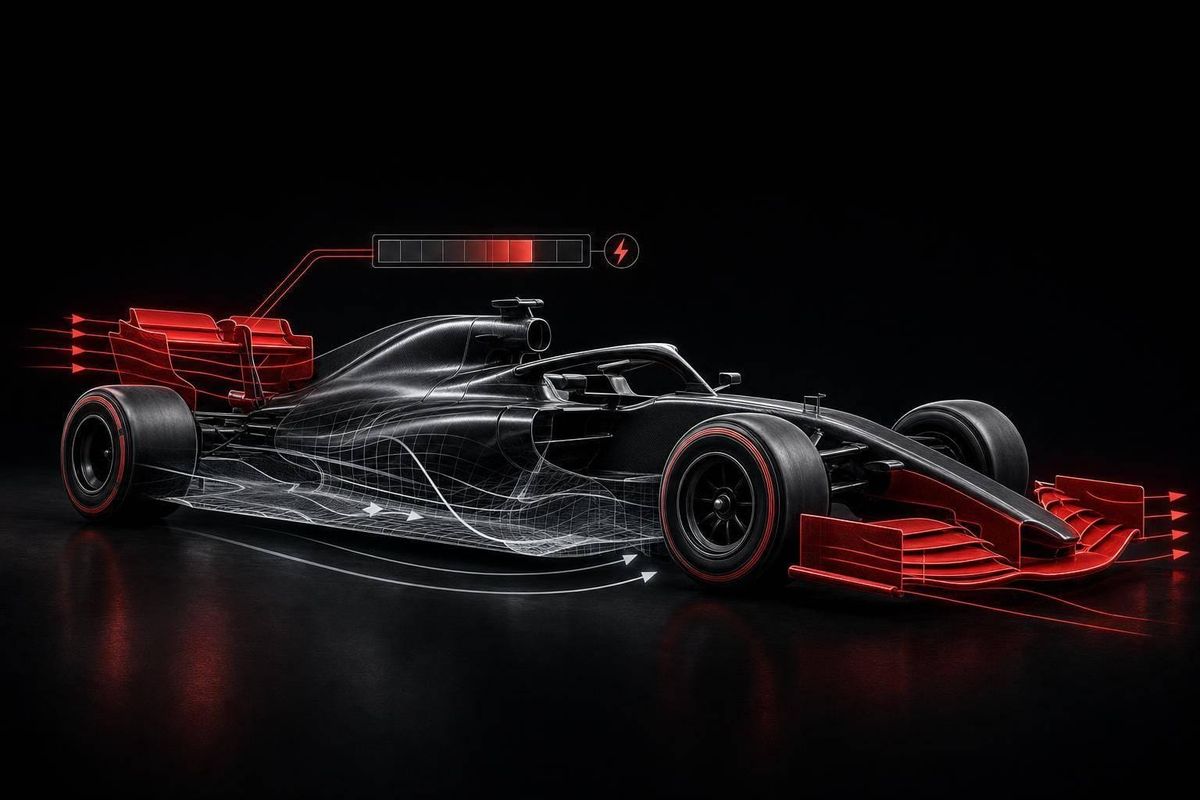
The short version: 2026 F1 cars will be slower in peak cornering, more drag-sensitive, and much more dependent on active wing control and battery use. I’d sum it up like this: teams now have to balance ~30% less downforce, ~55% less drag, active front and rear wings, and a power setup that makes drag hurt more over a lap.
If you want the main takeaway fast, here it is:
- Downforce shifts away from the floor and more toward the wings.
- Active aero matters more than old DRS because both axles can change mode.
- Mode changes can upset balance if front and rear wing movement does not line up.
- Energy use is now tied straight to aero trim, since more drag can drain deployment before the end of a straight.
- Teams will likely split between high-downforce setups for twisty tracks and low-drag setups for power tracks.
In other words: the best 2026 car may not be the one with the most grip. It may be the one that loses the least time from drag, balance shifts, and superclipping.
| Focus area | What changes in 2026 | What teams will chase |
|---|---|---|
| Downforce source | Less floor load, more wing load | Efficient wing performance |
| Active aero | Front and rear wings switch between Z-mode and X-mode | Low drag on straights, stable load in corners |
| Car balance | Aero center can move during mode changes | Smooth transitions drivers can trust |
| Energy use | No MGU-H, more battery pressure, drag costs more | Setup that protects deployment on long straights |
| Track approach | One setup won’t suit every circuit | Different trims for Monaco vs. Spa-style tracks |
I see the 2026 rules as a full reset of how lap time is made. The main fight is no longer just about adding load. It is about combining grip, drag, and energy use without hurting the car’s balance.
The Complete Guide to the 2026 F1 Aerodynamics Regulations
1. The 2026 Aero Rule Reset
The 2026 rules move downforce away from the floor and put more of it into active wings. That means teams can't just tweak what they already know. They have to rebuild the car's aero balance from the ground up.
Aero efficiency
The old DRS setup was simple and blunt: open or closed, rear wing only, and only in set zones. The 2026 active aero system works in a much broader way. Both the front and rear wings can move, and drivers can switch between Z-mode for high downforce in corners and X-mode for low drag on straights, with settings in between.
This matters because the wings now control a huge share of the car's behavior. The front wing produces about 25% of total downforce and 30% of total drag, while the rear wing adds another 25% of downforce and 20% of drag. Put those together, and the active wings let drivers alter about half of the car's aero balance and drag over a lap.
So the hunt for performance shifts with it. Teams will get less from the floor and more from how well the wings work.
Load source mix
With less load coming from the floor, wing efficiency becomes a bigger part of lap time. At the same time, the lower wake should make it less punishing for cars to follow each other closely.
In plain English, the job changes. Instead of leaning so hard on floor sealing, teams now need to get more out of the wings.
Mode transition stability
There’s another wrinkle here. The front and rear wings have to transition together, so any mismatch can create a sharp balance shift in the middle of a corner. That makes calibration just as important as peak load.
A car that makes big numbers on paper won't be much use if it feels snappy the moment the aero mode changes.
Energy and platform integration
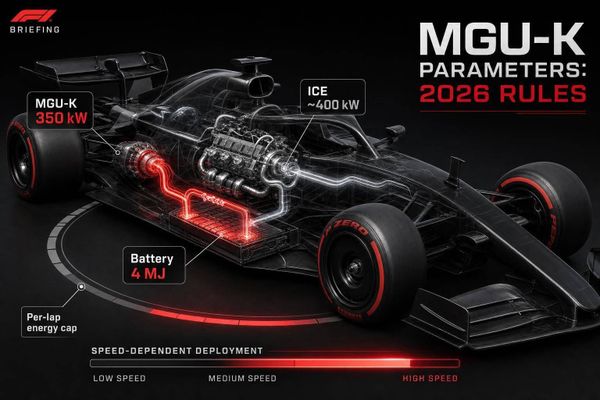
The aero reset also ties straight into the new power-unit setup. In 2026, output is split 50/50 between combustion and electric power, and the MGU-H is gone, so there’s no recovery from exhaust gases.
That changes the cost of drag. With less electric deployment to lean on, a car with too much wing may run short on energy before it even reaches the braking zone. That's why people are already talking about superclipping.
"The Belgian Grand Prix will be incredibly demanding from an energy management perspective... We expect a significant amount of superclipping." - Neil Houldey, Technical Director for Applied Engineering, McLaren
So this isn't just an aero puzzle. It's a trade-off between load, drag, and energy use on the same lap.
2. Downforce Generation Paths Under the New Rules
With the reset in place, the next issue is simple: where do teams get the lost load back?
Aero efficiency
The wings now do most of the heavy lifting. Front and rear wings control a big share of both downforce and drag, which means lap time depends on how well teams can manage the trade between the two.
Put another way: speed now comes more from aero efficiency than from chasing the highest possible load.
Load source mix
The 2026 rules cut total downforce by an estimated 30% compared to the 2022–2025 era. A big reason is the removal of the complex venturi tunnels that defined the ground-effect floor.
Under the new package, load comes from three main places:
- wing-generated downforce
- a simpler flat floor with less underbody contribution
- a narrower, shorter chassis with only a small aerodynamic role
That’s a major shift. Teams that built their 2022–2025 cars around squeezing everything out of underbody load are now dealing with a full reset.
Mode transition stability
The hard part isn’t peak load. It’s making the car behave cleanly as it moves between aero modes.
Switching between Z-mode and X-mode shifts the car’s aerodynamic center. If the front and rear wings don’t transition in sync, the balance can change sharply in the middle of a corner. And that’s where time disappears fast, or where a driver gets caught out by a car that suddenly stops feeling planted.
Energy and platform integration
Every downforce choice now has an energy price attached. Running more wing in Z-mode adds drag, and that pulls more from the battery.
That changes how fast corners work. In some cases, they become energy-management zones, with drivers lifting to save charge. With no MGU-H and tighter energy margins, teams have less room to hide drag with the power unit. So each setup call becomes a balancing act between grip, drag, and battery use.
Those trade-offs are likely to push teams down very different development paths.
3. How Teams Are Likely to Respond in Development
Aero efficiency
Those trade-offs are already pushing teams in different directions. The clearest target is cutting drag without giving away too much cornering load.
Right now, the field seems to be splitting into two camps: teams chasing lower drag and teams leaning harder on power-unit efficiency. McLaren and Williams, for example, are putting a lot of focus on aero efficiency to fight superclipping. That’s the point where the battery runs out before the car reaches the end of a straight, leaving only about 540 hp from the combustion engine. For context, that’s below Formula 2’s roughly 610 hp.
That reality pushes teams toward lower-drag X-mode packages. If the car can slice through the air with less resistance, it has a better shot at masking the drop once electrical deployment fades.
Mode transition stability
Getting the wing angles right on paper is only part of the job. The tougher part is keeping the car balanced while it switches modes.
In plain terms, teams need to tune those wing transitions so the car doesn’t suddenly feel nervous or lazy when the setup changes mid-lap. That means software, aero behavior, and mechanical response all need to work together. If one piece is off, the driver will feel it straight away.
Teams that nail those transitions should have an edge, especially at fast, flowing tracks where the car keeps moving back and forth between modes. That kind of circuit can punish even small balance shifts.
Energy and platform integration
Mercedes and Red Bull-Ford are reportedly putting their focus on engine-aero integration through higher-compression engine development, with an estimated gain of 0.4 seconds per lap.
A gain like that changes the trade-off in a big way. If the power unit and aero package work better together, a team may be able to carry more drag than before and still stay competitive on the straights. That’s because energy deployment and straight-line speed are now closely tied to each other.
At tracks like Spa-Francorchamps and Silverstone, that link becomes hard to ignore. Aero trim can’t be set on its own anymore. It has to match the deployment plan. In other words, aero and energy use now need to be developed as one package, and those calls will shape where teams find lap time - and where they get exposed - on track.
sbb-itb-7c68254
4. On-Track Competitive Trade-Offs
Aero efficiency
Those development choices show up fast once teams hit circuits with very different demands. Wing load is expensive on fast tracks where energy use matters. The front wing generates about 25% of total downforce but around 30% of total drag. So if a team adds more wing to get load back, it pays for that on the straights, and the penalty gets worse once the battery runs low.
You can see that in the projected top-end figures. The 2026 cars are expected to reach La Source braking at about 176 mph (283 km/h), down from 184 mph (296 km/h) in 2025. That drop shows what happens when drag and energy depletion stack on top of each other with the car already close to its limit.
Load source mix
The floor is still an efficient way to make downforce, but the new rules shift more of that load back toward the wings. The difference comes from wings being trimmed in X-mode, which swaps straight-line speed for cornering load.
That trade-off doesn’t land the same way everywhere. Monaco rewards maximum load. Spa punishes drag. At Monaco, where the straights are short and active aero changes offer only a small upside, teams may just run a fixed high-downforce wing setup for the whole lap.
Mode transition stability
Z-mode and X-mode physically move both wings. If those wing movements aren’t matched properly, the car’s balance can change hard in the middle of a corner. That risk is at its worst on fast entries, especially when the car switches back from X-mode to Z-mode.
That’s where setup gets touchy. One car might look sharp over a single lap, then feel far less settled in race conditions. The difference between headline qualifying speed and a car drivers can trust on Sunday may come down to how cleanly those mode changes happen.
Energy and platform integration
Energy planning is now part of pure lap-time performance. At Spa, if a driver uses deployment too early, there may not be enough left for the rest of the lap. So teams have to match aero trim with their energy maps from the very start.
On tracks where energy use is a big factor, the fastest packages will be the ones that tie recovery and deployment together cleanly enough to avoid superclipping. That’s where some of the biggest gains - and some painful losses - are likely to show up next.
Where the Biggest Gains and Risks Sit
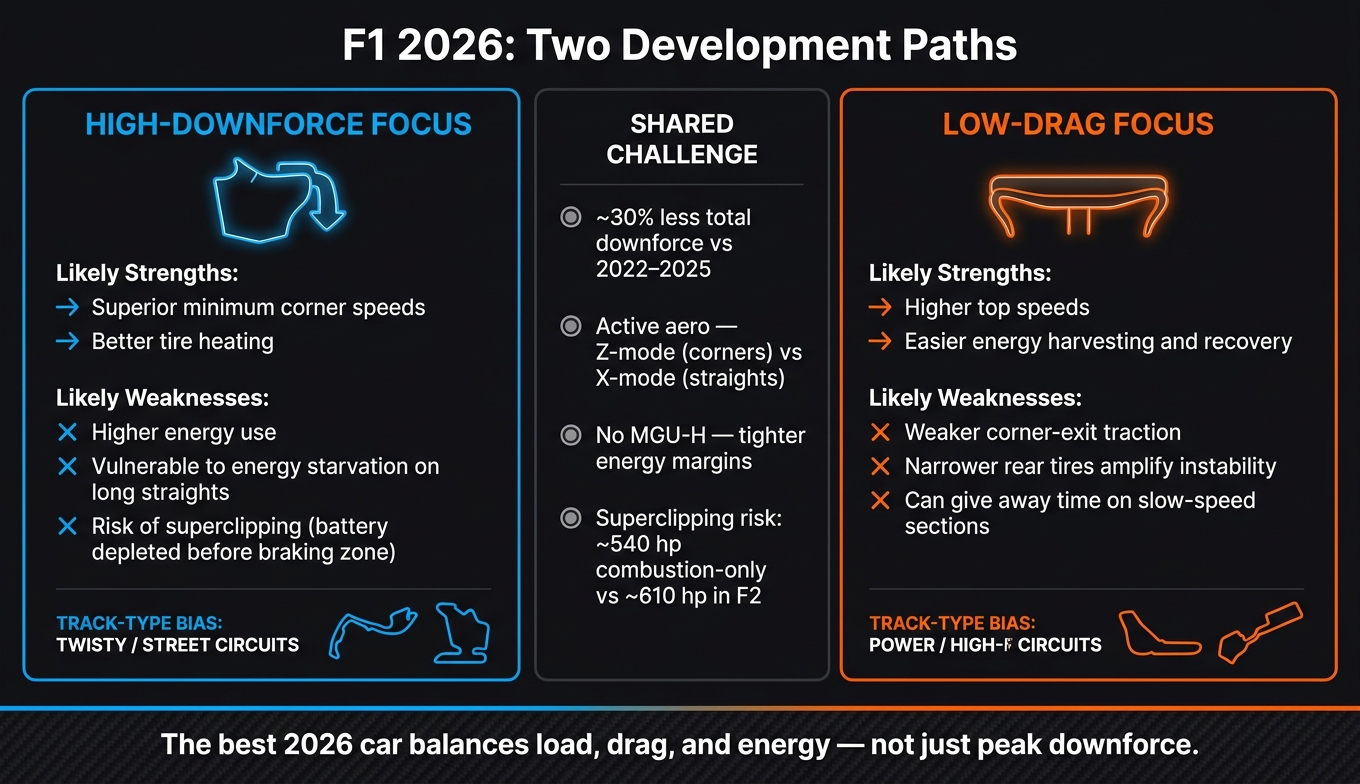
F1 2026 Rules: Two Development Paths Compared
The big split in 2026 is pretty simple: some teams will try to get load back through active aero, while others will try to save energy with lower drag.
That creates two clear development paths. Teams can add wing to recover lost load, or trim the car out and chase efficiency. With total downforce down by about 30% versus 2022–2025, every team has to decide where its lap time will come from.
| Development Path | Likely Strengths | Likely Weaknesses | Track-Type Bias |
|---|---|---|---|
| High-Downforce Focus | Superior minimum corner speeds; better tire heating | Higher energy use; vulnerable to energy starvation on long straights | Twisty/street circuits (Monaco, Hungary) |
| Low-Drag Focus | Higher top speeds; easier energy harvesting and recovery | A low-drag package saves energy but can weaken corner-exit traction, especially with narrower rear tires | Power/high-speed circuits (Monza, Baku) |
This is where the gap between qualifying speed and race-day consistency starts to open up.
Neither route is simple. A high-downforce setup can run into energy starvation, reaching the end of a straight with the battery already empty. That's the same superclipping risk McLaren and Williams are already designing around. On the other side, a low-drag car may look strong on the stopwatch, but if it gives away too much traction on corner exit, that trade-off can come back to bite over a race stint.
The teams that land on a workable middle ground early should have a clear edge.
What matters next is execution. It's not enough to solve load in isolation, or drag by itself. Teams need to hit the balance across load, drag, weight, and energy at the same time. The ones that do that first will set the 2026 benchmark.
Conclusion
The 2026 rules reward the most efficient package, not the car with the most downforce. So the main question changes. It’s no longer about how much load a car can make in peak conditions. It’s about how cleanly that load holds up over a full lap.
Aero efficiency and smooth mode switching will split the front-runners from everyone else. Teams that focus on clean aero efficiency instead of chasing peak load should end up with the stronger all-around package. A car that moves cleanly between X-mode and Z-mode will beat one that hunts for peak load but gets unsettled in the handoff.
Rear stability is the next big separator. With less downforce and narrower rear tires, braking and turn-in become more fragile. That puts more pressure on chassis and suspension setup, not just wing load. The same kind of trade-off shows up in energy use too.
Energy management matters just as much, because drag now brings a direct lap-time penalty when electrical deployment starts to run short. More wing only helps if the power-unit side can cover the bill.
The best 2026 cars won’t solve these trade-offs one by one. They’ll solve them together. The teams that line up aero load, drag, and energy use better than their rivals will have the edge.
FAQs
Why do the 2026 rules reduce floor downforce?
The 2026 regulations cut floor-generated downforce to deal with ground-effect issues like porpoising, shaky mid-corner balance, and cars reacting too sharply to bumps.
To do that, the FIA is moving to a simpler, flatter underfloor. The idea is pretty straightforward: reduce the sport’s dependence on extreme aerodynamic suction from the floor. If teams don’t have to chase that low-to-the-ground setup as aggressively, they can run higher ride heights.
That should make the cars more stable and help limit the violent bouncing and oscillations that have been a problem since 2022.
How will active wings change car balance?
For 2026, active aerodynamics will turn car balance into something that changes through the lap instead of staying locked into one setup. When the front and rear wings move between high-downforce Corner Mode and low-drag Straight Mode, the aerodynamic balance will shift again and again.
Drivers will feel every one of those changes in the cockpit. And that puts pressure on engineers to control what those shifts do to the suspension, ride height, and tire behavior. If they don't keep those transitions calm and stable, the car can become hard to read at exactly the wrong moment.
Why does drag matter more in 2026?
In 2026, drag matters more because strict energy management puts efficiency front and center. The new power units split output 50/50 between the combustion engine and electric power, and energy storage is tight.
That makes low drag a big deal.
With less drag, the car needs less energy to get up to speed and stay there on the straights. That helps stop the battery from draining too early and cuts back on lift-and-coast.
Active aerodynamics add another layer here. Teams can switch to a low-drag mode on straights, which helps save energy when the car is flat out.