F1 Broadcasting: Bandwidth Challenges in Global Delivery
Live F1 feeds are constrained more by sync, path design, and regional outputs than raw bandwidth—venue links, last-mile, and backups cause issues.
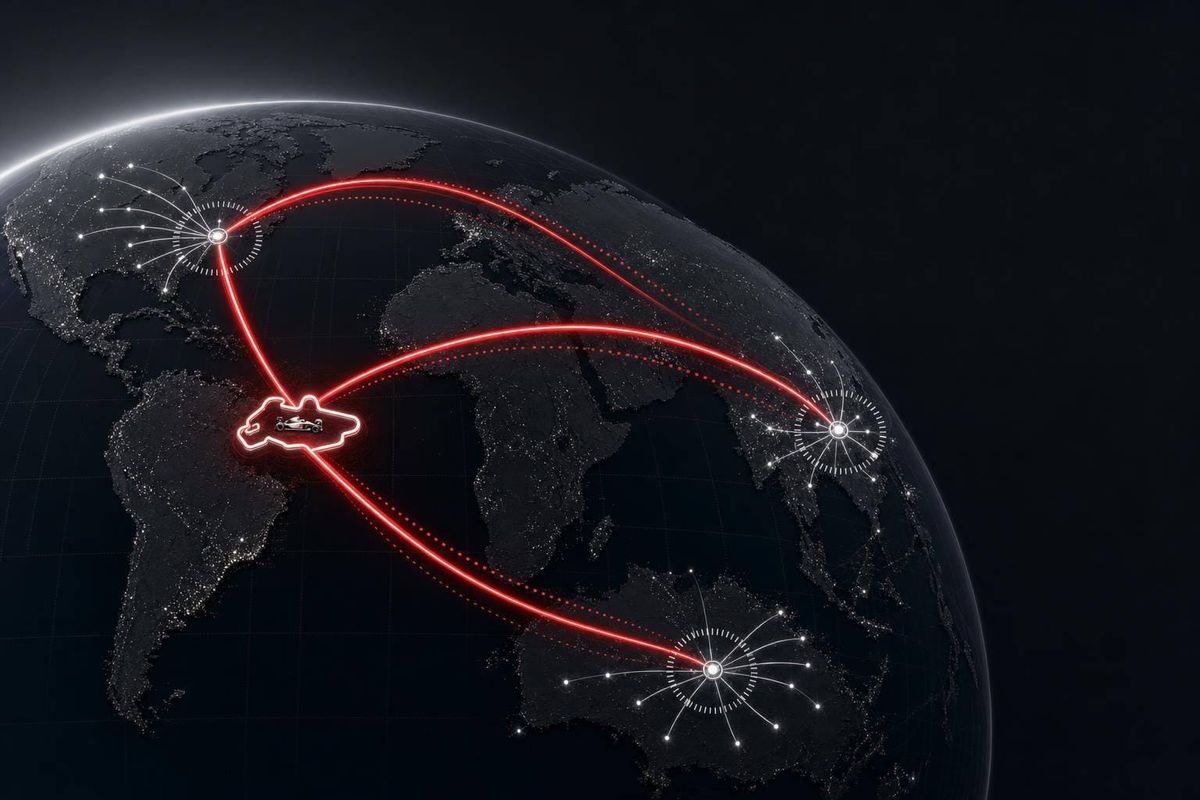
An F1 race feed is not one stream. It is a live bundle of video, audio, timing, graphics, and telemetry that all have to stay in sync across many regions at once.
I’d boil the article down to this: the biggest broadcast risk is not just raw capacity. It is timing + path design + regional output load. If even one part slips, viewers can see delayed graphics, hear audio drift, or lose onboard shots at the wrong moment.
Here’s the short version:
- I see three main choke points: venue links, last-mile handoff, and fake “backup” routes that share the same path.
- I see four signal groups under the most pressure: 4K video, onboard feeds, audio, and telemetry/graphics data.
- I see the network split into two jobs at once:
- move the race feed from circuit to hub with low delay
- send many regional versions out to rights holders and streaming services
- I’d treat sync as the top issue because hundreds of signals have to line up frame by frame.
- Rights deals add another layer: one race can turn into many parallel outputs with different commentary, graphics, formats, and latency targets.
A simple way to think about it: if the venue link is crowded, the last mile is weak, or the backup path is not physically separate, the whole chain can drift out of step. And once regional versions are added, outbound demand goes up fast.
Quick take: F1 broadcast delivery is now as much a distribution timing problem as a transport capacity problem.
That is the core point I’d carry into the rest of the article.
How Formula 1® is broadcast to 180 territories | Episode 1
sbb-itb-7c68254
How an F1 Broadcast Moves from Trackside to Global Distribution
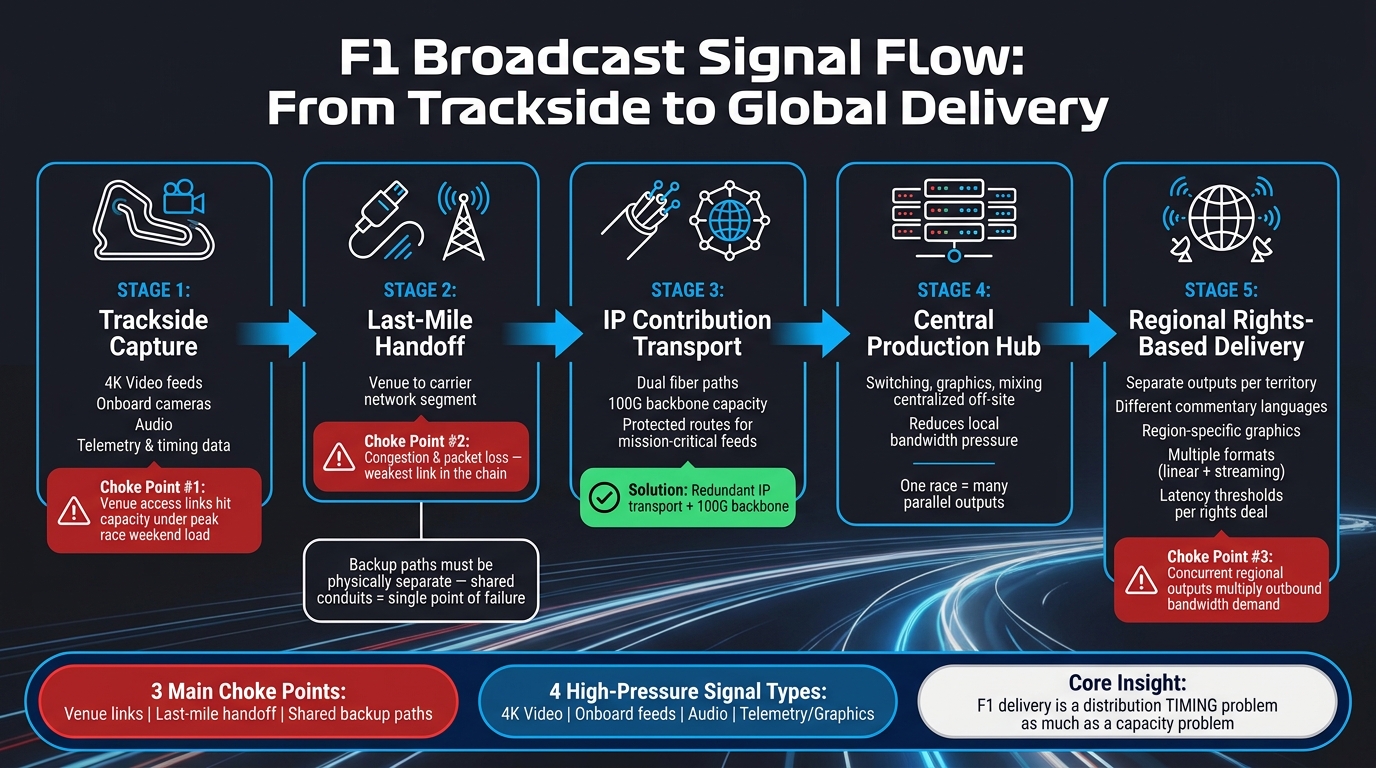
F1 Broadcast Signal Flow: From Trackside to Global Delivery
The next challenge is getting that synchronized feed off-site without losing timing or backup paths. Once the feed leaves the circuit, the job shifts to transport: keeping sync, resilience, and low latency intact as signals move toward the central hub.
Where Bandwidth Bottlenecks Appear During Race Weekends
Once the feed leaves the circuit, problems usually show up first where local capacity is under the most strain. On race weekend, that pressure tends to hit venue infrastructure, the last-mile handoff, and the routes carrying 4K video, onboard feeds, audio, and telemetry. When those choke points get stressed, the result is simple: sync issues, weaker resilience, and more latency, which are some of the biggest risks in live race broadcasting.
Venue Limits, Last-Mile Congestion, and Path Diversity
The venue is often the first pressure point. A circuit may have solid core connectivity on paper, but race weekend changes the load fast. Broadcasters, teams, timing systems, media crews, and event staff all compete for the same local network resources. That can create contention long before the signal reaches the main contribution path.
Last-mile links are another trouble spot. This is the short segment connecting the venue to the carrier network, and it often becomes the weakest link. Even if the long-haul network has enough headroom, congestion or limited capacity at the handoff can slow delivery or cause packet loss. In live production, that’s where small issues can snowball.
Path diversity matters for the same reason. A backup path only helps if it’s actually separate. If primary and backup circuits share the same conduit, exchange point, or local access route, a single fault can take both down at once. On a race weekend, that kind of hidden overlap is the sort of thing nobody notices until it hurts.
How Bandwidth Shortages Affect 4K Feeds, Onboard Cameras, Audio, and Telemetry Graphics
4K feeds usually feel the squeeze first because they demand more throughput and leave less room for error. When bandwidth gets tight, operators may need to compress harder, which can hurt picture quality, or deal with added delay from transport adjustments. In a fast-moving live event, even small delays can throw off the whole production chain.
Onboard cameras bring a different problem. They’re mission-critical, but they’re also part of a larger mix of live signals moving at the same time. If capacity dips or jitter climbs, onboard feeds can become unstable, fall out of sync, or arrive with enough delay to make live switching harder than it should be.
Audio may use less bandwidth than video, but that doesn’t make it safe. If transport conditions degrade, audio can drift against video, break up, or need recovery at the receiving end. And viewers forgive a lot, but bad audio usually stands out right away.
Telemetry graphics depend on timing as much as bandwidth. Data overlays, lap timing, speed traces, and position graphics need to line up with the live pictures. If the data path lags or drops packets, the graphics can appear late or mismatch the action on screen. That kind of error is hard to miss, especially in motorsport, where timing is everything.
Common Failure Points and the Mitigations Used for Each
A few failure points come up again and again during race weekends:
- Venue access links: These can hit capacity limits under peak event load. Teams deal with this by reserving headroom, traffic-shaping noncritical services, and keeping contribution circuits isolated from less urgent traffic.
- Last-mile handoff: This is a common source of congestion and packet loss. Typical fixes include dedicated access, service-level monitoring, and failover links that do not share the same local route.
- Shared backup paths: Backup circuits sometimes look separate but aren’t. The fix is route auditing and physical diversity checks, not just relying on a second line item in a contract.
- High-bitrate video transport: 4K and multi-feed workflows are less forgiving when bandwidth shrinks. Operators often respond with bitrate management, codec tuning, and priority rules for the most time-sensitive feeds.
- Sync-sensitive data flows: Audio and telemetry can break even when video stays up. That’s why timing checks, buffer tuning, and close monitoring of latency variation are such a big part of race-week operations.
The pattern is pretty consistent: the failure rarely starts in the most visible part of the system. More often, it starts in the local access layer or in a backup design that wasn’t as separate as people thought. That’s why race broadcasters put so much attention on bottlenecks close to the venue, not just on the main network path.
Technical Solutions Shaping F1 Broadcast Delivery Today
Venue limits and last-mile issues have pushed broadcasters to lean on redundant IP transport and higher-capacity backbones. In F1, that matters because broadcast systems need to protect mission-critical feeds without losing sync from the track to global distribution.
Redundancy, 100G Backbones, and IP Transport
IP contribution gives broadcasters a way to scale multi-feed race coverage while still keeping protected paths for key signals. At the heart of that setup are dual fiber paths and 100G backbone capacity.
That combination gives operators the backup they need to protect live timing integrity and keep worldwide distribution running at the same time, even if one route drops out.
Bandwidth Demands and Workflow Efficiency
After capacity is in place, the next job is making smart use of it across a large number of live feeds. IP transport can carry many live feeds at once and gives operators more room to route signals across a race weekend.
It also helps move parts of the production workflow away from the circuit. By centralizing switching, graphics, and mixing, broadcasters can cut down on large on-site hardware stacks and reduce local bandwidth pressure, while still keeping critical feeds protected.
Rights, Regional Delivery, and the Next Bandwidth Constraint
How Rights and Regional Delivery Requirements Shape Network Design
Once transport capacity is covered, the next bottleneck is rights. Each market needs the right feed, in the right format, at the right time. That sounds simple on paper. In practice, it changes the whole shape of the network.
Rights rules decide which feeds, languages, and territories the system has to handle at the same time. So a single race broadcast doesn't leave the central hub as one stream. It leaves as a set of separate regional outputs, each with the right commentary language, graphics package, and delivery format tied to that territory's rights deal.
Those rules have direct technical effects. Every regional variant becomes a concurrent output that has to be packaged, routed, and delivered inside its own timing window. One rights holder may want a clean international feed with no embedded commentary. Another may need a fully produced local-language version with region-specific graphics. In the same market, streaming platforms may ask for different bitrates or container formats than linear broadcast partners. Each of those needs adds another lane to the outbound network, pushing up concurrent bandwidth demand and making routing at the distribution layer more complex.
Delivery windows add even more pressure. Some rights agreements set maximum latency thresholds for live delivery, which limits how much buffering or repackaging can happen between the hub and the endpoint. When several regional outputs have to meet their delivery targets at once, the system must keep all of them in sync. Not just the main feed, but every variant in the outbound stack.
That shifts broadcast delivery from one live pipeline into a set of region-specific outputs that all have to stay synchronized.
Conclusion: Key Lessons from Current Bandwidth Research
Bandwidth planning in F1 broadcasting now has to support both live transport reliability and regional distribution complexity at the same time. Current research points to a clear lesson: F1 delivery is now shaped as much by regional output complexity as by raw transport capacity.
FAQs
Why is sync harder than bandwidth in F1 broadcasting?
In F1 broadcasting, the hard part isn’t just bandwidth. It’s synchronization.
There are hundreds of high-speed data streams, and they all need to stay lined up with live video across global networks. That sounds simple on paper. In practice, it’s a juggling act at full speed.
Cloud systems can scale to handle the volume. But timing has to stay exact. Telemetry, split-screen feeds, and driver battle analysis all need to match the live action at the same moment. If they drift even a little, the viewer feels it.
The challenge is that signals often travel along different paths. One feed may arrive a bit earlier, another a bit later. That’s why precise time-stamping matters so much. It keeps everything in sync and makes the whole broadcast feel like one unified experience for viewers.
What makes a backup route fail in practice?
A backup route usually fails because the core transmission network falls out of sync. When the main systems handling live telemetry, team radio, and timing data go down, the backup has to step in without a hitch.
If telemetry stops reporting the right way, or team radio doesn't move through the redundant channels, race-day data starts to disappear. And once that happens, the synchronized broadcast feed effectively goes dark.
How do regional rights increase broadcast bandwidth demand?
Regional broadcast rights split F1 across different platforms and broadcasters in each market. That setup puts more pressure on bandwidth, because each provider has to deliver high-quality video and real-time telemetry through a mix of regional systems.
It also adds more strain when regions need localized streams for commentary and analytics. In plain English, it’s not just one feed going everywhere. Broadcasters often need market-specific versions, which means broader delivery and computing networks are needed to keep viewing consistent and low-latency around the world.