Regional Sponsorships in F1: Key Trends 2026
F1 is shifting from global sponsorships to tightly targeted, market-by-market deals powered by virtual signage and precise ROI.
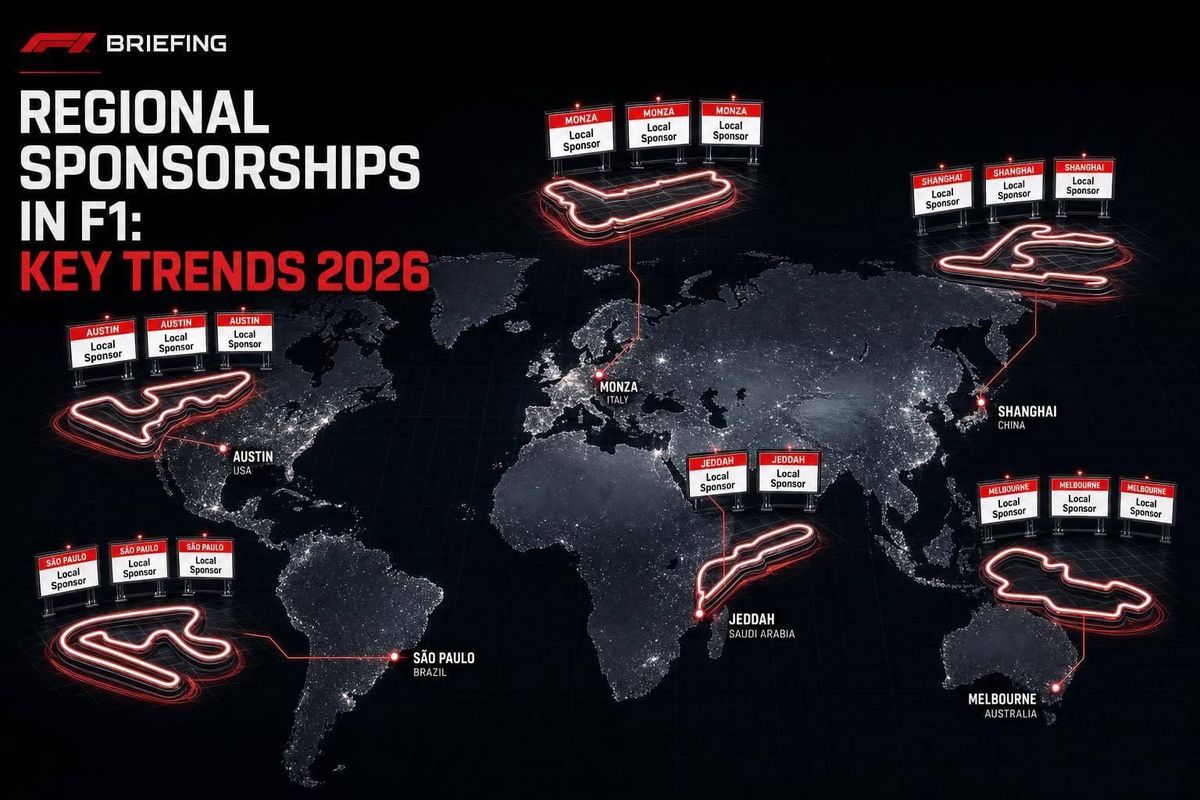
F1 sponsorships in 2026 are getting more local, more targeted, and easier to sell market by market. I’d sum it up this way: teams and broadcasters are making more money from territory-based deals, virtual signage, and region-specific media plans than from one-size-fits-all packages alone.
Here’s the short version:
- Regional rights now matter more because sponsors want access to specific audiences, not just global reach.
- Virtual signage helps sell the same space more than once by showing different brand messages in different markets.
- The Americas, EMEA, and APAC each work differently, based on language, regulation, broadcaster role, and race calendar strength.
- Teams are building layered sponsor packages with a global base and local add-ons.
- The business case is clear: F1 reported $617 million in Q1 2026 revenue, up 53% year over year, and the sport says it reaches 826.5 million fans globally.
What I take from this is simple: F1 is still a global sport, but the money is getting more local. Sponsors now pay for the markets they care about, and that makes pricing, delivery, and ROI easier to track.
What Formula 1’s Sponsorship Boom Means For The Future Of Motorsport
sbb-itb-7c68254
Quick Comparison
| Region | Main pattern | What brands focus on | Why it matters |
|---|---|---|---|
| Americas | U.S. race-led growth | English and Spanish messaging, North and Latin America reach | Strong fit for brands that want U.S. scale with regional targeting |
| EMEA | Category-led market splits | Betting, airlines, telecoms | Useful where rules and market access vary by country |
| APAC | Local market delivery | Local-language assets, broadcaster-led rollout | Works well in markets with very different audience needs |
If you want one takeaway before reading the rest: regional sponsorships are no longer a side option in F1 - they’re now a main part of how inventory is packaged and sold.
How F1 packages regional rights and media inventory
F1 sells media inventory in layers: global rights, territory-specific rights, and race-specific deals. Sponsors then show up across broadcast, digital, and trackside placements, with room to localize by market.
That setup is why regional sponsorship trends don’t look the same across the Americas, EMEA, and APAC.
The main regional sponsorship trends in 2026
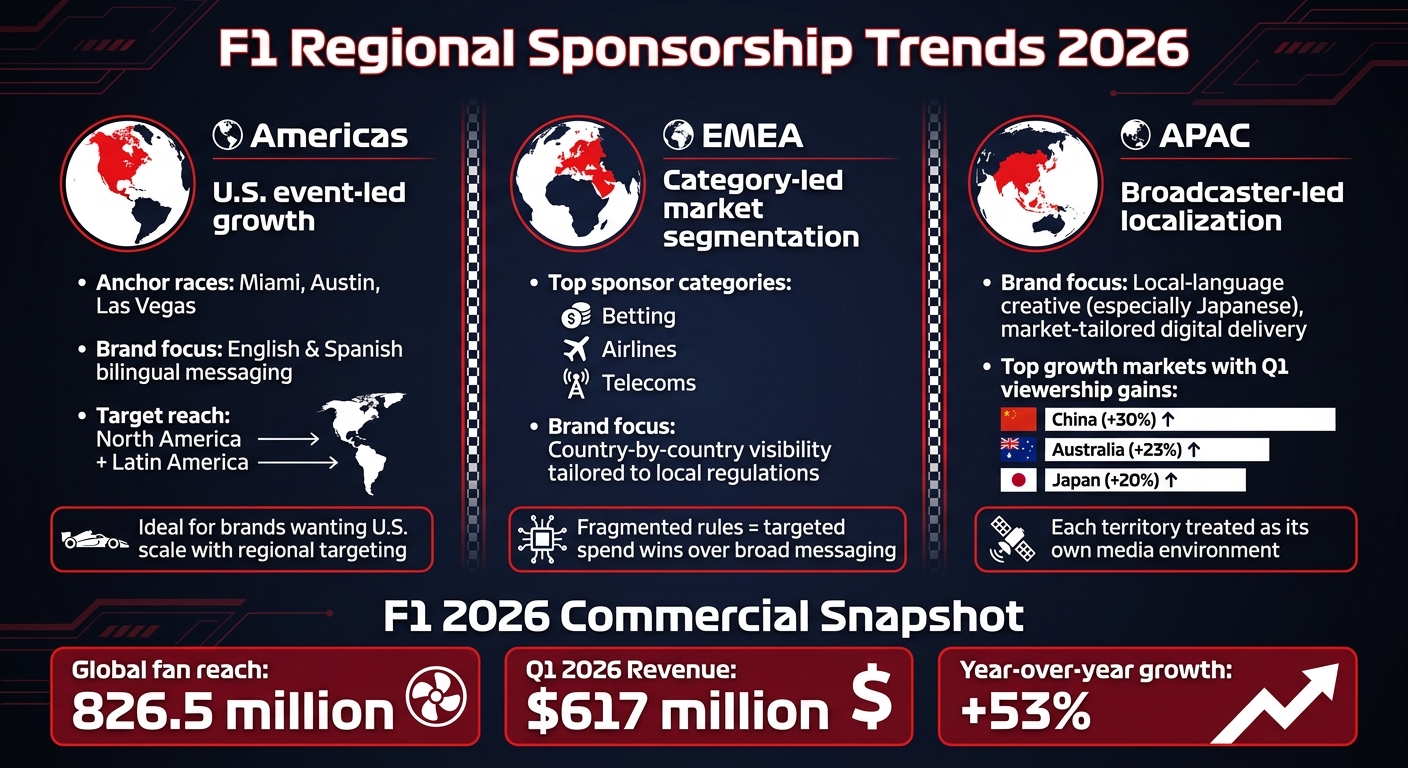
F1 Regional Sponsorship Trends 2026: Americas vs EMEA vs APAC
In 2026, regional sponsorships are splitting by category and by market.
Americas: U.S. event growth, bilingual targeting, and sponsor scaling
Miami, Austin, and Las Vegas are the commercial anchors of F1's Americas plan. Brands use those race weekends as key moments to build U.S. visibility across the full season. That gives them deeper reach in the U.S., plus access to North and Latin American audiences.
Bilingual creative now sits at the center of that approach. English- and Spanish-language messaging helps sponsors connect with U.S. audiences while still making sense across broader North and Latin American markets. For brands that want room to localize without putting all their weight behind one global campaign, regional Americas deals are a strong fit.
EMEA: betting, airlines, and telecoms using segmented visibility
EMEA is still a strong market for category-led sponsorships, especially in betting, airlines, and telecommunications. Brands can tailor visibility by market, with local rules and race location shaping where they appear.
That setup gives sponsors a way to focus spend where it has the most impact. Betting brands can stay visible in markets where they are allowed, while airlines and telecoms can match sponsorship with the regions they already serve. In a fragmented market, that kind of targeted exposure can work better than one broad regional message.
APAC: broadcaster-led activation and consumer brand localization
APAC is the region where localization matters most. Sponsors rely on local-language creative and market-tailored digital delivery to make the same campaign feel relevant across very different audiences. Local broadcasters and digital partners then rework those same assets for each market.
Japanese-language messaging matters in particular. It gives brands a way to match local expectations without rebuilding the full campaign from scratch. APAC tends to reward sponsors that localize market by market and treat each territory as its own media environment.
These regional patterns feed straight into how teams package partners and how virtual signage turns into sellable inventory.
What this means for teams, broadcasters, and sponsor ROI
Regional viewing patterns are changing the way teams package sponsorships and the way broadcasters put a price on them.
Teams are building layered partner portfolios
Teams now package rights as a global core plus market-specific layers, which makes territory-specific activations easier to price and sell.
In plain English, that means a team can keep its big, top-level partners in place while also carving out room for deals aimed at one country or one region. It’s a smarter way to organize inventory, and it gives sales teams more room to match each package to what a sponsor is trying to do.
Virtual signage turns localization into sellable inventory
Regional deals tend to work best when a sponsor’s commercial goal is focused on one market, because the buy is easier to target and measure against local KPIs.
That same logic gets even stronger with virtual signage. If one territory-specific message can run across different broadcast feeds and virtual placements, teams and broadcasters can turn localization into inventory they can actually sell, price, and measure with more precision.
Conclusion: The 2026 sponsorship model is more local inside a global sport
Those packaging choices are now showing up in sponsor returns in a direct way. F1's 2026 commercial model leans toward precision, not just scale. F1 reaches an estimated 826.5 million fans globally, but the deals pushing revenue growth are more often built around specific markets, specific audiences, and specific commercial goals.
That shift is showing up in the numbers. F1 posted record Q1 2026 revenue of $617 million, up 53% year over year. That makes one thing pretty clear: regional inventory is now a measurable revenue driver, not some extra sales layer on the side. The money is growing, but the deals that win are getting tighter and more targeted. That kind of precision helps sponsors move faster and makes market-by-market valuation much cleaner. This is a structural shift in the commercial model.
Key takeaways for the rest of the 2026 season
Three patterns are likely to shape the rest of the season.
- Regional rights are being split with more precision, which creates more sellable, market-specific inventory.
- The strongest Q1 viewership gains came from China, Australia, and Japan - up 30%, 23%, and 20% - which strengthens the business case for localized delivery in high-growth markets.
- Regulated sectors like betting and fintech will keep using targeted media delivery to work through fragmented legal environments.
The result is a model built on more market-specific rights, more localized delivery, and more precise sponsor valuation.
FAQs
How do regional F1 sponsorships differ from global deals?
Regional sponsorships differ from global deals mainly in scope, strategy, and cost.
Global sponsorships give brands one steady presence across all 24 races and teams. Regional deals work differently. They focus on a smaller set of priority markets, which lets brands put their budget where it matters most.
These deals are often built around local race periods or market conditions. That gives brands a more tailored way to connect with audiences through culturally relevant engagement, hospitality, and B2B activation.
Why is virtual signage so valuable in 2026?
Virtual signage matters in 2026 because it gives brands more room to stand out in Formula 1, where physical branding space is tight and expensive.
It also lets teams and sponsors run region-specific messaging at each race without clashing with a car’s livery or disappearing into visual clutter. That makes limited branding space more flexible and more effective from a commercial point of view.
Which regions offer the biggest growth for sponsors?
The United States is still Formula One’s biggest growth market for sponsors. Spending by U.S.-based companies has climbed 68% since 2023.
That growth isn’t happening in a vacuum. With a 52 million-strong fan base by 2024, plus races in Austin, Miami, and Las Vegas, the U.S. has become a prime market for digital-first media models. For sponsors, that means more ways to reach fans across streaming, social platforms, and other online channels.
China, Australia, and Japan are picking up speed too. Viewership is up 30% in China, 23% in Australia, and 20% in Japan. That shift opens the door for global brands that want to meet new audiences while Formula One keeps expanding across major markets.