Top 5 Carbon Capture Solutions in F1
Five carbon-capture routes behind F1’s 2030 net-zero: 2026 sustainable fuel, DAC e‑fuels, removal credits, SAF/logistics, and FIA checks.
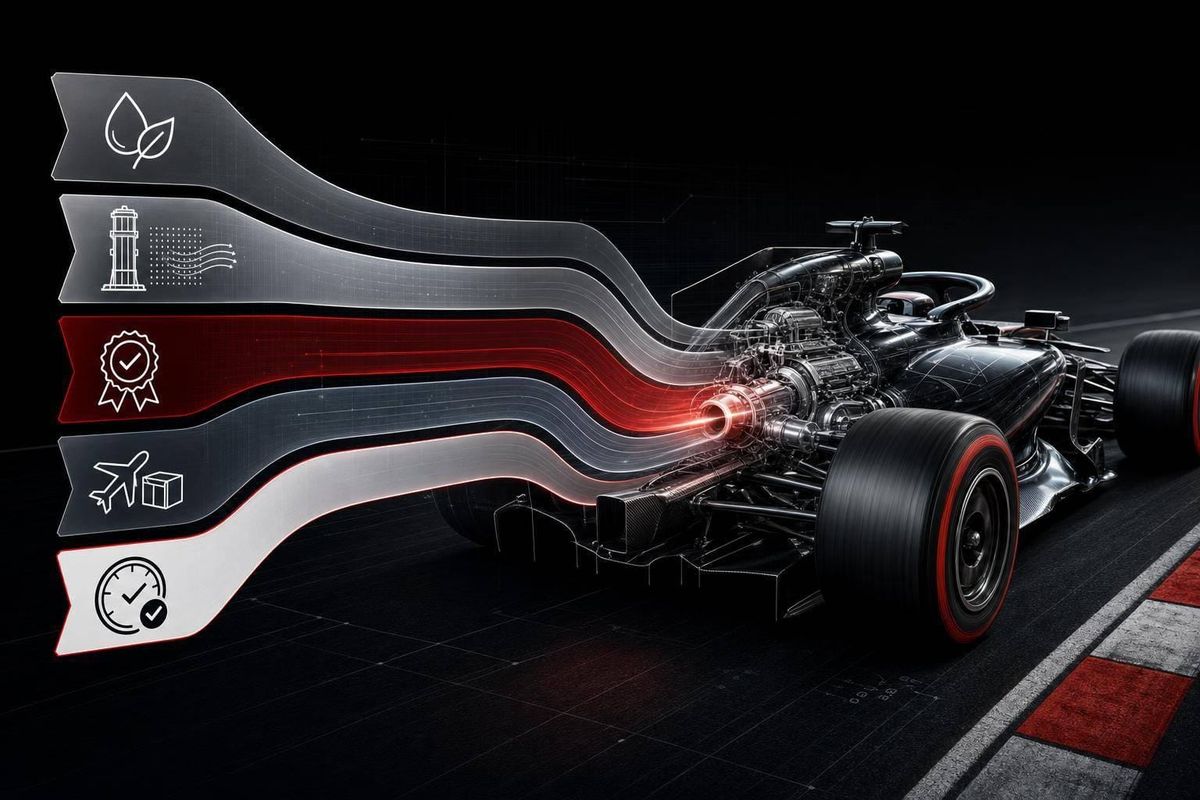
F1’s path to net-zero by 2030 comes down to five things: fuel, air-to-fuel systems, carbon credits, lower-carbon transport, and strict fuel checks.
If I strip the article to its core, here’s the answer: F1 is not relying on one fix. It is using 100% fuel made from non-fossil sources in 2026, a 50:50 combustion-electric power split, more electric output from the MGU-K jumping from 120 kW to 350 kW, and extra steps outside the car to deal with leftover CO2.
Here’s the short list:
- 2026 race fuel made from waste biomass or CO2 pulled from the air
- Mercedes and Petronas air-to-fuel work to supply carbon for synthetic fuel
- McLaren carbon removal and reforestation credits for emissions that still remain
- SAF and lighter freight loads to cut transport emissions
- FIA fuel approval rules to check if fuel claims match the full supply chain
That matters because F1 emissions do not come only from racing. A big share comes from factories, shipping, flights, and fuel production. So if you want the simple version, this is it: F1 is trying to cut new fossil CO2, deal with leftover emissions, and verify the math.
Quick Comparison
| Solution | Main job | What it affects | Main limit |
|---|---|---|---|
| 2026 fuel mandate | Replace fossil race fuel | Cars on track | Supply and approval checks |
| Mercedes DAC path | Pull CO2 from air for fuel | Fuel production | Scale |
| McLaren credits | Balance leftover emissions | Residual team emissions | Storage can vary by project |
| SAF and freight changes | Cut transport fuel emissions | Logistics | Fuel availability |
| FIA verification | Check claims and supply chains | All approved fuel pathways | Depends on strict enforcement |
If you want the takeaway in one line, I’d put it like this: the fuel rule is the center of the plan, and everything else helps close the gap to 2030.
Why Carbon Capture Matters in Formula One
Formula One's biggest emissions don't come only from what happens on Sunday. A large share comes from factories, logistics, and fuel use.
That matters even more under the 2026 rules. F1's move to 100% sustainable fuel depends on a closed carbon loop. In plain English, the carbon released when the fuel is used needs to match carbon that was already taken out of the air.
These fuels come from non-food biomass or from captured atmospheric carbon, so the CO2 released in use is offset by CO2 already removed from the air. That's why fuel is the most direct place to begin.
Efficiency can help, but it can't solve the whole problem on its own. Carbon capture helps close the gap, especially in fuel and logistics. The first solution starts at the fuel level.
sbb-itb-7c68254
1. Carbon-Capture-Derived Sustainable Fuel for the 2026 F1 Engines
In 2026, F1's fuel will come from captured carbon or waste biomass, turning combustion into a closed carbon loop. Put simply, the carbon released on track was already taken out of circulation earlier. That's what makes fuel one of the clearest proof-of-concept cases for carbon capture in F1.
Current F1 Adoption
Mercedes, McLaren, Williams, Alpine, and Aston Martin are already connected to the 2026 fuel supply chain through Petronas, Aramco, and the new engine partners.
Removal or Reduction Pathway
Because the carbon in the fuel was already captured from the atmosphere or derived from waste biomass, the CO2 released during combustion simply returns carbon that was already in circulation. That doesn't mean the system gets a free pass, though. The fuel has lower energy density than fossil fuel, so the 2026 power unit is being tuned for efficiency and reliability instead of pure fuel density.
Durability of Carbon Outcome
The big issue here is verification. These fuels must pass a rigorous approval process with independent third parties confirming compliance across the full production chain. If that chain isn't checked carefully, the whole claim starts to wobble.
Contribution to the 2030 Net-Zero Target
The shift to 100% sustainable fuel is a primary pillar of F1's plan to reach net-zero carbon by 2030. Fuel closes one carbon loop. The next hurdle is cutting carbon more directly from operations and infrastructure.
2. Mercedes-AMG PETRONAS Direct Air Capture Investments

If sustainable fuel helps close one part of the loop, Mercedes is backing the step that comes before it: pulling carbon out of the air.
Mercedes-AMG PETRONAS is putting support behind direct air capture, or DAC, to help supply the carbon feedstock for its 2026 fuel pathway. In plain English, DAC systems filter CO2 from ambient air and turn that captured carbon into the raw material for drop-in synthetic fuels.
Current F1 Adoption
Mercedes-AMG PETRONAS gets its sustainable fuel from Petronas, its main fuel development partner. Petronas also has to pass a strict third-party homologation process that checks sustainability across the full supply chain, with a deadline of March 1, 2026.
That same verification rule applies to customer teams as well.
Removal or Reduction Pathway
DAC removes CO2 from the atmosphere and converts it into synthetic fuel. When that fuel is burned, it releases carbon that was already taken from the air, which means no new fossil carbon is added to the atmosphere.
For Mercedes-AMG PETRONAS, that makes DAC part of the emissions-cutting mechanism itself, not a separate offset. That distinction matters. The carbon used in the fuel comes from the air first, then returns to the air after combustion.
Durability of Carbon Outcome
The staying power of this carbon outcome rests on two things: third-party verification and the ability to scale DAC fuel beyond one supplier.
Homologation acts as a proof point for operational maturity. It confirms that the full capture-to-combustion chain meets the required standard before the 2026 season starts.
Contribution to the 2030 Net-Zero Target
By replacing fossil carbon with atmospheric carbon, Mercedes-AMG PETRONAS turns fuel into a direct emissions-reduction tool on the path to F1's 2030 target.
The big test is scale. Can DAC-based fuel be verified on time and expanded beyond a single supplier? That answer will shape how much this pathway can contribute in practice.
3. McLaren Racing Reforestation and Carbon Removal Credits

Beyond fuel, McLaren uses reforestation and carbon removal credits to deal with residual emissions. In plain terms, these credits are meant to cover the share of emissions that efficiency gains and fuel changes still can’t cut.
This sits a bit differently from direct air capture, or DAC. DAC helps feed the fuel cycle. Reforestation and carbon removal credits, by contrast, are used to balance emissions left on the table. That’s the gap McLaren is trying to close here.
Current F1 Adoption
McLaren has already brought reforestation and carbon removal credits into its broader climate approach. The idea is simple: Formula 1 teams can trim a lot through better energy use, travel planning, and lower-carbon fuels, but some emissions are stubborn. Credits are used for that leftover portion.
In the current F1 setting, this puts McLaren in line with a growing push across the sport to deal with emissions that can’t yet be removed at the source. It’s not a swap for cutting emissions. It’s a second lever.
Removal or Reduction Pathway
The pathway here is removal, not just reduction. That distinction matters.
Reduction means producing fewer emissions in the first place. Removal means taking carbon dioxide out of the atmosphere, or storing it through projects such as reforestation, and then using credits tied to that work to counter residual emissions.
For McLaren, this means two things are happening at once:
- emissions are being cut where possible through efficiency and fuel changes
- carbon removal credits are being used for the remainder
That split is important because it shows these credits are part of a broader plan, not the whole plan.
Durability of Carbon Outcome
Durability depends on the type of removal credit involved.
Reforestation can store carbon over time, but the outcome may change if forests are damaged by fire, disease, land-use change, or poor project management. Carbon removal methods with longer-term storage can offer a more durable outcome, though the exact level depends on the project type and how storage is verified.
So while both reforestation and carbon removal credits sit under the same broad umbrella in this context, they don’t all carry the same staying power. That’s a key point when looking at the quality of the carbon outcome.
Contribution to the 2030 Net-Zero Target
For the 2030 net-zero target, these credits play a gap-filling role. They help McLaren address residual emissions that remain after direct cuts.
That makes them part of the path to net-zero, but not the main engine of it. The heavier lift still comes from reducing emissions through operations, energy use, and fuel changes. Credits are there to balance what those steps can’t yet remove on their own.
4. Sustainable Aviation Fuel and Lower-Carbon Freight Programs
F1 is pairing sustainable aviation fuel with lower-carbon freight planning to cut transport emissions. Once race fuels are dealt with, logistics becomes the next big emissions front.
Current F1 Adoption
F1 is using sustainable aviation fuel alongside lower-carbon freight planning to cut transport emissions. SAF uses biogenic or captured carbon instead of fossil jet fuel, so it connects directly to the same carbon-loop idea used for race fuel.
There’s also a freight angle that’s easy to miss but matters a lot. The 2026 cars are 30 kg lighter and 200 mm shorter, which means less weight and volume need to move around the world on each race weekend.
Removal or Reduction Pathway
SAF cuts fossil emissions by replacing standard jet fuel with fuel made from biomass or captured carbon. It does not remove CO2 that’s already in the atmosphere.
That’s why SAF works as a transport-side partner to the fuel-loop approach already used in the car. One deals with how the car is powered. The other deals with how the sport moves everything from one race to the next.
Durability of Carbon Outcome
The upside depends on SAF supply. If available volumes stay limited, the effect stays modest.
Contribution to the 2030 Net-Zero Target
These logistics changes support F1's net-zero by 2030 target. The 2026 cars are also 30 kg lighter and 200 mm shorter, which cuts freight volume and shipping emissions.
Taken together, the fuel and freight changes push fossil emissions further away from F1’s 2030 target gap and help shrink the transport footprint around each event.
5. F1's Fuel Verification Framework
F1's fuel sustainability system is run by the FIA and checked through a formal homologation process.
Current F1 Adoption
Once you look past the fuel cycle itself, the next issue is simple: can F1 actually prove the carbon claims?
The FIA sets the 2026 fuel rules and requires homologation, a third-party process that checks supply-chain claims before a fuel can count toward F1's 2026 fuel mandate.
For the 2026 season, suppliers such as Petronas and Aramco had to complete that process by March 1, 2026. That verification step is what separates compliant fuel from a basic sustainability claim.
Removal or Reduction Pathway
F1 recognizes two fuel pathways: biological fuels made from waste biomass or other non-food sources, and technical e-fuels made from captured atmospheric carbon.
This subsection focuses on how homologation checks both routes. Each pathway has to show a net-zero carbon cycle through independent third-party review before it can count under the framework.
Durability of Carbon Outcome
The main durability check is verification.
Homologation acts as the safeguard that confirms the fuel's sustainability claims before it is used in competition. That's what lets both the biological and technical routes count under the same framework.
Contribution to the 2030 Net-Zero Target
Homologation makes the 2026 fuel mandate auditable. And that's what turns carbon capture from a claim into a trackable part of F1's 2030 plan.
How These 5 Solutions Compare
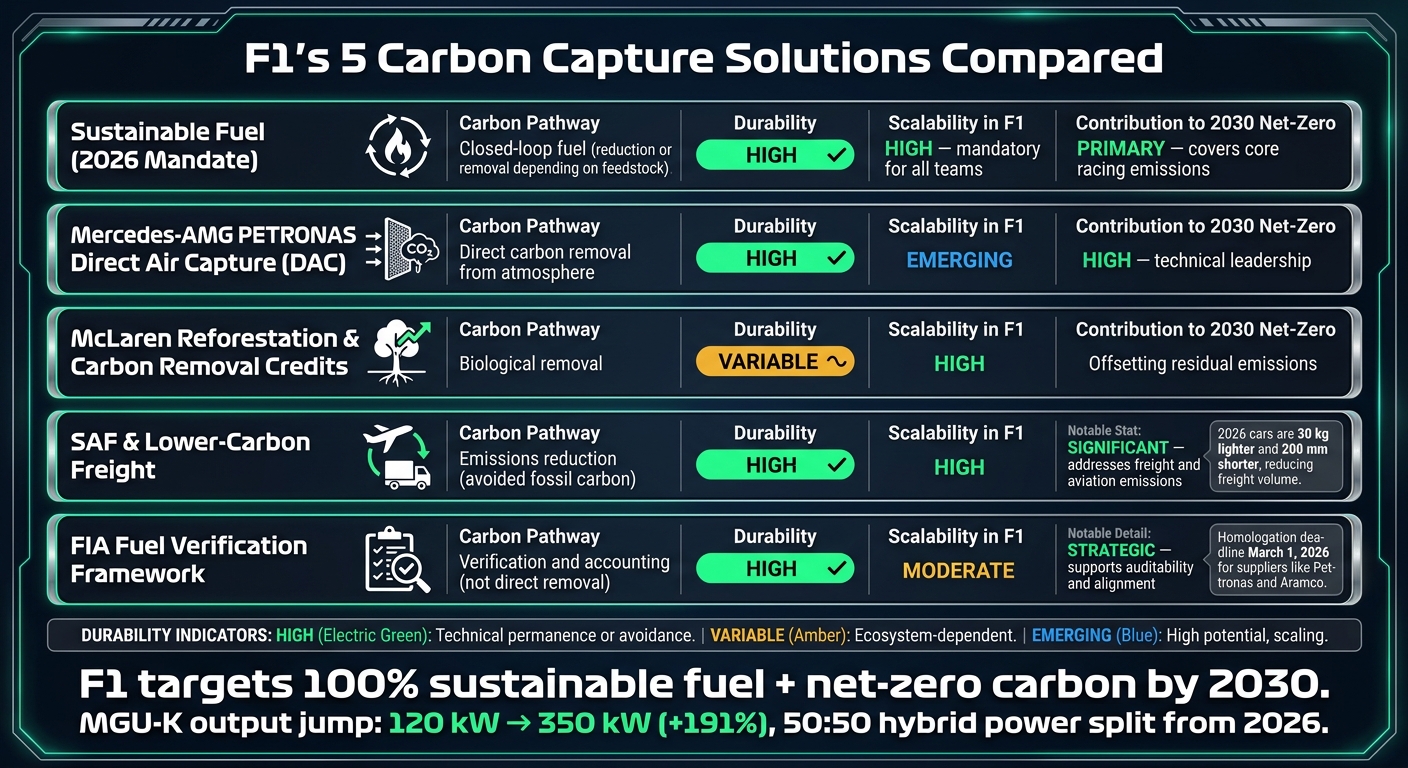
F1's 5 Carbon Capture Solutions: 2030 Net-Zero Breakdown
These five solutions differ in a simple but important way: some avoid fossil carbon, some remove CO2, and one checks whether the claims hold up. That distinction matters because F1 needs both actual emissions cuts and carbon accounting people can trust.
The 2026 sustainable fuel mandate is the main lever. It applies to every team and closes the racing-fuel carbon loop.
Mercedes-AMG PETRONAS's DAC path aims at high-durability removal, but it's still at an early stage and limited in scale. McLaren's reforestation credits can scale faster, though the carbon storage is less certain over time. Sustainable aviation fuel and lower-carbon freight programs go after logistics emissions across F1's global operations, so their effect can be large even if the pathway is reduction rather than removal. The FIA framework doesn't remove carbon on its own. What it does is make fuel and removal claims auditable, and its effect depends on the projects it verifies.
Comparison Table: 5 Carbon Capture Solutions in F1
| Solution | Carbon Pathway | Durability | Scalability in F1 | Contribution to 2030 Net-Zero |
|---|---|---|---|---|
| 1. Sustainable Fuel (2026 Mandate) | Closed-loop fuel: reduction or removal depending on feedstock | High | High - mandatory for all teams | Primary - covers core racing emissions |
| 2. Mercedes-AMG PETRONAS DAC | Direct carbon removal | High - technical permanence | Emerging | High - technical leadership |
| 3. McLaren Reforestation Credits | Biological removal | Variable - ecosystem-dependent | High | Offsetting residual emissions |
| 4. SAF & Lower-Carbon Freight | Emissions reduction | High - avoided fossil carbon | High | Significant - addresses freight and aviation emissions |
| 5. FIA Sequestration Framework | Verification and accounting | High - regulatory structure | Moderate | Strategic - supports verification and alignment |
What This Means for F1's 2030 Net-Zero Push
Put together, these five solutions do three things: cut fossil fuel use, deal with leftover carbon, and prove the claims are real. The 2026 sustainable fuel rule changes what F1 cars burn. Then carbon-removal methods like direct air capture and reforestation help address the emissions that fuel and power-unit changes still can't fully remove.
There’s also a supply problem. Sustainable fuel is limited, and aviation is already competing for the same feedstock and production capacity. That’s a big reason the 2026 rule change carries so much weight.
From 2026, F1 shifts to 100% sustainable fuel, a 50:50 hybrid split, and a 191% jump in MGU-K output, from 120 kW to 350 kW. That’s not a small tweak. It shows the sport rebuilding the heart of the car around efficiency and lower emissions.
But none of this works on trust alone. The whole setup depends on proof. That’s the thread running through everything here: verification. FIA homologation is what makes fuel and carbon-removal claims auditable at scale.
Conclusion
F1's carbon capture strategy now covers fuel, removal, freight, and verification. The clearest proof is the 2026 fuel mandate, which moves carbon capture from an optional idea to a compliance requirement - a core technical standard used across the entire grid.
That change matters because the fuel supply chain is being checked from end to end. It carries weight because there is a fixed deadline and clear compliance rules written into the FIA Technical Regulations, with homologation behind them. Put simply, those controls turn carbon capture from a claim into an operational standard.
What F1 is doing now feels less like a promise and more like an enforceable engineering program. The sport is treating carbon capture as engineering infrastructure, not branding. That is the real story of F1's 2030 push: execution, not rhetoric.
FAQs
How is F1’s 2026 fuel actually made?
From 2026, Formula 1 will run on 100% advanced sustainable fuel made with no fossil sources. This synthetic drop-in fuel is produced from non-food biological materials, including waste biomass and municipal waste, along with captured atmospheric carbon.
That shift sounds simple on paper, but the fuel itself changes the engineering job. Its energy density is different from standard gasoline, so teams and partners are tuning the fuel’s chemistry to match the needs of the 1.6L V6 turbo engines and the 2026 power unit design.
Does carbon capture make F1 truly net-zero?
Carbon capture plays an important role in Formula One’s plan to reach net-zero by 2030. But on its own, it won’t get the job done.
F1 also relies on 100% sustainable fuels, advanced hybrid energy recovery systems, and broader work across the sport, including supply chain decarbonization and material circularity.
Why is fuel verification so important in F1?
Fuel verification matters in Formula 1 for a simple reason: it helps keep the sport fair and makes sure teams follow the rules.
That job becomes even more important as F1 moves to 100% advanced sustainable fuels in 2026. To police that shift, the FIA uses strict homologation so it can confirm that fuels meet sustainability standards across the supply chain.
Checks happen in a few ways. Officials look at telemetry, review fuel flow meter data, and test post-race fuel samples. If a team fails any of those checks, the penalties can be severe. That helps stop teams from gaining an unfair performance edge.