Do Budget Caps Create Fairer F1 Competition?
How F1's budget cap cut spending gaps and improved fairness, while legacy resources still shape race results.
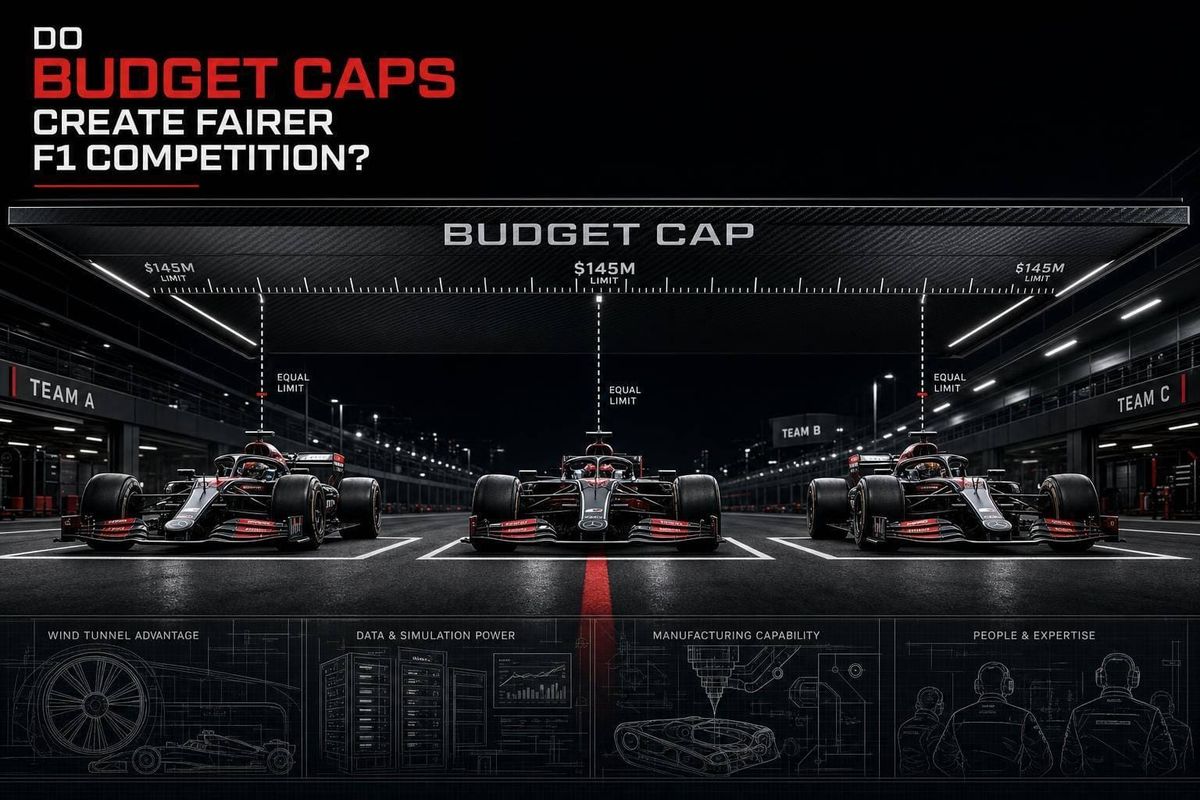
Yes - budget caps have made F1 more even on money, but not level on results. Since the cap began in 2021, the spending gap has dropped from about 6-to-1 to about 2.5-to-1, the cap moved from $145 million to $135 million before adjustments, and teams now face audits, fines, and testing cuts if they go over.
Here’s the short version:
- On spending: Big teams can’t outspend the field like they used to.
- On results: The grid looks tighter, but top teams still keep old advantages.
- On upgrades: Smaller teams have a better shot to plan and develop, but rich teams still have stronger factories, tools, and staff.
- On rule policing: The FIA does check the numbers, and breaches have led to penalties.
- On the limit of the cap: Driver pay, top executive pay, power units, marketing, and some factory costs still sit outside the cap.
A good example is Red Bull’s 2021 overspend case. The team went over by £1.864 million - about 1.6% of the cap - and got a $7 million fine plus a 10% cut in aero testing for 12 months. That showed the system has teeth, even if some people think the punishments should hit harder.
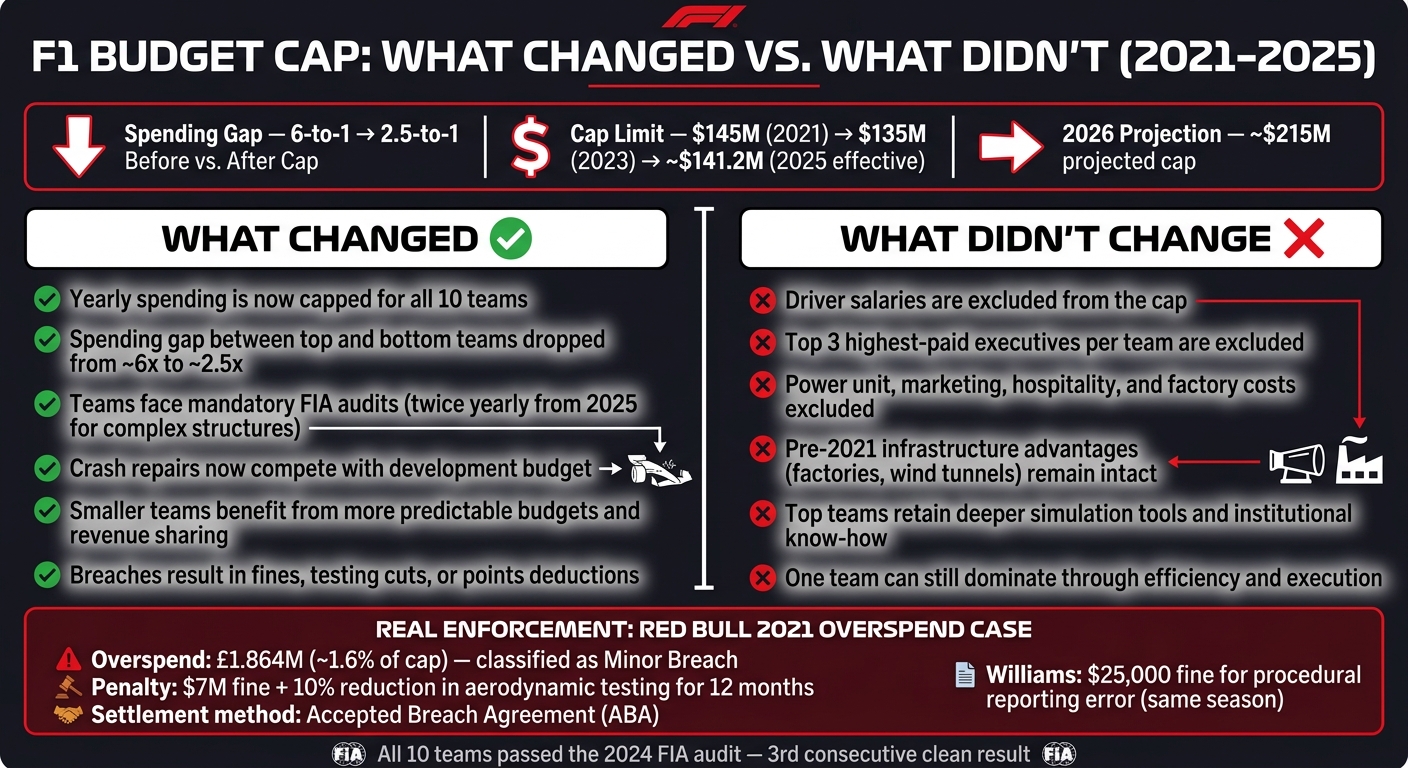
F1 Budget Cap: What Changed vs. What Didn't (2021–2025)
F1's Cost Cap Saga Explained
sbb-itb-7c68254
Quick Comparison
| Area | What changed | What did not change |
|---|---|---|
| Spending gap | Fell from about 6-to-1 to 2.5-to-1 | Top teams still have more total resources |
| On-track order | Midfield has moved closer at times | One strong team can still dominate |
| Team budgets | More control and better planning | Crash costs still hurt smaller teams more |
| Rule policing | Audits, breach reviews, and penalties exist | Debate remains over whether penalties go far enough |
| Team advantages | Yearly spend is limited | Old factories, tools, and know-how still matter |
My takeaway: the cap has helped stop runaway spending and made the sport tighter in money terms, but it has not erased the head start built before 2021. So if you’re asking whether budget caps make F1 more even, the answer is yes. If you’re asking whether they make F1 equal, the answer is no.
How the Budget Cap Works in Practice
The cap matters for one simple reason: it blocks the easiest route to more speed - just spending more money.
The limit dropped from $145 million in 2021 to $135 million from 2023 onward. Then a couple of moving parts changed the actual number teams had to work with. Inflation adjustments, plus race-count changes, added more room under the rules. Teams get an extra $1.8 million per Grand Prix beyond 21 races, which pushed the effective cap to about $141.2 million by 2025. Looking ahead, that figure is projected to jump to about $215 million in 2026 under the new technical rules, which also tighten how some previously exempt costs are treated.
That all sounds clear enough on paper. But a cap only does its job when the rules are applied the same way to everyone.
Which Costs Are Capped and Which Are Left Out
The cap covers the heart of car performance. That includes car design, manufacturing, race operations, wind tunnel and CFD testing, and most personnel salaries tied to performance work.
But some big-ticket items still sit outside the limit.
Driver salaries are excluded, and so are the three highest-paid employees at each team. Power unit costs, marketing, hospitality, and factory construction and upgrades are also left out. So while teams can't pour unlimited money into every part of the car program, they can still spend heavily in areas that shape performance without those costs hitting the yearly cap.
How Audits, Breach Categories, and Penalties Work
Teams have to submit full financial records to the FIA Cost Cap Administration by March 31 each year. From 2025, the FIA also increased on-site audits to twice a year for teams with complex corporate structures or related manufacturing businesses.
When a team breaks the rules, the outcome falls into three categories:
| Breach Category | Definition | Potential Penalties |
|---|---|---|
| Procedural | Reporting or documentation errors | Fines, public reprimand |
| Minor Overspend | Overspend < 5% of the cap | Fines, points deduction, testing restrictions, cap reduction |
| Major Overspend | Overspend > 5% of the cap | Fines, points deduction, testing restrictions, event suspension, possible championship exclusion |
A clear example came with Red Bull Racing in October 2022. The team exceeded the 2021 cap by £1.864 million, which worked out to a 1.6% minor overspend. Under an Accepted Breach Agreement (ABA) - a fast-track settlement - Red Bull paid a $7 million fine and took a 10% reduction in aerodynamic testing allowance for 12 months.
Williams went through the same process for a procedural reporting error from that season and received a $25,000 fine.
The ABA gives teams a way to settle minor or procedural breaches without dragging things out. But it can't be used to sidestep the harshest sporting penalties, including championship exclusion. That's the part that matters most. The value of the cap doesn't rest on whether teams file the right paperwork. It rests on whether enforcement changes what happens on track.
The next issue is the one fans care about most: have tighter spending rules actually closed the gap between teams?
Has the Cap Actually Brought the Grid Closer Together?
Enforcement matters, but the main test is still the stopwatch. On that front, the cap seems to be doing its job, just not all at once.
What the Early Cost-Cap Era Data Points To
The early signs point in the right direction. The cap has helped reduce performance gaps, but the change has been slow rather than dramatic. By 2024, the gap between the front-runners and the midfield had started to tighten. That's a gradual change, yes, but it's still measurable.
Why One Team Dominating Does Not Automatically Mean the Cap Has Failed
Red Bull's run at the front doesn't prove the cap failed. It proves something else: a budget cap doesn't promise equal outcomes. And that's the key distinction. Fairness and equality are not the same thing.
Red Bull's edge came from efficiency and execution, not from endless spending. The team produced a better car concept and managed development with more discipline. A spending limit can't erase that, and it shouldn't.
Some built-in advantages still sit outside the cap, including driver salaries and infrastructure. What the cap does stop is a team simply outspending everyone else to muscle its way forward. The battle has moved from a pure spending war to an efficiency race, where every dollar has to justify itself. That change matters, even if it still leaves a few built-in edges untouched.
Where the Budget Cap Helps and Where It Falls Short
What the Cap Gets Right: Spending Control, Stability, and Long-Term Planning
Before the cap, top teams could spend more than $400 million per year. That kind of spending created a huge gap between the front and the rest of the grid. The current cap changes that. Teams now have to make harder choices about where the money goes, whether that's car development, crash repairs, or day-to-day operations. It brings more discipline to the process, even if it doesn't wipe out the head start some teams built before the rules changed.
The cap also shifts how teams deal with risk during a season. A crash isn't just a racing problem anymore. It's a budget problem too. If a car is badly damaged, the repair bill comes out of the same capped pool used for performance upgrades. That tradeoff matters. One big accident can slow development plans in a very direct way.
For smaller teams, this setup has helped in another way: more predictable budgets. Revenue sharing has made planning easier for them, which means they can think further ahead instead of scrambling from one season to the next.
What the Cap Does Not Fix: Infrastructure, Talent, and Excluded Costs
Here's the catch: the cap controls yearly spending, not the advantages teams built up over many years.
Mercedes spent decades building a top-level factory and wind tunnel before the cap existed. Ferrari has deep technical infrastructure of its own. Those assets didn't vanish when the rules came in. The cap can slow new expansion, but it doesn't level what was already there.
Some of the biggest costs also sit outside the cap. Driver salaries are excluded, along with the pay of each team's three highest-paid executives. So while teams now face tighter limits on car spending, richer organizations can still keep elite people without cutting into the development budget.
That matters because in Formula 1, even small edges can decide a lot. Better factories, stronger simulation tools, and years of internal know-how can all make a team more efficient. And when development gets more efficient, that usually shows up in lap time. So yes, the cap has narrowed the spending gap. But it hasn't erased the deeper structural edge held by teams that were already ahead.
What Breach Cases Reveal About How Well the System Is Enforced
This same divide between capped and uncapped advantage shows up in enforcement too.
Breach cases make one thing clear: the cap is not just for show. It is monitored, and teams can be penalized for crossing the line. At the same time, critics aren't wrong to question whether fines and testing penalties are enough to scare off teams with major financial backing. If the upside of overspending is race performance, some people will always wonder whether the punishment hits hard enough.
The FIA has tried to close some of those gaps by tightening rules around intellectual-property transfers from non-F1 work, including road-car and hypercar programs. That's a clear sign the system is getting stricter. Still, gray areas haven't disappeared.
Conclusion: Budget Caps Make F1 Fairer, But Not Equal
The picture is clearer now, even if the grid still isn’t level. The budget cap has made F1 fairer. Before 2021, the gap between the biggest spenders and the backmarkers was about 6-to-1. Now it’s closer to 2.5-to-1.
That’s a big shift. But there’s a catch: the cap limits what teams can spend each year. It doesn’t wipe out years of past investment, old facilities, or deep-rooted advantages. Put simply, it slows the gap from getting bigger, but it doesn’t make the old gap disappear.
There’s also a strong case that the rules are being enforced. All 10 teams passed the 2024 audit, marking the third straight clean result. That matters. A rule only means so much if nobody checks it. At the same time, Accepted Breach Agreements still get pushback because they stop short of tougher sporting penalties.
The next big checkpoint comes in 2026. A major technical reset tends to shake up the order, so the 2026 rules should show whether the cap can keep teams closer when the sport changes direction in a big way.
So the verdict stays simple: the budget cap made Formula One fairer, not equal.
FAQs
Why doesn’t the budget cap make F1 fully equal?
The budget cap doesn’t make F1 fully equal. It mostly puts limits on certain types of performance spending, but it doesn’t erase every edge a team can have.
Some big advantages sit outside the cap, including talent, factory infrastructure, commercial activity, and long-term investment. So even with spending limits in place, teams with better facilities, stronger tools, and deeper resources can still stay ahead.
What expenses are still excluded from the budget cap?
Excluded expenses include:
- Driver salaries
- Salaries for the top three team executives
- Marketing and hospitality costs
- Property and capital expenditure
- Engine development, which is covered by a separate cap
Are the penalties strong enough to stop overspending?
Penalties for going over the budget cap can hit hard. Red Bull’s minor overspend in 2021 is a good example. Even a small breach led to sanctions that affected the team’s development and forced changes to its program.
That said, the cap on its own doesn’t completely stop excess spending. Some of the biggest expenses still sit outside the rules, including infrastructure and driver salaries. So while the cap can limit part of the arms race, it doesn’t cover the whole bill.