Why Teams Spend Millions on Simulators
How F1 teams use costly simulators to save money, speed development, train drivers, and comply with FIA testing and budget limits.
F1 teams invest millions in simulators because they save time, money, and resources while improving car development and driver preparation. With strict FIA rules limiting physical testing and a $215 million budget cap, simulators offer a cost-effective way to test car setups, components, and strategies virtually. Here's why they're indispensable:
- Cost Savings: Simulators catch design flaws early, avoiding expensive manufacturing and on-track testing costs (e.g., a single front wing costs $195,000).
- Regulatory Compliance: FIA limits track testing and computational resources, making simulators the best tool for development within these constraints.
- Driver Training: Drivers practice on virtual tracks with precise feedback, helping them prepare for new circuits and refine race strategies.
- Advanced Technology: Simulators use digital twins and high-performance hardware to replicate real driving conditions, enabling teams to test millions of scenarios quickly.
Simulators are a long-term investment classified as capital expenditure (CapEx), which helps teams stay competitive without exceeding budget limits. They’re now a core part of modern F1 operations, especially with the complex 2026 regulations ahead.
The Problem: Why Teams Need Simulators
FIA Testing Rules and Their Effect on Development

The FIA's stringent testing rules have made simulators an essential tool for Formula 1 teams. In-season testing is practically off the table - teams are restricted to just two 200-kilometer (about 124-mile) "filming days" per year. These sessions are meant for systems checks, not for exploring performance upgrades or setup experiments. This limited track time makes it nearly impossible to conduct thorough evaluations or test a wide range of configurations.
The restrictions don’t stop at the track. The FIA also imposes a "Compute Cap", measured in Mega Allocation Unit hours (MAUh), which limits how much Computational Fluid Dynamics (CFD) work and wind tunnel testing teams can perform. This means even digital development resources are finite, forcing teams to be extremely selective about how they use their simulation time.
The upcoming 2026 technical changes make this even harder. With the introduction of active aerodynamics and a 50/50 power split between internal combustion engines and electric systems, previous data from older car generations becomes much less relevant. Teams essentially have to start from zero, and without sufficient track time to gather fresh data, simulators become the most practical way to tackle early development challenges. These regulations demand careful financial planning, turning every investment into a high-stakes decision.
Spending Wisely Under the Budget Cap
The $215 million cost cap further complicates matters, making financial efficiency a top priority. For instance, building a physical aerodynamic prototype means sacrificing funds that could have been used to improve simulator software, hire more engineers, or expand cloud computing capabilities. Simulators help mitigate this risk by catching design flaws in a virtual space, which is far less expensive than discovering them during a race weekend.
"By purchasing our technology commercially, teams no longer need to maintain a large internal simulator team... they can dedicate those resources to advancing car performance." - Simon Hollway, Commercial Director, Dynisma
This approach allows teams to allocate their budgets more effectively, especially as cars become increasingly complex.
Handling Complexity in Car Development
Modern F1 cars are incredibly intricate, adding another layer of difficulty for teams already navigating tight testing and budget limits. A change in one area - like floor aerodynamics - can ripple through the car, affecting downforce, tire loads, and even hybrid energy systems. No single engineer can manage all these interdependencies intuitively, and physical testing alone isn’t enough to untangle them.
Simulators step in to fill this gap. They allow engineers to isolate and adjust individual variables in a controlled environment, making it possible to see how changes affect the entire car. For example, Oracle Red Bull Racing uses 6 billion Monte Carlo simulations per race weekend, running at a staggering 1 million simulations per second using cloud-based systems. This level of analysis simply isn’t achievable through traditional testing methods.
"This has shifted team focus to what they can achieve within the vehicle model: improving it, refining tire modeling, and everything necessary to create a true digital twin of the car." - Simon Hollway, Commercial Director, Dynisma
With the 2026 regulations on the horizon, incorporating advanced simulation tools will become even more critical. The new active aerodynamic systems and hybrid architecture will demand unprecedented levels of precision, making simulators indispensable before the cars even touch the track.
sbb-itb-7c68254
Why F1 Teams Spend £8m on Simulators (I drove one)
The Cost: What Makes Simulators So Expensive
F1 Simulator Costs vs. Savings: The Numbers Behind the Investment
Developing cutting-edge simulators isn't just about technical precision - it’s also about managing the steep costs tied to their hardware and software infrastructure.
Hardware and Facility Requirements
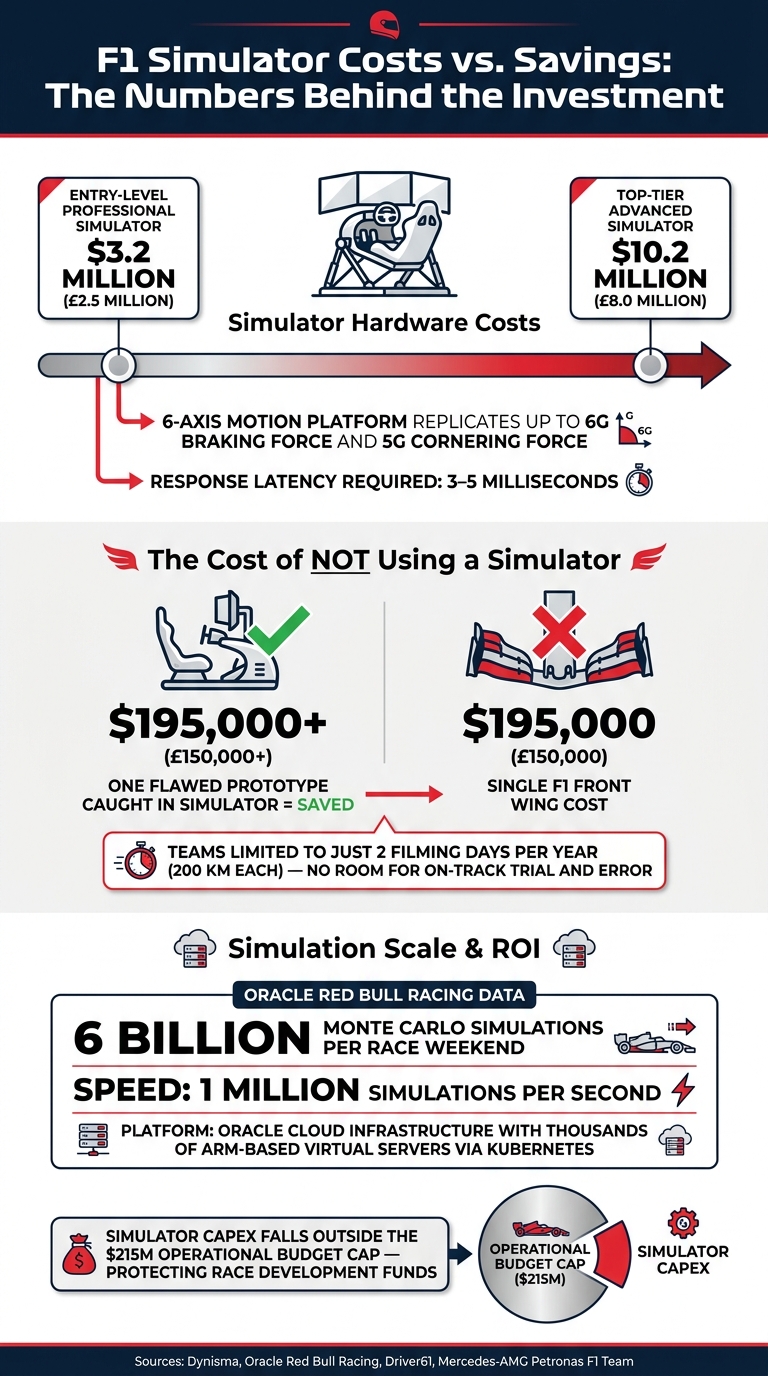
F1 simulators come with hefty price tags. Entry-level professional systems start at around $3.2 million (approximately £2.5 million), while the most advanced setups can climb to $10.2 million (around £8 million). This price range reflects the stark difference between a basic rig and a high-performance tool capable of simulating real-world racing conditions.
At the heart of these systems is a six-axis motion platform, which uses hydraulic or electric mechanisms to move the cockpit in sync with driver inputs. These platforms must replicate the extreme forces experienced in F1 racing - up to 6G during braking and 5G in corners. Since the hardware can’t sustain such accelerations directly, engineers rely on high-pass filtering to mimic these rapid force changes, requiring precise calibration.
Latency is another major factor driving costs. To effectively simulate the demands of F1 driving, the system needs to respond to driver inputs within an incredibly tight window of 3 to 5 milliseconds. Any delay beyond this makes it harder for drivers to accurately feel and react to car movements, undermining the simulator’s value for high-performance development. Achieving this level of responsiveness requires advanced processors, dedicated server clusters, and highly optimized software - all of which add to the expense.
But the hardware is just one piece of the puzzle. Software and data integration play an equally important role in making these simulators effective.
Software Systems and Data Integration
The real power of a simulator lies in its digital vehicle model, which is continuously updated using data from wind tunnel tests and computational fluid dynamics (CFD) simulations. As the car evolves, so must the model, requiring constant engineering input and software updates.
Teams also invest heavily in creating virtual replicas of race circuits. These digital track models allow drivers to practice and familiarize themselves with circuits before race weekends. To be useful, these models must accurately reflect real-world conditions, including surface textures, elevation changes, and grip levels. Regular updates are needed as circuits undergo modifications. Integrating all these elements - motion platforms, vehicle models, track data, and even strategy tools - into a unified system adds significant complexity and cost.
"Technology plays a key role in everything that happens in the garage and here back in the factory. Whether as an engineer, a mechanic, or someone responsible for track logistics, technology is involved in everything." - Steven Riley, Head of IT Operations, Mercedes AMG Petronas F1 Team
This seamless integration not only improves performance but also sets the stage for long-term cost efficiency.
Long-Term Value vs. Short-Term Costs
Although the upfront costs of simulators are steep, they align with teams' broader strategies for managing expenses under the budget cap. Teams classify simulators as capital expenditure (CapEx), meaning these investments fall outside the $215 million operational budget cap. This allows teams to enhance their simulator infrastructure without cutting into funds for car development, staffing, or race operations.
Over time, these investments pay off significantly. For instance, manufacturing a single F1 front wing costs about $195,000 (around £150,000). Catching design flaws in the virtual environment before production can eliminate such expenses entirely. As Driver61 points out:
"The £2.5 million entry-level system might seem expensive, but when a single F1 front wing costs £150,000 to manufacture, virtual testing saves massive amounts of money and time."
Teams are also finding ways to manage these costs more effectively. Many now rely on commercial solutions from companies like Dynisma, outsourcing simulator maintenance and freeing up resources for performance-focused engineering. Others, like Oracle Red Bull Racing, are leveraging cloud-based computing through platforms such as Oracle Cloud Infrastructure, turning fixed infrastructure costs into flexible, usage-based expenses.
The Return: How Simulators Improve Performance
Simulators play a key role in improving car development, preparing drivers, and refining race strategies. Their value is especially clear in Formula 1, where teams must navigate ever-tightening technical rules and budget caps.
Cutting On-Track Development Costs
One of the clearest benefits of simulators is how they help teams save money by reducing the need for physical testing. For example, identifying a design flaw in a simulator eliminates the cost of producing flawed components entirely.
Simulators also help teams avoid many of the expenses tied to on-track testing, such as fuel, logistics, wear and tear on hybrid systems, and safety permits - all of which impact the budget cap.
"Teams no longer need ten engineers just to run an in-house simulator - they can dedicate those resources to advancing car performance. It's a significant saving within the budget cap." - Simon Hollway, Commercial Director, Dynisma
By freeing up engineering resources, teams can focus more on improving car performance. Beyond just saving money, simulators also speed up the process of developing and fine-tuning cars.
Faster Car Development and Setup Work
Simulators allow engineers to test aerodynamic parts and configurations virtually, long before the car reaches the track. This ensures that by the time the car is ready for the circuit, its setup is already close to optimal.
In early 2026, the Mercedes-AMG Petronas F1 Team began using TeamViewer Tensor and augmented reality tools at their Brackley base to enhance their simulator workflow. This innovation enabled drivers like George Russell and Kimi Antonelli to rehearse on new tracks and refine car setups remotely, ensuring the car was nearly race-ready before the weekend even began.
"That allows us to test new parts and different set-up options before we get to the circuit, so that when the car arrives... it is as close to an optimal set-up as possible." - Steven Riley, Head of IT Operations and Service Management, Mercedes-AMG Petronas F1 Team
Unlike track testing, simulators let engineers isolate and test individual variables, such as suspension stiffness or wing angles, in a controlled environment. This speeds up development and also improves driver readiness and strategic planning.
Driver Preparation and Race Strategy
For drivers, simulators are an essential tool. When a race schedule includes a brand-new circuit, simulators often provide the only chance to learn the track before the first practice session.
"The simulator is an important tool for the drivers. Sometimes we might not know the track we're going to. It could be a brand-new track. Having the chance to drive it before we get there is important for the driver's preparation." - Frederik Vesti, Reserve Driver, Mercedes-AMG Petronas F1 Team
With latency as low as 3–5 milliseconds, simulators deliver precise physical feedback, allowing drivers to feel grip loss, understeer, or wheel lock-ups - without the risks of actual on-track testing. This feedback helps drivers build muscle memory that closely mirrors real-world racing conditions.
On the strategy side, simulators enable teams to model an incredible range of scenarios. During the 2026 season, Oracle Red Bull Racing used Oracle Cloud Infrastructure to run 6 billion Monte Carlo simulations per race weekend. These simulations processed 1 million scenarios per second using thousands of Arm-based virtual servers through Kubernetes. This level of analysis helps teams evaluate tire strategies, weather conditions, and energy deployment options, giving them a solid foundation for making race-day decisions.
Conclusion: Why Simulators Are Central to F1 Today
Modern F1 operates under tight restrictions: limited track testing, stringent budget caps, and increasingly complex technology. With FIA regulations curbing physical track time, simulators have become essential tools. They allow teams to run unlimited virtual laps, cutting down on fuel costs, avoiding logistical headaches, and bypassing the need for strict FIA permits.
Take this for perspective: producing a single front wing can cost around $195,000. Spotting design issues in a simulator avoids these hefty production costs. Plus, investments in simulators fall under CapEx, which means operational budgets can focus on performance-critical areas. By reinvesting these savings into simulation technology, teams can stay ahead of evolving regulations.
Simulators are also crucial in addressing the technical demands of the upcoming 2026 power unit regulations. These changes require pinpoint accuracy in energy deployment and recovery. Virtual environments allow engineers to isolate variables, run detailed tests, and iterate faster - something physical testing simply can’t match. This makes simulators indispensable for modern F1 teams, offering flexibility and precision.
As Frederik Vesti, Reserve Driver for the Mercedes-AMG Petronas F1 Team, emphasizes:
"The simulator is designed to reflect what happens on the real track, which is why we rely on it when preparing for performance."
FAQs
How accurate are F1 simulators compared to real track data?
F1 simulators are cutting-edge tools designed to mirror the behavior of the car, allowing teams to fine-tune setups and test components with incredible accuracy. But no matter how advanced they are, they can't perfectly replicate unpredictable real-world factors like weather conditions, track grip, or heat effects.
The most important measure of a simulator's effectiveness is correlation - essentially, how well the simulation lines up with actual track data. Even with latency as low as 3-5 milliseconds, small mismatches can lead to inaccurate conclusions if the data isn't carefully cross-checked with on-track results.
What’s the difference between a driver simulator and strategy simulations?
A driver simulator is all about the human experience. It combines hardware and software to mimic real-world vehicle physics. Drivers use it to practice tracks, experiment with setups, and share feedback about how the car feels and behaves.
In contrast, strategy simulations rely entirely on data. Teams use advanced tools, like Monte Carlo simulations, to analyze countless variables - things like tire degradation, weather conditions, and traffic scenarios. Thanks to cloud computing, these simulations can process billions of scenarios, offering predictions without needing human input during execution.
Do simulator investments count under the $215 million budget cap?
Simulators are indeed part of the budget cap, but their costs are handled under particular financial guidelines. Initial purchases are often categorized as capital expenditures (CapEx), which means they don’t immediately affect the operational budget. However, ongoing expenses - like maintenance and upgrades - are counted within the $215 million cap. Starting with the 2026 regulations, the scope of the cost cap will broaden, adding stricter oversight to these types of expenditures.