Lotus Ground-Effect Revolution Explained
Explains how Venturi tunnels and sealed skirts let cars generate underbody downforce, reshaping F1 aero and causing porpoising.
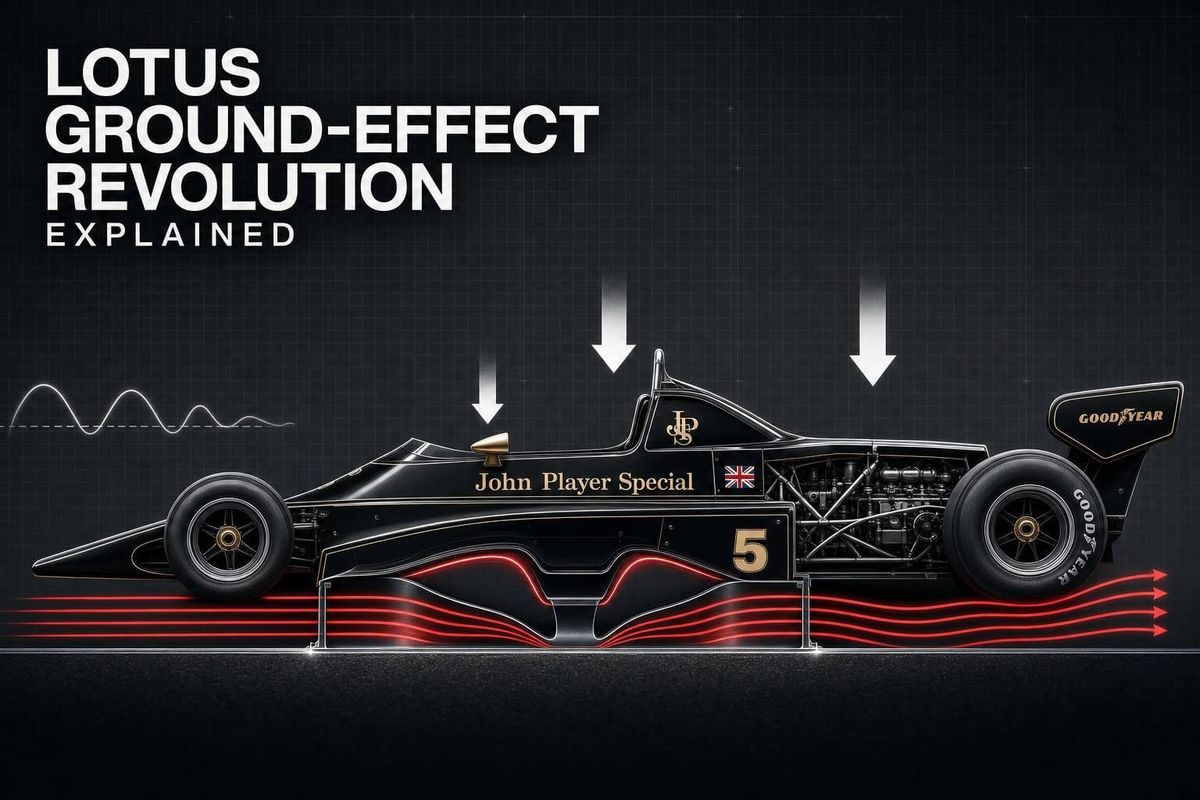
Lotus changed Formula 1 by making the floor - not just the wings - the main source of downforce. In 1977, the Lotus 78 showed the idea worked, and by 1978 the Lotus 79 turned it into a title-winning car. The result was more grip, less drag than big wings alone, and a design path that still shapes F1 today.
If you want the short answer, here it is:
- Lotus used Venturi tunnels under the car to speed up airflow and lower pressure beneath the chassis.
- Side skirts sealed the floor so outside air couldn’t leak in and weaken the effect.
- The Lotus 78 proved the concept, including a 1.5-second pole margin for Mario Andretti at Zolder in May 1977.
- The Lotus 79 fixed the balance issues and helped Lotus win both 1978 titles.
- The downside was brutal setup demands: stiff suspension, tight ride-height control, and the risk of porpoising or sudden downforce loss.
- F1 later restricted and then banned the old version with skirt limits, a 2.4-inch (6 cm) ride-height rule, and flat-bottom rules in 1983.
- Modern F1 brought the core idea back in 2022, just without sliding skirts.
If I had to sum it up in one line, it’s this: Lotus found a faster way to make downforce, and the sport spent years chasing it, then years trying to control it.
How Lotus Revolutionized Formula One Through 'Ground Effects' Aerodynamics

sbb-itb-7c68254
Quick Comparison
| Car | Main role | Key aero trait | Main issue | Big result |
|---|---|---|---|---|
| Lotus 78 | First full F1 ground-effect car | Venturi sidepods with skirts | Front-heavy balance, big rear wing needed | 5 wins in 1977 |
| Lotus 79 | Refined championship version | Longer, smoother tunnels | Pitch sensitivity | 1978 Drivers’ and Constructors’ titles |
For me, that’s the whole story in simple terms: Lotus moved downforce under the car, got a big speed edge, forced the rest of F1 to copy it, and left behind ideas that are still in use now.
The Aerodynamic Principles Behind the Lotus Concept
From Wings to an Inverted-Wing Car
For ground effect to work, Lotus had to make the whole lower half of the car do the job of an aerodynamic device. Instead of piling on more wing above the car, Lotus flipped the usual idea and shaped the floor to make downforce underneath it. That was a big deal because underbody downforce gave the car a lot of grip without the drag penalty that came with huge wings.
The main edge over a top-mounted wing came down to efficiency. An aircraft wing makes lift by speeding up air over its curved upper surface, which drops pressure there compared with the air below. Lotus applied that same idea upside down. The floor sped up airflow under the chassis, lowered pressure, and pulled the car toward the track.
Venturi Tunnels, Side Skirts, and Aero Balance
That idea only worked if Lotus could manage airflow all the way from the nose to the diffuser. So the team shaped the floor into Venturi tunnels, with a narrow throat under each side of the car. As air moved through those tighter sections, it sped up and pressure dropped. And because the car ran so close to the ground, the effect got much stronger. As the gap between the floor and the track got smaller, airspeed through the tunnel climbed hard, and the pressure drop climbed with it.
"The increase in air speed as the gap between the road surface and opening is narrowed is vastly more than proportional – i.e. it speeds up very suddenly indeed as the gap closes to almost nothing." - Mark Hughes and Giorgio Piola, Technical Contributors
Of course, this only held together if outside air stayed out. Without a seal, higher-pressure air from the sides would rush in and spoil the low-pressure area under the car. That’s why the side skirts mattered so much. They sealed the tunnel edges and kept the airflow where Lotus wanted it.
"With the skirts then preventing the air from escaping out of the sides, the acceleration of the air through the channel – and therefore its pressure reduction – was spectacular." - Mark Hughes and Giorgio Piola, Technical Contributors
The Lotus 78 still had a problem, though. Its tunnels moved too much aerodynamic load to the front of the car, which upset the balance. To get that stability back, Lotus had to run a big rear wing. That brought back some of the drag the team had been trying to cut in the first place. In a way, the 78 proved the concept worked, but it also showed where the layout still needed work before Lotus reached the more sorted Lotus 79.
Lotus 78 and Lotus 79: From First Concept to Championship Car
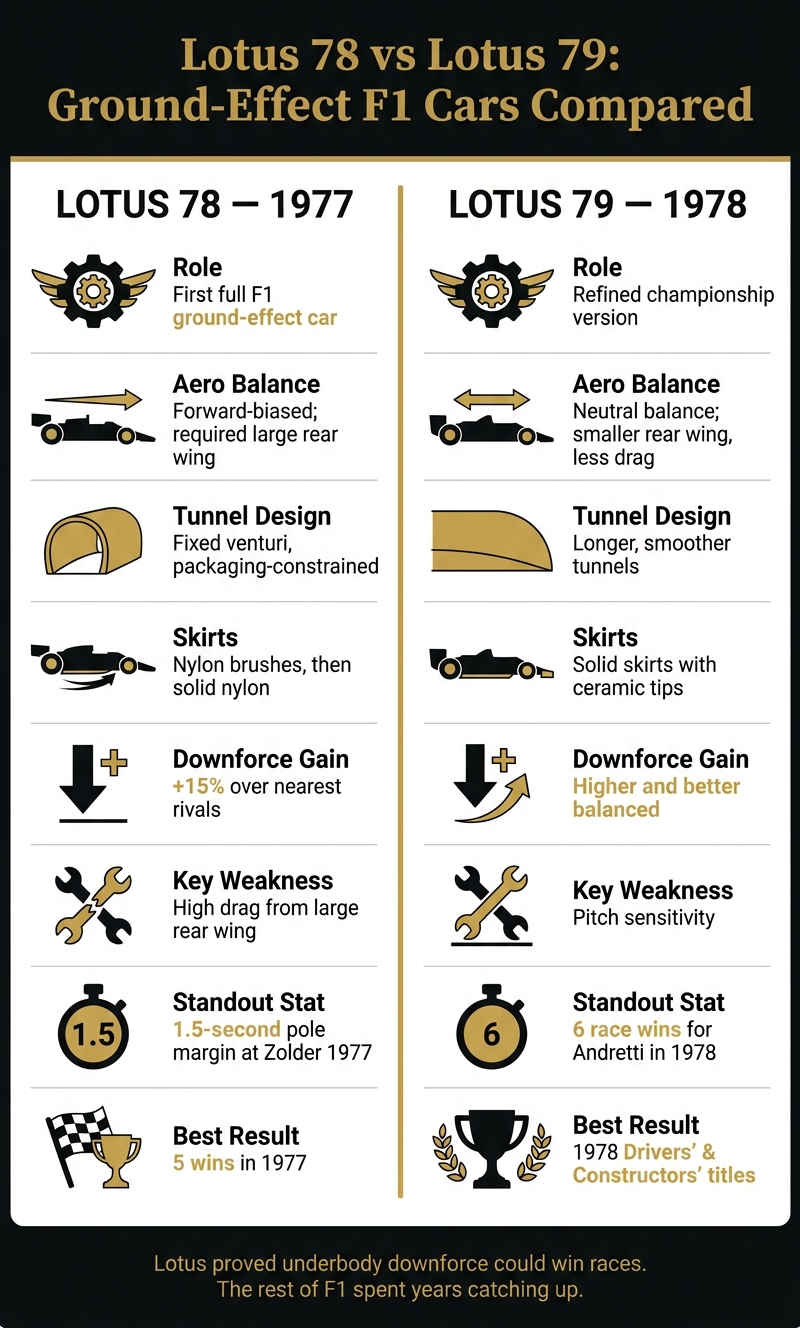
Lotus 78 vs Lotus 79: Ground-Effect F1 Cars Compared
Lotus 78: The First Wing Car
The Lotus 78 made ground effect more than an idea on a drawing board. When it debuted in 1977, it showed that the theory could work in a Formula 1 car at full speed. Colin Chapman worked with Peter Wright, Tony Rudd, and Ralph Bellamy to shape the sidepods into venturi tunnels. Wright and Rudd placed the radiators at an angle near the front of each sidepod, creating a narrow inlet that sped air through a tight throat before it expanded through a rear diffuser.
That layout came with trade-offs. To keep the tunnel shape intact, Lotus had to fit the radiators and auxiliary fuel tanks inside the sidepods. That left the central monocoque extremely narrow. Suspension travel also had to be kept under close control, because even small changes in ride height changed how the venturi tunnels worked. Lotus first used nylon brush seals to avoid a movable-aero penalty, then later moved to solid nylon skirts after rival teams had already gone with rubber seals.
The payoff was big: about 15% more downforce than the nearest rivals. Still, the Lotus 78 had a clear balance issue. The tunnels put too much aerodynamic load toward the front, so Lotus had to use a large rear wing to bring the car back into balance. That solved one problem, but it also added drag the team had hoped to cut. Even with that flaw, the pace was obvious. At the 1977 Belgian Grand Prix at Zolder, Mario Andretti took pole by 1.5 seconds over John Watson's Brabham.
"The car which made that breakthrough was the Lotus 78 of 1977, which ushered F1 into the era of ground effect." - Mark Hughes and Giorgio Piola, Technical Contributors
Lotus 79: Refining the Formula in 1978
The Lotus 79 took the same basic idea and cleaned up the weak spot. Lotus lengthened and smoothed the tunnels, which shifted the center of aerodynamic pressure farther rearward. That gave the car a much more neutral balance. With that change, Lotus could run a smaller rear wing and cut drag without giving up the huge cornering grip that ground effect delivered.
The chassis was stiffer too, built to cope with the higher aerodynamic loads. Lotus also tidied the bodywork to reduce disruption to airflow. The skirt tips were changed to ceramic so they could survive constant contact with the track.
Nicknamed "The Black Beauty," the 79 was dominant. Mario Andretti won six races in 1978 and took the World Championship. Ronnie Peterson finished second in the drivers' standings posthumously, and Lotus also won the Constructors' title.
| Feature | Lotus 78 | Lotus 79 |
|---|---|---|
| Aero Balance | Forward-biased; needed large rear wing | Balanced; smaller rear wing, less drag |
| Tunnel Design | Fixed venturi, packaging-constrained | Longer, smoother tunnels |
| Skirts | Nylon brushes, then solid nylon | Solid skirts with ceramic tips |
| Key Weakness | High drag | Pitch sensitivity |
| Best Result | 5 wins in 1977 | 1978 Drivers' & Constructors' titles |
How Drivers Experienced the Difference
From the cockpit, the upside was massive grip. The downside was a much harsher car. These machines were brutally stiff, and they could start porpoising if the underbody seal broke. The setup window was tight. A car that felt perfect in qualifying could turn edgy in a race if the ride height moved even a little.
How Lotus Ground Effect Worked in Practice
Underbody Flow, Pressure Loss, and Floor Sealing
With the Lotus 79, ground effect stopped being a neat idea on paper and became something teams had to beat on Sunday. Lotus made the floor the car’s main downforce device. Each sidepod worked like a venturi tunnel: a narrow inlet, a tight throat, and then an expanding exit. As air rushed through the throat, it sped up and pressure fell, which pulled the car down toward the track.
For that to work, the tunnel had to stay sealed. If the sides were left open, higher-pressure air from outside would spill in and wreck the low-pressure area under the car. That’s where the sliding side skirts came in. Springs kept them pressed against the track, and the suction under the car pulled them down even more. The result was simple: they shut out that outside air. As Mark Hughes and Giorgio Piola described it:
"The increase in air speed as the gap between the road surface and opening is narrowed is vastly more than proportional – i.e. it speeds up very suddenly indeed as the gap closes to almost nothing."
That wasn’t just a theory from a notebook. In wind-tunnel tests, the skirts were strong enough to lift the moving belt.
Ride Height, Pitch Control, and Chassis Stiffness
That led straight to a new setup headache. Ground effect lived and died by ride height, so even small changes could slash downforce. If the floor got too close to the ground, the airflow could choke and the downforce would suddenly fall away.
So teams had to rethink suspension from the ground up. The car needed to hold a fixed, steady height under braking, through corners, and under acceleration. Even a small amount of pitch or roll could shift the center of aerodynamic pressure. When that happened, the car could start porpoising: a harsh resonance where it bounced between high- and low-downforce states in quick succession. At that point, suspension wasn’t just there for mechanical grip. It had become part of the aero system.
Advantages and Drawbacks of the Lotus System
The upside was huge: a lot more grip, and with less drag than relying on big wings alone.
But the trade-off was harsh. The setup window was narrow. The suspension had to be very stiff. And if a skirt failed or the floor stalled, the car’s balance could change in an instant, which was bad news at speed.
That same trait - the one that made these cars so fast - also left them exposed when the rules changed.
Legacy, Regulation Changes, and What Modern F1 Still Owes Lotus
The Arms Race and the Rule Changes That Followed
Once Lotus showed that underbody downforce worked, the rest of F1 did what F1 always does: it rushed to copy it, refine it, or beat it.
The moment teams saw how much lap time ground effect could unlock, the whole grid went after the same target. Patrick Head’s Williams FW07 pushed the idea further and won the 1980 World Championship. Brabham’s BT49, designed by Gordon Murray, went even further in a different way. It used hydropneumatic suspension to drop the car while it was moving, then return it to the legal 2.4 inches (6 cm) of ground clearance when stationary for FIA checks.
That speed came with a cost. These cars could be brutal to drive. They porpoised at high speed, felt harsh and unpredictable, and could lose downforce in an instant if a skirt failed.
The FIA stepped in bit by bit. First, it restricted sliding skirts. Then it required 2.4 inches (6 cm) of ground clearance in 1981. After that, it shut the door on the original idea with flat-bottom rules in 1983. Lotus proved the concept, Williams sharpened it, Brabham worked the gray areas, and the FIA ended the era.
Modern Ground-Effect Cars and Chapman's Lasting Influence
The ban killed the first version of ground effect. It didn’t change the physics.
When F1 brought underbody aerodynamics back in 2022, it returned to the same puzzle Lotus had cracked nearly 50 years earlier. The new rules brought back regulated Venturi tunnels and diffusers to cut dirty air and make wheel-to-wheel racing better. The heart of the idea stayed the same: speed up the airflow under the car, drop the pressure, and make downforce. That’s the same principle Chapman’s team proved in the late 1970s.
Of course, the modern version works in a different way. Today’s cars seal the floor aerodynamically with careful shaping instead of physical sliding skirts. That avoids the sudden failure risk of a broken skirt, but it doesn’t make the problem go away.
And sure enough, in 2022, the sport ran into a familiar issue. Drivers including Lewis Hamilton and George Russell reported chest and back pain from violent porpoising at high speed, which led the FIA to issue technical directives aimed at driver health. Same sport, same physics, same headache. The 2022 rules brought Lotus’s main idea back in a new form.
Key Takeaways
Here’s the short version:
- Ground effect made downforce with low pressure, not wings. Instead of pushing the car down from above, it pulled the car toward the track from below, with much less drag.
- The Lotus 78 showed the idea could win races, taking victory at Long Beach in 1977 and putting the rest of the grid on notice.
- The Lotus 79 turned that idea into a title-winning package, taking the 1978 Drivers’ and Constructors’ championships with a cleaner and better-balanced design.
- The gains came with harsh trade-offs: a narrow setup window, very stiff suspension, and the danger of sudden downforce loss if the floor seal broke.
- Modern F1 still follows Chapman’s logic. The 2022 rules brought Venturi tunnels back, and today’s ride-height and porpoising problems sound a lot like what Lotus engineers were dealing with nearly five decades ago.
FAQs
Why was ground effect more efficient than big wings?
Ground effect worked better because it used the car’s floor to make downforce with far less drag than big wings. As air moved faster under the car, pressure dropped, which helped suck the car down onto the track.
The result was strong grip over a large part of the car, without the straight-line speed loss that usually came with big wings and their extra aerodynamic resistance.
Why did the Lotus 79 work better than the Lotus 78?
The Lotus 79 worked better because it made fuller use of ground-effect. Its more refined venturi tunnels and diffuser produced more downforce and better cornering grip.
It also kept a tighter seal with its side skirts, which helps explain why it dominated in 1978.
Why did ground effect cause porpoising and setup problems?
Ground effect generated huge downforce by speeding up airflow under the car. But it came with a catch: it was extremely sensitive to ride height and pitch. Even small shifts in ground clearance could change the pressure under the car in a hurry and throw off stability.
That made these cars prone to porpoising - violent up-and-down bouncing - and hard to dial in. The same design that boosted grip could also bring discomfort, safety concerns, and hard-to-predict handling if teams didn’t keep it under tight control.