Top Collaboration Strategies Used by F1 Team Principals
How F1 team principals use clear decisions, open data, no-blame debriefs and cross-functional ownership to boost on-track results.
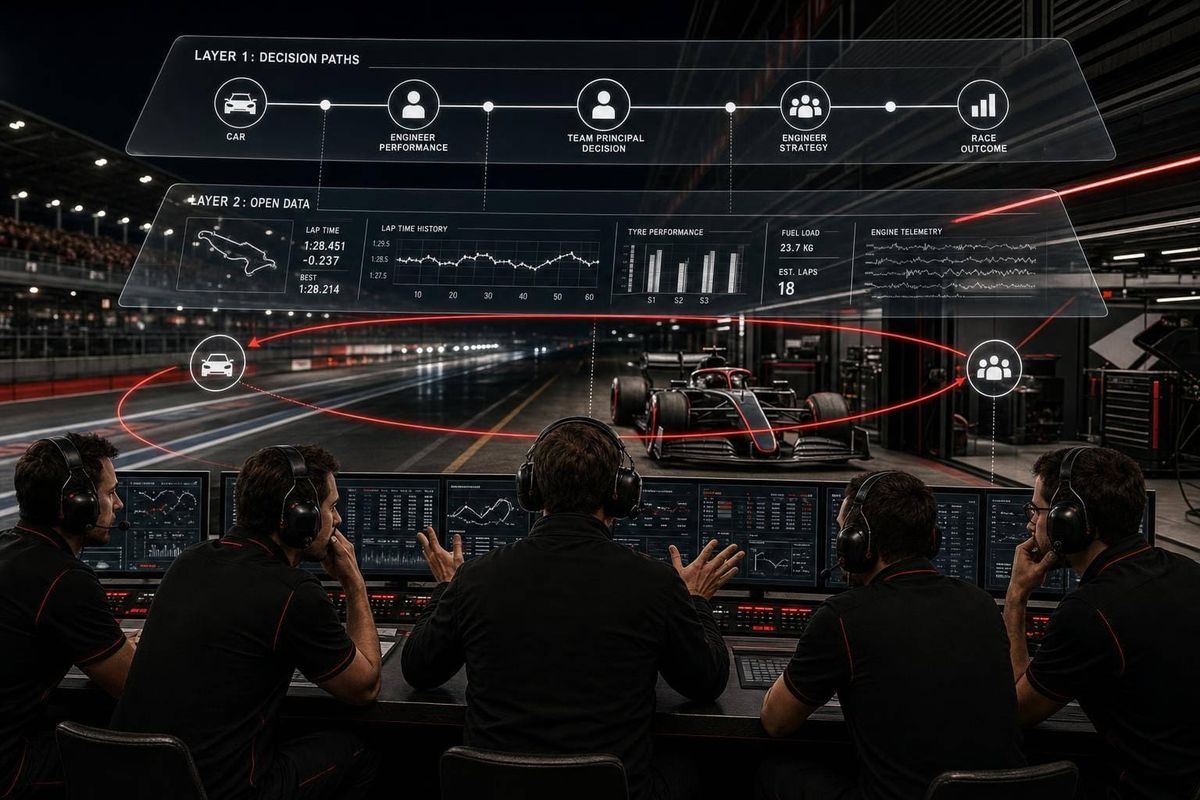
F1 team principals play a pivotal role in uniting diverse specialists to achieve peak performance. Their leadership ensures seamless teamwork across departments, from engineering to strategy. Here’s how they do it:
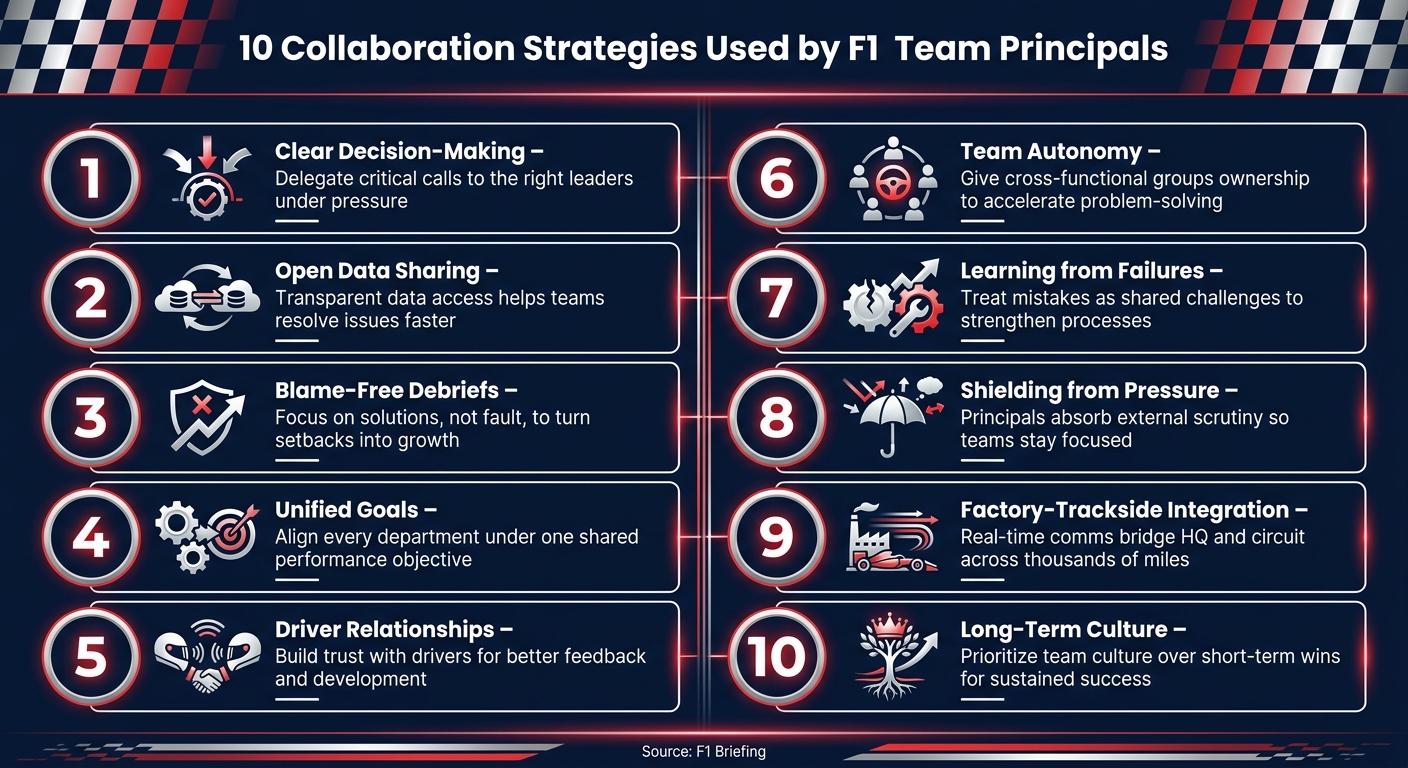
- Clear Decision-Making: Delegating critical decisions to the right leaders ensures swift action during high-pressure moments like races.
- Open Data Sharing: Transparent communication of data helps teams identify and resolve issues faster, as seen in Red Bull’s quick recovery in 2025.
- Blame-Free Debriefs: Teams focus on solving problems rather than assigning fault, turning setbacks into opportunities for improvement.
- Unified Goals: Every department aligns under a shared objective, ensuring all efforts contribute to on-track performance.
- Driver Relationships: Building trust with drivers fosters better feedback and collaboration for car development.
- Team Autonomy: Cross-functional groups with ownership over tasks drive faster problem-solving and innovation.
- Learning from Failures: Treating mistakes as shared challenges strengthens processes and team resilience.
- Shielding from Pressure: Principals handle external scrutiny, allowing teams to stay focused on their tasks.
- Factory-Trackside Integration: Real-time communication between factory and trackside teams ensures alignment, even across thousands of miles.
- Long-Term Vision: Prioritizing team culture over short-term wins ensures sustained success over seasons.
These strategies highlight how leadership in F1 transcends technical expertise, focusing on people, processes, and collaboration to deliver results.
10 Collaboration Strategies Used by F1 Team Principals
Mercedes CEO Answers F1 Team Principal Questions | Tech Support | WIRED
sbb-itb-7c68254
1. Set Clear Decision-Making Structures Under Pressure
A Formula 1 race weekend is all about speed - not just on the track, but in decision-making. Pit stop windows open and close in mere seconds, weather conditions can shift unpredictably, and a single misstep might cost a team valuable championship points. The best team principals know they can't handle every decision themselves. Instead, they create systems where the right person makes the right call at the right moment.
Toto Wolff, the Head of Mercedes-Benz Motorsport, explains his role as follows:
"I would say my role is to structure a group of individuals to create a team that is best in class – to give guidance, to be a sparring partner, without interfering in the detail of the business."
This "sparring partner" approach is essential. Rather than trying to control every detail, successful leaders delegate critical decisions to a senior leadership team. These leaders - Engineering Directors, Technical Directors, and Sporting Directors - each have clearly defined responsibilities. Mercedes' 2014 season is a perfect example of this strategy in action: by empowering three senior engineering roles to take ownership of their areas, the team secured 16 wins out of 19 races.
Claire Williams, former Team Principal of Williams Racing, adopted a similar method to manage the chaos of race day. She implemented a single guiding principle for every high-pressure decision during a race: prioritize the Constructors' Championship position above all else.
"Whatever consequence a decision was going to have on our constructor's position, that was king. That was all that mattered." - Claire Williams, former Team Principal, Williams Racing
2. Build Transparency Through Open Data Sharing
In Formula 1, data isn't just a technical asset - it’s the glue that holds every department together. Each race weekend generates an astonishing 1.5 TB of data for teams like McLaren, covering everything from tire wear patterns to aerodynamic sensor readings. But the real challenge isn’t just gathering this data - it’s making sure the right people can access it and work together to act on it.
Take Red Bull Racing as an example. After the 2025 Australian Grand Prix, Max Verstappen noticed understeer issues that weren’t immediately clear in the initial sensor data. Using live video communication, he shared his observations with the suspension and aerodynamics teams back at Red Bull’s headquarters in Milton Keynes - over 3,700 miles away. This real-time collaboration allowed engineers to investigate adjustments to suspension geometry and floor edge sealing. The result? Within just three races, Red Bull was back on the podium.
"We are all solving this together." - Max Verstappen, Driver, Red Bull Racing
Williams Racing also embraced a transparent data-sharing approach during the 2025 season. Team Principal James Vowles had drivers Alex Albon and Carlos Sainz run split setups during practice sessions, each testing different technical configurations. By openly sharing their feedback after each session, the team was able to combine the best aspects of both setups into a single, optimized race configuration. This collaborative strategy helped Williams secure 5th place in the Constructors' Championship with 137 points - their best performance in a decade.
"It's that honest feedback after practice that then drives the unified setup." - James Vowles, Team Principal, Williams Racing
This kind of transparency creates the perfect environment for leaders to turn raw data into actionable insights. Leaders like Andrea Stella and James Vowles, who are fluent in technical concepts, play a key role in translating live data into performance improvements. With simulations now accounting for over 90% of development decisions, this technical fluency is more important than ever. As David Carter points out, today’s Formula 1 requires leaders who not only understand engineering but can also leverage it to deliver results.
3. Run Structured Debriefs With No Blame Attached
A tough session can turn into a valuable opportunity when teams embrace open, blame-free debriefs. Instead of pointing fingers, successful team principals use these moments to encourage collective problem-solving. This method builds on clear decision-making structures and transparent data sharing, ensuring that feedback leads to actionable steps.
Take Red Bull Racing’s approach after the 2025 Australian Grand Prix. Faced with aerodynamic issues, Team Principal Laurent Mekies and driver Max Verstappen didn’t waste time assigning fault. Instead, they conducted a structured debrief where Verstappen meticulously described the car’s behavior, analyzing corner-by-corner understeer that even sensors hadn’t picked up. Red Bull’s engineering team in Milton Keynes joined the session remotely to explore theories around floor edge sealing and suspension geometry. This collaborative effort led to a complete shift in their development strategy, putting them back on the podium within three races.
"What I did not anticipate was how Max would elevate the collective mindset, turning potential frustration into focused determination." - Laurent Mekies, Team Principal, Red Bull Racing
When a team principal treats technical setbacks as shared challenges rather than personal failures, it shifts the entire team’s dynamic. Engineers feel encouraged to question assumptions and refine their models, while drivers are more willing to translate their sensory feedback into precise engineering terms without fear of judgment. This creates a productive environment where debriefs become less about criticism and more about finding solutions.
Williams Racing demonstrated a similar approach during the 2025 season opener in Melbourne. After FP1, Team Principal James Vowles urged Alex Albon to share detailed feedback with his new teammate, Carlos Sainz. Albon passed on specific techniques for handling Turn 3, drawing from his own experience, which differed from Sainz’s time at Ferrari. Vowles emphasized the bigger picture:
"This is about our journey back to the front. We're not getting caught up on who finished where at which race - it's about how the team moves forward."
The takeaway is clear: shift the focus from individual blame to team performance goals. When debriefs center on closing the gap between simulation data and on-track performance, they become essential tools for fostering trust and driving continuous improvement.
4. Unite Specialists Around a Common Performance Goal
In Formula 1, teams bring together experts from a variety of fields, all working simultaneously toward a shared objective. However, with each department often prioritizing its own metrics and speaking its own "language", it's easy for silos to form. When that happens, collaboration falters, and ultimately, the car's performance suffers.
The most successful team leaders tackle this challenge by using strategic intent - a concise, clear statement that outlines the team's seasonal goals and how every department plays a role in achieving them. At Mercedes-AMG Petronas, this approach is deeply ingrained in their culture. Nicole Bearne, their former internal communications lead, explained:
"They lead through intent: setting clear annual goals that define each department's role."
This clarity ensures that every team member understands how their daily work connects to the car's performance on the track. Bearne emphasized this further, saying, "Every single person in the team needs to be pulling in the same direction. They need to know what's happening around the organization; they need to know what's expected of them." This alignment fosters seamless coordination across departments and strengthens the overall structure of the team.
To complement strategic intent, teams often rely on structural decisions that align their specialists. For example, McLaren employs a dual-leadership model: Andrea Stella serves as Team Principal, focusing on technical and cross-departmental alignment, while Zak Brown, as CEO, handles commercial and political responsibilities. This setup allows technical specialists to concentrate on performance without being sidetracked by external pressures. This model has proven effective, helping McLaren secure back-to-back Constructors' Championships heading into 2026. Notably, as of the start of the 2026 season, 6 out of 11 F1 team principals have backgrounds in engineering, strategy, or technical roles.
Phil Charles, an engineer, captured the importance of leadership in this context:
"A team principal does not need to be the technical director... but must possess the cultural tools to assess, guide, and mediate decisions that now carry decisive technical weight."
Beyond formal strategies, informal interactions play a key role in keeping teams cohesive. For instance, James Allison, Technical Director at Mercedes-AMG Petronas, regularly meets with team members during daily lunches. These casual conversations help maintain open communication across departments and prevent the silos that can undermine team performance over a demanding season.
5. Build Genuine Relationships With Drivers
Technical expertise alone won’t cut it if there’s no trust between the team principal and the driver. Drivers are the final piece of the puzzle in achieving peak performance, and their collaboration with leadership can make or break a car’s development progress.
The best team principals don’t just rely on their authority to lead. Instead, they earn respect by demonstrating empathy, building mutual trust, and showcasing their ability to deliver results. When drivers trust their team principal, communication becomes more open and effective, leading to sharper feedback and a stronger, united push toward success.
Take the example from April 2025, when Red Bull Racing's Team Principal, Laurent Mekies, led a debrief after the Australian Grand Prix. During that session, Max Verstappen detailed the RB22’s handling issues, pinpointing subtle understeer problems. He worked in real-time with suspension geometry experts at Red Bull's Milton Keynes HQ via video link. This collaborative effort unlocked performance gains that helped the team return to podium finishes in just three races. Reflecting on Verstappen’s role, Mekies noted:
"What has been my biggest surprise... is the manner in which Max rallies the entire organisation - not merely through his driving prowess, but through a precision of communication and an innate ability to draw every individual into a shared pursuit of excellence."
Structured debriefs and transparent data sharing are essential, but building strong relationships with drivers goes beyond that. In today’s cost-cap era, where over 90% of decisions are driven by simulations, clear and accurate feedback from the driver’s seat is a game-changer. The Race Engineer also plays a critical role, acting as a bridge between the driver and the rest of the team, ensuring that feedback translates into actionable adjustments. When leadership treats drivers as true partners in the development process - rather than just contractors - it creates a ripple effect, boosting both team morale and efficiency.
6. Give Cross-Functional Groups Ownership Of Their Work
Building on the idea of empowering teams, speed in decision-making often depends on how quickly teams can tackle problems. One highly effective approach is to assign small, cross-functional groups full ownership over specific challenges, rather than funneling every decision through layers of management.
A typical cross-functional group in this context might include a Race Engineer, a Performance Engineer, a Data Analyst, and mechanics specializing in the engine, chassis, and gearbox. Each member is responsible for their area of expertise, but they all work toward a shared goal. To maintain alignment without creating delays, subteam leaders hold brief stand-up meetings twice a day to address dependencies and update progress.
What keeps these groups efficient is a clear and simple decision-making framework. Organizational consultant Jurriaan Kamer sums it up with one guiding question:
"One simple question serves as your guide: 'Will it make the car go faster?'"
This straightforward filter eliminates unnecessary bureaucracy. Instead of waiting for approvals or drafting lengthy reports, engineers on the front lines act on the best data available. This method supports other strategies by enabling quick, data-driven decisions. In a sport where teams implement around 1,000 changes to a car's configuration each week, these incremental improvements can collectively shave an average of two seconds per lap off a car's time over a season.
Take, for example, Red Bull Racing's response to Daniel Ricciardo's 2018 Monaco Grand Prix win. During that race, Ricciardo experienced a mid-race power loss. To address the issue, the team conducted a two-hour debrief involving 60 trackside engineers and 45 factory-based engineers in the UK. Together, this cross-functional group analyzed 400GB of sensor data to pinpoint the cause. By treating the issue as a shared responsibility, they identified the problem and prioritized a fix before the next race in Canada. The success wasn’t due to one person solving the issue but rather a cohesive group of specialists working together.
Accountability is just as crucial as autonomy in this setup. Rob Smedley, former Head of Performance Engineering at Williams F1, has highlighted the dangers of a blame culture:
"When you have a blame culture, people spend 60–90% of the effort covering what they have done rather than doing anything positive and understanding the problem, making the car go quicker or making operations slicker."
7. Treat Failures And Near-Misses As Learning Opportunities
In Formula 1, failures and near-misses aren’t just setbacks - they’re opportunities to improve. Building on the idea of no-blame debriefs, top team principals take these moments and turn them into lessons that drive the team forward. The question that often separates good teams from great ones is this: do team members feel safe admitting when something has gone wrong?
In F1, the answer must be yes. Concealing issues can cost a race - or worse, jeopardize safety. Take the April 2018 Bahrain Grand Prix, for example. During a pit stop, Ferrari allowed Kimi Räikkönen to leave while a mechanic was still working on the left rear tire. The result? A broken leg for the mechanic and lost points for the team. Instead of assigning blame, Ferrari focused on fixing the underlying pit lane procedures. This kind of systems-thinking ensures that errors lead to better processes rather than repeated mistakes.
"Formula 1 teams understand that it's rarely one person's mistake. And that it's best to learn from all the factors that happened during an incident, to prevent it from happening again." - Jurriaan Kamer, Author and Organizational Designer
This mindset - analyzing processes instead of blaming individuals - distinguishes a learning culture from a blame culture. Teams ask, "What went wrong with the system?" rather than "Who messed up?" Data analysts play a critical role here, using telemetry to focus discussions on performance gaps rather than personal mistakes. Mercedes aerodynamicist Ola Jagied captures this approach perfectly:
"We typically start with ideas generation, what we think the car is lacking, ways to improve it and what kind of parts and body shapes we think might be able to achieve these aims."
By framing conversations around what's missing rather than who's at fault, teams keep their momentum. Red Bull Racing demonstrated this during the 2025 Australian Grand Prix. When wind-tunnel simulations didn’t align with the RB22’s on-track performance, Team Principal Laurent Mekies brought together trackside engineers, factory specialists in Milton Keynes, and driver Max Verstappen via live video link. Together, they analyzed understeer gradients and adjusted their development strategy. The result? Red Bull returned to podium contention within just three races.
The lesson is clear: when failures are treated as shared challenges, teams channel their energy into finding solutions instead of protecting egos. This approach not only fixes problems but also strengthens the team as a whole.
8. Shield The Team From Outside Pressure
In Formula 1, the spotlight is relentless. A single bad race can trigger tough questions from journalists, anxious calls from sponsors, and a storm of criticism on social media. For a team to stay focused, the team principal must act as a shield, absorbing the external pressure before it reaches the engineers and mechanics who need to stay locked in on the next race. This protective role is just as important as the internal strategies that keep the team working as a cohesive unit.
The best team principals take on the role of a public relations buffer. They handle press conferences, deal with stakeholder concerns, and manage public criticism to ensure that outside noise doesn’t disrupt the team’s focus on race-day performance. When team members feel constantly exposed to external scrutiny, their energy shifts from solving problems to defending themselves - a dynamic that can quickly derail progress. By keeping that pressure at bay, principals create an environment where the team can focus entirely on improving performance.
McLaren’s history provides a clear example of how leadership style can influence team dynamics under pressure. Back in 2007, Ron Dennis’s leadership during the Alonso-Hamilton conflict leaned heavily on managing the team’s public image, often at the expense of fostering open internal communication. The result? A breakdown that highlighted the risks of prioritizing PR over genuine team cohesion. Fast forward to 2025, and Zak Brown adopted a different approach. By setting clear expectations for drivers Oscar Piastri and Lando Norris to "go race each other" while emphasizing accountability to the team, McLaren fostered a healthier, more confident dynamic - even under the intense pressure of championship contention.
On a practical level, many teams also take steps to minimize distractions during race weekends. One effective tactic is separating hospitality from operations. Dedicated hospitality teams handle sponsors and VIP guests, creating a clear boundary so engineers and technical staff can stay focused on performance. This division is crucial, especially considering the sheer workload during a typical race weekend, which includes around 50 internal review meetings. By keeping commercial demands separate from technical operations, teams ensure that every ounce of energy is directed toward what matters most - winning.
9. Connect Factory And Trackside Teams As One Unit
In Formula 1, seamless communication between factory and trackside teams is absolutely crucial. With around 1,000 people involved in building a car and running a race, it's no exaggeration to call this the largest team sport in the world. However, the reality is that most of these individuals are not at the circuit. They're stationed at the factory, often thousands of miles away. Take Red Bull Racing, for instance - their headquarters in Milton Keynes is roughly 6,000 kilometers (about 3,728 miles) from some flyaway race locations. The challenge of keeping these two groups aligned is one of the most complex tasks for team principals, pushing them to rethink traditional communication methods.
To overcome this, many teams are moving away from rigid, top-down hierarchies and adopting a "mission control" model. This structure allows for direct, real-time communication between engineers at the track and those back at the factory. By cutting through layers of bureaucracy, decisions can be made quickly and efficiently, reinforcing the collaborative mindset essential in Formula 1.
A great example of this approach comes from Cadillac in 2025. They operated a "ghost team" of factory engineers based in Indiana and North Carolina, simulating race conditions in real time. These engineers worked on tire degradation modeling, pit-stop timing, and decision-making under various weather scenarios. According to Team Principal Graeme Lowdon, this practice built "decision muscle memory" ahead of their 2026 debut.
"You don't want the team to be going through the process of executing a race for the first time when it's the real thing." - Graeme Lowdon, Team Principal, Cadillac
Red Bull Racing has also embraced this strategy. After facing aerodynamic correlation issues early in 2025, Team Principal Laurent Mekies introduced live video links to connect trackside engineers with specialists at their Milton Keynes base during post-session debriefs. Max Verstappen played a key role in this system, translating on-track feedback - such as subtle understeer sensations - into actionable engineering insights. This approach helped the team adjust their development direction, leading them back to podium finishes within just three races. Today, over 90% of their development decisions are now based on simulations, showcasing the effectiveness of their integrated communication setup.
10. Build A Long-Term Team Culture, Not Just Short-Term Wins
Winning a single race might grab headlines, but maintaining consistent success demands a team culture that stands the test of time.
At the heart of this is a clear, shared purpose. Organizational designer Jurriaan Kamer simplifies it with one guiding question: "Will it make the car go faster?" When every team member - whether they’re working in the factory or strategizing trackside - understands how their role contributes to this central goal, alignment happens naturally. This shared focus doesn’t just improve efficiency; it also helps the team stay strong when challenges arise.
A no-blame environment is another critical piece of the puzzle. As Rob Smedley, former Head of Performance Engineering at Williams F1, points out:
"When you have a blame culture, people spend 60–90% of the effort covering what they have done rather than doing anything positive and understanding the problem, making the car go quicker or making operations slicker."
McLaren’s journey over nearly two decades highlights the power of investing in long-term culture. Back in 2007, internal competition and poor communication held the team back, even with advanced technology at their disposal. Fast forward to June 2025, and McLaren had transformed into a team built on strong relationships, open communication, and trust in key individuals. CEO Zak Brown summed it up perfectly: "relationships, communication, and the two individuals that we have."
This cultural overhaul paid off during the Spanish Grand Prix, where McLaren secured a 1–2 finish. Driver Oscar Piastri credited his race engineer Tom Stallard for providing "data-driven confidence", a trust that came from years of collaboration. Meanwhile, Lando Norris worked seamlessly with engineer Will Joseph, demonstrating real-time strategic alignment.
This kind of trust and cohesion doesn’t happen overnight. McLaren’s transformation shows how investing in a strong, enduring team culture amplifies every collaborative effort, paving the way for long-term success in Formula 1.
Conclusion
The strategies discussed in this article - ranging from structured decision-making and transparent data sharing to no-blame debriefs and fostering a strong team culture - work together to elevate team performance to new heights.
In Formula 1, where success depends on the coordination of around 800 specialists, leadership must be intentional. Organizational designer Jurriaan Kamer sums it up with a single, guiding question:
"One simple question serves as your guide: 'Will it make the car go faster?'"
This focus is mirrored in the methods employed by team principals, such as protecting engineers from outside distractions and carefully blending expertise within the team. By combining innovation with consistency, these practices demonstrate how thoughtful leadership can impact every aspect of an F1 team’s performance.
For an even deeper dive into team dynamics, race strategies, and what happens behind the scenes, check out F1 Briefing for expert analysis and exclusive content that goes beyond the track.
FAQs
Who makes the final call during a race?
The team principal or race director is the one who typically makes the final decision during a race. They carefully evaluate a mix of factors, including real-time data, feedback from the team, and the ever-changing race conditions, to decide on the most effective strategy.
How do teams share data between factory and track?
F1 teams rely on real-time communication to bridge the gap between the factory and the track. Key data like telemetry, lap times, and sensor readings are transmitted instantly to the factory, where engineers dive into analysis and compare it with simulations. Meanwhile, drivers play a crucial role during debriefs, offering insights that help align actual on-track performance with theoretical predictions. This teamwork creates a shared approach to data, speeding up problem-solving and driving ongoing performance gains.
How do F1 teams avoid blame after failures?
F1 teams steer clear of blame by creating a culture built on collaboration, prioritizing teamwork, and establishing open lines of communication. Team principals are central to this effort, acting as the glue that connects critical departments like engineering and strategy. They emphasize shared responsibility, work to mediate disputes, and encourage collective problem-solving. By tackling challenges as a unified group and fostering transparency, the focus moves away from pointing fingers and toward finding solutions and reaching shared objectives.