What Fuel Data Shifts Race Calls in F1?
Real-time fuel burn, fuel-corrected pace and forecast confidence that drive lift-and-coast, pace targets, and pit-wall calls.
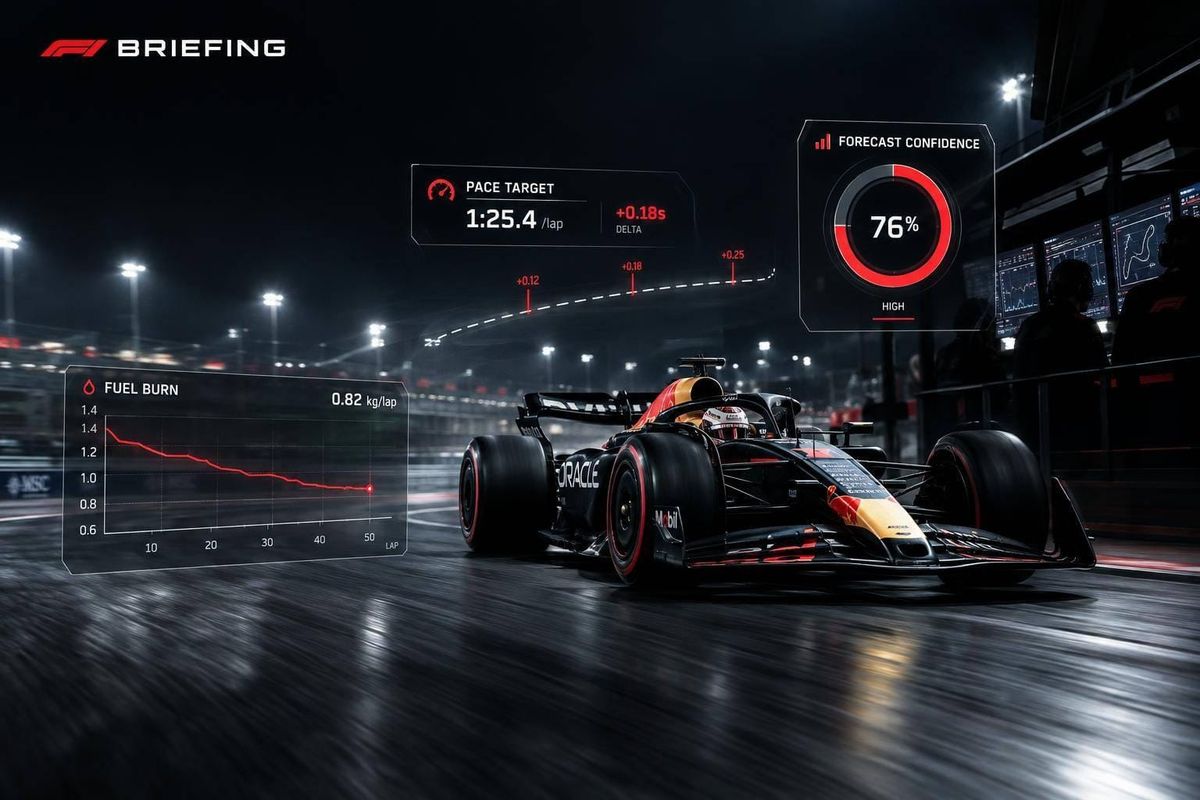
I’d judge an F1 fuel call by one question: Will the car finish with enough fuel left? For example, burning an extra 0.05 kilograms per lap over 20 laps uses 1 kilogram more than planned. A drift that small can turn “push” into “save.”
Here’s what I’d check before reading too much into a radio message:
- Fuel burn and finish forecast: Is the shortfall lasting, or did one lap skew the estimate?
- Fuel-adjusted lap times: Are worn tires hiding behind the pace gained as the car gets lighter?
- Saving versus time lost: Can lift-and-coast recover enough fuel without losing a position?
- Race conditions and forecast doubt: Do traffic, weather, battery use, or a Safety Car change the plan or the buffer needed?
The aim is the best total race time, not the fastest next lap. I’d look for <u>a clear action, a duration, and a review trigger</u> in each fuel-related radio call - with the safety buffer kept separate from the required fuel sample.
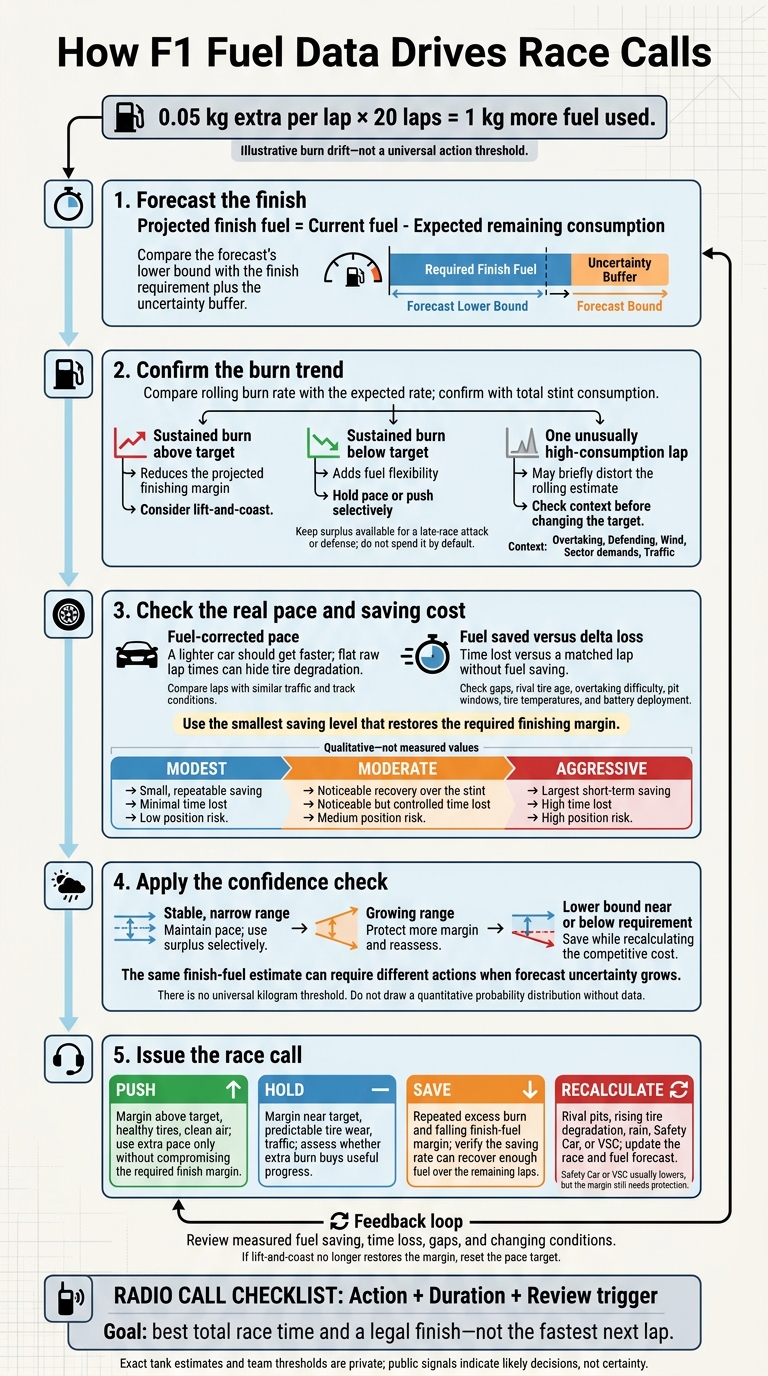
How F1 Fuel Data Drives Race Calls
The Fuel-Saving Technique That Changes Everything in F1
sbb-itb-7c68254
When Should Fuel Burn Change the Race Plan?
Use burn-rate drift, not one lap, to decide whether to change the race plan. Building on the finish-fuel forecast above, compare the rolling burn rate with the expected rate. Then check total stint consumption to confirm the trend. If the drift holds, decide whether to save fuel or maintain the current pace.
What Does Above- or Below-Target Fuel Burn Mean?
A change matters when it shifts the remaining-race forecast - not simply when consumption moves. Overtaking, defending a position, headwinds, and acceleration-heavy sectors can increase fuel use. Traffic can reduce it by lowering speeds and time at full throttle. Check these conditions before changing the target.
| Consumption pattern | Forecast effect | Possible instruction | Check before acting |
|---|---|---|---|
| Sustained burn above target | Reduces the projected finishing margin | Call lift-and-coast | Recent battles, wind, and sector demands |
| Sustained burn below target | Adds fuel flexibility | Hold pace or push | Upcoming Safety Car windows or track evolution |
| One unusually high-consumption lap | May briefly distort the rolling estimate | Keep the target | Overtaking or defending a position |
Keep surplus fuel available for a late-race attack or defense. Don’t spend it on pace by default.
Why Adjust Lap Times for Fuel Weight?
As fuel burns off, the car gets lighter and should get faster. That means raw lap times can hide tire degradation. If lap times stay flat, declining tire performance may be offsetting the gain from lower weight. Engineers adjust lap times to a common fuel load, then compare laps with similar traffic and track conditions.
| Timing measure | Main use | Main limit |
|---|---|---|
| Raw lap time | Tracks actual gaps and race position | Mixes fuel-weight gains with tire and track effects |
| Fuel-corrected lap time | Helps show the tire-performance trend | Depends on a circuit-specific weight model |
| Fuel-corrected laps matched for traffic and track state | Gives a cleaner comparison for pace decisions | Still requires checks for traffic and rear overheating |
Even fuel-corrected pace needs checks for traffic and track state. That corrected trend informs the lift-and-coast decision.
When Is Lift-and-Coast Worth the Time Loss?
Call lift-and-coast only when the fuel saved is worth the time lost. If the burn rate puts the fuel forecast below target, the pit wall weighs saving against delta loss: the time lost compared with a matched lap without fuel saving.
The safe saving margin is the fuel the driver can still save without unacceptable losses in pace, position, tire performance, or reliability. Both measures depend on circuit layout and conditions. The team then checks whether the fuel saved justifies the time penalty.
How Does Fuel Saving Affect Track Position?
The driver lifts earlier and coasts toward the braking zone, aiming to arrive at the planned speed. Lifting too early without adjusting the braking point scrubs off too much speed and costs lap time. Heavy braking zones after long straights offer the best saving opportunities.
Engineers use matched laps or simulations to calculate the lap-time penalty for a given fuel saving. They check lift distance, sector time, corner-exit speed, and battery deployment. That time penalty limits how much fuel the driver should save.
The saving level must match the remaining fuel shortfall and pace target. The team checks gaps ahead and behind, the rival’s tire age, how difficult overtaking is, and the next pit window.
Saving can create a chance to attack or protect the next pit stop. Lower energy input can also help with overheating. But too much coasting can cool the tires or disrupt braking preparation. If saving no longer helps the race plan, return to target pace.
How Much Fuel Saving Should the Driver Use?
Use the smallest saving level that restores the required finishing margin.
| Saving level | Fuel saved | Time lost | Position risk | Suitable conditions |
|---|---|---|---|---|
| Modest | Small, repeatable saving | Minimal | Low | Stable gap, mild fuel shortfall, tire-temperature management |
| Moderate | Noticeable recovery over the stint | Noticeable but controlled | Medium | Pit-window protection, surplus gap, tire condition that allows saving |
| Aggressive | Largest short-term saving | High | High | Fuel emergency, large gap, safety-car conditions, or risk of not finishing |
Give the driver fixed lift points and a clear stop condition tied to the fuel target or gap. Check whether the measured fuel saving justifies the delta loss. Surplus fuel alone does not justify slower laps: continue saving only for another race-plan benefit, such as tire management or gap control. Otherwise, return to target pace.
When Should the Pit Wall Change the Pace Target?
If lift-and-coast no longer restores the margin, the pit wall must reset the pace target. That means checking fuel flow, throttle, energy deployment, and lap times when excess burn continues for several representative laps, the finish-fuel margin keeps shrinking, or conditions make the plan no longer valid. The goal is the best total race time and a legal finish - not the fastest next lap.
What Triggers a Push, Hold, Save, or Recalculate Call?
When the margin stops improving, the team moves from fuel saving alone to managing the race situation.
| Signal | Possible instruction | Decision check |
|---|---|---|
| Finish-fuel margin above target, healthy tires, clean air | Push | Can extra pace secure position without using the required reserve? |
| Margin near target, predictable tire wear, traffic | Hold | Is the pace gain worth the added burn when traffic limits progress? |
| Repeated excess burn, falling finish-fuel margin | Save | Will the measured saving rate recover enough fuel over the remaining laps? |
| Rival pits or tire degradation increases | Recalculate | Compare undercut risk, tire life, pit-lane loss, and likely rejoining traffic. |
| Rain, Safety Car, or Virtual Safety Car | Recalculate | Update consumption, remaining racing laps, tire choice, and restart expectations. |
A Safety Car or VSC usually lowers fuel consumption. That changes the forecast, but the team still needs to protect the margin.
How Does the Forecast Become a Radio Call?
Every radio call needs an action, a duration, and a review trigger.
How Should Forecast Confidence Guide the Call?
After assessing burn rate and pace, the pit wall uses forecast confidence to decide how much fuel margin it can safely spend. The same finish-fuel estimate can call for different actions when the forecast range grows. The buffer should reflect that uncertainty.
How Does Forecast Uncertainty Affect the Fuel Margin?
Projected finish fuel equals current fuel minus expected remaining consumption. Keep the buffer separate from the finish requirement, then compare the forecast’s lower bound with the requirement plus that buffer. There’s no universal kilogram threshold.
As uncertainty grows, less of the fuel margin is safe to use.
| Forecast condition | What can cause it | Possible response |
|---|---|---|
| Stable, narrow range | Representative laps, steady tires, settled weather | Maintain pace; use surplus selectively |
| Growing range | Changing traffic, tire degradation, limited data after a stop | Protect more margin and reassess |
| Lower bound near or below requirement | Persistent excess burn or a broader remaining-consumption range | Save while recalculating the competitive cost |
Public lap times, gaps, tire age, weather, and radio messages can point to the likely source of uncertainty. But exact tank estimates and private thresholds stay hidden. Forecast confidence is the final check before the pit wall spends or protects surplus fuel.
Conclusion: Which Fuel Signals Matter Most?
Start with the finish requirement, then weigh burn drift, fuel-corrected pace, and the time cost of saving. Tires, traffic, and pit windows set the competitive cost; forecast confidence sets the safe margin.
FAQs
How do F1 teams estimate fuel remaining?
F1 teams estimate how much fuel is left by using real-time telemetry to track fuel consumption. Engineers feed that data into simulation models that account for engine modes, track conditions, and ambient temperature.
They compare live fuel burn rates with past data and model predictions. Throughout the race, they adjust engine settings and fuel strategies to get the best performance while keeping enough fuel to reach the finish line.
How does battery deployment affect fuel-saving calls?
Battery deployment helps teams balance pace and fuel efficiency. Teams track fuel use in real time and may ask drivers to adjust battery usage, shifting how much power comes from the internal combustion engine versus the electric hybrid system. Paired with more conservative engine modes, these changes help drivers maintain a competitive pace while staying within fuel limits throughout a stint.
What if fuel forecasts disagree with measured burn?
Teams compare real-time telemetry with pre-race models to see why fuel use differs from forecasts. Engine settings, safety car periods, and driving style can all explain the gap.
They adjust engine settings or hybrid energy deployment and may ask drivers to lift and coast to save fuel. If the gap persists, strategists rerun simulations and revise target lap times, balancing pace with the fuel needed to finish.