What Slick Tires Solved in F1 Racing
Explains how slick F1 tires boost dry grip by replacing grooves with continuous rubber — and the trade-offs in wet conditions, heat, and wear.
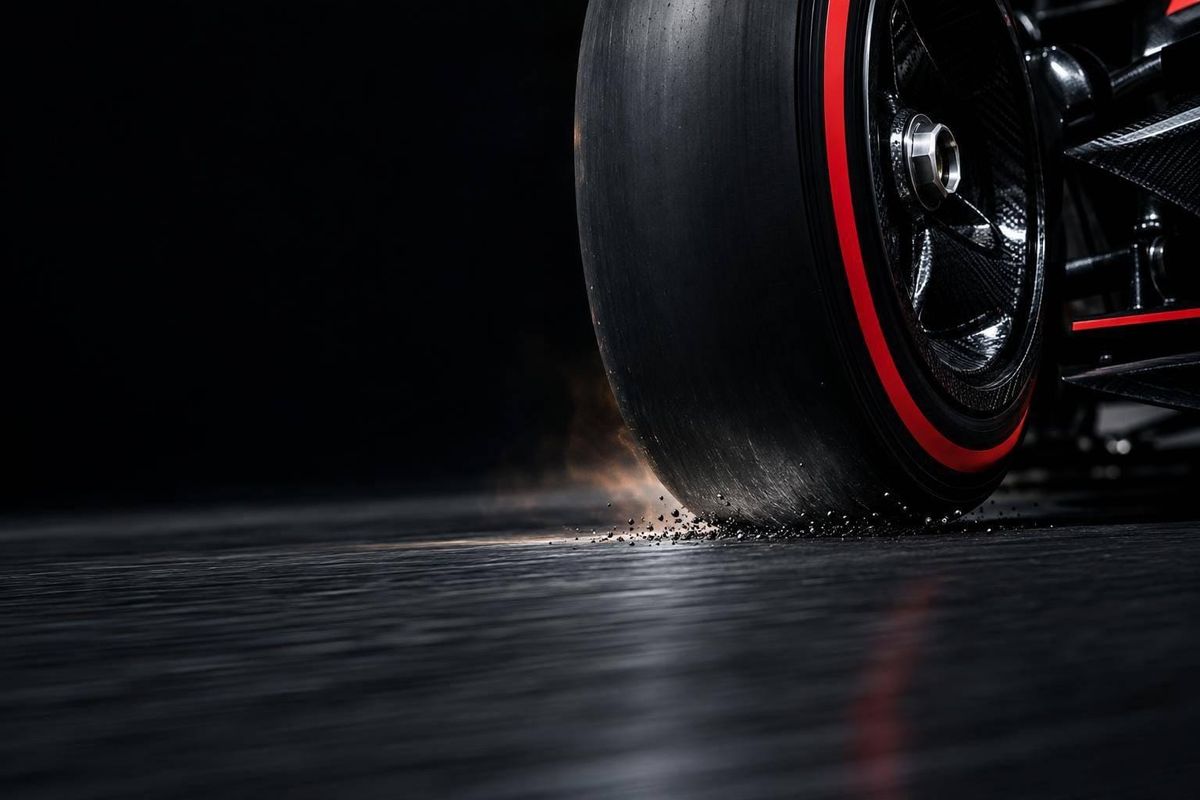
Slick tires solved a dry-track grip problem: grooves left less rubber touching the road, and tread blocks flexed under load. First used in F1 in 1971, slicks helped drivers brake later, carry more corner speed, and accelerate harder.
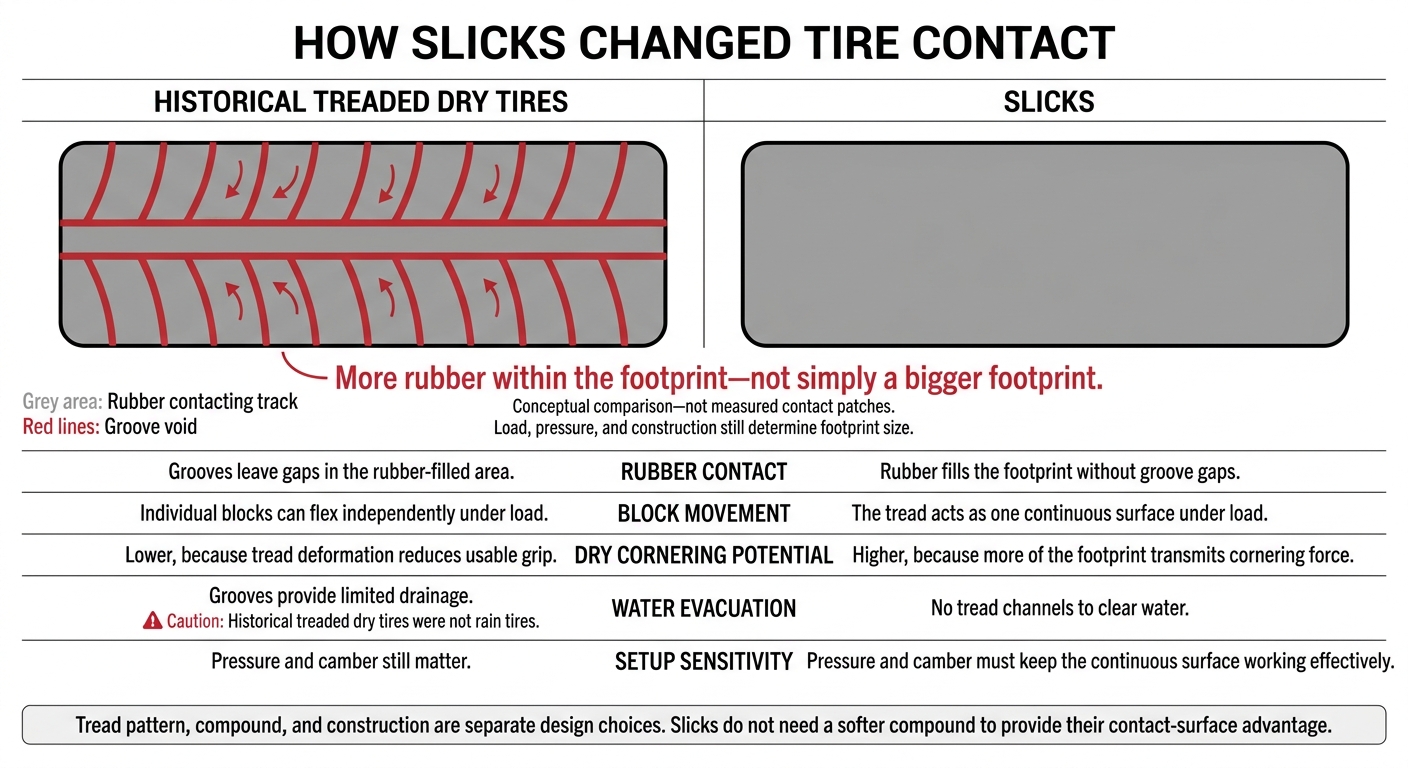
I’d put the difference this way: more rubber within the footprint - not simply a bigger footprint.
- More dry grip: A continuous tread surface reduced block movement, but braking, turning, and acceleration still shared one grip limit.
- More setup work: Teams still had to control temperature, wear, pressure, and car balance.
- A wet-track trade-off: With no drainage grooves, slicks risked losing contact with the road in standing water.
<u>More grip did not mean grip in every condition.</u> Slicks returned in 2009 after mandatory grooved tires, while later changes - including 18-inch wheels in 2022 - kept tire and car design closely linked.
Why FORMULA 1 Tires are SLICK?
sbb-itb-7c68254
Why Tread Limited Dry Grip
The tread itself set the limit. Before slicks, F1 dry tires still had grooves.
Tread Gaps and Block Movement
Grooves reduced the contact patch, leaving less rubber to carry the load. That smaller patch heated up faster and reached its grip limit sooner.
Under braking, acceleration, and cornering, individual tread blocks bent before they could transmit force consistently. That movement made steering response less precise.
The smaller contact patch limited grip through every phase of a corner.
The Tire's Shared Grip Limit
Braking and cornering share the same finite grip. During trail braking - holding some brake pressure while entering a corner - the driver must ease off the brakes as cornering demand grows. On exit, acceleration must build as the driver unwinds the steering. Too much throttle breaks traction rather than adding speed.
Downforce adds grip, but not in direct proportion to the added load. Tires are load-sensitive: each extra unit of load produces a smaller gain in grip. That grip limit set the ceiling for braking, cornering, and exit speed.
How Slicks Changed Tire Contact
F1 Slicks vs. Treaded Tires: How Dry Grip Changed
Tread blocks and grooves limited dry grip. Slicks addressed that limit by putting more rubber within the tire’s footprint. With no grooves, these dry-weather tires maximize rubber-to-track contact.
More Rubber in the Contact Patch
The key change was not a larger footprint, but more rubber within it. Load, pressure, and construction still determine footprint size. Removing grooves replaces empty spaces with rubber that carries load.
Under load, the tread acts as one continuous surface. Slicks don’t need a softer compound to work well: tread pattern, compound, and construction are separate design choices.
Treaded Dry Tires vs. Slicks
Historical treaded dry tires had grooves that interrupted rubber-to-track contact. Those grooves offered some drainage, but that didn’t make them rain tires.
| Feature | Treaded dry tires | Slicks |
|---|---|---|
| Rubber contact | Grooves leave gaps in the rubber-filled area. | Rubber fills the footprint without groove gaps. |
| Block movement | Individual blocks can flex independently under load. | The tread acts as one continuous surface under load. |
| Dry cornering potential | Lower, because tread deformation reduces usable grip. | Higher, because more of the footprint transmits cornering force. |
| Water evacuation | Grooves provide limited drainage. | No tread channels to clear water. |
| Setup sensitivity | Pressure and camber still matter. | Pressure and camber must keep the continuous surface working effectively. |
That extra rubber contact increased the available grip, giving drivers more lap-time potential under braking, through corners, and when applying the throttle.
How Slicks Improved Lap-Time Potential
That extra rubber gave drivers more scope to cut lap times in dry conditions.
Braking, Cornering, and Corner Exit
Slicks increased the available dry grip. Drivers could brake later, carry more speed through corners, or accelerate harder on exit. How much they gained still depended on car balance and tire temperature.
Approach ─── A ───╮
                 B )
                  ╰─── C ─── Exit

A  -  Braking: added grip can allow a later braking point.
B  -  Corner: added grip can support higher cornering speed.
C  -  Exit: added rear grip can allow earlier acceleration.

Conceptual diagram only.
Drivers couldn’t maximize all three at once. Each phase used the extra grip differently, and pushing too hard on exit could overheat the rear tires, leaving less grip for later laps. Braking as late as possible was only part of the gain; corner-exit traction and sustained pace mattered, too.
Tire and Car Development Over Time
Teams had to build their cars around the grip their tires could provide. High downforce helped limit sliding in fast corners and keep tires within their operating temperature range. Tire compounds and dimensions also affected heat management.
Getting more performance meant developing the tires and the car together.
| Year | Change | Why it matters |
|---|---|---|
| 1971 | F1 adopted slick tires. | Dry-weather tire development shifted toward an ungrooved tread surface. |
| 1977 | Michelin entered F1 with radial tires. | Tire construction offered another route to better performance. |
| 1998 | Grooves became mandatory on dry tires. | The rules deliberately limited grip to reduce cornering speeds. |
| 2009 | Slicks returned. | Teams regained an ungrooved dry tire within a changed rules package. |
| 2022 | F1 introduced 18-inch wheels. | The lower-profile tires changed sidewall flex and heat buildup. |
These changes show how F1 car development responded to tire grip. But the dates alone don’t support a controlled lap-time comparison: aerodynamics, chassis dimensions, engine rules, and tire compounds changed as well.
Conclusion: The Trade-Offs Slicks Left
Slicks removed tread-block movement and tread losses, increasing dry grip and improving lap-time potential. But teams still had to manage temperature, wear, and setup within a narrow operating window. Wear removes rubber; degradation reduces performance. More grip did not remove the tires’ sensitivity to heat, load, or track conditions.
Temperature, Wear, and Setup
Extra grip helps lap times only when tires stay within their working range. Cold rubber limits grip, overheating cuts performance, and thinner, worn tread can produce less heat as it deforms.
When Slicks Give Way to Wet Tires
Those operating limits matter even more when the track gets wet. Cooling can wipe out slicks’ dry-grip advantage, while standing water increases aquaplaning risk because slicks have no tread to clear it. Teams weigh pace, driver feedback, and rain risk - not just whether a dry line has formed.
FAQs
Why doesn’t more tire contact produce proportionally more grip?
A larger contact patch doesn’t mean proportionally more grip. Tires need to stay within an optimal temperature range. Outside that range, grip drops - even with more rubber touching the track.
Too cold, and the rubber stiffens. Too hot, and it softens and degrades. Teams must balance tire pressure and load to keep the rubber within this operating window.
How do teams balance slick-tire grip against tire life?
Teams balance slick-tire grip and tire life by managing heat-related degradation and mechanical wear. Drivers adjust their pace, especially early in a stint, to keep tires in their best temperature range. Push too hard, and the tires can overheat, slide, and lose performance. Run them too cool, and grip drops, too.
Engineers use simulations and track-specific setups to help tires last throughout a stint while planning the best pit-stop strategy.
When should drivers switch from slicks to intermediates?
Drivers use a crossover point to judge when to switch from slicks to intermediates - commonly when lap times reach about 112% of a reference dry-track lap time. In heavy rain that calls for full wet tires, the threshold often climbs to about 118%.
Teams and drivers keep checking track conditions and moisture levels as they change. The wrong tires can severely hurt performance.