Driver Lineup Ripple Effect Across Seasons
Lineup changes reshape team hierarchy and morale, but car design and rules drive results across seasons.
A driver change can reshape a team for years - but it cannot explain results alone. I look at moves from 2013–2024 across four teams, separating changes in driver roles from the effects of car design and rule changes.
- Ferrari: Leclerc’s promotion changed the team hierarchy and gave its academy a route to a race seat.
- McLaren: Sainz’s departure brought Ricciardo in; Ricciardo’s struggles later helped open the door for Piastri.
- Mercedes: Hamilton added title-winning experience, while Russell’s later promotion served a separate succession plan.
- Red Bull: Ricciardo and Verstappen showed how its junior ladder offered opportunity - and pressure.
My takeaway: track who changed, what changed, and when. Mercedes went from 3 wins in 2013 to 16 in 2014, but new hybrid rules also transformed the contest. <u>A seat change is only part of the story</u>, whether you’re judging results, team morale, sponsor appeal, or driver feedback.
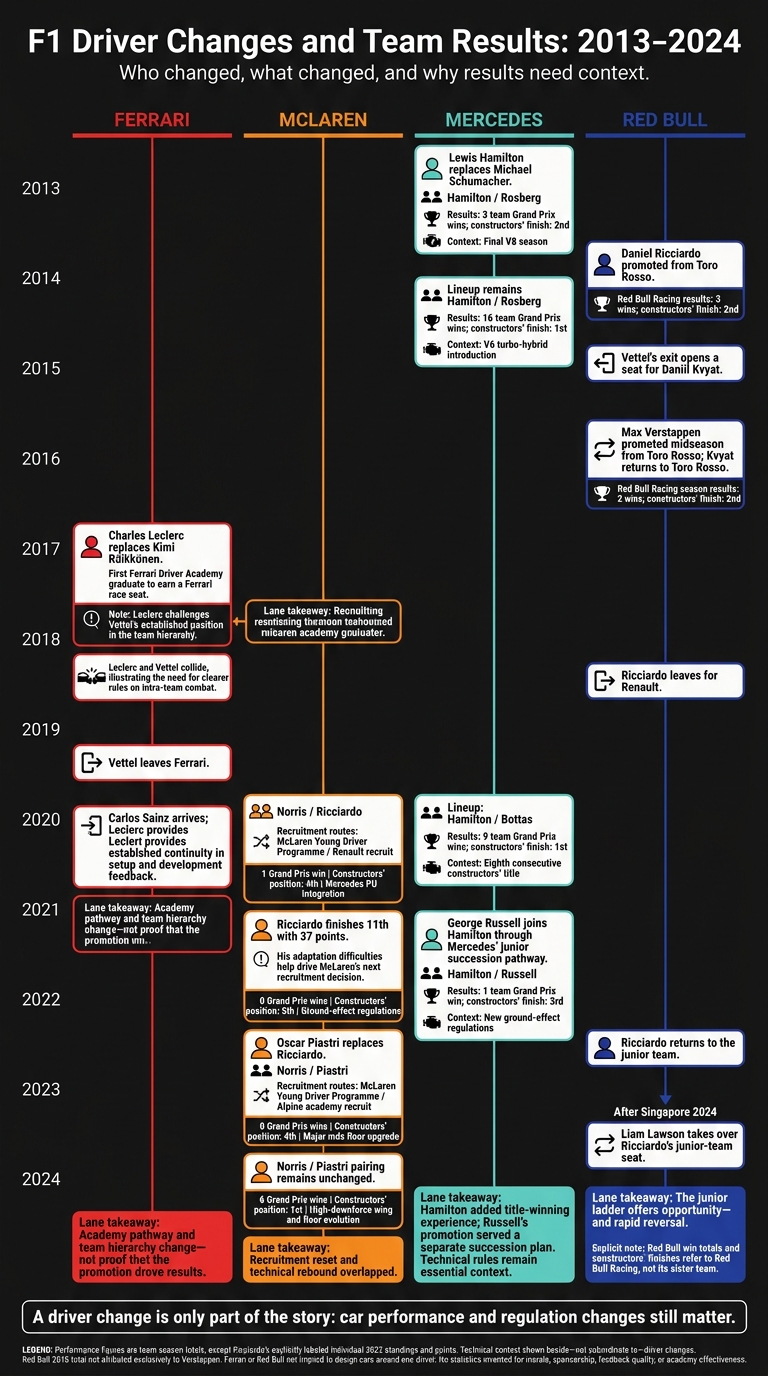
F1 Driver Changes and Team Results: 2013–2024
Leclerc Replaces Räikkönen: Ferrari’s Changing Hierarchy
Ferrari replaced Kimi Räikkönen with Charles Leclerc in 2019, promoting a Ferrari Driver Academy graduate to its senior team. The move changed the team’s pecking order, the story of its academy, and its development feedback over the next four seasons. Vettel began 2019 as Ferrari’s more established driver, but Leclerc’s pace soon challenged that hierarchy.
Team Tension, Sponsor Appeal, and the Academy Route
Leclerc and Vettel’s collision at the 2019 Brazilian Grand Prix illustrated Ferrari’s management problem. Ferrari had to set clearer rules for intra-team combat and team orders.
Leclerc’s youth and academy background also made him a marketable, homegrown driver Ferrari could build its commercial future around.
As the first academy graduate to earn a Ferrari race seat, Leclerc showed that its driver pathway could lead all the way to the senior team. His promotion backed Ferrari’s commitment to its academy and its willingness to recruit from within.
Setup Feedback and Ferrari’s Results, 2019–2022
After Vettel left at the end of 2020, Leclerc became Ferrari’s established reference for development. His experience with the team helped maintain continuity in setup feedback when Carlos Sainz arrived in 2021.
The lasting ripple effect was a change in who provided that continuity - not proof that Ferrari designed its cars around Leclerc’s preferences or that the promotion drove its results.
sbb-itb-7c68254
Sainz Joins Ferrari: McLaren’s Next Driver Choices
Sainz’s move left a seat open at McLaren, which brought in Daniel Ricciardo for 2021. The team later recruited Oscar Piastri for 2023, largely because Ricciardo struggled to adapt - not simply because Sainz had left.
The ripple extended beyond Ferrari: McLaren had to reassess its own driver path, not just replace one driver.
Working Relationships, Recruitment, and Sponsors
Ricciardo’s popularity gave McLaren more visibility. But his difficulties with the car helped steer the team toward a younger, more stable pairing: Piastri alongside Lando Norris.
The two drivers took different routes to McLaren. Piastri came from Alpine’s academy, not McLaren’s junior program, and his switch caused friction with Alpine leadership. Norris had come through McLaren’s own development path.
Driver Adaptation and Team Results, 2021–2024
Across two seasons, Ricciardo struggled with McLaren’s car balance, which limited his setup feedback. He finished 11th in the 2022 standings with 37 points before the team replaced him.
Piastri’s arrival overlapped with McLaren’s technical rebound, so the rise cannot be credited to the lineup alone.
| Year | Lineup | Recruitment route | Grand Prix wins | Constructors’ position | Major technical change |
|---|---|---|---|---|---|
| 2021 | Norris / Ricciardo | McLaren Young Driver Programme / Renault recruit | 1 | 4th | Mercedes PU integration |
| 2022 | Norris / Ricciardo | Unchanged | 0 | 5th | Ground-effect regulations |
| 2023 | Norris / Piastri | McLaren Young Driver Programme / Alpine academy recruit | 0 | 4th | Major midseason floor upgrade |
| 2024 | Norris / Piastri | Unchanged | 6 | 1st | High-downforce wing and floor evolution |
Hamilton Joins Mercedes: Star Signing and Junior Succession
Lewis Hamilton replaced Michael Schumacher in 2013 as Mercedes pushed to become a championship contender. The team was already building toward the 2014 hybrid era. Hamilton strengthened the lineup; he didn’t change the car concept. His arrival made Mercedes a test case for how a driver switch can play out alongside new technical rules.
Team Ambition, Rivalry, and Sponsor Exposure
Hamilton brought Mercedes a title-caliber leader and global star power. Rosberg, meanwhile, became his main rival within the team.
Russell’s promotion in 2022 told a different story. It reflected Mercedes’ junior pipeline and long-term succession plans - not a direct follow-up to Hamilton’s 2013 signing.
Setup Feedback and Results Under the New Rules
Hamilton described an engineering group that listened closely:
“When I moved to this team, they really listened to every single thing I said. They acted on so many things, the smallest details.”
That feedback helped Mercedes fine-tune its setup direction and execution. But results still depended on the car’s underlying design.
The season results show the contrast between Mercedes’ peak under the hybrid rules and its slump when ground-effect regulations arrived.
| Season | Mercedes lineup | Team Grand Prix wins | Constructors’ finish | Regulation context |
|---|---|---|---|---|
| 2013 | Hamilton / Rosberg | 3 | 2nd | Final V8 season |
| 2014 | Hamilton / Rosberg | 16 | 1st | V6 turbo-hybrid introduction |
| 2021 | Hamilton / Bottas | 9 | 1st | Eighth consecutive constructors’ title |
| 2022 | Hamilton / Russell | 1 | 3rd | New ground-effect regulations |
Mercedes’ 2014 peak and 2022 drop track car concept more than lineup changes. Russell arrived during the decline, not as its cause.
Red Bull Promotes Ricciardo and Verstappen
Red Bull’s junior ladder made driver changes a recurring part of its system. Ricciardo’s promotion from Toro Rosso in 2014 showed that path at work. Vettel’s exit opened a seat for Kvyat in 2015, while Verstappen’s promotion in 2016 showed how fast the lineup could change.
Junior Promotions, Team Pressure, and Sponsors
Verstappen replaced Kvyat midseason, sending him back to Toro Rosso. The message was clear: promotion could reverse just as fast. The swap changed the pecking order at the top team and who stood next in line. Ricciardo left for Renault in 2019 after internal competition grew; he later said Red Bull was no longer the right fit.
Ricciardo’s personality boosted Red Bull’s social reach, while Verstappen’s titles kept its brand at the center of Formula One. Changes continued across Red Bull’s driver pool: Ricciardo returned to the junior team in 2023, and Lawson took over after Singapore in 2024.
Car Balance and Red Bull’s Results Through 2024
The available evidence does not prove that Red Bull built the car around Verstappen alone. Ricciardo’s 2023 Pirelli tire test at Silverstone suggested the RB19 was still quick in another driver’s hands. Verstappen’s title run through 2024 reflected both his skill and Red Bull’s engineering work.
The pattern is clearest in the seasons where promotion and performance moved together.
| Season | Promoted driver | Junior-program background | Red Bull Racing wins / constructors’ finish |
|---|---|---|---|
| 2014 | Ricciardo | Toro Rosso graduate | 3 wins; 2nd |
| 2016 | Verstappen | Midseason Toro Rosso promotion | 2 wins; 2nd |
Wins and constructors’ positions refer to Red Bull Racing, not its sister team.
Conclusion: What Driver Changes Can and Cannot Explain
Across Ferrari, McLaren, Mercedes, and Red Bull, the pattern is clear: lineup changes matter most when they fit the team’s technical direction. A clear link between one driver’s departure and another’s arrival does not prove a performance gain.
Leclerc’s Ferrari promotion strengthened the academy pathway and changed the hierarchy. Sainz’s departure prompted McLaren’s recruitment reset, while Ricciardo’s adaptation difficulties helped drive its next change.
Star signings can add to a team’s ambition, but the team still needs to handle the pressure and turn driver feedback into results.
Hamilton’s Mercedes signing reinforced its ambitions and strengthened setup feedback; the hybrid-era technical program remained fundamental to its success. Red Bull’s promotions demonstrated both the opportunity and pressure of its junior ladder.
These lineup decisions can change morale, sponsor appeal, succession plans, and setup direction. They can also shape a team’s path across seasons. But a driver change cannot explain results on its own: car performance and regulation changes still matter.
FAQs
How can we separate a driver’s impact from car upgrades?
Compare teammates’ qualifying speed and race-day consistency over time, using simulation data alongside observations of how drivers respond to rule changes and car upgrades. Gaps between teammates, especially when a new driver joins, can help separate a driver’s race management and tire strategy skills from the car’s underlying pace.
How do teams resolve conflicting driver setup feedback?
Teams work through conflicting driver setup feedback by talking openly and discussing performance issues constructively. Engineers and technical directors then compare that feedback with data and lap times.
Team leaders help drivers speak freely and make sure feedback gets an objective review instead of dividing the team. Agreeing on a shared development path helps keep the car competitive throughout the season.
How do junior promotions affect team morale and sponsor appeal?
Promoting junior drivers brings youthful energy and can draw sponsors looking to reach younger audiences. But rookies also face intense media scrutiny and pressure to prove themselves fast.
Teams often pair them with experienced veterans to balance that pressure. Veterans bring race management skills and consistency, helping offset the rookie learning curve and keep team morale steady.