F1 Power Unit Rules: 2014 to 2026 Comparison
Compare 2014 vs 2026 F1 power unit rules: MGU‑H removed, MGU‑K up to 350 kW, new fuel‑energy limits and cooling trade‑offs.
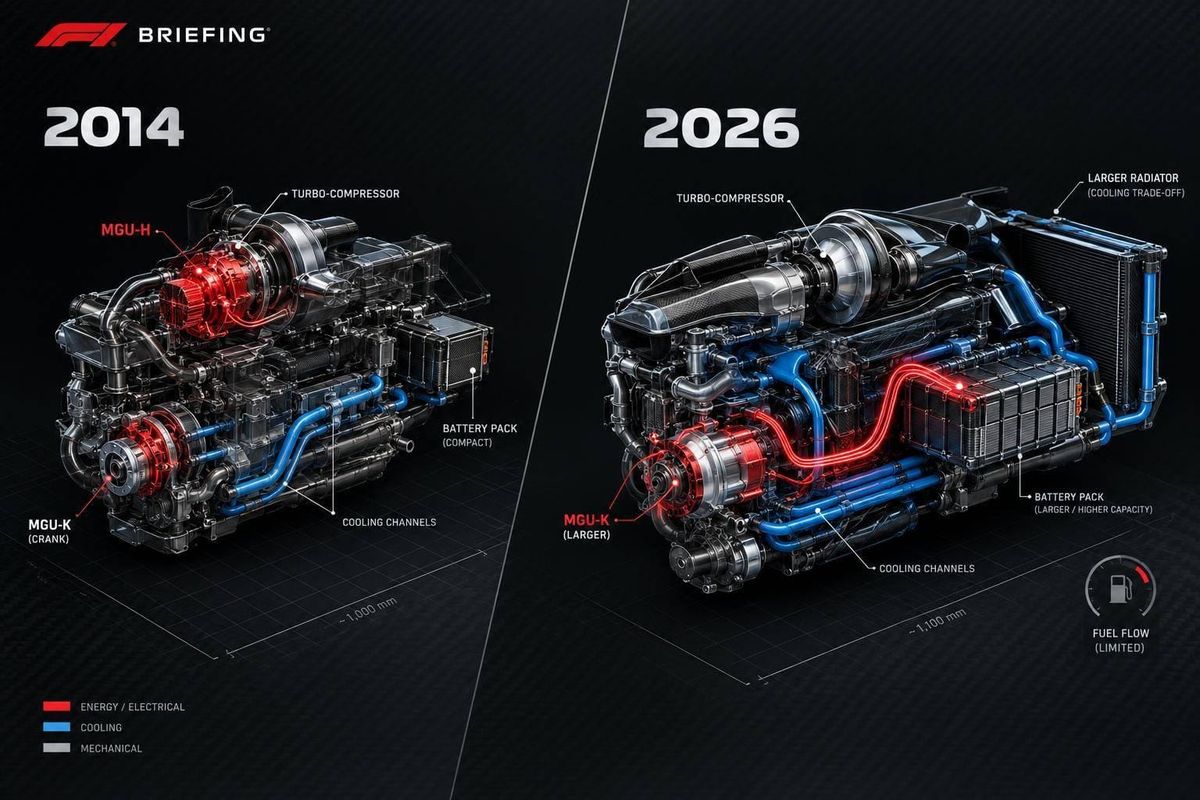
My main takeaway: F1’s 2026 rules keep the 1.6-liter turbo V6 but shift more work to electric power. The MGU-H disappears, and maximum MGU-K output rises from 120 kW to 350 kW - about 161 hp to 469 hp.
That means more than extra electric power. I’ll compare fuel limits, battery recovery, turbo response, cooling, and car layout. For you, the key distinction is this: <u>peak power isn’t the same as power available throughout a lap</u>. The roughly 50/50 combustion-electric split is a target, not a fixed output.
Quick Comparison
| Comparison | Original 2014 rules | 2026 rules |
|---|---|---|
| Engine | 1.6-liter turbo V6 | Same basic engine |
| Hybrid hardware | MGU-K and MGU-H | MGU-K only |
| Maximum MGU-K power | 120 kW | 350 kW |
| Fuel limits | 100 kg per race; 100 kg/h flow cap | Energy-based flow cap of 3,000 MJ/h |
| MGU-K recovery ceiling | 2 MJ per lap | 9 MJ per lap |
| Turbo response | Electric turbo assistance | No MGU-H assistance |
| Battery and cooling | Two recovery paths | Higher electrical loads; more reliance on braking recovery |
| Chassis and aero | Packaging for both motor-generators | Revised packaging and cooling; separate chassis rules target smaller, lighter cars |
I’ll separate what the rules require from what teams must solve: keeping electrical assistance available, controlling heat, and balancing power with drag.
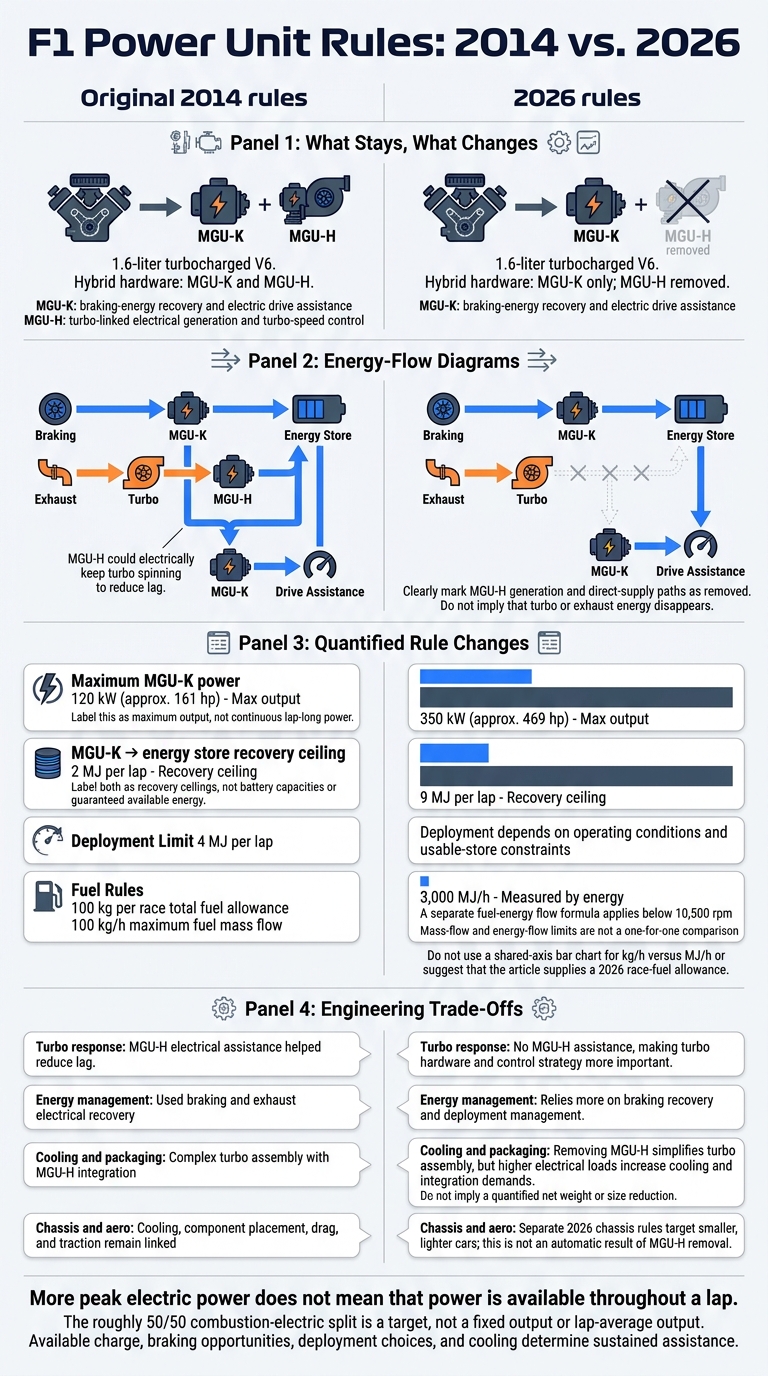
F1 Power Unit Rules: 2014 vs. 2026
A Full Review Of F1's 2026 Engines
sbb-itb-7c68254
2014 vs. 2026: Power Unit Layout
The table below compares the main hardware changes.
| Feature | 2014 rules | 2026 rules |
|---|---|---|
| Engine architecture | 1.6-liter turbocharged V6 | Same basic architecture; higher electric output and no MGU-H |
| Hybrid components | MGU-K and turbo-linked MGU-H | Higher-power MGU-K; no MGU-H |
| Maximum electrical power | 120 kW, approximately 160 hp | Approximately 350 kW, or 470 hp |
| Fuel restrictions | 100 kg race-fuel allowance; maximum flow of 100 kg/h | Energy-based fuel-flow limits replace mass-flow limits |
| Energy storage and deployment | Battery supports two energy-recovery paths | Battery must handle much higher MGU-K output |
2014: V6 Turbo, MGU-K, and MGU-H
The 2014 system recovered energy in two ways: the MGU-K recovered braking energy, while the MGU-H recovered exhaust energy through the turbo.
Fuel rules set two separate limits. The 100 kg allowance capped total race fuel, while the 100 kg/h flow cap controlled how fast teams could burn it. Teams had to balance fuel efficiency with outright power.
For 2026, those two recovery paths become one higher-output electric system.
2026: V6 Turbo and Higher-Power MGU-K
With the MGU-H removed, the higher-power MGU-K becomes the only electrical energy-recovery path. Energy-based fuel-flow limits also replace the 100 kg/h mass-flow approach.
The combustion engine keeps its basic architecture, but the hybrid layout changes. This affects turbo response, energy recovery, and battery load - as well as how teams fit the power unit into the car, manage heat, and store energy.
MGU-H Removal: Gains and Trade-Offs
Removing the MGU-H changes how the hybrid system makes and uses energy, not the engine’s shape.
| Design choice | Advantage | Disadvantage |
|---|---|---|
| MGU-H turbo-speed control | Could keep the turbo spinning electrically to reduce lag | Required a high-speed motor-generator and its controls |
| 2014 exhaust-energy recovery | Supplied electricity without relying only on braking | Added hardware and electrical integration |
| 2026 layout without MGU-H | Simplifies the power unit and cuts manufacturing costs | Relies more on braking recovery and deployment management |
Turbo Response and Energy Recovery Paths
The biggest change is how teams control the turbo without exhaust-side electric assistance. Turbo response depends more on hardware and control strategy, making lag harder to mask. Exhaust gases still drive the turbine in 2026. What disappears is the MGU-H’s electrical generation path.
| Energy path | 2014 system | 2026 system |
|---|---|---|
| Exhaust → turbo → MGU-H → energy store | Available | Removed |
| MGU-H → MGU-K directly | Available; electricity could bypass the store | Removed |
| Braking → MGU-K → energy store | Available | Main recovery route |
Fuel Flow Limits and MGU-K Power
| Measure | Original 2014 rules | 2026 rules |
|---|---|---|
| Maximum fuel flow | 100 kg/h, measured by mass | 3,000 MJ/h, measured by energy |
| Lower-rpm restriction | Maximum mass flow decreases below its threshold | A separate fuel-energy flow formula applies below 10,500 rpm |
| Maximum MGU-K power | 120 kW, approximately 161 hp | 350 kW, approximately 469 hp |
These fuel-flow limits aren't a one-for-one comparison: one measures mass, while the other measures energy. The higher MGU-K power ceiling makes energy deployment a bigger part of lap-time performance. That change also affects battery load and cooling demands.
Battery Limits, Recovery, and Cooling
| Constraint | Original 2014 system | 2026 distinction |
|---|---|---|
| MGU-K → energy store | 2 MJ per lap | Recovery ceiling increases to 9 MJ per lap |
| Energy store → MGU-K | 4 MJ per lap | Deployment still depends on operating conditions and usable-store constraints |
| Separate exhaust recovery | MGU-H could charge the store or supply the MGU-K | No equivalent electrical path |
| Non-ERS storage | Separate from hybrid-store accounting | The 300 kJ allowance covers specified non-hybrid functions, not usable traction-battery capacity |
Storage capacity is only part of the picture. Teams also have to manage how much energy they can recover, move, and deploy each lap. The 9 MJ figure is a recovery ceiling - not guaranteed usable energy. Higher electrical throughput demands more cooling and charge control, while circuit layout still shapes braking recovery. Those cooling and packaging demands also affect chassis layout and aerodynamic design.
2014 vs. 2026: Chassis and Aero Effects
Power-unit rules set the limits; chassis rules and packaging choices shape the car. Higher electrical loads affect where components fit, how they’re cooled, and the bodywork around them.
Packaging, Cooling, and Weight Distribution
| Area | 2014 installation | 2026 demand and design trade-off |
|---|---|---|
| Turbo assembly | Included the MGU-H and its connections | Removing the MGU-H simplifies the turbo assembly. |
| Electrical hardware | Used a lower-power MGU-K | The higher-power MGU-K and energy store demand more cooling and tighter integration. |
| Sidepods and cooling outlets | Made room for engine and hybrid cooling | Cooling still dictates bodywork volume and outlet area. Removing the MGU-H doesn’t automatically make the car smaller. |
| Weight distribution | Reflected the full hybrid installation | Component placement must still balance cooling, available space, and mass distribution. |
These packaging choices also affect drag and how the car puts power down.
Drag, Braking, and Acceleration
| Area | 2014 baseline | 2026 effect |
|---|---|---|
| Energy recovery and deployment | Exhaust recovery supplemented braking recovery | Greater reliance on electric power makes deployment timing more critical. |
| Straight-line performance | Depended on both power and drag | Teams still need to weigh available electrical power against aerodynamic drag. |
| Rear-tire traction | Turbo assistance helped smooth engine response | Removing the MGU-H can bring back turbo lag, making corner-exit acceleration harder to manage. |
The separate 2026 chassis package also targets smaller, lighter cars. That change comes from the chassis rules - not from removing the MGU-H.
Conclusion: The Main Power Unit Trade-Offs
In 2014, energy recovery was split between the MGU-H and MGU-K. For 2026, hybrid performance centers on a higher-output MGU-K and tighter energy management. The 50/50 target is a design goal, not a lap-average output. Available charge, recovery opportunities, and deployment choices determine how long electrical assistance can last.
The test is whether teams can sustain deployment, keep turbo response stable, and control cooling across different circuits. A simpler power-unit layout puts more pressure on braking-led recovery, cooling, and packaging. That changes how teams design around heat, energy storage, and aerodynamic drag.
FAQs
What happens if a 2026 F1 car runs low on battery?
When a 2026 F1 car runs low on battery, it loses electric boost from its 350 kW motor. That cuts performance and keeps it from reaching its combined 1,006 horsepower output.
To recover energy, drivers may need to lift off the throttle and coast - or, in extreme cases, downshift on straights. Poor energy management can hurt straight-line performance as the car balances electric power delivery, battery charging, and active aerodynamics.
Which circuits will make energy recovery hardest in 2026?
Circuits with fewer braking zones - or less heavy braking - will make energy recovery hardest in 2026. Without the MGU-H, the MGU-K must recover energy solely through braking, even as recovery capacity increases to 8.5 MJ per lap.
Drivers at 12 circuits, up from eight, will face tighter energy management limits. They'll need techniques such as lift and coast to keep the battery charged throughout a race.
How will stronger energy recovery affect braking feel?
Under the 2026 regulations, braking energy recovery doubles to 8.5 MJ per lap, while MGU-K power nearly triples to 350 kW. Energy recovery will do more of the work of slowing the car, changing how suspension loads build and release through corners.
Drivers will face a more complex braking feel as they balance mechanical braking with stronger electrical braking.