Historical Trends in Constructors' Championships
How rule changes, technical edges and two-car scoring shaped F1 constructors' dominance from 1958 to 2026.
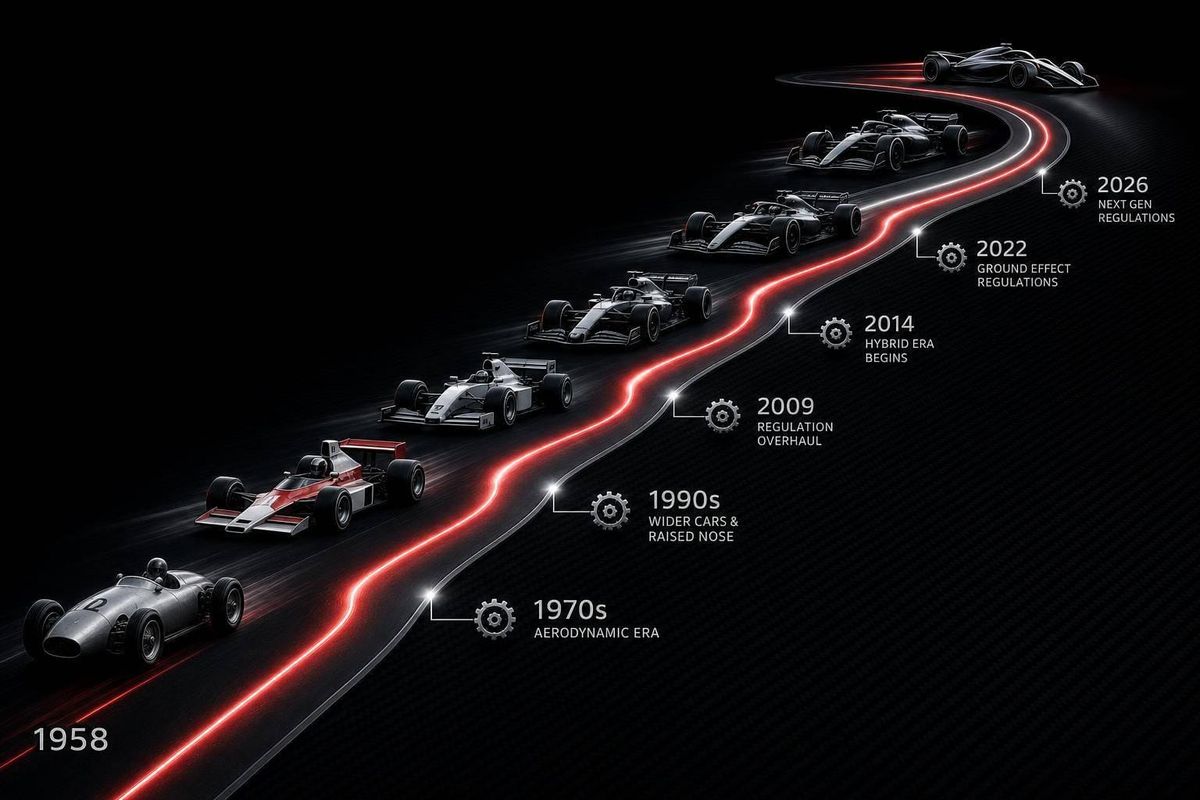
F1 constructors' titles usually go to the team that gets rule changes right, scores with both cars, and stays strong all season. Since 1958, only 15 teams have won the championship across 68 seasons, and just 4 teams - Ferrari, McLaren, Williams, and Mercedes - took 43 of 68 titles (about 63%).
If I boil the full article down, the pattern is simple:
- 1958–1982: more title turnover, with reliability and factory backing driving results
- 1983–2013: longer runs as engines, aero, and electronics shaped the front
- 2014–2021: Mercedes owned the hybrid era with 8 straight titles
- 2022–2026: ground-effect rules changed the order again, with Red Bull first, then McLaren winning 2024 and 2025
A few numbers tell the story fast:
- The WCC winner and Drivers' Champion did not match in 12 seasons
- Red Bull won 21 of 22 races in 2023, a 95.45% win rate
- McLaren ended a 26-year gap between titles by winning again in 2024
- Ferrari still leads all teams with 16 constructors' titles
Here’s the main takeaway for you: raw pace helps, but titles come from full-team output. After the 1979 scoring shift, both cars mattered much more, so a weak second driver or poor race-day work could cost a team the championship even with a star in the other car.
Every F1 Constructors’ Champion (1958–2025) with Team Principals/Founders 🏎️...🔥
sbb-itb-7c68254
Quick Comparison
| Era | What usually decided titles | Pattern |
|---|---|---|
| 1958–1982 | Reliability, factory strength | More winner turnover |
| 1983–2013 | Engine deals, aero work, electronics | Longer title streaks |
| 2014–2021 | Hybrid power-unit edge | Mercedes control |
| 2022–2026 | Ground-effect cars, cost-cap use | High concentration, but changing order |
In short, I’d frame the whole history this way: F1 constructors' dominance is less about decades and more about rule eras. The teams that read the new rules best - and keep both cars scoring - tend to sit on top.
How championship dominance shifted across F1 eras
1958–1982: Factory strength, early aerodynamics, and reliability-led titles
The first 25 years of the constructors' championship were marked by constant change. Mechanical failures were common, factory-backed teams had a big edge, and the first aero gains started to matter. Across those 25 seasons, 10 different constructors won titles. Ferrari and Lotus kept showing up near the front, while Vanwall, BRM, and Tyrrell each took one championship.
Cooper is a good early example of how fast the order could flip. It won back-to-back titles in 1959 and 1960, then dropped to fourth after the engine formula changed from 2.5 liters to 1.5 liters in 1961. Ferrari reacted at once with the Sharknose 156, moving from third to first. That kind of swing wasn't rare. When the rules changed, the pecking order often changed with them.
1983–2013: Turbo cycles, electronics, refueling, and long team streaks
As the rulebook got more complex, title runs started lasting longer. Engine deals and aero work mattered more, and the sport began to see its first long dynasties. Teams stretched their advantage across several seasons by pairing strong engines with aero gains. Stable partnerships, stronger development cycles, and faster reactions to rule changes helped one top team stay ahead for longer.
McLaren won four straight titles from 1988 to 1991 with Honda engines and the Senna/Prost pairing. Williams followed with five titles in six seasons from 1992 to 1997, built around active suspension and Renault power.
The 1998 rule reset changed that picture fast. Narrower cars and grooved tires ended Williams' run right away, and the team has not won a constructors' title since. Ferrari then took control, winning six straight championships from 1999 to 2004 through operational stability and reliability. Red Bull closed the era with four in a row from 2010 to 2013, powered by Adrian Newey's aero edge.
2014–2026: Hybrid power units, budget caps, and tighter competition
In the modern era, power-unit design became the big separator. More than any period before it, the hybrid rules concentrated success at the top. Mercedes won eight consecutive constructors' titles from 2014 to 2021. The 2014 V6 turbo hybrid rules gave the team an immediate power-unit edge, and that edge turned into title-winning pace almost at once.
Then the cycle flipped again. The 2022 return of ground effect aerodynamics ended Mercedes' streak just as sharply as it began. Red Bull won the 2022 title and then produced a brutal 2023 campaign, taking 21 of 22 Grands Prix with the RB19. At the same time, cost caps and aero limits have tightened the field more quickly than in earlier eras. McLaren's 2024–25 titles underline how much execution and upgrade timing now matter.
The theme across all three eras is pretty simple: the thing that decides titles changes, but the edge still comes from a small group of strengths.
| Era | Concentration Level | Notable Dominant Teams | Key Driver of Success |
|---|---|---|---|
| 1958–1982 | Low | Lotus, Ferrari, Cooper | Mechanical reliability and factory strength |
| 1983–2013 | Medium–High | McLaren, Williams, Ferrari, Red Bull | Engine partnerships and aero leadership |
| 2014–2021 | Extreme | Mercedes | V6 hybrid power-unit integration |
| 2022–2026 | High but shifting | Red Bull, McLaren | Ground effect aero and cost-cap efficiency |
What consistently wins Constructors' Championships
Technical edge: aerodynamics, power units, and reliability
The technical edge that wins titles tends to shift with the rulebook. When new rules arrive, the team that gets on top of them first often takes control. Engine changes have reset the pecking order more than once: Ferrari made the most of the 1961 move to 1.5-liter engines, and Mercedes did the same in 2014 with the V6 turbo-hybrid formula.
Aerodynamics has played the same role at other turning points. Brawn GP’s double diffuser in 2009 and Red Bull’s command of ground-effect cars from 2022 onward show how one aero idea, timed well and executed cleanly, can change everything.
Reliability adds weight to raw speed. In earlier eras, it could win championships on its own. Now it more often keeps a team close enough to fight. If two cars are near each other on pace, the one that finishes cleanly more often stays alive longer in the standings.
And when the field is tight, speed alone usually isn’t enough. That’s where execution starts to separate teams.
Execution edge: pit stops, strategy, tire use, and upgrade timing
As F1 turned into a more data-heavy sport, execution became the bridge between pace and points. Ferrari’s 1999–2004 run under Jean Todt and Ross Brawn is the clearest early case: six straight titles built not just on a fast car, but on depth, strategy, and week-to-week consistency.
McLaren’s back-to-back 2024 and 2025 titles followed that same path, with both cars scoring on a steady basis. When two teams are close in outright speed, the team that keeps stacking small gains tends to edge away over a full season.
That can show up in a few places:
- Cleaner pit stops
- Better tire management
- Sharper strategy calls
- Well-timed upgrades that keep the car moving forward
None of those things always looks dramatic on Sunday afternoon. But across 20-plus races, they add up. A tenth here, a safer tire call there, one fewer messy stop - that’s how points margins grow.
That’s also why team depth matters just as much as headline car speed.
Two-car scoring and team depth
The Constructors’ Championship is built around depth because the scoring system says so. A rule change in 1979 changed the whole logic of the title race. Before then, only the top car scored. After 1979, both cars scored, which meant a weak second driver stopped being a side issue and became a clear problem.
The 1981 season shows this in plain terms. Nelson Piquet won the Drivers’ title for Brabham, but his teammate Hector Rebaque scored only 11 points all season. Williams, with Alan Jones and Carlos Reutemann finishing 2nd and 3rd in the Drivers’ standings, took the Constructors’ title by 34 points.
The same pattern showed up in 2024. Red Bull’s car became tougher to drive on a steady basis, while McLaren got strong contributions from both Lando Norris and Oscar Piastri. That difference mattered in the title fight. In a close Constructors’ battle, the second car is almost never neutral. It helps you, or it hurts you.
Regulation resets and the data behind repeat champions
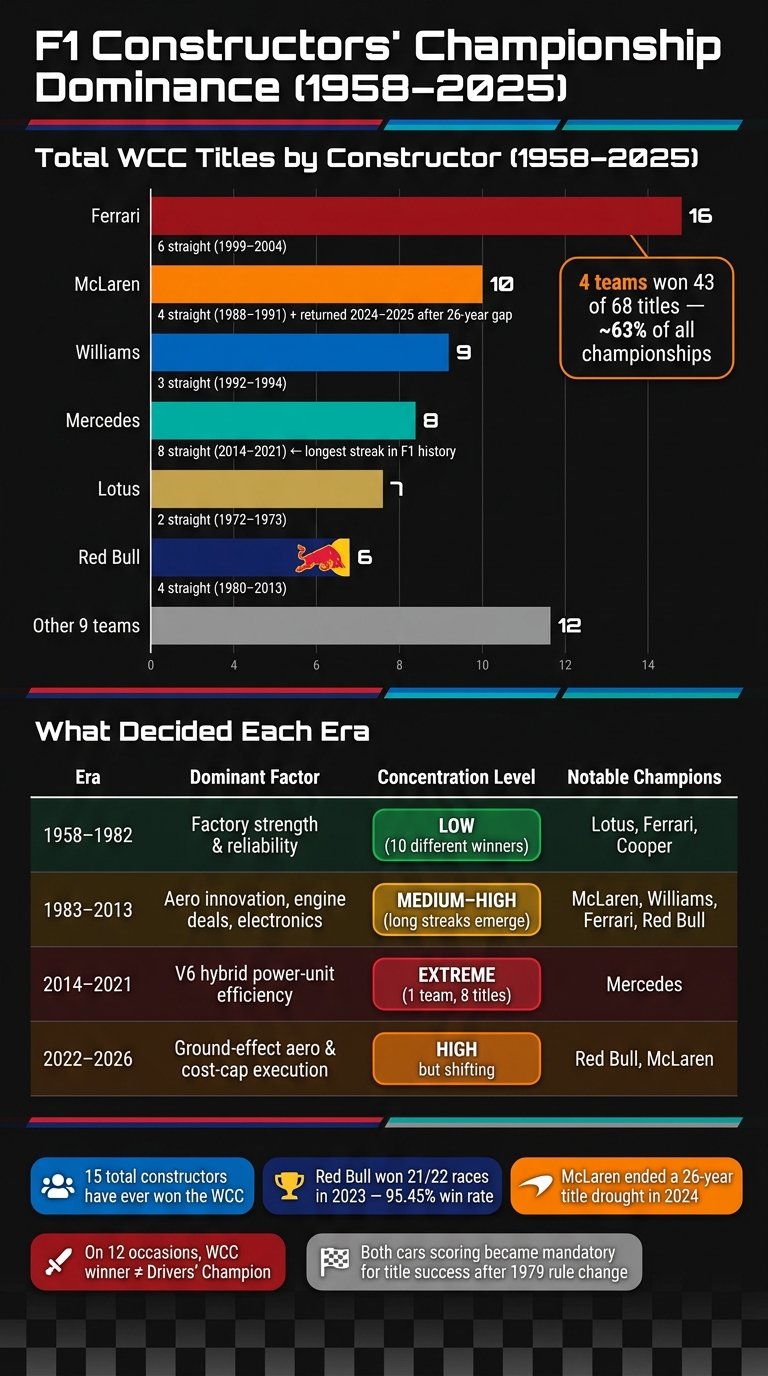
F1 Constructors' Championship Dominance by Team and Era (1958–2025)
How rule changes create new winners and end dynasties
One pattern stands out: when the rules change in a big way, the pecking order often changes with them. When the rules stay steady, the team already on top usually keeps stacking wins.
Since 2009, each major technical reset has produced a new champion: Brawn in 2009, Mercedes in 2014, and Red Bull in 2022. That said, a reset doesn't always blow everything up. Ferrari stayed on top after the 1983 ground effect ban, McLaren kept its title after the 1989 turbo ban, and Williams came through the 1994 driver aids ban still in front.
Why the mixed results? A lot depends on what the rule change hits. If the new rules cut into the exact area where the leading team had its biggest edge, the old order can fall apart fast. If not, the leader may keep rolling. And that matters beyond one season, because these resets help decide where championships pile up over time.
Title concentration, streak length, and gaps between wins
On the surface, the title race can look wide open. The numbers tell a tougher story. Across 68 seasons, only 15 constructors have won at all. And just four teams - Ferrari, McLaren, Williams, and Mercedes - account for 43 of those 68 titles, or about 63% of the total.
That kind of concentration points to deep team strength, not just one fast car or one hot season.
Here’s how the full title count breaks down by constructor:
| Constructor | Total Titles | Longest Streak | Peak Era |
|---|---|---|---|
| Ferrari | 16 | 6 (1999–2004) | 1999–2008 (8 titles in 10 years) |
| McLaren | 10 | 4 (1988–1991) | 1984–1991 & 2024–2025 |
| Williams | 9 | 3 (1992–1994) | 1980–1997 (9 titles in 18 years) |
| Mercedes | 8 | 8 (2014–2021) | 2014–2021 (8 consecutive) |
| Lotus | 7 | 2 (1972–1973) | 1963–1978 |
| Red Bull | 6 | 4 (2010–2013) | 2010–2013 & 2022–2023 |
Mercedes set the longest streak the sport has seen: 8 straight titles from 2014 to 2021. Ferrari’s six-year run from 1999 to 2004 is next. McLaren’s drought was a long one too. The gap between its 1998 title and its return in 2024 lasted 26 years, the longest wait between championship wins for a major team.
The next step is to look at when those wins came, because the shape of dominance changed from one era to the next.
Era comparison: what changed most over time
Different rule sets rewarded different strengths. In one era, it was about building solid cars that finished races. Later, the edge came from aero and electronics. More recently, power-unit efficiency and working well under cost limits have mattered most.
| Regulation Era | Dominant Factor | Typical Competitive Pattern |
|---|---|---|
| 1958–1982 | Factory strength and reliability | High turnover; frequent single-year champions |
| 1983–2013 | Aero innovation and electronics | Long streaks (McLaren, Williams, Ferrari, Red Bull) |
| 2014–2026 | Power unit efficiency and budget efficiency | Extreme concentration; long-term dominance (Mercedes) |
Red Bull handled the 2022 ground-effect reset almost as well as Mercedes handled the hybrid era. In 2023, the RB19 won 21 of 22 races, good for a 95.45% win rate. McLaren now heads into the 2026 regulation reset as the reigning champion after back-to-back titles in 2024 and 2025.
That sets up a familiar test. Can McLaren hold its edge through the next rules change, or does another team spot the opening first? The data points in one direction: constructors' titles tend to go to the teams that react fastest when the sport changes underneath them.
Conclusion: From fast cars to complete organizations
The Constructors' Championship rewards the best team over a full season, not just the car with the most raw speed. The points system baked that idea into the sport. In 1979, both cars' points started counting toward the team total, which meant depth was no longer a nice bonus. It became part of the job of winning the title.
The clearest proof is simple: on 12 separate occasions, the team that won the Constructors' Championship did not have the Drivers' Champion that same year. You see the same thing again and again when one team gets points from both cars while another leans on one star driver to do most of the heavy lifting.
That’s why structure matters just as much as pace. Titles have tended to go to fully integrated factory teams that control the chassis, power unit, and race-day execution. And when key people leave or major technical ties fall apart, dominant runs usually come to an end.
McLaren now heads into the 2026 rules reset as the reigning champion after back-to-back titles in 2024 and 2025. Different era, same pressure: the constructors' crown usually goes to the team that handles both cars best and adjusts first when the sport shifts.
FAQs
Why do rule changes reshape constructors' title races?
Rule changes can flip the constructors' title race by throwing off the balance that teams had worked hard to build. A new set of rules often changes what matters most on the car, whether that's hybrid systems or ground-effect aerodynamics. And when that happens, the teams that saw it coming and put time and money into it early often end up ahead.
So past dominance doesn't always carry over. What matters more is technical foresight and getting the new package to work without major issues. The numbers back that up: about 44% of teams hold on to their title through regulation changes, while 56% are replaced by new champions when rivals handle the shift better.
Why does the second car matter so much in the championship?
The Constructors' Championship comes down to the combined points scored by both drivers. That means the second car matters just as much as the first.
One star driver can carry a bid for the Drivers' Championship on their own. The team title works differently. To win it, a team needs steady points from both teammates across the whole season. If one driver scores far less than the other, that gap can end up costing the team the championship.
Can a team win the constructors' title without the Drivers' Champion?
Yes. A team can win the Constructors' Championship without winning the Drivers' Championship, and that has happened 12 times in Formula 1 history.
The constructors' title depends on the total points scored by both drivers across a season. The drivers' title, on the other hand, goes to one person.
That's why steady points from both cars can make all the difference.