Evolution of F1 Steering Wheel Design
How F1 steering wheels evolved from large wooden rims to carbon-fiber control hubs with paddles, displays, rotaries, and software controls.
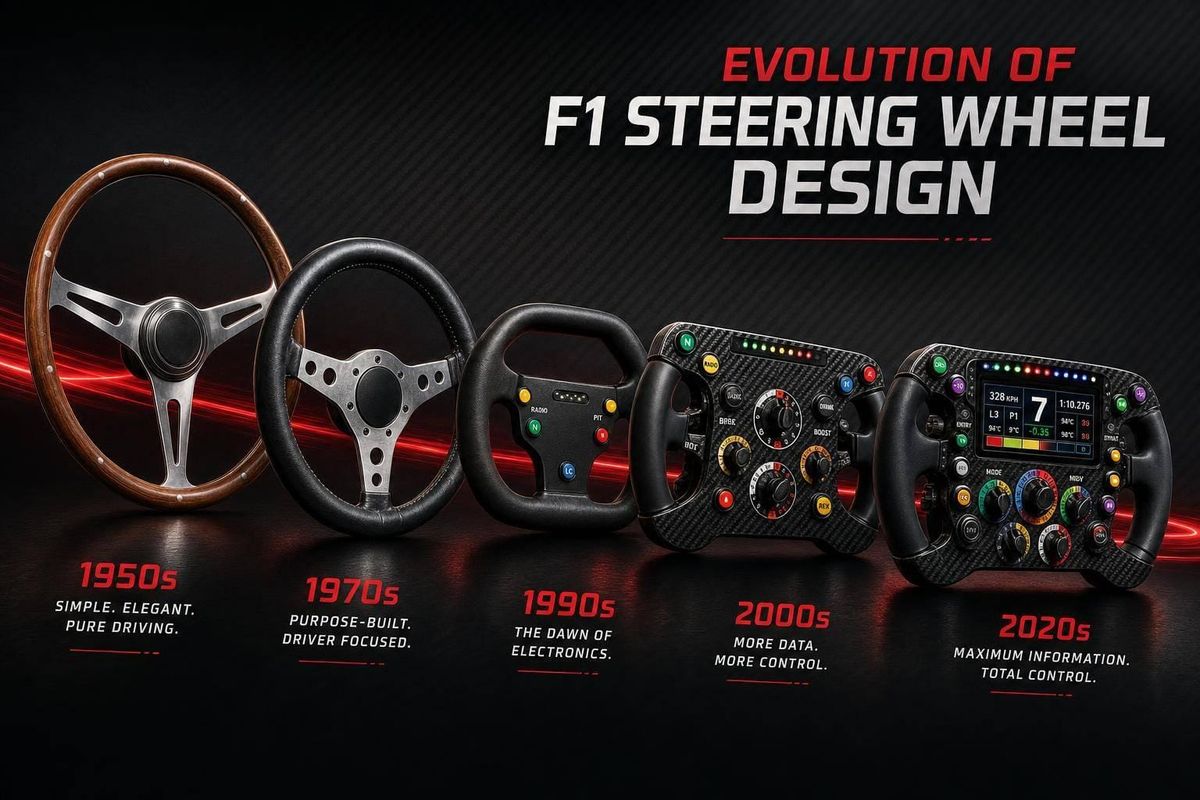
An F1 steering wheel went from a big wooden circle to a sub-3.3-pound carbon-fiber control panel that can cost over $100,000. That change happened because Formula 1 cars got tighter, faster, and much more complex, so teams moved more and more functions onto the one part the driver never lets go of.
If I had to sum up the whole story in a few lines, it would be this:
- Early wheels were large, simple, and built for leverage
- Smaller cockpits pushed wheels down to about 11.8 to 12.6 inches (300 to 320 mm)
- The first switch on the wheel was added for safety
- Paddle shifters in 1989 changed the wheel from a steering tool into a control hub
- Displays, rotaries, and radio buttons turned it into the driver’s main interface
- In the hybrid era, the wheel took on ERS, brake balance, differential, DRS, and pit controls
- Modern wheels can have 180+ switch positions and 100+ data pages
- One wrong press can change a race, as Lewis Hamilton’s 2021 Azerbaijan lock-up showed
A few numbers show how far things have moved:
| Era | Main Role | Typical Form |
|---|---|---|
| 1950s–1960s | Steering only | Large round wood/metal wheel, 13.8 to 15.7 in. |
| 1970s–1980s | Steering + first safety switch | Smaller rim, suede/Alcantara grip, quick-release |
| Late 1980s–2000s | Gear shifts + display + core controls | Paddles, LCD screen, rev lights, rotaries |
| 2014–today | Full car management | Carbon-fiber wheel, under 3.3 lbs, multi-mode software controls |
What matters most is simple: the wheel now helps run the car, not just point it. Layout, button placement, paddle shape, and software mapping all affect how cleanly a driver can make changes at speed. That is why F1 teams treat the steering wheel like a performance part, not just a cockpit accessory.
Below, I’ll walk through how that shift happened, what changed in each era, and why modern F1 wheels look more like flight controls than old race-car steering rims.
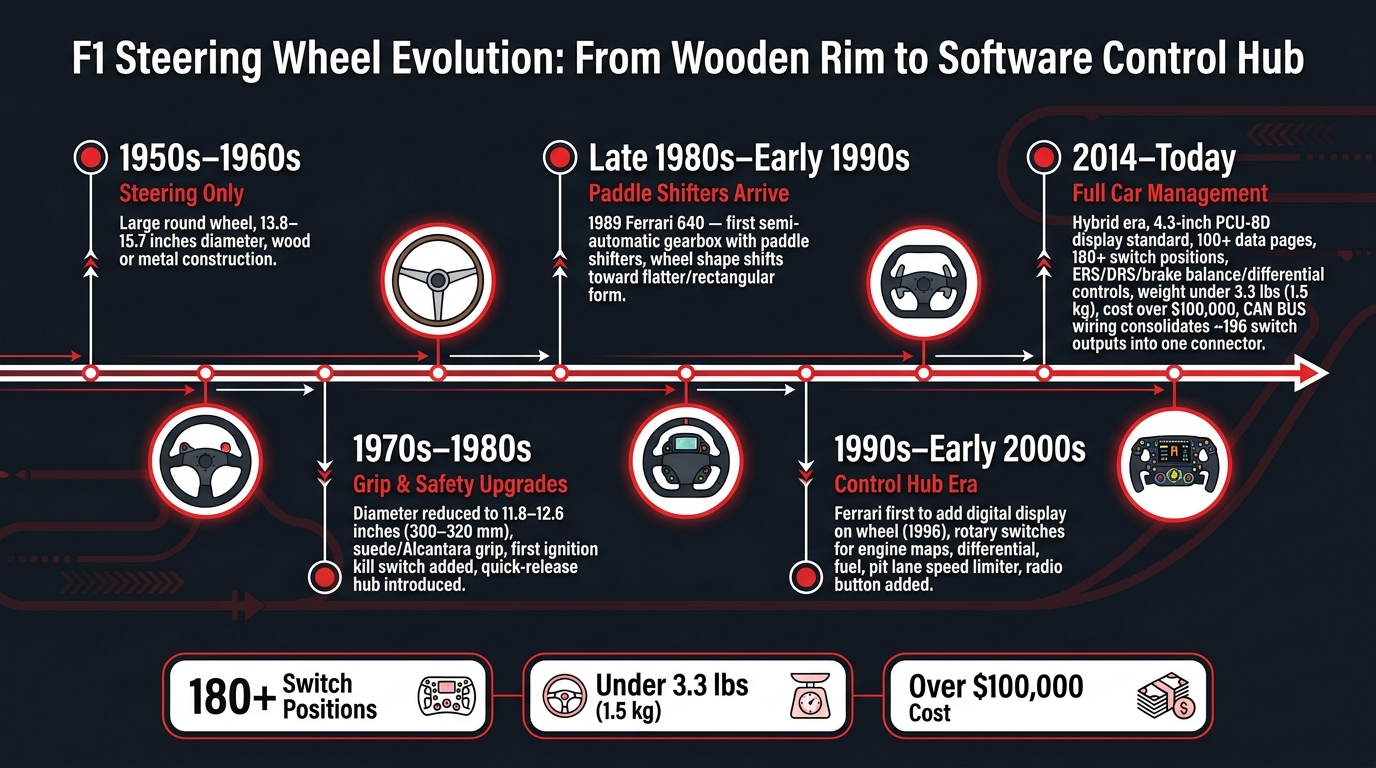
F1 Steering Wheel Evolution: From Wooden Rim to Software Control Hub
From Wood Rims to Paddle Shifters: The Mechanical Era Through the First Electronic Controls
1950s to 1960s: Large Circular Wheels With Almost No Onboard Controls
Early F1 wheels were big, plain, and built for one job: giving drivers enough leverage to wrestle heavy cars with no power assistance. Almost everything else sat on the dashboard or elsewhere in the cockpit. At that point, the wheel solved a single problem - steering force.
1970s to 1980s: Smaller Wheels, Better Grip Materials, Tighter Packaging
As chassis design got tighter, the wheel started to change from a basic rim into a more finely tuned part of the cockpit. Narrower cockpits meant smaller wheels, usually around 300 to 320 mm, and the materials changed too: from wood to leather, then to suede and Alcantara for more grip.
"Suede replaced the leather rim which received a lot of plaudits... it was the first 'real improvement' because it gave [the driver] more of a feel in the car through improved grip." - Stefan Johansson, F1 Driver
The pattern here is pretty clear. First came the smaller wheel. Then came better grip materials. After that came the first electronic switch. In the mid-1970s, teams added an ignition kill switch to the F1 wheel because dirt could jam throttle parts open, which left the driver with no direct way to shut off the engine.
Quick-release hubs arrived in the 1980s for a simple but serious reason: cockpits had become so tight that, in an emergency, drivers often could not climb out without taking the wheel off first.
By the 1980s, grip shape and thickness had also become driver-specific. Different drivers wanted different steering feel, and the wheel started to reflect that.
That change in ergonomics opened the door for the next big shift: electronic gear control.
Late 1980s to Early 1990s: How Paddle Shifters Changed Wheel Layout
Once the wheel started doing more than steering, gear changes were the next function to move into the driver's hands. In 1989, Ferrari's John Barnard gave the Ferrari 640 paddles behind the wheel, creating the first semiautomatic gearbox in F1. From that moment on, the wheel was no longer just a steering device. It had started to take over drivetrain control too.
Taking away the floor-mounted gear lever opened up cockpit space and nudged wheel design toward flatter, more rectangular shapes.
sbb-itb-7c68254
How F1 Steering Wheels Went From Wooden Hoops to Carbon Fibre Computers
The Control Hub Era: Displays, Electronics, and Software-Led Complexity
Once paddle shifters showed that the steering wheel could handle drivetrain control, teams kept going. The same idea spread to the engine, chassis, and race systems. Step by step, the wheel stopped being just a steering input and became the car’s control center.
1990s to Early 2000s: LCD Screens, Rev Lights, and Rotary Switches
In the 1990s, electronics started flooding into F1 cockpits, and the steering wheel took on much of that load. Ferrari was the first team to put a digital display right on the wheel in 1996, showing shift lights and lap times. That move changed the wheel in a big way. It was no longer just a rim with extra buttons bolted on. It had become a live console the driver used every lap.
Rotary switches came next, and they spread fast. Teams added dials for engine maps, fuel, and differential control, letting drivers adjust torque delivery through a lap. A pit lane speed limiter button showed up too, along with a radio button. By the early 2000s, drivers such as Michael Schumacher were pushing this even further, including research into highly customized molded silicone grips built to maximize tactile feedback and performance.
The Hybrid Era From 2014: ERS Management and Mode-Based Racing
The hybrid era made this setup impossible to avoid. When turbo-hybrid power units arrived in 2014, even more data and control had to move onto the steering wheel. The 4.3-inch PCU-8D display became the standard setup, used by most teams that season. It can show more than 100 customizable pages of data, including ERS harvesting, battery state of charge, tire temperatures, lap deltas, gear position, and FIA marshal warning lights.
Rotary switches also picked up more jobs. A Strat mode dial handled power unit performance settings, while other rotaries managed ERS deployment and differential settings. In plain English, drivers could adjust performance in real time instead of waiting for the next lap or a pit stop.
One detail here says a lot about F1 design choices. Williams was the last team to move the display onto the wheel itself, finishing that change for the 2024 season. For years, they had stuck with a dash-mounted screen to cut steering wheel weight and inertia. That’s a good reminder that even upgrades that seem obvious on paper can come with trade-offs.
Modern Software Layers: Fewer Physical Controls, More Programmable Functions
As more functions piled up, software had to step in where extra hardware no longer made sense. Modern wheels now lean on multi-function switches and software mapping. One rotary dial can control different settings based on the car’s current mode, and menu buttons let drivers cycle through options without stuffing the wheel with even more switches.
The wiring side is just as wild. The interface unit inside the wheel uses CAN BUS technology to manage roughly 196 switch outputs and cut nearly 200 individual cables down to a single connector on the steering column. Even with more than 20 controls and advanced electronics packed inside, the wheel still weighs less than 1.5 kg (3.3 lbs). That’s a lot of function in a very small package - and it also means one wrong input can carry a steep price.
How Teams Design the Wheel: Ergonomics, Materials, Reliability, and Team Philosophy
Driver-Specific Ergonomics and Control Placement
Once the wheel turned into the car’s main control hub, the job changed. It wasn’t just about adding more functions. It became about making each one easy to find and use at racing speed.
That’s where ergonomics takes over. Teams custom-mold the grips in silicone, then place each control based on reach and how often the driver uses it. Some drivers like upper-thumb rotaries. Others want DRS and brake-balance controls moved farther away so they don’t hit them by mistake.
High-priority functions such as DRS and Overtake often go on rear-facing buttons or thumb switches instead of front buttons. Why? Because they’re easier to find by feel when the driver is braking hard or fighting cornering loads.
Even clutch layouts can differ inside the same team. Charles Leclerc uses a single wishbone-style clutch paddle with a left-hand hinge, while Carlos Sainz uses a twin-paddle setup that works with either hand. That says a lot about how personal the wheel has become.
To make each input clear, buttons use tactile microswitches, and paddles use spring-loaded stops. The result is a sharp click the driver can feel through thick gloves and nonstop vibration.
Carbon Fiber, Electronics Packaging, and Failure Resistance
The wheel shell is made from carbon fiber, with paddles and mounts picked for low mass and long-term durability. Paddles are usually carbon fiber, titanium, or aluminum. Inside the wheel, switch mounts are often 3D-printed plastic - light, but still tough enough to last a full race distance.
On the electronics side, CAN BUS wiring pulls roughly 196 cables and outputs into a single network that runs through the steering column. That keeps the system compact and cuts down on clutter.
The electrical link is built into the quick-release mechanism. So when the wheel locks into place, it also connects automatically. It’s a neat bit of packaging, but it also has to work every single time.
For critical functions like clutch position, teams use redundant sensors. Those sensors send live analog data to the ECU, so one sensor failure doesn’t stop the car.
Team Design Philosophies and Visible Differences on Broadcast
These choices aren’t just cosmetic. They show how each team weighs speed, reliability, and driver memory while working under the same rules.
Ferrari leans toward maximum adjustability, packing in up to six rotary dials so drivers can make more changes on the fly. Red Bull goes the other way, keeping the layout cleaner with fewer buttons to cut the risk of accidental inputs. Those choices even affect radio language, since many instructions point to a certain rotary position or a button sequence.
At a glance, the differences look like this:
| Team | Design Priority | Control Philosophy |
|---|---|---|
| Ferrari | Maximum adjustability | Up to 6 rotary dials; driver-specific clutch paddles |
| Mercedes | Ergonomic precision | Finger-socket clutch paddles; multi-function "magic" button presets |
| Red Bull | Simplicity & reliability | Fewer buttons to minimize accidental inputs |
| Williams | Weight & inertia reduction | Butterfly shape; historically avoided a wheel-mounted screen until the FW46 |
And when this goes wrong, the cost is immediate. At the 2024 Saudi Arabian Grand Prix, Ollie Bearman had to learn Ferrari’s wheel layout on short notice, with control positions that differed by driver. In a car where inputs depend on muscle memory, that’s a big ask.
Regulations, Telemetry, and the Future of F1 Steering Wheel Design
FIA Rules That Shape Wheel Design and Safety Systems
Once the steering wheel became the car's main interface, the rulebook had to catch up. As more functions moved into software, the FIA stepped in to standardize parts of safety, displays, and control limits. Put simply, FIA rules set the boundaries for what an F1 steering wheel can do.
One rule leaves no room for debate: the quick-release mechanism. In an emergency, drivers must be able to remove the wheel and get out of the cockpit within five seconds. The splined quick-release only locks at the 12 o'clock position, which makes removal clear and direct under pressure.
The FIA also standardizes the wheel display, although teams still tailor the data pages to suit their own needs. On top of that, marshal warning lights are required. These flash the color of the active flag - yellow, blue, or red - right in front of the driver.
There are limits on hardware, too. Sporting rules cap rotary switches at nine, and each can have up to 16 positions. That means teams can't just keep adding knobs forever. They have to choose which controls earn a spot on the wheel. The pit lane speed limiter is another required function. Once the driver activates it, the car cannot go over the regulated pit speed, even with full throttle applied.
The FIA also steps in when a steering wheel function starts to affect parts of the car beyond steering. Mercedes' Dual Axis Steering (DAS) system is the best-known case. It let drivers change front toe angles by pushing or pulling the wheel, but it was banned starting in 2021. The message was simple: the wheel can steer, but it can't double as a suspension tool.
Those rules don't just limit hardware. They shape how teams interpret driver inputs and how much can be done from the cockpit.
Telemetry and Race Strategy Through Wheel Inputs
Every input on the wheel is logged and sent to the pit wall in real time. So engineers aren't only tracking lap times. They're watching how the driver is using the car, one adjustment at a time.
Rotary dials for engine maps, differential settings, and ERS deployment give engineers a live read on how the driver is trading outright pace against tire wear and fuel targets. If something needs to change during a stint, the radio message often points to one exact switch position. The driver makes the change, and telemetry shows it right away.
The "Mark" button is a good example of how tight that loop has become. Drivers use it to flag a specific moment in the data, like a handling issue, a curb hit, or a sudden snap of oversteer. Instead of digging through a huge session file later, engineers can jump straight to that moment in post-session review.
A single wrong input can still swing a race restart.
In modern F1, the wheel is doing two jobs at once: it's a control device, and it's a live stream of driver data.
Conclusion: What the Steering Wheel's Evolution Says About Modern F1
The modern steering wheel is a software-defined control hub, and that says a lot about where F1 has gone. As power units became more complex through the KERS era and then full hybrid systems from 2014 onward, the wheel took on each new layer of management. ERS deployment, engine modes, and differential tuning now sit right on the grips where drivers can reach them fast.
The 2026 regulation cycle will add one more layer. A new power unit layout will bring new management jobs, and teams will redesign their wheels around those needs, much like they did in 2014. At the same time, the shift toward software-defined functions means one button can trigger a programmable preset instead of one fixed mechanical action. So even if the systems underneath get more complicated, the number of physical controls may shrink.
"The wheel is now anything but round, its primary function blurred between steering and controlling just about everything else on the car with over 180 different switch positions." - Craig Scarborough, Technical Illustrator
As more function moved onto the wheel, the wheel turned into a software-managed control surface. The driver isn't just steering a car. They're operating a rolling software platform at extreme speed, with the wheel sitting right between human instinct and machine intelligence.
FAQs
Why are F1 steering wheels no longer round?
F1 steering wheels aren't round anymore for one main reason: modern cars need the wheel to do far more than steer.
Today's wheel has to fit a lot into a small space, including buttons, rotary dials, and LCD screens. As gearboxes, power units, and chassis settings got more complex, the steering wheel turned into a compact control center.
The shape change also helps in a few practical ways. It improves ergonomics, cuts weight, lowers rotational inertia, and gives drivers more room to get in and out of the cockpit. On top of that, the design makes quick steering inputs easier during a race.
How do drivers avoid pressing the wrong button at speed?
Drivers mostly avoid mistakes through customization and ergonomic design. Each steering wheel is set up for the driver, down to the button layout, control placement, and grip shape, so the main functions feel natural to reach.
That sense of familiarity improves tactile feel and cuts down on errors. Teams also use software to handle complex inputs, and drivers may follow radio instructions to confirm settings during the race.
What could change on F1 steering wheels in 2026?
The provided information does not point to any planned changes for Formula 1 steering wheels in 2026.
It explains how F1 steering wheels have changed over time, moving from simple circular rims to compact carbon-fiber control hubs with paddle shifters, LCD screens, and rotary dials.
But it does not mention any 2026 rules, specs, or design updates tied to steering wheels.