Rear Wing Rules: Impact on F1 Downforce
2026 F1 rear-wing rules don't remove downforce — they cut wing load, shift it to the floor, force active‑aero mode switching, and tighten flex limits.
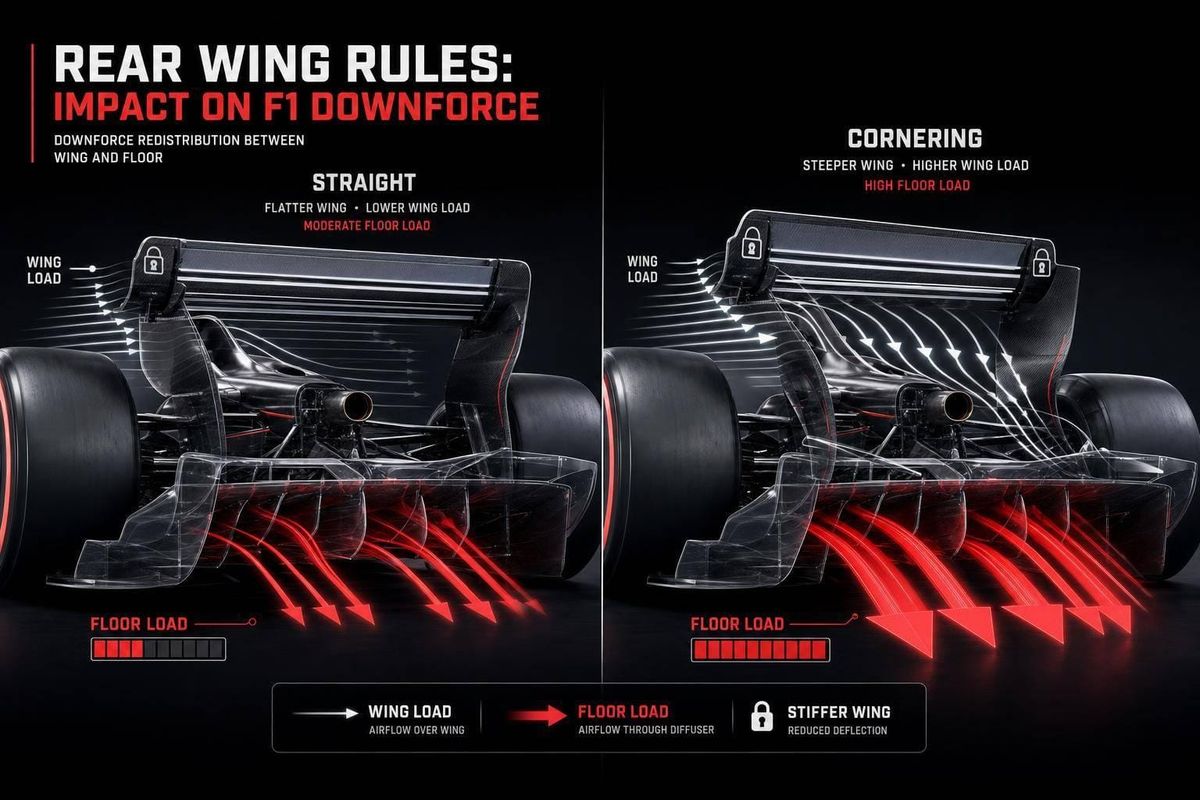
Here’s the short answer: rear wing rules have cut design freedom, shifted more load to the floor, and changed how teams balance corner grip vs. straight-line speed.
From 2022 to 2025, F1 moved to simpler rear wings and cleaner wake targets. For 2026, the FIA goes further with active aero, no beam wing, and a much tighter flex limit. The result is simple:
- Less total downforce: target is about 30% lower
- Less total drag: target is about 55% lower
- More floor dependence: the floor is expected to make about 50% of total downforce
- More mode-switching: cars will use Z-mode for corners and X-mode for straights
- Less room for flex tricks: rear-wing slot-gap movement under load falls to 0.5 mm
If you want the takeaway in one line, it’s this: the rear wing still matters a lot, but it no longer carries the same share of the job on its own.
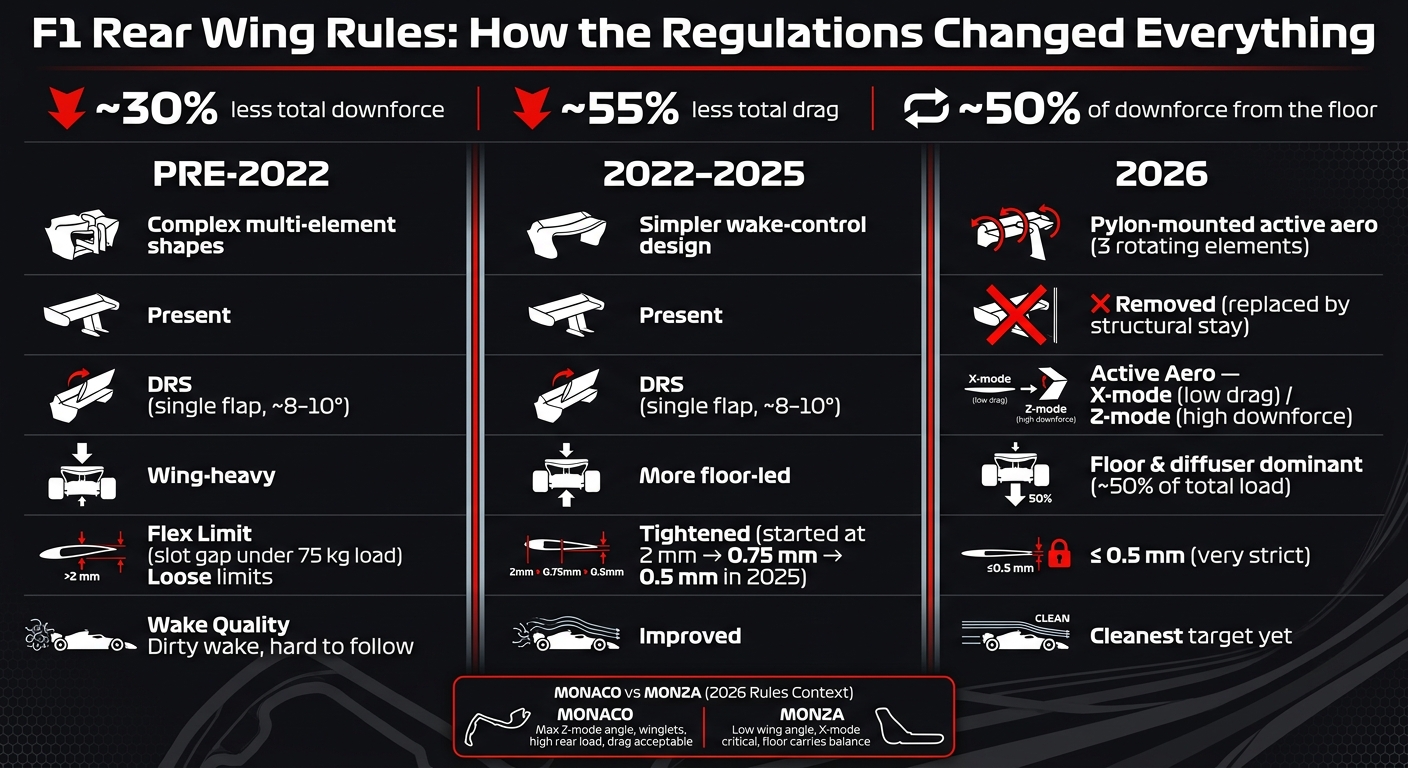
F1 Rear Wing Rules: Pre-2022 vs 2022–2025 vs 2026 Regulations
The Complete Guide to the 2026 F1 Aerodynamics Regulations
sbb-itb-7c68254
Quick Comparison
| Area | Pre-2022 | 2022–2025 | 2026 |
|---|---|---|---|
| Rear wing concept | More complex shapes | Simpler wake-control design | Pylon-mounted active aero |
| Beam wing | Used | Used | Removed |
| Straight-line drag cut | DRS-based | DRS-based | X-mode active aero |
| Rear load source | Wing-heavy mix | More floor-led | Even more floor/diffuser-led |
| Flex control | Looser | Tightened | Very tight limits |
For teams, that changes setup in a clear way. Monaco still wants max rear load. Monza still wants low drag. But the path to each setup is now more tied to the floor, diffuser, and rear-wing mode changes than before.
That’s the core of the article, and I’ll break it down in plain terms below.
The Rules Behind Rear Wing and Beam Wing Design
Rear wing geometry limits and wake-control goals
For 2026, the FIA moved away from the 2022 integrated-endplate rear wing and went to a pylon-mounted rear wing with distinct endplates. The aim is simple: cut rear-wing load. With a tighter wing box, more of the rear load has to come from the floor and diffuser.
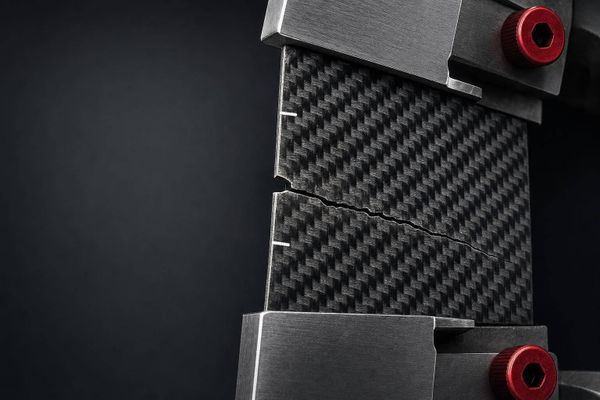
The FIA also clamped down on flexing rear wings. Teams had been looking for ways to let the wing bend at speed and shrink the slot gap. So during 2025, the rear-wing deformation test got much stricter. When a 75 kg vertical load is applied to the main plane, the gap between the main plane and flap can change by no more than 0.5 mm. That limit started the season at 2 mm, dropped to 0.75 mm at the Chinese Grand Prix, and then fell again to 0.5 mm by the Japanese Grand Prix.
Nikolas Tombazis said the initial 2025 flex test was too weak, prompting the tighter 0.5 mm limit.
That one rule says a lot. Teams can’t lean on aero elasticity the way they might have wanted to, so they need to find rear performance in more controlled areas.
Beam wing rules and diffuser interaction
From 2022 to 2025, teams could use a two-element beam wing between the floor and the rear wing. For 2026, that piece is gone and replaced by a structural stay. Under the old setup, the beam wing worked with the diffuser to increase upwash and rear load.
Take it away, and the job doesn’t disappear. It shifts. More of the aerodynamic burden now lands on the diffuser and lower rear structure, which interact directly.
So the rear of the car has less support from extra wing surfaces. That means rear drag reduction has to come more from the rear wing itself, not from the old beam-wing-plus-diffuser combo.
How current DRS rules differ from the 2026 active-aero direction
Under the 2022–2025 rules, DRS is pretty straightforward: it opens a single flap by about 8 to 10 degrees. The 2026 rules go in a different direction. Instead of a one-piece DRS move, they use active aero with three rear-wing elements that rotate together between Z-mode for maximum downforce and X-mode for minimum drag.
In X-mode, some layouts rotate the upper element past horizontal, which creates a much larger slot gap than a standard DRS setup. That’s a much more aggressive drag-cutting tool on the straights.
| Feature | 2022–2025 (DRS Era) | 2026 (Active Aero Era) |
|---|---|---|
| Rear wing elements | 2 main elements plus beam wing | Up to 3 elements |
| Beam wing | Present | Removed |
| Actuation | Single upper flap opens for DRS | All 3 elements rotate together |
| Primary modes | DRS open / DRS closed | X-mode / Z-mode |
| Endplates | Integrated/rolled design | Pylon-mounted with distinct endplates |
The knock-on effect is pretty clear. Since X-mode cuts drag much harder on the straights, teams can afford to run higher wing angles in Z-mode than they likely would have under the 2025 rules. That gives them more cornering load without paying the usual top-speed price.
In other words, the rear wing can be more aggressive in the corners because the car has a stronger way to shed drag on the straights. But with the beam wing gone and rear-wing flex under tighter control, the route to rear downforce is also more narrow. The research data below makes that plain.
The next section shows how those limits change downforce and drag in practice.
What the Research Shows About Downforce and Drag
How rear downforce shifted from pre-2022 cars to the ground-effect era
With rear-wing and beam-wing limits locked in, the big issue is simple: how much rear load can the car still carry?
The floor now does most of the heavy lifting, but rear-wing changes still have a strong effect on balance. For 2026, the floor is expected to produce about 50% of total downforce.
That number tells you a lot. Even with the floor acting as the main source of load, the rear wing still plays a major part in keeping the car stable and giving drivers the balance they need.
Trade-offs between peak load and cleaner wake
Less freedom around the rear wing means less rear-wing load. But that's not an accident. Since 2022, the FIA has aimed to clean up the wake behind the car so another car can follow more closely without shedding as much grip.
So yes, tighter rear-wing geometry cuts peak rear-wing load. The upside is a cleaner wake, which is the whole point.
What the 2026 rules are expected to change
The FIA's 2026 targets call for a 30% downforce cut and a 55% drag cut compared with the 2022-2025 cars. Active aero is supposed to keep cornering load in place while trimming drag on the straights.
Because active aero can swap between low-drag X-mode on straights and high-downforce Z-mode in corners, teams can split straight-line efficiency from cornering load far better than they could with DRS alone.
There's also a second effect here. In dirty air, a car with less total downforce should lose a smaller absolute amount of grip. Put plainly, if the car starts with less load overall, the grip loss from following another car should hurt less.
That's why teams are now chasing balance through floor and diffuser tuning, not just by making the rear wing bigger or smaller.
How Teams Work Within Rear Wing Restrictions
Moving load to the floor, diffuser, and beam wing
When rear-wing load is capped, teams have to find rear downforce somewhere else. Most of that work shifts to the floor and diffuser.
That puts a lot more pressure on the diffuser to carry rear load. One area matters a lot here: the diffuser–wing transition point, where the diffuser exit flow meets the lowest element of the three-element rear wing. If that handoff is messy, the whole rear of the car can lose efficiency.
Teams also shape suspension members with great care so they can condition airflow into the diffuser. And the small details matter too. Features like "mouse holes" in the diffuser walls add energy to the airflow, while underbody fences help manage pressure across the floor and shed vortices in a controlled way.
The knock-on effect is simple: track choice and wing package selection now matter even more.
Why Monaco and Monza still need very different rear wing setups
You can see this best when teams split their approach for Monaco and Monza.
Monaco rewards downforce much more than low drag, so teams can run aggressive rear-wing angles without paying much of a price. At Monaco, teams have also used packaging loopholes to claw back rear load with winglets and other aero hardware, including the use of actuator-pod space for winglets.
Monza is the other end of the scale. There, drag is the enemy. Teams trim wing angle, chase straight-line speed, and lean more on aero efficiency.
| Feature | Monaco (High Downforce) | Monza (Low Drag) |
|---|---|---|
| Wing Angle (Z-mode) | Maximum possible angle of attack for peak load | Moderate to low angle to minimize base drag |
| Active Aero (X-mode) | Often disabled or irrelevant | Critical for minimizing residual drag |
| Relative Load | Very high; supplemented by bespoke winglets | Low; focused on efficiency and X-mode |
| Drag Penalty | High, but acceptable because of the circuit's low speed sensitivity | Critical; teams prioritize straight-line speed |
| Handling Effect | Maximum rear stability and low-speed traction | Reduced stability; the car relies more heavily on the floor for balance |
How DRS and active-aero concepts shape setup decisions
Under the 2022–2025 DRS rules, teams still had to make a trade-off between rear-wing load and straight-line drag. More load helped in corners, but it usually cost speed on the straights.
The 2026 active-aero system changes that balance a bit. X-mode gives teams more room to run steeper Z-mode angles, while the floor still has to keep the car in balance when X-mode cuts drag. So the compromise gets looser, but it doesn't go away.
The next section shows how that balance appears in CFD, wind-tunnel work, and track data.
On-Track Effects, Case Studies, and Key Takeaways
What CFD, wind tunnel work, and track data reveal
Teams don't just sketch a rear wing, bolt it on, and hope for the best. These limits get tested in simulation first, then checked in the wind tunnel, and then verified on track. In practice, teams validate rear-wing ideas across all three stages before committing to a direction. The FIA also uses high-speed cameras during free practice to monitor flexing and shut down mini-DRS-style flex gains.
Visible effects on racing and development direction
That pressure has changed how teams chase performance. Instead of only trimming the wing in a simple way, teams have moved toward rotating rear-wing concepts.
At Miami in May 2026, Ferrari and Red Bull introduced rotating rear wing designs that went past standard DRS. Ferrari's "flip-flop" wing rotates the flap element fully upside down, while Red Bull's version opens an even larger slot gap by lifting the upper element above the endplates.
The same idea appeared at high-downforce street tracks too. At Monaco in June 2026, the FIA disabled Straight Mode, and teams such as Mercedes, Red Bull, and McLaren used the extra actuator-pod area to fit local load-generating devices.
| Metric | 2022–2025 Generation | 2026 Generation (Target) |
|---|---|---|
| Total Downforce | Baseline (100%) | ~70% (30% reduction) |
| Total Drag | Baseline (100%) | ~45% (55% reduction) |
| Following Car Impact | Degraded by wake turbulence | Improved by lower total load and cleaner wake |
Conclusion: Rear wing rules reduce freedom, not importance
Modern rear wing rules have narrowed what teams can do with the wing itself, but the rear wing still matters a lot. The limits have pushed more aero work into the floor and diffuser, while the beam wing's removal for 2026 is meant to simplify the wake structure.
That shift changes the rear wing's job more than its status. With the floor expected to produce roughly 50% of total downforce in 2026, the rear wing becomes more about keeping the car balanced as it switches between rotating rear-wing modes.
Rear-wing rules don't remove rear downforce. They change where it comes from, and you can see that in everything from Monaco winglet add-ons to Miami's rotating flap systems.
FAQs
Why does removing the beam wing matter so much?
Removing the beam wing matters because it ties the diffuser and rear wing together, so the back of the car works like one aero package.
It also helps pull airflow through the underbody, which strengthens the low-pressure effect that adds downforce. Take it away, and teams have to lean harder on the floor and diffuser to keep the car stable and balanced under the 2026 rules.
Will active aero make cars faster in corners or only on straights?
Active aerodynamics are built to handle both jobs.
In corners, cars run a high-downforce setup to get as much grip as possible and carry more speed through the turn. On straights, they switch to a low-drag setup so the car cuts through the air more cleanly and reaches a higher top speed.
So no, active aero doesn't make a car faster in corners by itself. What it does is keep the downforce the car needs in corners, while also letting it go faster on the straights.
How do tighter flex rules affect rear wing design?
Tighter flex rules are pushing teams to build stiffer rear wings. The goal is simple: stop the wing from bending just enough to gain speed while still passing FIA checks.
The FIA is now using 165 lb (75 kg) static load tests, 4K cameras, and a much smaller allowance for slot gap movement: 0.5 mm instead of 2.0 mm. In plain terms, teams have far less room to play with. They now have to juggle aerodynamic load and very tight material tolerances when the car is flat-out at high speed.