Brake Pad Wear: Key Data from Recent F1 Seasons
F1 brake pad life, cooling trade-offs, circuit impacts since 2022, and 2026 regen effects on wear.
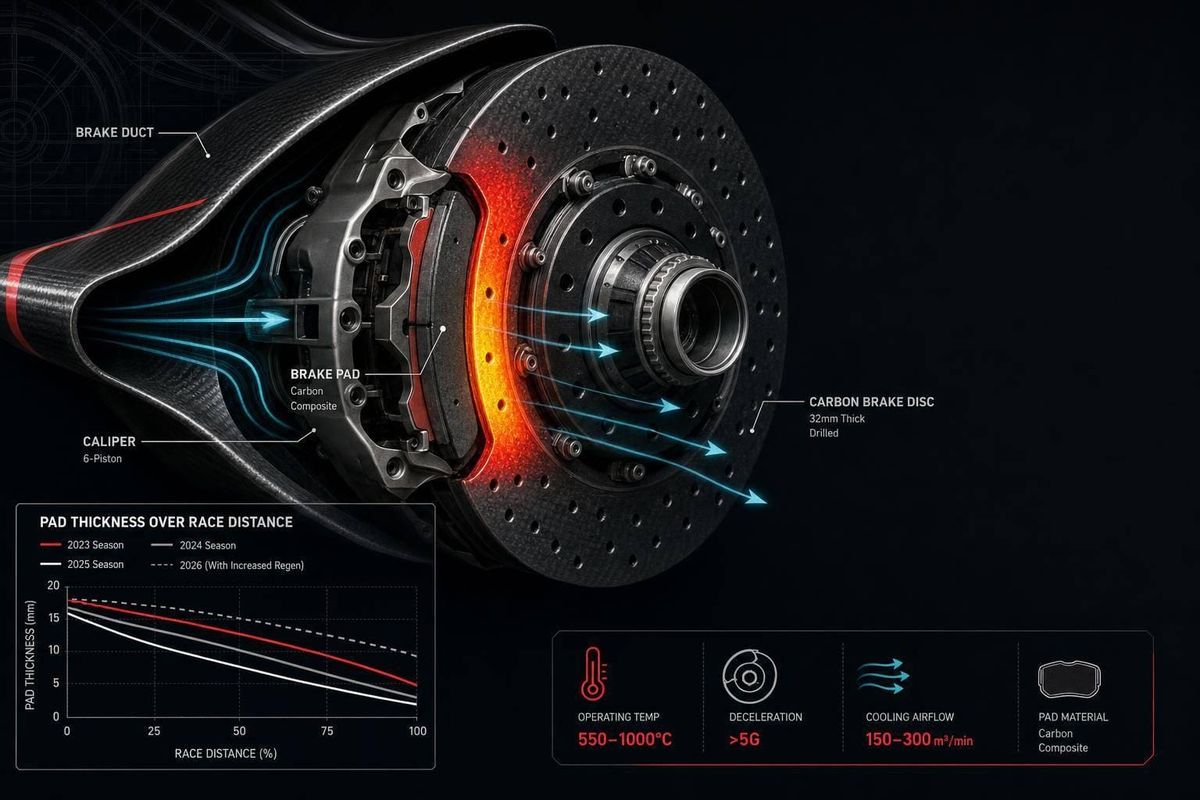
F1 brake pad wear since 2022 comes down to three things: track layout, brake cooling, and heat control. I’d boil the article down like this: a full disc-and-pad set lasts about 500 miles (800 km), teams get about 140 to 240 pads per driver per season, and wear now depends more on thermal control because the 2022 ground-effect rules changed wheel, brake, and duct behavior.
If you want the short answer, here it is:
- Hard-braking tracks burn pads faster. Monza and Bahrain sit at 5/5 for brake demand.
- Cooling setup now matters more than before. Since 2022, teams lost some old duct and wheel-flow tricks.
- Rear wear is lower than front wear. The MGU-K takes part of the rear braking load.
- Temperature is the key live signal. Too cold hurts bite; too hot speeds wear and oxidation.
- 2026 shifts the picture again. Standard pad thickness drops from 22 mm to 20.5 mm, with more braking load moving into energy recovery.
A few numbers stand out. Peak pedal load hit 162 kg at Monza’s first chicane in 2025. In Montreal, Turn 13 sees a drop from 306 km/h to 147 km/h in 1.93 seconds. And after the 2022 rules, Brembo said cars needed about 5% more braking torque by 2023. That helps explain why teams watch brake temperatures so closely and use lift-and-coast when heat starts climbing.
How £100,000 F1 Brakes Are Made (Factory Visit)
sbb-itb-7c68254
Quick Comparison
| Area | Main takeaway | Key numbers |
|---|---|---|
| Pad supply | Teams must use sets carefully across the season | 280 to 480 pads per team |
| Set life | One disc-and-pad set does not last long by road-car standards | ~500 miles / 800 km |
| Hardest tracks | Heavy stops and poor cooling drive wear | Monza/Bahrain: 5/5 |
| Rear vs. front | Rear pads usually wear less | MGU-K shares rear braking load |
| 2026 change | Pad spec shifts with more regen | 22 mm → 20.5 mm |
So if I had to sum it up in one line: recent F1 brake pad wear is less about sudden failure and more about keeping brake feel and heat in the right range for a full race weekend.
Season-Level Data: Pad Usage, Wear Rates, and Operating Margins
Estimated Pad Consumption Across a Full Season
Brembo supplies each team with 280 to 480 carbon brake pads per season across both cars. That comes out to about 140 to 240 pads per driver.
That sounds like a lot at first glance. But once you spread that total across practice, qualifying, and races, the limit starts to feel pretty tight. So teams don’t burn through new pads carelessly.
Instead, they’re selective. A team will usually bed in one new pad-disc set in FP1, then hold that set back for qualifying and the race. In later practice sessions, they lean on older sets instead. It’s a simple way to save the best braking feel for the moments that matter most.
Typical Wear Over a Race Distance
Teams manage that limited pad life to keep enough performance margin for qualifying and race trim. For 2026, Brembo reduced standard pad thickness from 22 mm to 20.5 mm because the MGU-K takes on more of the braking load.
Rear pads wear less, since the MGU-K handles a big share of the rear braking effort. That changes the workload across the car and gives teams a bit more room at the rear. Even so, the key job stays the same: protect enough margin so the brakes keep working as expected when the pressure is on.
How Teams Monitor Wear During a Race
Once the set is in the car, temperature becomes the main signal teams watch for wear. Sensors at each wheel corner send brake disc and caliper temperature data back to the pit wall all the time.
Carbon brakes work best in a tight temperature window. If they’re too cold, bite falls away. If they get too hot, wear can climb fast. That’s why brake management isn’t just about stopping power. It’s also about keeping the system in the right zone lap after lap.
When temperatures start to spike, engineers may call for lift-and-coast before the braking zone to trim heat load. It’s one of those race tools that can look small from the outside, but inside the garage it’s a direct way to protect the brakes.
Those operating margins can shift a lot from one circuit to another, and they also depend on the brake-cooling package.
What Drives Wear Differences: Circuits, Car Design, and Regulations
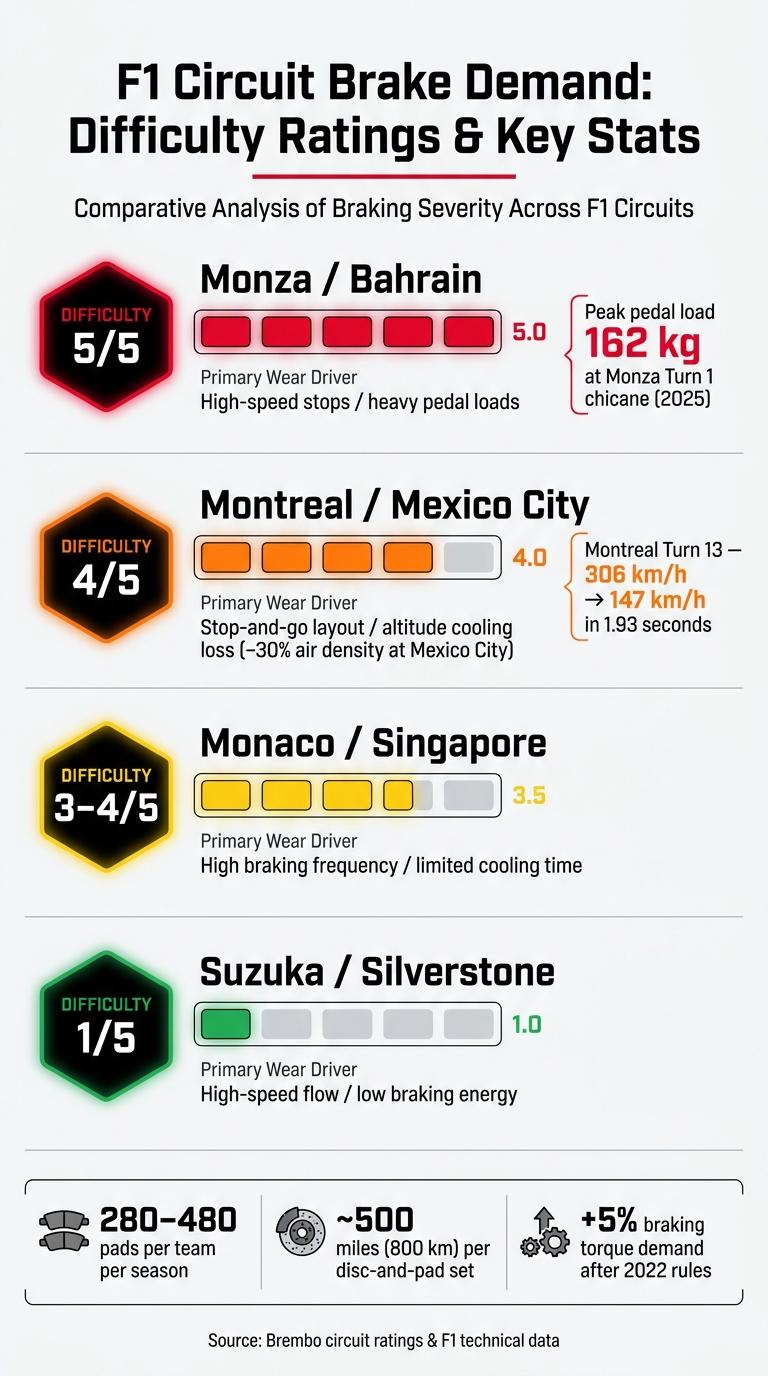
F1 Brake Pad Wear by Circuit: Difficulty Ratings & Key Stats
Circuit Braking Profiles and Which Tracks Are Hardest on Pads
Circuit layout is the biggest week-to-week factor behind pad wear. Brembo scores tracks on a 1-to-5 difficulty scale. Monza and Bahrain sit at 5 out of 5 because they put huge loads through the brakes. The peak pedal load recorded in 2025 was 162 kg at Monza’s first chicane.
Montreal and Mexico City both rate 4 out of 5, but they stress the brakes in different ways.
Montreal is a classic stop-and-go circuit with six heavy braking zones. At Turn 13, drivers drop from 306 km/h to 147 km/h in 1.93 seconds. Mexico City is tougher for another reason. The thinner air at altitude cuts air density by about 30%, which means less heat can escape, even if the braking demand itself isn’t quite as harsh.
At the other end of the scale, Suzuka and Silverstone rate just 1 out of 5. Both tracks flow at high speed, so drivers lean on the brakes less and the system gets more time to cool between big stops. That difference from one circuit to the next has a direct effect on how much pad life a team uses in a given race weekend.
| Circuit | Difficulty (1–5) | Primary Wear Driver |
|---|---|---|
| Monza / Bahrain | 5 | High-speed stops / heavy pedal loads |
| Montreal / Mexico City | 4 | Stop-and-go layout / altitude cooling loss |
| Monaco / Singapore | 3–4 | High braking frequency / limited cooling time |
| Suzuka / Silverstone | 1 | High-speed flow / low braking energy |
That spread from track to track is why brake cooling design matters just as much as the pad compound.
Ground-Effect Cars, 18-Inch Wheels, and Brake Cooling Tradeoffs
Front disc diameters moved to 325–330 mm to deal with the higher braking torque from heavier ground-effect cars. At the same time, the rules removed a trick teams had used for years: sending cooling air through the wheel face with blown axles. Since 2022, hot air has to leave through a set outlet on the brake duct’s inner end fence.
So teams had to make a tradeoff. More cooling helps the brakes live longer, but it can also add drag. To deal with that, teams turned to nesting systems: internal drums and fairings that wrap around the disc and pull heat away before it exits. Bigger ducts cool more, but they also cost more in aero, so the best setup changes from circuit to circuit.
The 2022 rules also set a minimum cooling hole diameter of 3 mm. That cut the top hole count per disc from about 1,470 with 2.5 mm holes to about 1,100. For 2026, that cap is loosening again. Teams will be able to go up to 1,440 holes at 2.5 mm, partly because more deceleration will come from regenerative braking and the front-to-rear brake balance will shift.
Once the cooling package is locked in, the next limit comes from the material itself.
Materials and Supplier Influence on Wear Behavior
After circuit demand and cooling are sorted, material limits set the rest of the range. Carbon-carbon pads and discs lose bite below 300°F (572°F) and start to oxidize above 1,000°C (1,832°F), which speeds up wear fast. That’s why teams spend so much effort trying to keep brake temperatures steady, not just cooler.
Most of the grid uses parts from Brembo/AP Racing and Carbone Industrie. Even then, teams still shape the system in their own way. Red Bull has used sharp-pin cooling surfaces on its calipers to add heat-dissipation area, while Ferrari has used transverse blades. Mercedes has long run a single cooling tract between the inlet and caliper, while McLaren sends air through two separate channels so each side gets its own feed. Small design choices like these can decide how often the brakes stay in the right temperature band.
Case Studies: What Recent Races Show About Brake Pad Wear
These races show how circuit load turns into pad wear on track.
Canadian Grand Prix: A High-Wear Reference Point
Montreal is one of the toughest stops on the calendar for brakes. The circuit has six high-load braking zones per lap, which puts it near the top end for brake demand.
Turn 13 is a good example of why. Drivers slow from 210 mph to 83 mph in 2.09 seconds over 122 meters, with peak deceleration hitting 5.1g. That’s a brutal slowdown in a very short distance.
To deal with that stress, teams can use front discs with up to 1,050 ventilation holes. Drivers also rely on lift-and-coast to keep brake temperatures under the 1,000°C (1,832°F) oxidation threshold, even if that gives away a bit of lap time.
Albert Park After the Layout Changes
Albert Park sits near the low-wear end after the layout changes. With fewer heavy braking events, pad use drops and teams get more room to work with on brake cooling.
That also lets teams run smaller brake ducts and trim drag.
How the 2022 Rule Shift Changed Wear
The 2022 rules made pad wear depend more on cooling performance. Airflow moved away from venting heat through the wheel rim and toward the brake duct end fence. That shift changed how teams had to manage brake temperatures over a run.
By 2023, Brembo said the cars needed 5% more braking torque than in 2022.
When cooling tweaks weren’t enough, teams moved to hardware. Some changed disc specs to get more thermal headroom. Mercedes said it cut brake wear by 12% over a single stint after switching specifications for Lewis Hamilton at the 2024 Bahrain Grand Prix. Ferrari said it cut wear by 10% to 15%, while also gaining 0.2 to 0.4 seconds in exit times, after fitting Charles Leclerc's SF-24 with Carbon Industries discs at the 2024 Spanish Grand Prix.
Key Takeaways from Recent F1 Brake Pad Wear Trends
Put it all together, and three things stand out: circuit demand, cooling setup, and live temperature control.
Track layout is still the biggest factor behind brake pad wear. Stop-start circuits hit the pads much harder than flowing tracks, which is exactly what recent seasons have shown.
The 2022 rules changed the way teams deal with brake heat. Before that, teams could lean more on airflow to help cool the brakes. After the rule change, wear control depended much more on tight thermal control, which pushed teams toward more specialized ducting and hardware. And by 2023, braking torque demand was already up by more than 5% year over year.
At the same time, teams now use live brake-temperature data to shape wear models during the race. Those models help guide brake balance, cooling targets, and stint management as conditions change lap by lap.
The next big change is already coming into view with the 2026 rules. More MGU-K recovery is expected to cut rear pad wear, which means teams will need to rethink which circuits put the most stress on the brakes. In plain terms, brake duty is becoming more tied to energy recovery than before.
FAQs
Why do front brake pads wear faster than rear pads in F1?
Front brake pads wear out faster because the front axle takes most of the braking force when the car slows down. The rear brakes get help from regenerative braking and the ERS-K, but the front brakes depend mostly on hydraulic pressure.
That means the front brakes deal with more heat and more physical load. To handle that, teams fit larger discs and tougher caliper setups at the front.
How did the 2022 rules change brake pad wear?
The 2022 Formula 1 rules changed brake wear mostly by changing cooling, not brake pad material.
The biggest shift came from the FIA’s rule on disc cooling holes. Brake disc holes now had to be at least 3.0 mm, which cut the total number of holes per disc to about 1,100, down from 1,470 with the old 2.5 mm setup.
That matters because those holes help move heat out of the disc. Fewer holes means teams had to think much harder about temperature control.
The rules also changed the way heat and airflow could leave the brake assembly. Instead of venting air straight through the wheel rims, teams had to manage brake temperatures with more complex ducting. So the main wear issue wasn’t a new pad compound. It was the knock-on effect of a new cooling package that made heat management tougher.
Why are some F1 tracks harder on brake pads than others?
It mostly comes down to circuit layout and energy demands.
Tracks with long straights and heavy braking zones, like Circuit Gilles-Villeneuve, make drivers scrub off a lot of speed in a very short space. That puts the brakes under heavy heat stress.
On the other hand, circuits with more MGU-K energy recovery take some of the load off the mechanical brakes, which means less strain on the pads. Teams also tweak brake cooling to manage temperatures, including changing the number of holes in the discs, so the carbon parts stay in the right operating window.