7 Designers Who Shape F1 Circuit Change
Designers and teams rework F1 circuits to preserve track identity while boosting safety and overtaking.
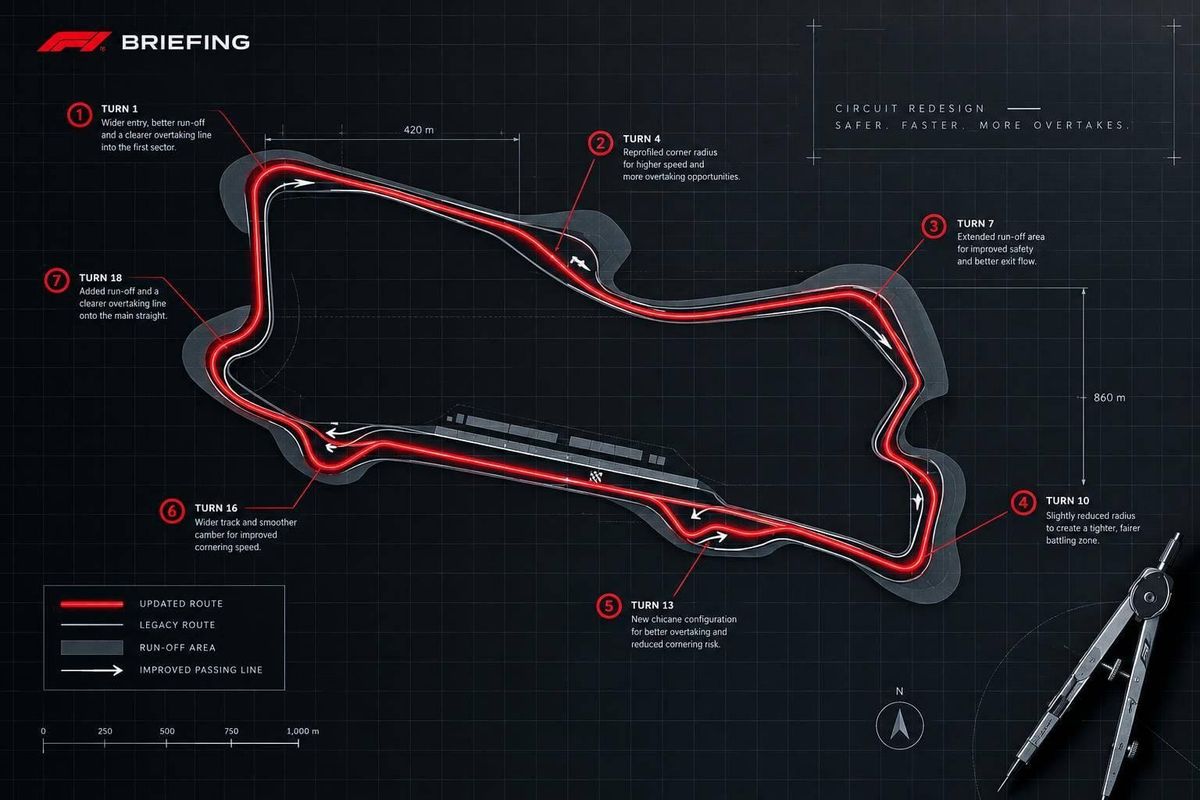
I judge an F1 circuit redesign by three things: safety, passing chances, and what it keeps of the original track. The Red Bull Ring shows why: after more than 1,000 potential track-limit breaches in 2023, gravel strips were added at two corner exits in June 2024.
These seven profiles show how designers balance speed with protection - and why <u>design credit matters</u>. Creating a layout, revising it, and approving it are different jobs.
Quick Comparison
| Designer or team | Main approach | Safety trade-off |
|---|---|---|
| John Hugenholtz | Linked corners and flowing layouts | Keep the driving challenge while improving crash protection |
| Jules de Thier and Henri Langlois van Ophem | Spa’s fast public-road route | Preserve speed and hills while reducing road-course risks |
| Nürburgring planning and engineering team | Long, purpose-built loops through mountain terrain | Blind corners and distance complicate emergency access |
| Giuseppe Bianchi and Alfredo Rosselli | Monza’s road circuit and banked loop | Sustained speed increases crash risk |
| Silverstone conversion and redesign teams | Turn an airfield into a circuit, then revise it | Change sections without losing the track’s character |
| Hermann Tilke | Long straights, hard braking, and broad runoff | Recovery space can make track limits harder to enforce |
| Redesign teams and FIA safety specialists | Update surfaces, corners, and safety measures | Gravel discourages mistakes but can damage cars |
My takeaway: safer racing does not require every track to feel the same. Look at who designed each layout, who changed it, and how those changes affect the racing.
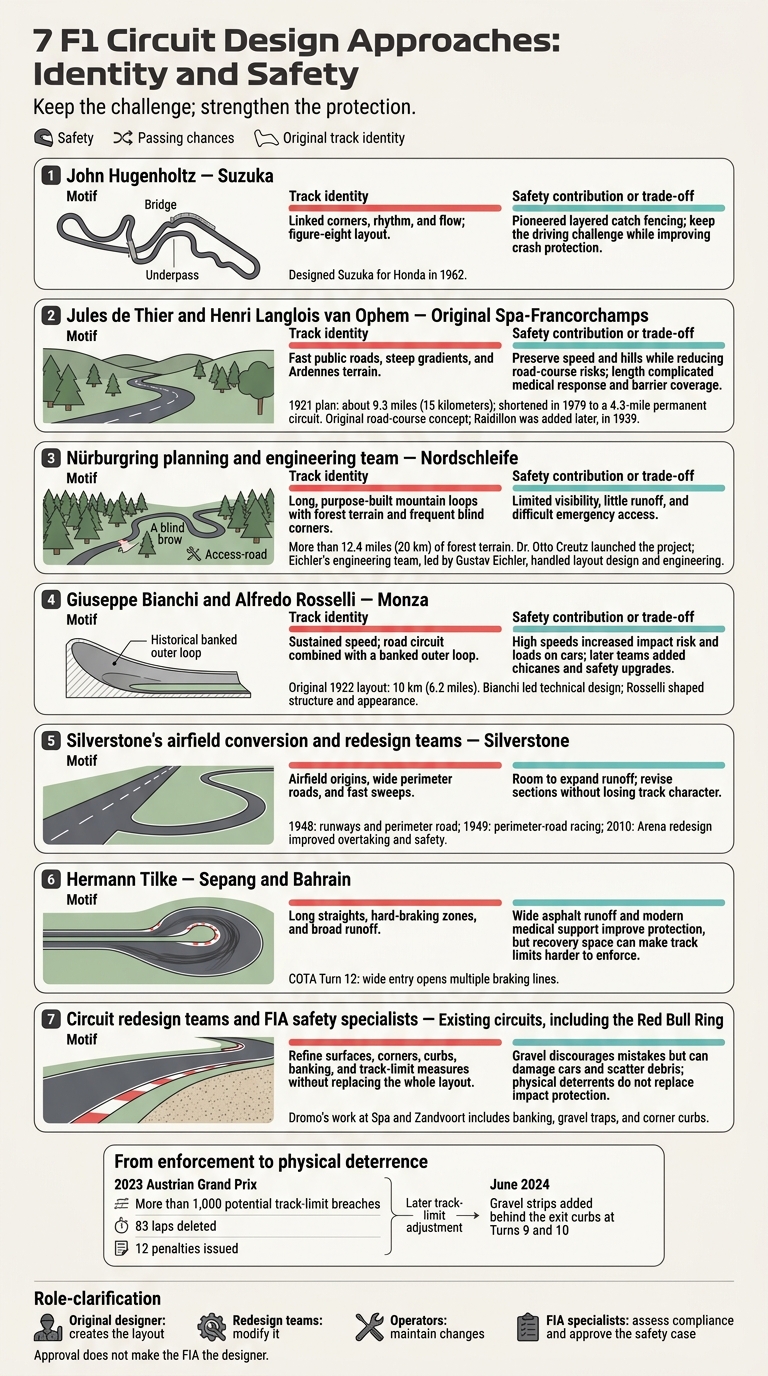
7 F1 Circuit Design Approaches: Identity and Safety
Speed, Danger and Spectacle: The Evolution of F1 Circuits
sbb-itb-7c68254
From Roads and Airfields to F1 Circuits
Road and airfield origins limited where planners could add runoff, barriers, and access roads. Purpose-built circuits gave them more control over the racing surface and supporting facilities. Even so, designers had to treat safety, access, and track shape as one connected problem.
A circuit’s shape determines corner speeds, sight lines, runoff, barrier placement, and emergency access. Change one element, and the others shift too - including how and where drivers can overtake.
Runoff involves trade-offs. Asphalt gives drivers more room to recover, while gravel discourages mistakes but can damage cars and scatter debris. Some venues also need removable surfaces to accommodate different racing series. How designers balance speed and restraint sets apart the people in the profiles that follow.
Design credit needs care, too. The original designer creates the layout. Later consultants and redesign teams modify it, often to meet Grade 1 requirements, while operators maintain those changes. FIA specialists assess compliance and may require safety or track-limit adjustments, but approval does not make the FIA the designer. A circuit’s history should distinguish who created the layout from who later revised, operated, or approved it.
1. John Hugenholtz
Design ideas and track features
John Hugenholtz designed Suzuka for Honda in 1962, building linked corners around rhythm, precision, and flow. Its bridge and underpass create F1’s only figure-eight layout. The “S” Curves make each corner exit the setup for the next bend, so a small mistake can disrupt the whole sequence.
Safety measures
Hugenholtz pioneered layered catch fencing, using layered chain-link mesh to slow crashing cars more gradually than a single barrier.
That focus on control also shaped his later circuit work.
F1 venues and design roles
Beyond Suzuka, Hugenholtz brought the same approach to tighter, safer sites.
At Hockenheim, he designed the Motodrom stadium section, adding a tighter, spectator-oriented complex to the fast forest circuit.
He also designed Nivelles-Baulers in 1971, prioritizing extensive runoff as a safer alternative to Spa-Francorchamps.
At Zandvoort, he later guided development, but the original layout is primarily credited to S.C.H. “Sammy” Davis.
Influence and trade-offs
Jarama shows the same principle in a tighter form: a narrow site can produce demanding racing, but little room to pass.
2. Jules de Thier and Henri Langlois van Ophem
Design ideas and track features
Jules de Thier, manager of the Liège newspaper La Meuse, and Henri Langlois van Ophem, chairman of the Royal Automobile Club of Belgium’s Sports Commission, conceived Spa’s original circuit. Their 1921 plan connected Francorchamps, Malmedy, and Stavelot with about 9.3 miles (15 kilometers) of public roads.
The route followed existing roads through the Ardennes terrain. Steep gradients and fast stretches between villages shaped the challenge, with sections such as Burnenville and the Masta Kink.
F1 venues and design roles
Their design credit belongs to Spa’s original road-course concept. Raidillon was added later, in 1939.
Safety measures
Spa was shortened in 1979, creating a 4.3-mile permanent circuit that better met modern safety demands.
Influence and trade-offs
The trade-off was clear: keep Spa’s speed and elevation changes while leaving much of its public-road loop behind.
Their lasting influence is Spa’s terrain-led identity, which later planners had to preserve in a shorter, more controlled layout.
The tension between natural terrain and modern safety would soon push circuit design toward more engineered solutions.
3. The Nürburgring Planning and Engineering Team
At the Nürburgring, the shift from natural terrain to an engineered layout took an early turn toward extremes.
F1 venues and design roles
Dr. Otto Creutz, Adenau’s district administrator, launched the Nürburgring as a Weimar-era public works project. The project also aimed to create jobs in the Eifel region.
The engineering firm Eichler, led by Gustav Eichler, handled the engineering work. Its purpose-built layout paired long, road-like loops - not public roads - with steep elevation changes and little runoff. That combination made the Nürburgring a brutal test for F1 drivers and later forced major safety compromises.
Creutz got the project started; Eichler’s team turned it into a circuit through layout design and engineering. The scale of their work set a template for later circuits that traded raw terrain for more controlled engineering.
4. Giuseppe Bianchi and Alfredo Rosselli
Monza pushed circuit design toward engineered speed, showing how layout could prioritize performance over natural terrain.
F1 venues and design roles
As director of the Automobile Club of Milan, Giuseppe Bianchi led Monza’s technical design in 1922. Architect Alfredo Rosselli shaped the circuit’s structure and appearance.
Design ideas and track features
The original 10-km (6.2-mile) layout combined flat road sections with a banked outer loop. This setup made sustained speed Monza’s defining feature and supported manufacturer testing.
That emphasis defined the safety trade-off that followed.
Safety measures
The 1922 layout put speed ahead of safety. Others later repaired the banking and added chicanes and safety upgrades.
Influence and trade-offs
Monza still trades pace for control, with gravel traps at the chicanes slowing cars and discouraging track-limit abuse.
5. Silverstone’s Airfield Conversion and Redesign Teams
F1 venues and design roles
Silverstone took a different path from road circuits such as Spa: it converted an airfield into a racetrack, then reshaped it over time. The circuit grew in stages, rather than following a single master plan.
The 1948 Grand Prix used an hourglass layout that combined runways with the perimeter road. Two runways met at a hay-bale split point. By 1949, racing had moved entirely onto the perimeter road.
Design ideas and track features
With the perimeter-road layout in place, later redesigns focused on speed, runoff, and overtaking.
Safety measures
The 2010 Arena redesign replaced Abbey’s chicane with a fast right-hander and added an infield section. It also bypassed the aging Bridge section to improve overtaking and safety.
The trade-off was to change part of the layout while preserving Silverstone’s broader airfield identity.
Influence and trade-offs
That layered evolution shows how F1 circuits can stay recognizable while meeting modern safety demands.
6. Hermann Tilke
Tilke shaped the modern circuit era, shifting the focus from land and legacy to layouts, runoff, and overtaking opportunities designed around regulations and race management.
Design ideas and track features
Tilke’s circuits usually pair long straights with hard-braking zones and broad runoff. The aim: give drivers chances to pass while meeting modern safety standards.
At COTA, Turn 12’s wide entry opens multiple braking lines.
At the Red Bull Ring, elevation changes and blind brows in the mountain foothills add technical difficulty.
Safety measures
COTA’s broad asphalt runoff improves safety, but it also removes some of the physical barriers that keep drivers within track limits. That makes those limits harder to police.
Influence and trade-offs
The 2023 Austrian Grand Prix showed the trade-off at the Red Bull Ring. Officials identified more than 1,000 potential track-limit breaches, deleted 83 laps, and issued 12 penalties.
Gravel strips were later added at Turns 9 and 10, giving drivers a physical reason to stay within the limits rather than leaving enforcement solely to officials.
Tilke’s legacy is a safer, faster circuit model that often needs added deterrents to keep limits meaningful.
His approach became the template for later safety-led redesigns and FIA refinements.
7. Circuit Redesign Teams and FIA Safety Specialists
F1 venues and design roles
Earlier designers set the template. Today’s redesign teams update it corner by corner. Design teams build the changes; the FIA checks compliance and approval.
Dromo’s work at Spa and Zandvoort includes banking, gravel traps, and corner curbs - surface choices that reshape older circuits without erasing their character.
Design ideas and track features
At Zandvoort, grass and gravel beside the racing surface punish mistakes immediately and force drivers to commit to the line.
But there’s a trade-off: the material that slows a car can also damage it.
Safety measures
Loose gravel can be dragged onto the racing line and cause punctures or floor damage.
Influence and trade-offs
The same layout often serves multiple racing series, so surfaces may need to switch between F1 and motorcycle use.
Comparing the 7 Circuit Design Approaches
Compare each circuit’s original layout with its later safety revisions - not just the track used today. Early planners worked around roads, forests, or airfields. Purpose-built circuits gave designers more control over runoff and access.
These seven cases trace the shift from fitting circuits to the land to reshaping land for safer racing.
| Designer or team | Representative venue | Main design approach | Defining layout feature | Main safety contribution or limitation | Effect on F1 circuit development |
|---|---|---|---|---|---|
| John Hugenholtz | Suzuka | Fit flowing corners into the natural terrain. | Figure-eight layout with linked high-speed curves. | Early layouts lacked modern runoff and relied on gravel. | Defined the rhythmic, high-speed “driver’s track.” |
| Jules de Thier and Henri Langlois van Ophem | Original Spa-Francorchamps | Link rural public roads into a fast circuit. | Large elevation changes and the Masta Kink. | The circuit’s length made medical response and barrier coverage difficult. | Showed the appeal of road circuits - and why shorter successor layouts were needed. |
| The Nürburgring planning and engineering team | Nordschleife | Build a mountain racing and testing track through difficult terrain. | More than 12.4 miles (20 km) of forest terrain with frequent blind corners. | Limited visibility and difficult emergency access exposed the limits of such a long course. | Helped drive the safety debate that changed F1 venue standards in the 1970s. |
| Giuseppe Bianchi and Alfredo Rosselli | Monza | Put pure speed and aerodynamic efficiency first. | High-speed concrete banking, the Oval. | High speeds increased impact risk and placed heavy loads on cars. | Defined Monza as the Temple of Speed; F1 later abandoned the banking for safety. |
| Silverstone’s airfield conversion and redesign teams | Silverstone | Turn a flat airfield into a racing circuit. | Wide perimeter roads and fast sweeps. | Flat terrain allowed runoff areas to expand later. | Shifted design from terrain-led layouts to wide airfield circuits with room for changes. |
| Hermann Tilke | Sepang and Bahrain | Design purpose-built tracks around racing, facilities, and safety requirements. | Long straights leading into heavy-braking hairpins. | Wide asphalt runoff and modern medical support improved protection. | Supported F1’s global expansion with a repeatable modern venue model. |
| Circuit redesign teams and FIA safety specialists | Red Bull Ring | Refine existing tracks rather than replace their layouts. | Gravel strips and revised track-limit markings. | Physical deterrents curb track-limit violations but do not replace impact protection. | Made redesign a continuing safety process rather than a one-time build. |
At the Red Bull Ring, gravel strips made running wide immediately costly. Added behind the exit curbs at Turns 9 and 10 in June 2024, they shifted track-limit control from steward-led enforcement toward physical deterrence.
Conclusion: Keeping Track Identity While Improving Safety
These seven examples follow the same principle: Keep the challenge; strengthen the protection. Whether the track began on roads, on airfields, or as a purpose-built circuit, redesign helps preserve its identity while meeting modern F1 demands.
At Lusail, that work extends beyond the track layout.
Before the 2023 Qatar Grand Prix, Lusail rebuilt its paddock, pit buildings, and spectator areas to modernize the venue without changing the core layout.
Getting that balance right takes teamwork. Designers shape the changes, operators maintain them, and FIA specialists approve the safety case.
Assess a redesign by what it preserves, where it allows passing, and how it improves safety and access.
FAQs
What makes a circuit redesign improve overtaking?
A circuit redesign can improve overtaking by giving drivers more chances to pass and battle under braking, instead of relying only on straight-line speed or DRS assistance. Reshaping braking zones - often near DRS points - and changing slow sections that interrupt momentum can help cars approach faster, brake later, and spend more time attempting a pass into key corners. When done well, these changes make passes more likely to happen and succeed, without making them automatic.
How do designers choose between gravel and asphalt runoff?
Designers use crash and impact analysis to pinpoint high-risk sections and size runoff areas that manage speed and absorb crash energy while keeping racing running smoothly. Gravel usually slows cars more forcefully and dissipates more energy. Asphalt gives drivers more control, causes less disruption, and offers better grip for slower re-entry onto the track. The choice depends on how the runoff should work and where barriers and other safety features sit.
What does FIA Grade 1 approval require?
FIA Grade 1 approval requires circuits to meet strict safety and infrastructure standards before hosting Formula One events.
Circuits must have debris fences, energy-absorbing materials, run-off or deceleration zones, advanced timing systems, and improved medical facilities. Track limits must also be clearly defined, often using gravel traps.
The FIA keeps updating these standards as crash structures and safety technology advance, helping protect drivers and spectators.