Mercedes F1 Story: From 1950s Exit to 2010 Return
Track Mercedes' path from a 1950s factory exit to a 2010 works-team return through engine supply and the Brawn GP takeover.
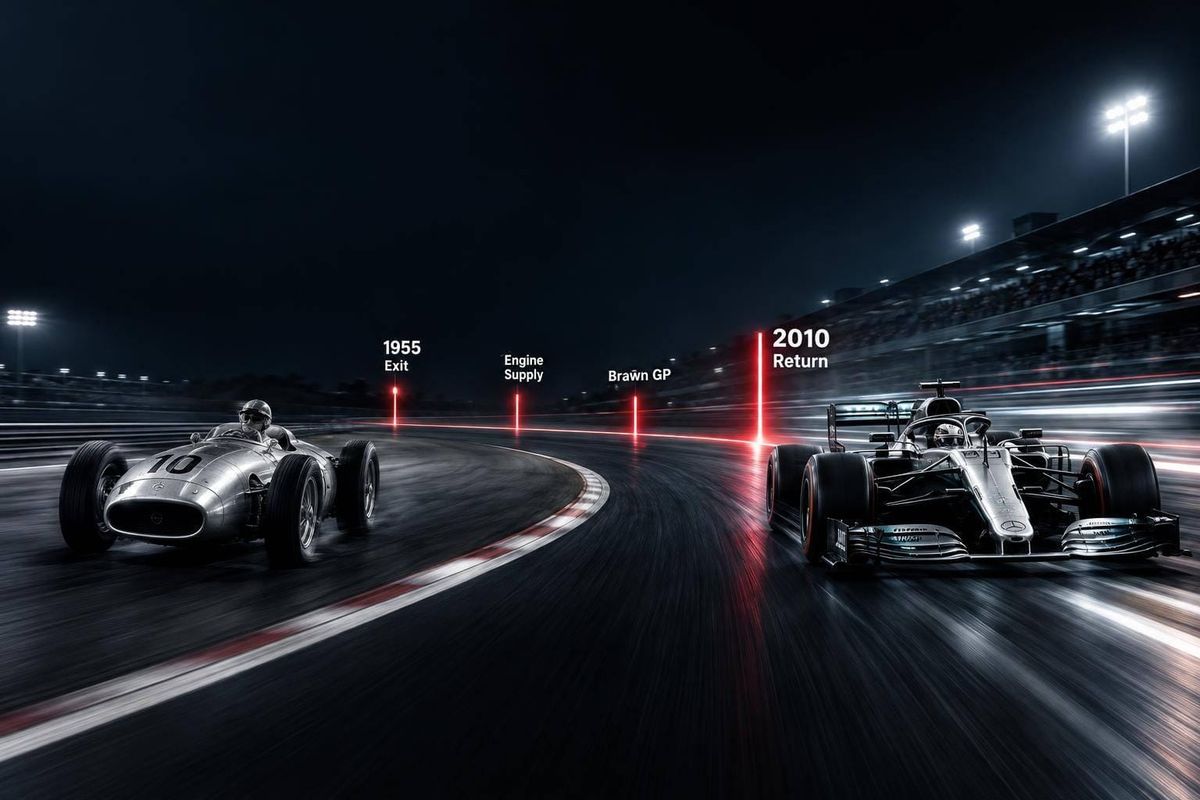
Mercedes returned to F1 as a works team in 2010 after a 55-year absence - not 55 years out of the sport. It had already returned as an engine supplier in 1994, later winning titles with McLaren.
The path back covered five main steps:
- 1954–1955: Mercedes won nine Grands Prix and helped Juan Manuel Fangio claim two drivers’ titles.
- 1955 exit: Mercedes ended its factory racing programs after a season marked by the Le Mans disaster, which accelerated its withdrawal.
- Engine-supplier years: Sauber brought Mercedes-branded engines back in 1994. The McLaren partnership began in 1995.
- 2009 takeover: Daimler and Aabar bought a combined 75.1% stake in Brawn GP, setting up the works-team return.
- 2010 and beyond: Mercedes finished fourth with Nico Rosberg and Michael Schumacher. Rosberg’s 2012 Chinese Grand Prix win ended its wait for a works-team victory.
The key difference: supplying engines brought Mercedes back to F1, but buying Brawn put it back in charge of the whole car.
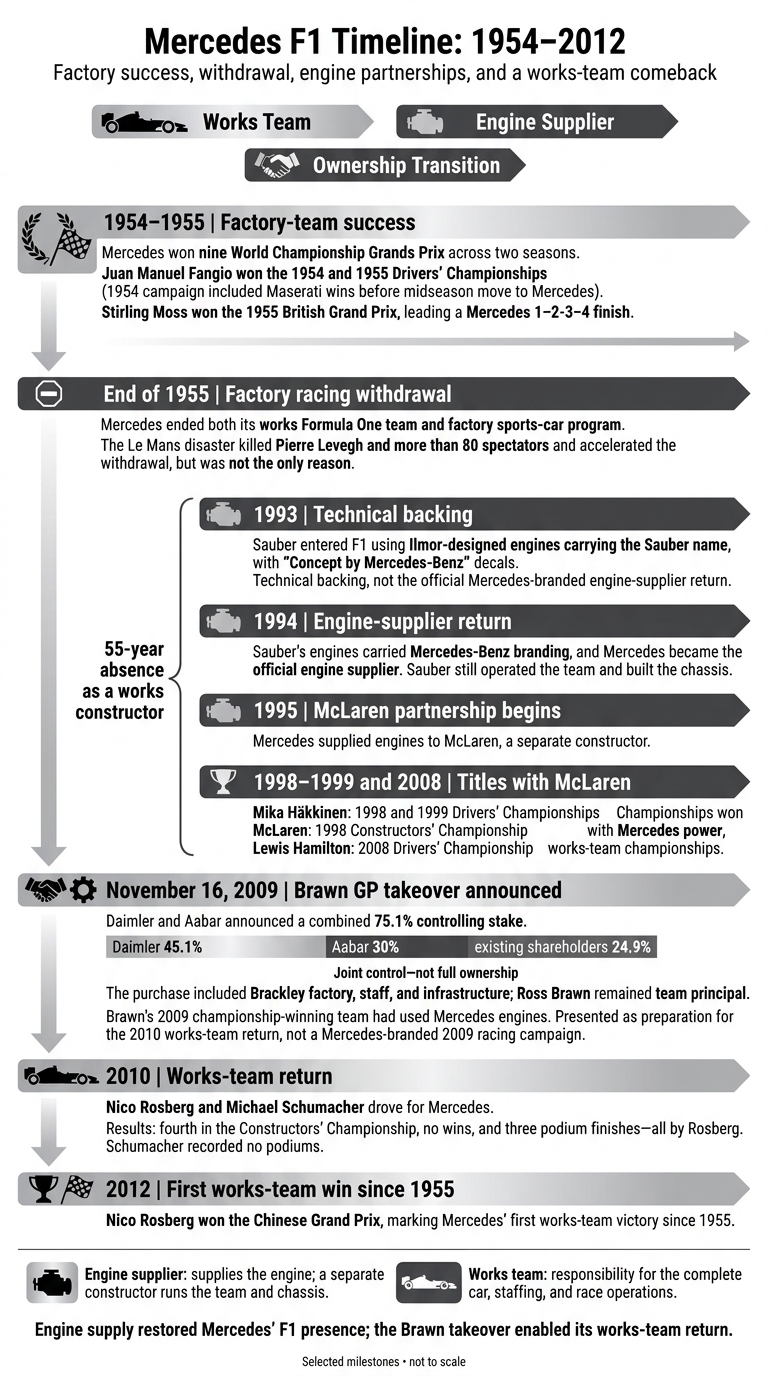
Mercedes F1 Timeline: 1954–2012
The History Of Mercedes
sbb-itb-7c68254
Mercedes’ First F1 Seasons: 1954–1955
Mercedes started winning as soon as it arrived in 1954, with Juan Manuel Fangio taking the drivers’ title. Fangio kept his crown in 1955, while Stirling Moss claimed his first World Championship victory at the British Grand Prix. Those two seasons set the standard for Mercedes’ eventual return as a works team.
The W196: Engine and Bodywork
The W196 paired fuel injection with a straight-eight engine, unlike the supercharged Alfa Romeo 158 that had defined the early 1950s. Mercedes built both streamlined and open-wheel versions, choosing the bodywork to suit each circuit and maintain its title-winning pace.
But race results weren’t the only story. The 1955 season would end with a decision that carried far more weight.
Fangio’s Titles and Moss’s British Grand Prix Win
Fangio’s 1954 title included wins for Maserati before he moved to Mercedes midseason. His second title in 1955 showed what the W196 could do across a full campaign. Moss added another milestone at Aintree, leading a Mercedes 1–2–3–4 finish to claim his British Grand Prix win.
Mercedes won nine World Championship Grands Prix across those two seasons, making its withdrawal all the more abrupt.
Why Mercedes Left F1 After 1955
The Le Mans Disaster and the Withdrawal Decision
Mercedes left F1 after 1955 despite its title-winning pace. The decision went beyond race results. That year’s Le Mans disaster killed Mercedes driver Pierre Levegh and more than 80 spectators. The disaster accelerated Mercedes’ exit, but it wasn’t the only reason.
What Ended After the 1955 Season
At the end of 1955, Mercedes-Benz shut down both its works Formula One team and its factory sports-car program. It was a withdrawal from factory racing - not just F1.
The 55-year absence refers to Mercedes’ time away as a works constructor, not from all motorsport. Its next F1 involvement would be as an engine supplier, a different role from running its own works team.
Mercedes Returns as an Engine Supplier
Sauber and Mercedes Engine Branding in 1994
Mercedes returned to F1 through Ilmor and Sauber. When Sauber entered F1 in 1993, its Ilmor-designed engines carried the Sauber name. “Concept by Mercedes-Benz” decals showed Mercedes’ technical backing.
In 1994, the engines carried Mercedes-Benz branding, and Mercedes became the official engine supplier. Sauber still ran the team and built the chassis.
The McLaren Partnership Begins in 1995
Mercedes switched to McLaren in 1995, teaming up with a proven chassis builder. The deal let Mercedes develop its engine program without running a full team.
Championships followed. Mika Häkkinen won the 1998 and 1999 Drivers’ Championships, McLaren claimed the 1998 Constructors’ Championship, and Lewis Hamilton won the 2008 Drivers’ Championship with Mercedes power. Those titles established Mercedes as a championship-winning engine supplier and gave it the standing to pursue a full works return.
Mercedes later held a minority stake in McLaren Group, taking the relationship beyond a standard engine-supply deal. But McLaren remained a separate constructor. Mercedes still lacked a works team - a step it would take through Brawn GP for its 2010 return.
Buying Control of Brawn GP in 2009
Daimler and Aabar’s Stakes in Brawn GP
On November 16, 2009, Mercedes completed its return to works-team status through Brawn GP. Daimler and Aabar announced a 75.1% controlling stake: Daimler held 45.1% and Aabar 30%, while existing shareholders retained 24.9%. The deal gave them joint control - not full ownership.
The purchase included the Brackley factory, staff, and infrastructure behind Brawn’s championship season. Ross Brawn remained team principal. Mercedes now controlled chassis design, staffing, and race operations, rather than supplying only the engine.
Why Brawn’s 2009 Titles Did Not Ensure 2010 Wins
Mercedes supplied Brawn’s engines during its 2009 title run. But buying a works-team entry didn’t mean buying a winning car for the next season.
Brawn’s success rested partly on Honda-funded development before Honda’s withdrawal and a double diffuser that rivals soon copied. The 2010 MGP W01 was developed on a tighter budget, and the team could no longer rely on that technical edge. Winning required new chassis development, not just momentum from 2009. Those limits would show up immediately in Mercedes GP’s 2010 campaign.
Mercedes GP’s 2010 Return Season
Mercedes had its works-team structure back. The 2010 season was the first test of the Brawn takeover - and showed how much work remained before the team could win.
Rosberg and Schumacher Finish Fourth as a Team
Nico Rosberg partnered with returning seven-time champion Michael Schumacher. Mercedes finished fourth in the Constructors’ Championship, with no wins and three podium finishes. Rosberg took all three; Schumacher had none.
Mercedes in the 1950s and 2010 Compared
The two eras measured success differently, so their results aren’t directly comparable. Fangio’s titles were individual honors. Mercedes’ fourth-place finish in 2010 reflected the combined points of both drivers.
The details show how much had changed:
| Feature | 1954–1955 factory program | 2010 works-team return |
|---|---|---|
| Ownership and organization | Direct Daimler-Benz factory operation | Works team under Daimler and Ross Brawn |
| Engine rules | W196 used a 2.5-liter naturally aspirated engine | 2.4-liter V8s limited to 18,000 rpm |
| Aerodynamics | Streamlined and open-wheel bodywork | High-downforce wings and diffusers |
| Leading drivers | Fangio; Moss joined in 1955 | Rosberg and Schumacher |
| Championship structure | Drivers’ title only | Drivers’ and Constructors’ titles |
| First-season outcome | Fangio won the 1954 drivers’ title | Fourth in 2010; no wins |
| Development conditions | Private testing without modern restrictions | Restricted testing outside race weekends |
With refueling banned and testing limited, 2010 tested the chassis and race strategy, not just the engine.
What the Works-Team Return Meant
The return brought chassis, engine, and team operations under one works team. Winning now depended on the complete car and the people running it - not engine performance alone.
Fourth place gave Mercedes a starting point for its next task: turning that team structure into race wins.
Conclusion: From Withdrawal to Rebuilding
Mercedes’ success in the 1950s built its F1 legacy. But it took Daimler and Aabar’s 2009 purchase of Brawn GP to bring Mercedes back as a full works team in 2010, with Ross Brawn in charge. The team structure came first; results followed later.
Rosberg’s 2012 Chinese Grand Prix Win
Rosberg’s win at the 2012 Chinese Grand Prix was Mercedes’ first works-team victory since 1955 - and the clearest sign that the rebuild was working.
FAQs
Why buy Brawn GP instead of starting a new team?
Mercedes bought Brawn GP in late 2009 to take over a championship-winning team with experienced technical staff instead of starting from scratch. After Honda withdrew in 2008, Brawn GP developed a title-winning car with features such as the double diffuser. The deal kept Ross Brawn and key technical staff in place, retaining the winning team spirit and engineering know-how that helped set up Mercedes’ later dominance.
What advantages did works-team status give Mercedes?
As a works team, Mercedes had complete control over how its car design and power unit technology worked together. Matching aerodynamic development to the PU106A’s split-turbo configuration helped maximize efficiency, packaging, and performance in ways independent teams couldn’t.
Buying Brawn GP also brought championship-winning expertise and an established team culture. Both gave Mercedes a competitive base that played a key role in its long-term dominance.
How did testing limits affect Mercedes’ comeback?
Mercedes’ comeback gained momentum as the team adjusted to strict rules, especially with the switch to hybrid power in 2014. Fuel use was limited to 220 pounds per race, while fuel flow was capped at 220 pounds per hour.
Mercedes focused on aerodynamic efficiency, compact cooling layouts, and the PU106A power unit to keep performance high within those limits. The team won eight consecutive Constructors’ Championships, starting in 2014.