F1 2026 Power Units: Efficiency Standards Explained
F1's 2026 power-unit overhaul forces a 50/50 ICE–electric split, 100% sustainable fuel, MGU-H removal and new overtake mode.
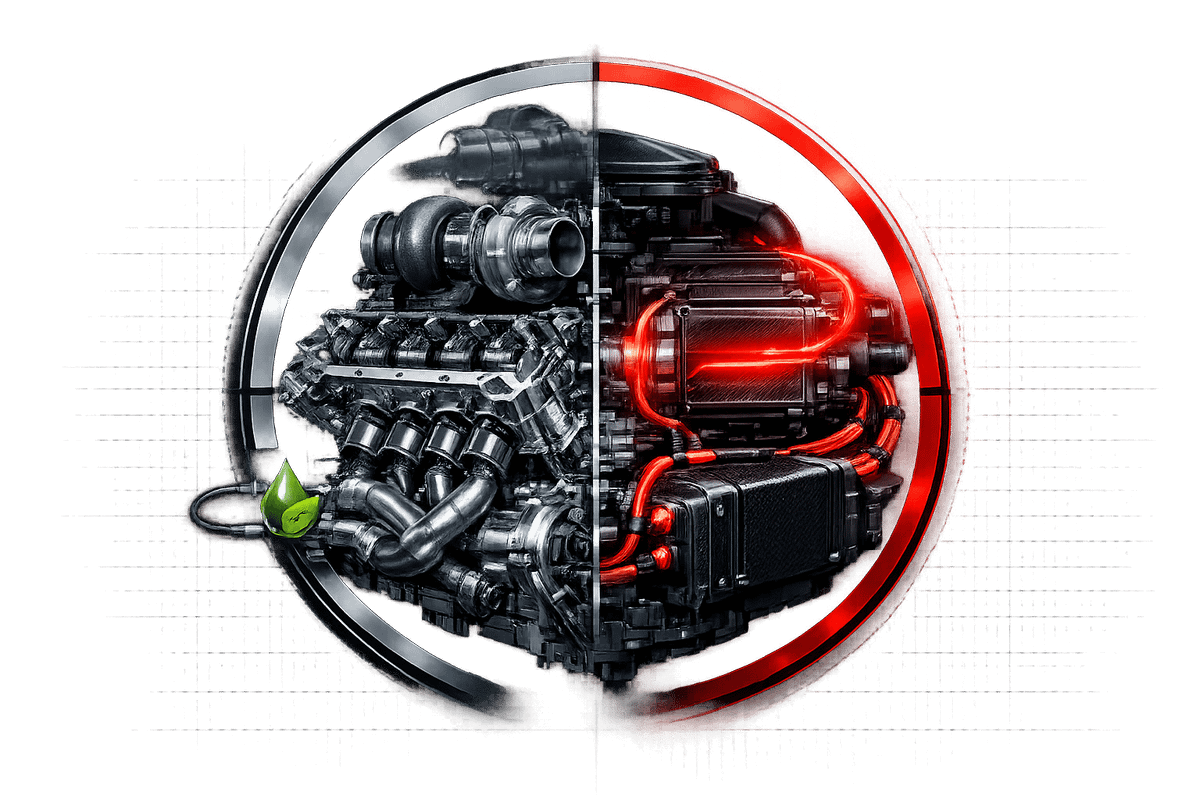
Formula 1's 2026 power unit regulations introduce sweeping changes aimed at balancing performance with reduced emissions. Here's what you need to know:
- Energy Balance Shift: Electrical power increases to 350 kW, matching the reduced internal combustion engine (ICE) output of 400 kW. This creates a 50/50 energy split.
- Sustainable Fuels: Cars will run on 100% advanced sustainable fuel, cutting greenhouse gas emissions by up to 65%.
- MGU-H Removed: The complex MGU-H is gone, simplifying engine design and reducing costs.
- Energy Recovery Boost: Energy recovery during braking doubles to 8.5 MJ per lap, reducing fuel dependency.
- New Overtake Mode: Replaces DRS, offering a 0.5 MJ electrical power boost for trailing cars within one second.
These updates aim to align F1 with its net-zero carbon target by 2030 while maintaining competitive racing. The removal of the MGU-H and focus on efficiency have attracted six engine manufacturers - Ferrari, Mercedes, Alpine, Audi, Honda, and Red Bull Ford. Expect a shift in race strategies as teams and drivers adapt to these changes.
The F1 2026 Power Unit Explained in 9 Minutes
sbb-itb-7c68254
The Core Efficiency Standards of the 2026 F1 Power Units
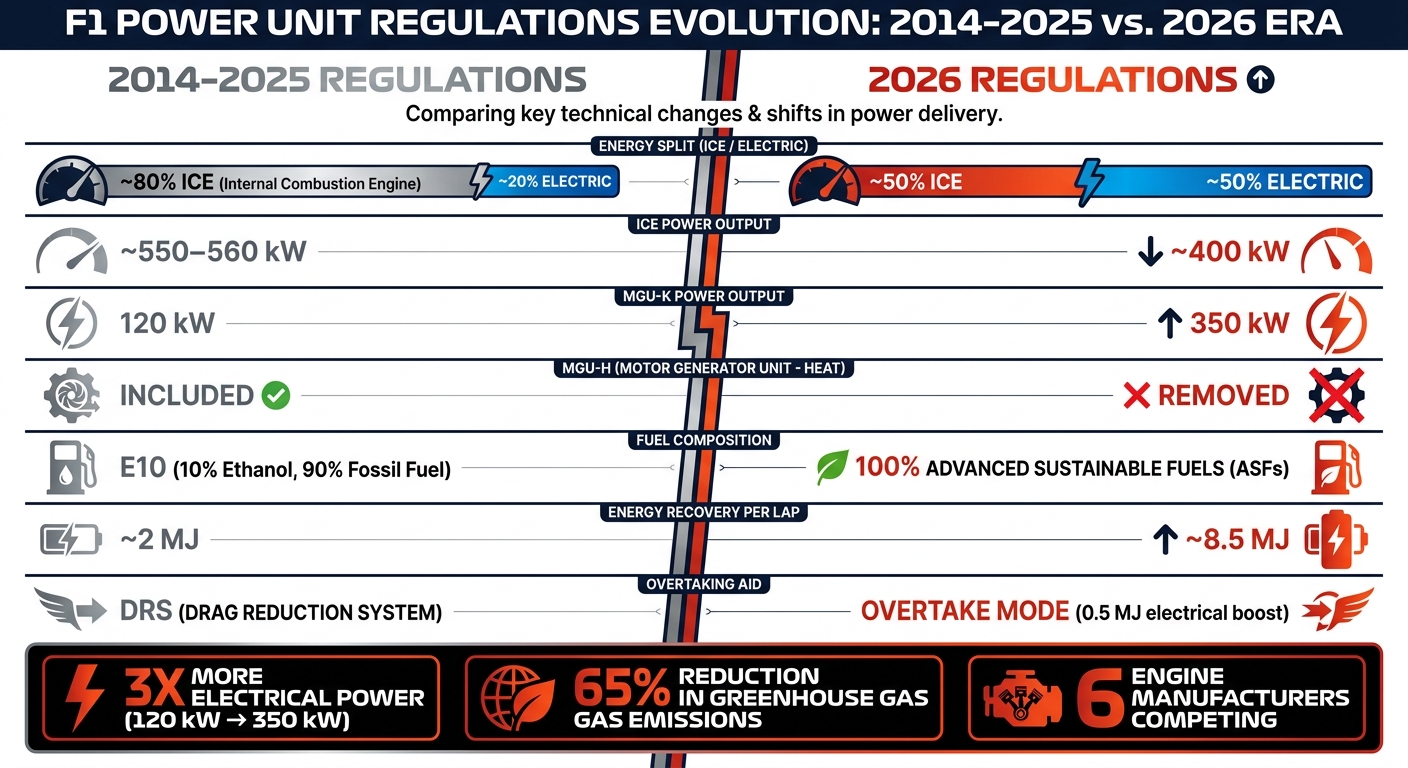
F1 Power Units: 2014–2025 vs 2026 Regulations Compared
The 2026 regulations represent a complete overhaul of F1's power unit framework. At the center of these changes are three key updates: a new balance between combustion and electric power, the adoption of fully sustainable fuels, and a reimagined energy recovery system. Together, these updates are set to redefine performance and efficiency in F1.
The 50/50 Energy Split Between ICE and Electric Power
One of the most dramatic shifts is the introduction of a 50/50 energy split between the Internal Combustion Engine (ICE) and the electrical system. The ICE's output will decrease to about 400 kW, while the MGU-K's output will increase to 350 kW. This combination results in a total peak output of approximately 750 kW, matching the power of today's cars but delivered through a completely different mechanism.
This new setup forces teams to rethink how they manage electrical energy during a lap. To assist with this, the 2026 cars will feature active aerodynamics, including adjustable front and rear wings. These wings can switch between a low-drag "Straight Mode" for long straights and a high-downforce "Corner Mode" for better grip, helping to optimize energy use.
"From 2026, it'll feature a far more powerful battery component that will allow it to generate three times the electrical power produced by the current hybrid components." - Lawrence Barretto, F1 Correspondent
This shift in energy balance will push teams to develop innovative solutions, fundamentally altering how power is delivered and managed on track.
The Move to 100% Carbon-Neutral Fuels
Another major step forward is the transition to fully sustainable fuels. F1 will move away from the current E10 blend (10% ethanol, 90% fossil fuel) to 100% Advanced Sustainable Fuels (ASFs). These fuels are produced from sources like non-food biomass, municipal waste, or carbon capture technology.
What makes these fuels especially practical is that they are designed as "drop-in" replacements, meaning they can work with existing engine designs. However, teams will fine-tune their engines to optimize performance with the specific fuel blends provided by their partners. Leading energy companies are already collaborating with teams: Shell with Ferrari, Haas, and Cadillac; Petronas with Mercedes; Aramco with Aston Martin; and ExxonMobil with Red Bull and Racing Bulls.
"The switch to Advanced Sustainable Fuels... has the potential to be just as ground-breaking." - Matt Youson, Special Contributor
Dropping the MGU-H and Expanding the MGU-K
The removal of the MGU-H marks a significant change, with the MGU-K taking on a much larger role in the power unit. Its output will rise from 120 kW to 350 kW, and it will handle increased energy recovery during braking - jumping from around 2 MJ per lap to approximately 8.5 MJ per lap.
A new "Overtake Mode" will replace the traditional Drag Reduction System (DRS). This feature allows a trailing driver within one second of the car ahead to deploy an additional 0.5 MJ of electrical energy, boosting power to 350 kW and enabling speeds of up to 209 mph (337 km/h). Meanwhile, the leading car's energy deployment decreases above 180 mph (290 km/h), dropping to zero at 221 mph (355 km/h).
| Feature | 2014–2025 Regulations | 2026 Regulations |
|---|---|---|
| Energy Split (ICE/Electric) | ~80/20 | ~50/50 |
| ICE Power Output | ~550–560 kW | ~400 kW |
| MGU-K Power Output | 120 kW | 350 kW |
| MGU-H | Included | Removed |
| Fuel Composition | E10 (10% ethanol) | 100% Sustainable (ASFs) |
| Energy Recovery per Lap | ~2 MJ | ~8.5 MJ |
| Overtaking Aid | DRS | Overtake Mode (electrical boost) |
These updates collectively represent a significant leap forward for F1, pushing both technological boundaries and sustainability goals. The balance between combustion and electric power, the commitment to sustainable fuels, and the enhanced energy recovery systems promise to reshape the sport's future.
Engineering Challenges and Design Changes for 2026
Improving Thermal Efficiency in the ICE
The 2026 regulations introduce a major shift in how fuel flow is managed. Instead of limiting fuel by mass (kg/h), the new rules set an energy-based cap of 3,000 MJ/h. This change pushes engineers to focus on extracting the maximum energy from every drop of fuel, rather than just controlling its volume.
To support this, the FIA has allowed more flexibility in designing the combustion chamber and related systems, while keeping stricter rules for components like the lower block, crankshaft, and pumps. As the FIA stated:
"The upper part, mainly focused on the combustion area and the associated components will also feature prescription but there will be more freedom to develop the combustion system for the new fuel." - FIA
Fuel suppliers are now critical collaborators in this process. Companies like Shell (working with Ferrari, Haas, and Cadillac), Petronas (Mercedes), Aramco (Aston Martin), and ExxonMobil (Red Bull and Racing Bulls) are creating custom sustainable fuel blends. These blends aim to maximize energy density, effectively making fuel a "liquid component" of the engine. This partnership between teams and fuel suppliers will play a pivotal role in shaping energy recovery strategies and race dynamics.
Energy Recovery and How It Shapes Race Strategy
With the removal of the MGU-H, the MGU-K takes on the full responsibility for energy recovery. This shift significantly impacts race strategies. Starting in April 2026, the FIA reduced the maximum energy recharge limit from 8 MJ to 7 MJ per lap to limit excessive harvesting. Additionally, peak "superclip" power is capped at 350 kW, reducing the time drivers spend in recharge mode.
Active aerodynamics becomes a crucial tool for managing energy. By minimizing drag on straights, the electrical system conserves battery charge for critical moments. Nikolas Tombazis, FIA Single-Seater Director, explained:
"The new active aero system is primarily designed to help conserve energy, as reducing drag on straights is essential for efficient energy use with 2026 power units that will rely much more on electrical energy." - FIA Single-Seater Director Nikolas Tombazis
These adjustments mean teams must carefully integrate energy strategies into their overall power unit and chassis designs.
Fitting the Power Unit Into the Car's Overall Design
The challenge of incorporating these energy and efficiency advancements into a compact, aerodynamic chassis is immense. A 350 kW MGU-K generates significant heat, and managing this - along with the demands of a larger, more powerful battery - requires innovative cooling solutions. At the same time, teams must reduce the car's weight to 724 kg (1,598 lb), a 30 kg (66 lb) decrease. Larger cooling intakes can help with thermal management but come at the cost of aerodynamic efficiency, while tighter reference volumes restrict component placement to prevent teams from gaining undue aerodynamic advantages.
Mercedes' Deputy Technical Director Simone Resta highlighted the evolving dynamics:
"It's going to be quite different... every driver will be running moveable front and rear wings together, at many points in the lap, and they will be using the energy to help overtaking." - Simone Resta, Deputy Technical Director, Mercedes
The increased reliance on electrical energy also brings heightened safety considerations. For example, lateral safety lights have been added to indicate ERS (Energy Recovery System) status, and roll hoop load capacity has been increased from 16G to 20G. These updates ensure safety remains a priority, but they also add complexity to the already tight packaging requirements of the 2026 designs.
How Teams and Manufacturers Will Approach the New Rules
What to Expect From Each Major Engine Supplier
The 2026 regulations have drawn six major power unit manufacturers to the grid: Ferrari, Mercedes, Alpine (Renault), Honda, Audi, and Red Bull Ford. This marks one of the most competitive lineups in years. While established players like Ferrari and Mercedes will refine their existing engine designs, Audi and Red Bull Powertrains (working with Ford) are starting from scratch. This clean slate could offer them an edge in integrating the expanded electrical systems into their designs.
A key focus across all manufacturers is the top-end of the engine, particularly the combustion chamber. The FIA has allowed more design freedom in this area, giving engineers room to innovate. However, the lower engine components, such as the crankshaft and block, are heavily regulated to keep costs in check. Many parts, including injectors, knock sensors, and ignition coils, are standardized under the $130 million power unit cost cap. As a result, the emphasis shifts from raw mechanical power to optimizing combustion and improving electrical efficiency.
Fuel technology is another critical factor. Partnerships between teams and fuel suppliers are shaping the development of 100% sustainable fuel blends. For instance, Shell is working with Ferrari, Haas, and Cadillac; Petronas with Mercedes; Aramco with Aston Martin; and ExxonMobil with Red Bull and Racing Bulls. With the new fuel flow limit set at 3,000 MJ/h, energy density becomes a key performance driver. These tailored fuel blends, combined with redesigned engines, influence not only how cars perform but also how teams manage energy throughout a race.
"The power from the engine element drops from between 550–560kW to 400kW, overall there will be more power available and it'll be produced more sustainably." - Lawrence Barretto, F1 Correspondent
Together, these engineering developments will have a profound impact on race dynamics, placing energy management at the heart of competition.
How the Rules Will Change Race Strategy and Driver Decisions
The revamped power unit architecture introduces new challenges for drivers, requiring them to rethink how they manage energy on the track. With a greater reliance on electrical systems, energy harvesting during braking and real-time battery deployment become crucial. Drivers will need to carefully balance power usage to avoid running out of reserves too early in the race.
One major change is the introduction of the Manual Override mode, which directly ties overtaking opportunities to energy management. This system allows a car within one second of a leader to maintain full power up to 337 kph, while the leading car's power tapers off at 290 kph. Unlike traditional aerodynamic aids, this approach shifts the focus to tactical energy deployment.
Safety concerns have already prompted adjustments. After a high-speed crash at the Japanese Grand Prix in April 2026 involving Haas driver Oliver Bearman and Alpine's Franco Colapinto, the FIA introduced limits on boost mode. Boost power is now capped at 150 kW, with maximum deployment restricted to 250 kW outside designated straight-line zones. This move addresses the extreme speed differences - up to 470 bhp - that can occur between cars in different energy states.
Not everyone is on board with these changes. Max Verstappen has voiced frustration, arguing that the increased focus on energy management, including lifting and coasting, takes away from the essence of racing. Mercedes Team Principal Toto Wolff, however, offered a different perspective:
"We all share the same objectives. It's how can we improve the product, make it out-and-out racing, and look at what can improve in terms of safety."
What the 2026 Rules Mean for F1's Future
How the 2026 Rules Support F1's Net-Zero 2030 Target
F1’s decision to adopt 100% advanced sustainable fuels by 2026 marks a major step toward its goal of achieving Net Zero Carbon by 2030. These fuels are designed to work seamlessly with standard combustion engines, making them a potential game-changer not just for racing but for the global fleet of vehicles. With approximately 1.2 billion cars expected to still be on the road by 2030, this innovation could significantly cut emissions worldwide.
"By 2030, there will be around 1.2bn such cars on the road worldwide and thus fuel developed in Formula 1 could be used to reduce emissions." - Lawrence Barretto, F1 Correspondent
To ensure these fuels live up to their promise, the FIA has partnered with Zemo Partnership to create the Sustainable Racing Fuel Assurance Scheme (SRFAS). This initiative will independently verify the origins and emissions performance of every fuel used in the 2026 season.
"Formula 1 sets the tone: it inspires and leads. Switching over to use sustainable fuels in F1 power units is a potent statement." - Matt Youson, Special Contributor, Formula 1
These advancements aren’t just about hitting environmental targets - they’re also paving the way for breakthroughs in power unit technology that could influence industries far beyond motorsport.
Where F1 Power Unit Development Could Go After 2026
The 2026 regulations are just the beginning of what could be a transformative era for F1. By shifting from mass-based fuel limits (measured in kg/h) to energy-based limits (measured in MJ/h), the new rules encourage innovation in fuel chemistry rather than simply focusing on fuel volume. This change could spark fresh ideas and advancements in energy efficiency.
Hybrid technology is another area set for significant progress. Electrical output in F1 power units will jump from 120 kW to 350 kW in 2026 - nearly three times the current level. As battery technology continues to improve, future regulations might push for even higher electrical output or place stricter limits on traditional combustion engines. The addition of General Motors (Cadillac) as an approved power unit supplier starting in 2029 highlights the growing interest from manufacturers in these cutting-edge developments.
What makes F1 so attractive to companies like General Motors is its ability to bridge the gap between racing innovation and road car technology. As Lawrence Barretto explained, "the newcomers are said to have been attracted by the opportunity to develop a hybrid engine with a high energy recovery capacity... which in turn helps them develop technologies that are relevant to the road car arm of their businesses".
These upcoming changes underscore F1's role as a testing ground for ideas that could shape the future of automotive technology, both on and off the track.
Conclusion: What the 2026 Power Unit Rules Mean for F1
The 2026 regulations represent a sweeping transformation in F1's technical framework. Nearly every aspect of the power unit has been redesigned - moving toward an almost equal balance between the internal combustion engine (ICE) and electric power, eliminating the MGU-H, and adopting fully sustainable fuels. These changes go beyond just tweaking performance; they reshape the very essence of the sport.
Key changes include increasing electrical output from 120 kW to 350 kW, doubling braking energy recovery to approximately 8.5 MJ per lap, and reducing car weight by 30 kg, bringing the minimum to 724 kg. On top of that, the shift to 100% sustainable fuels is set to cut emissions by about 65%. These aren't minor updates - they're structural shifts that redefine the technical and competitive dynamics of F1.
Even before the new rules have taken effect, the redesigned power unit is already influencing the competitive landscape. The removal of the MGU-H has played a crucial role in attracting both new and returning manufacturers, resulting in six major suppliers now being involved - a level of interest the sport hasn’t seen in decades.
From a racing perspective, drivers will need to master energy management with even greater precision, adding complexity to overtaking and strategy. This combination of cleaner technology and heightened competition among manufacturers reflects F1's commitment to progress. These changes pave the way for a future that's not just more sustainable, but also technologically advanced and fiercely competitive.
FAQs
Will 2026 F1 cars be slower or faster?
In 2026, F1 cars are likely to take corners a bit slower due to reduced downforce. However, they’ll make up for it with quicker acceleration and higher top speeds coming out of those corners, thanks to increased electrical power and a lighter overall design. Although lap times might start off slightly slower, teams are expected to fine-tune their cars, leading to faster performances as the season progresses.
How will teams avoid running out of battery mid-lap?
In 2026, teams will combine automated systems with driver input to manage battery energy efficiently. Energy recovery happens automatically during braking, coasting, and partial throttle, all directed by pre-set engine maps. Drivers also play a role in regeneration through techniques like lift-off regeneration or "super clipping", which captures energy even at full throttle. These methods ensure steady energy recovery, allowing drivers to make the most of the Boost Button for both offensive and defensive moves.
How will the new overtake mode work in wheel-to-wheel racing?
In the 2026 Formula 1 season, a revamped overtake mode is set to redefine wheel-to-wheel racing. This system offers drivers an additional 0.5 megajoules (MJ) of electrical energy when they’re within one second of the car ahead at a designated activation point.
Unlike the now-retired DRS system, which relied on active aerodynamic adjustments, this feature allows drivers to manually engage the mode. When activated, it delivers up to 350 kW of extra power from the energy recovery system (ERS), giving them a significant boost to execute overtakes. This change aims to make battles on the track even more engaging and competitive.