Broadcasting and Sponsorships: F1's Growth Formula
How centralized broadcast rights, pay TV and streaming scaled F1 into a global sponsorship business and its access trade-offs.

F1 grew by fixing one simple problem: more people could watch, and sponsors could count on being seen. Once TV rights were sold in one system instead of race by race, the sport became easier to air, easier to follow, and easier to sell to global brands.
Here’s the short version:
- Old problem: TV coverage was uneven, local, and hard to scale.
- Main fix: F1 moved toward centralized media rights and a shared world feed.
- Why it mattered: Sponsors could now buy repeat exposure across many markets.
- Next shift: Pay TV brought more rights money, while streaming opened new paths for new fans.
- U.S. angle: ESPN, new U.S. races, and Netflix helped F1 become easier to find in America.
- Current risk: Higher media deals can limit access if too many fans hit a paywall too early.
A few numbers show the model at work:
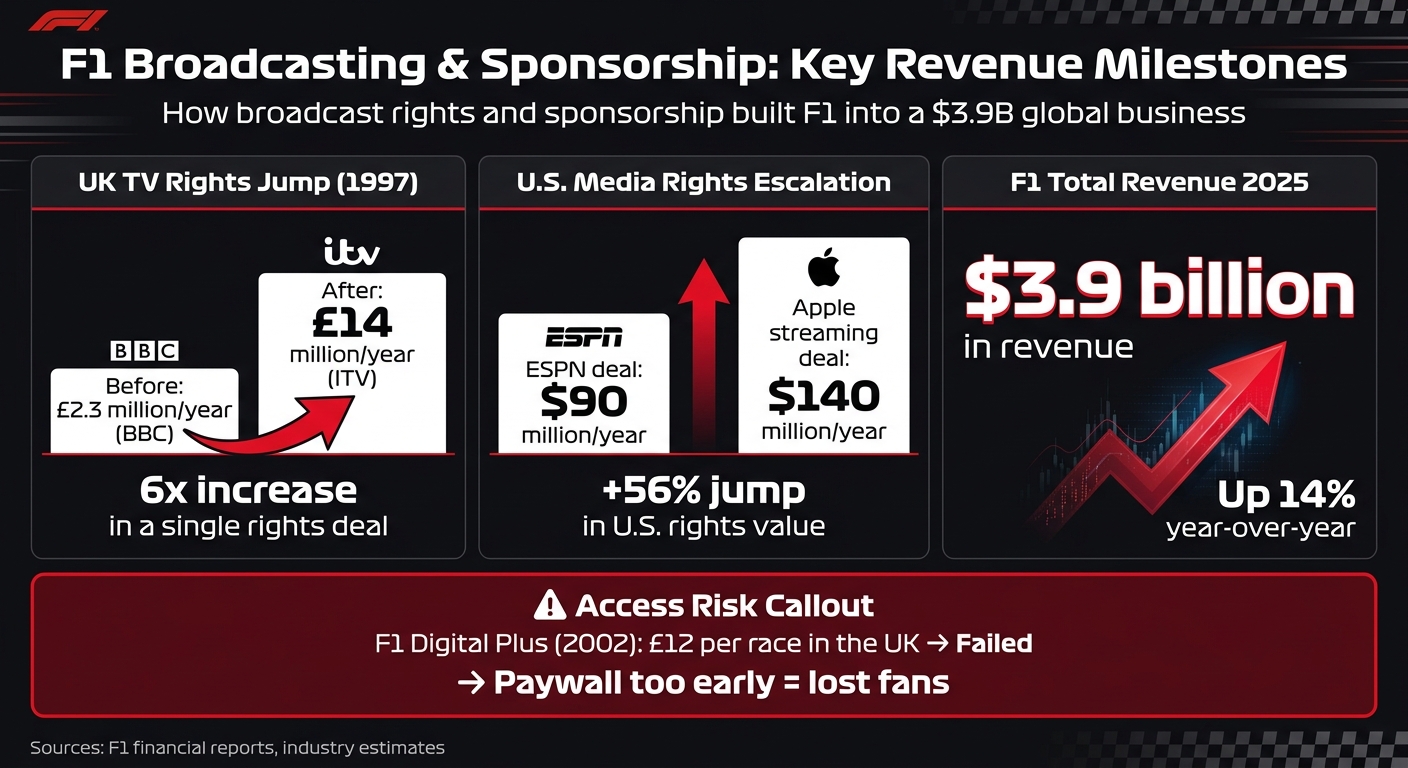
- UK rights jumped from $2.3 million to $14 million per year in 1997
- F1 posted $3.9 billion in revenue in 2025, up 14%
- Apple’s U.S. deal is estimated at $140 million per year, up from ESPN’s $90 million
If I had to sum it up in one line, it would be this: broadcast reach made sponsorship worth more, and sponsorship helped turn F1 into a global media business.
F1 Broadcasting & Sponsorship: Key Revenue Milestones
What Formula 1’s Sponsorship Boom Means For The Future Of Motorsport
sbb-itb-7c68254
F1's audience problem in the television era
Formula One had global appeal long before TV did it justice. The sport already had the speed, the drama, and the star power. What it lacked was steady, watchable coverage. For years, there was a big gap between what F1 was and what fans could actually see, and that gap slowed both audience growth and revenue.
From highlights packages to live global race coverage
Early F1 television coverage was patchy and rough around the edges. Viewers didn’t get a clean, steady version of the sport. In many cases, footage was passed around as telerecorded copies, filmed off a screen. So even when races reached people, they often looked second-rate.
That kept F1 in public view as an event, but not as a reliable TV product.
In 1953, the BBC dropped live coverage of Silverstone for Ascot and showed the race later as a telerecording. Live international coverage came much later. It wasn’t until the 1976 Japanese Grand Prix that F1 aired its first race outside Europe live by satellite.
Why fragmented coverage reduced sponsor value
This uneven coverage created a basic problem for sponsors: they couldn’t count on being seen. Exposure changed from one country to the next, and even from one race to the next. National broadcasters often showed races only when a home driver had a shot. No local favorite, no steady coverage.
That made sponsor value hard to pin down. A brand might get strong visibility in one market and almost none in another. For companies paying to appear on cars, suits, and trackside boards, that was a weak deal.
The issue came into sharper focus at the 1976 Race of Champions at Brands Hatch. The BBC pulled its cameras after John Surtees refused to remove Durex branding from his cars. Just like that, one broadcaster could wipe out a sponsor’s exposure in a whole market.
The money showed how much room there was for growth. When ITV beat the BBC for British rights in 1997, the fee rose from £2.3 million to £14 million per year, more than six times higher. That jump showed how badly the rights had been priced under a setup that treated F1 like filler instead of must-watch programming. TV only turned into a strong business driver when it could offer repeatable sponsor inventory, and fragmented rights got in the way.
The U.S. problem: niche TV coverage and low mainstream recognition
The same weakness hit even harder in the U.S. F1 was trying to break into a market already crowded with NASCAR and IndyCar. Without steady television coverage, it never had much chance of becoming part of the casual sports diet.
The sport also had two big handicaps. It had no permanent U.S. race from 2007 to 2012, and many races aired early in the morning because the calendar revolved around Europe. That’s a tough sell in any market, but especially in one with so many other options.
Without regular airtime, F1 couldn’t build habit. And without habit, it couldn’t build much value with American fans or advertisers.
That’s why centralized global rights became the only fix that could work at scale.
How centralized TV rights made F1 a global broadcast product
Bundled rights fixed a fragmented market
The first Concorde Agreement moved TV rights away from individual promoters and put them under FOCA. That let F1 sell the full season as one package instead of race by race.
That change mattered a lot. It gave the sport more leverage in negotiations, and it gave broadcasters something far easier to buy and plan around: a full-season product, not a patchwork of separate deals. Sponsors benefited too. Instead of piecing together local exposure market by market, they could use F1 as one global platform.
Consistent live coverage raised sponsor confidence
A unified world feed meant every broadcaster got the same camera angles, graphics, and timing data. That made the product feel consistent from one market to the next.
For multinational sponsors, that was a big deal. They could build global campaigns around F1 with far more confidence because the presentation was stable wherever the race aired.
Results: broader reach and higher rights fees
The end result was a cleaner, season-long broadcast product that broadcasters could market and sponsors could trust. It also made F1's broadcast inventory easier to sell to global sponsors.
That broadcast stability set up the next step: sponsorship scaling from local branding to global title partnerships.
How Sponsorship Turned Broadcast Reach into Revenue
Once F1 had a stable global feed, sponsors could buy the same exposure across markets instead of dealing with patchy local coverage. That changed the business fast. Sponsorship was no longer just a logo seen by fans at one circuit. It became global inventory that could be sold across a full broadcast product.
From local backers to global title partners
Before that shift, many deals were tied closely to local race promoters, home markets, or country-by-country visibility. A sponsor might matter a lot in one place and barely register anywhere else.
A stable international broadcast feed changed the math. Brands could now justify bigger deals because they weren't buying scattered impressions. They were buying access to a worldwide audience through one sport with one visual package. That opened the door for global title partners rather than a loose collection of local backers.
Broadcast-first branding changed how sponsors appeared in F1
Broadcast changed more than reach. It also changed placement.
When television became the main way fans watched F1, sponsor value shifted toward whatever showed up well on screen. Car liveries, driver suits, trackside boards, garage backdrops, and podium moments all mattered more because they were now part of a repeatable media product.
In plain English: if the camera kept finding it, the sponsor could sell it internally.
That pushed teams and rights holders to think less like event organizers and more like media sellers. Branding had to read clearly at speed, look good in a global feed, and appear often enough to matter over a full season.
Regulation forced a new sponsorship mix
Rules also changed who could spend and how that money entered the sport.
As regulation tightened around some sponsor categories, F1 had to replace old funding sources with new ones. That didn't shrink the role of sponsorship. It changed the mix. Teams and the sport itself had to look for brands that fit the new rules while still paying for premium worldwide visibility.
So the sales pitch evolved. Instead of leaning on narrow local deals or category-heavy money, F1 could offer something bigger: a global broadcast platform with repeat exposure across many races, many markets, and one highly recognizable stage.
Pay TV, streaming, and the U.S. surge: the next phase of the formula
Once F1 built a premium global broadcast product, the next step was clear: get the sport in front of more people without cutting into the value of media rights.
Pay-TV deals brought in more revenue, but they also made the sport harder to stumble into. People who pay to watch tend to be more engaged than casual free-to-air viewers. But in mature media markets, fewer entry points also mean fewer chances for new fans to find the sport in the first place.
That tension sits at the heart of the model. Free-to-air brings reach. Pay TV brings revenue. Streaming adds another lane by making access easier while still allowing tighter audience targeting.
How streaming and digital content addressed the access problem
Streaming and digital content helped ease that access problem. Fans got more flexible ways to keep up with the sport, and F1 reopened growth channels with younger, mobile-first audiences.
F1 TV and other digital platforms pushed access beyond the standard race broadcast. That mattered because following a sport now often happens in pieces, not all at once. A fan might start with clips, highlights, recaps, or app alerts before ever sitting down for a full live race.
The U.S. case: ESPN, new Grands Prix, and the Netflix effect
In the United States, ESPN coverage and new U.S. races gave F1 steadier visibility in a market that had gone without a home Grand Prix from 2007 to 2012.
The Netflix effect mattered for a simple reason: story-led content made F1 easier to understand before fans watched live. It didn't replace live coverage. It helped build the audience that would later go looking for it.
That discovery path matters even more in markets where live races still need easier access. In that sense, discovery isn't just a marketing job. It's tied directly to revenue.
Conclusion: What broadcasting and sponsorship still need to solve
Centralized media rights, global sponsorship, and digital distribution helped turn F1 into a commercial product that can grow across markets.
You can see that scale in the numbers. F1 posted a record $3.9 billion in revenue in 2025, up 14% from the year before. That kind of growth shows how the broadcast model keeps turning audience attention into sponsor dollars.
But there's still a built-in tension here. Apple's five-year U.S. streaming deal, estimated at $140 million per year, is a big jump from ESPN's previous $90 million deal. More money from media rights sounds great on paper. The catch is that higher rights fees can make it harder for casual fans to tune in.
F1 has run into this problem before. F1 Digital Plus failed in 2002 in part because it charged £12 per race in the UK. That's the risk in plain English: if access costs too much before people are hooked, the sport can shut out the next wave of fans.
And that's still the main issue F1 has to deal with. Broadcasting and sponsorship built the sport's global reach. Whether that reach keeps growing will depend on how well F1 handles the gap between premium revenue and broad access, especially in markets like the U.S., where the fan base is still taking shape.
FAQs
Why did centralized TV rights matter so much?
Centralized TV rights helped Formula One grow from a fragmented series into a more unified global business. Instead of dealing with scattered national broadcasts, F1 could sell entire seasons to broadcasters. That meant more consistent scheduling and start times that could actually be enforced.
It also gave the sport more control over how races were shown. With in-house production and more standardized coverage, Formula One could present a cleaner, more consistent product to fans around the world.
The result was simple but powerful: media rights became a major source of revenue. That income gave the sport the financial stability to grow into a multi-billion-dollar entertainment business.
How did better broadcasting increase sponsor value?
Better broadcasting made F1 more useful for sponsors because it opened the sport up to more people and made the viewing experience far richer. Once coverage moved beyond limited linear TV and into digital, multi-platform formats, sponsors got a clearer view of who was watching and more ways to connect with fans.
That shift changed the game. Real-time telemetry, interactive content, and behind-the-scenes storytelling pulled fans deeper into the sport. And that gave sponsors room to do more than rely on trackside signage. They could build more targeted campaigns, test different formats, and measure results with far more precision.
Could paywalls slow F1's growth in the U.S.?
Probably not. Formula 1 has used paywalls to grow revenue and build long-term business value, but the signs so far suggest this move is not slowing its growth in the U.S.
Part of the reason is balance. F1 hasn’t leaned on paywalls alone. It has paired that shift with social media, live data, and streaming, while newer premium broadcast models are built to improve access and give fans a more personal viewing experience.
And the audience numbers back that up: U.S. viewership hit a record 1.4 million per race in 2025.