7 Original F1 Circuits: History and Legacy
Examines the seven 1950 F1 circuits and how they shaped modern racing through speed, safety and track variety.
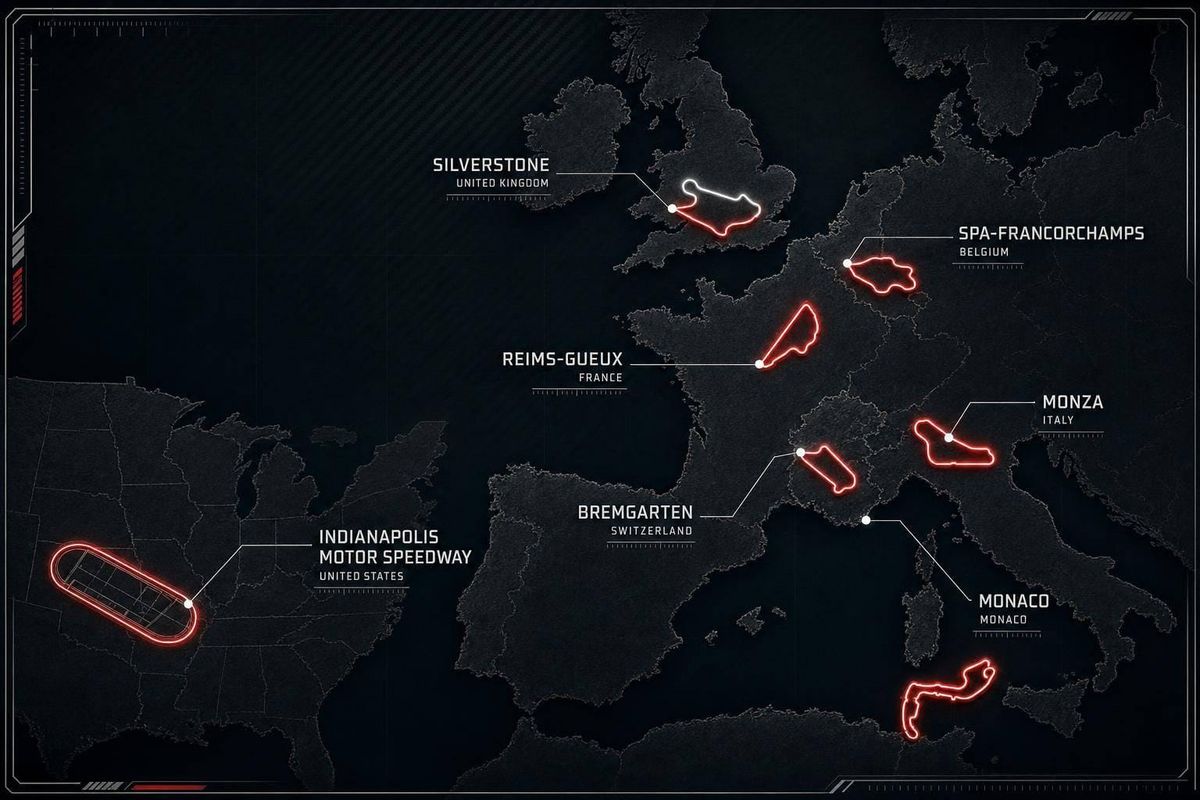
Formula 1 started in 1950 with seven very different tracks, and that first lineup still explains a lot about the sport today. I’d boil it down like this: 4 of the 7 circuits are still on the F1 calendar, 1 active venue no longer hosts F1, and 2 are gone as race tracks but still matter in F1 history.
If you want the short version, here it is:
- Silverstone opened the championship on May 13, 1950
- Monaco showed how harsh street racing could be
- Indianapolis gave the series a world title race outside Europe
- Bremgarten and Reims-Gueux represent the old public-road era
- Spa and Monza survived by changing a lot over time
- The first calendar mixed an airfield, a street circuit, road courses, a permanent track, and an oval
What stands out to me is how little these tracks had in common. Teams had to deal with narrow city roads, flat-out public-road circuits, and the 2.5-mile Indianapolis oval, often only days apart. That put pressure on car setup, tire life, and reliability from race to race.
A Brief Explanation of EVERY Circuit in Formula 1 History
sbb-itb-7c68254
Quick comparison
| Circuit | 1950 type | Status now | Main legacy |
|---|---|---|---|
| Silverstone | Airfield circuit | Active | Site of the first F1 World Championship race |
| Monaco | Street circuit | Active | Street-race test of precision |
| Indianapolis | Oval | Active venue | Brought a U.S. round into the early title fight |
| Bremgarten | Road circuit | Inactive | Example of early forest-road Grand Prix racing |
| Spa-Francorchamps | Road circuit | Active | Old high-speed road course reshaped for safety |
| Reims-Gueux | Road circuit | Historic site | Clear link to F1’s fast public-road past |
| Monza | Permanent circuit | Active | Long-running home of top-speed racing |
In short: these seven circuits did more than host races. They set the early pattern for Formula 1 - speed, danger, variety, and constant change.
The First Seven F1 World Championship Circuits at a Glance
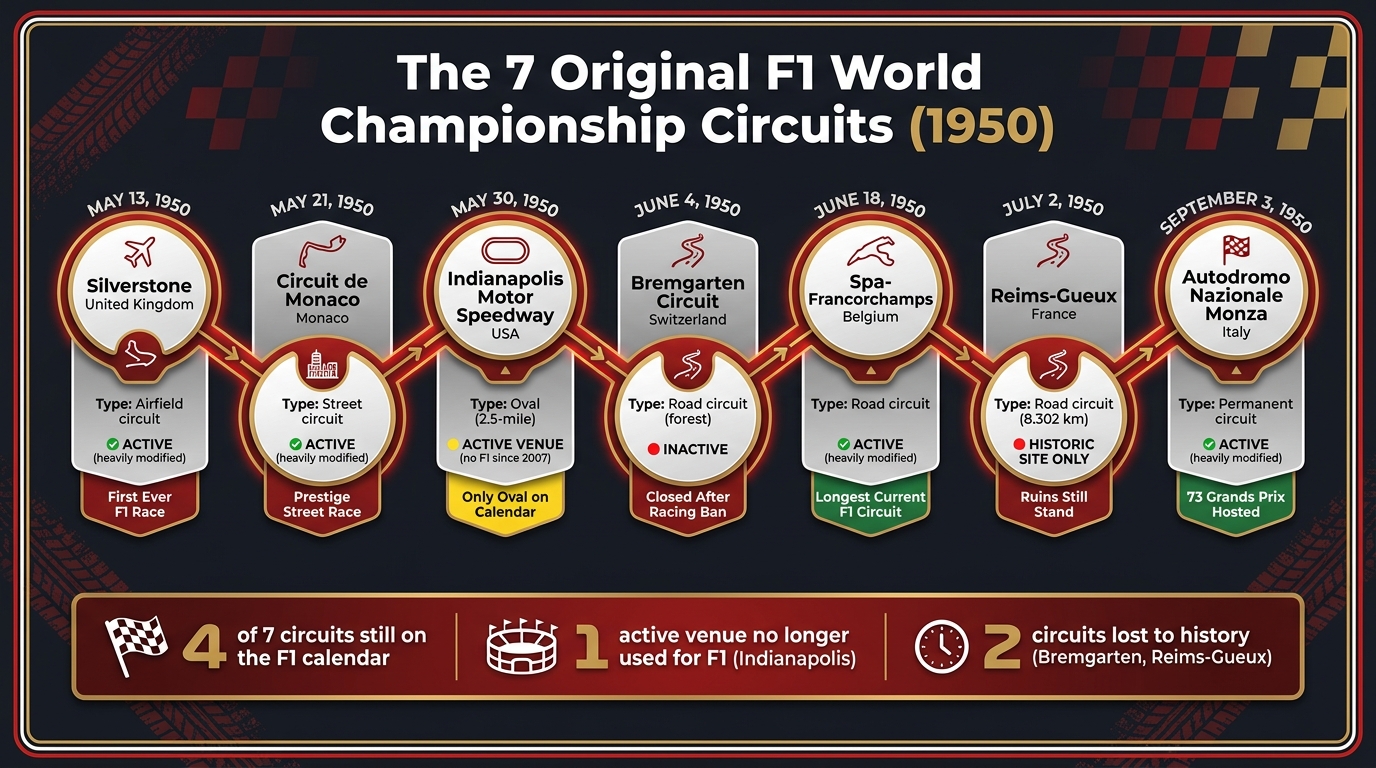
The 7 Original F1 Circuits: 1950 Season Timeline & Legacy
Here’s a quick reference to the seven circuits from the opening 1950 season.
| Circuit | Country | Type | 1950 Race Date | Present-Day Status |
|---|---|---|---|---|
| Silverstone | United Kingdom | Airfield circuit | May 13, 1950 | Active, heavily modified |
| Circuit de Monaco | Monaco | Street circuit | May 21, 1950 | Active, heavily modified |
| Indianapolis Motor Speedway | USA | Oval | May 30, 1950 | Active, no longer used for F1 |
| Bremgarten Circuit | Switzerland | Road circuit | June 4, 1950 | Inactive |
| Spa-Francorchamps | Belgium | Road circuit | June 18, 1950 | Active, heavily modified |
| Reims-Gueux | France | Road circuit | July 2, 1950 | Historic site |
| Autodromo Nazionale Monza | Italy | Permanent circuit | September 3, 1950 | Active, heavily modified |
Four of the seven circuits - Silverstone, Monaco, Spa-Francorchamps, and Monza - still host F1, though each one has changed a lot in the name of safety. Monza has been used more than any other track in F1 history, with 73 Grands Prix since 1950. Indianapolis Motor Speedway is still active too, but it hasn’t hosted an F1 race since 2007. Reims-Gueux no longer runs races, though its pit buildings still stand and other parts of the old course have gone back to farmland.
That lineup says a lot about early Formula 1. Teams had to move from airfields to city streets, from long road courses to an oval, and then do it all again a week or two later. Car setup couldn’t stay the same. Neither could the approach to speed, tire wear, or reliability.
Silverstone opened the championship and set the tone for the season, which makes it the right place to start.
1. Silverstone Circuit

Origins and layout type
Silverstone started life as a disused World War II Royal Air Force bomber base. The British Racing Drivers' Club picked it for a few plain reasons: it sat in a central part of the UK, and the site was flat and treeless, which made it safer by the standards of the time.
The first version of the circuit used the airfield’s perimeter roads and runways. That gave drivers long straights and fast corners. It also gave the track a hard, exposed feel that still shapes how people talk about Silverstone now.
Role in the 1950 championship
That fast airfield layout made Silverstone a natural place for Formula 1’s first world championship race. The event put the circuit on the map at once and set an early standard for speed, logistics, and scale in the sport.
Technical or driving challenge
The old airfield design created long straights and quick corners, with almost no protection for spectators. It was flat-out in a way that now feels almost hard to believe. Woodcote once saw speeds of 150 mph before the 1975 chicane cut corner speed.
Modern F1 cars still get pushed hard here. Copse remains one of the big tests on the calendar, with speeds reaching 190 mph (306 km/h) and drivers dealing with 5.2G of lateral force.
Enduring legacy in F1 history
A track built around speed had to keep changing as F1 safety rules got stricter. Silverstone has hosted 53 Grands Prix as of early 2026. Big revisions came in 1991, when sweeping curves and the Priory and Vale sections were added, and again in 1994, when the Abbey Corner chicane arrived after the safety overhaul that followed Imola.
Even with those changes, Silverstone has stayed the home of the British Grand Prix. Its wartime roots still show in the layout, the pace, and the kind of racing the circuit tends to produce.
2. Circuit de Monaco
Origins and layout type
If Silverstone was about speed, Monaco was about precision. The track runs through public city streets, which gives it a very different feel from a purpose-built circuit. It's tight, twisty, and short on runoff, with almost no room for mistakes.
Monaco had already been hosting Grand Prix races since the years after World War I, so it was a well-known stop in motorsport long before Formula 1 came along.
Role in the 1950 championship
Monaco was one of the six European Grands Prix chosen by the FIA for the first Formula 1 World Championship in 1950. That choice mattered. By linking the new series to a race that already had status and history, the championship looked more established from the start.
Technical or driving challenge
Monaco's street layout has always made it a different kind of test. The corners are tight, the roads are narrow, and the barriers sit just inches from the racing line. There is no margin for error.
In the 1950s, the danger was even more stark. Straw bales were the only barrier between the cars and the harbor, there was no pit lane, and there was no fast way to stop a burning car. Today, the circuit is lined with modern barriers and fast-response recovery equipment.
Enduring legacy in F1 history
Monaco is one of only three circuits from the 1950 debut season - along with Monza and Spa-Francorchamps - that still appears on the modern F1 calendar.
It still stands as Formula 1's defining street circuit: narrow, unforgiving, and built around precision rather than outright speed. From Monaco's cramped streets, the calendar moved to a completely different test at Indianapolis.
3. Indianapolis Motor Speedway

Origins and layout type
After Monaco's tight, exacting test, Indianapolis brought the other extreme: flat-out speed. Indianapolis Motor Speedway opened in 1908, more than 40 years before Formula 1 even existed. It was built as a purpose-made 2.5-mile oval for long, fast running.
Role in the 1950 championship
The FIA included the Indianapolis 500 to give the championship a more global feel, but most F1 teams saw it as its own world. That gap shaped the way teams handled the race. It also led to some unusual entries in the record books: American drivers such as Bill Vukovich are officially credited with F1 race wins even though they never raced in a standard Grand Prix.
Technical or driving challenge
Indianapolis asked for something very different from the road circuits. Success came from holding speed, staying stable on an oval, and running a low-drag setup. In plain terms, it was the setup outlier among the original seven venues. Teams needed a different aerodynamic approach and a different car configuration from what the European road courses called for.
Enduring legacy in F1 history
The Indianapolis 500 counted toward the Formula 1 World Drivers' Championship for 11 straight seasons, from 1950 through 1960. As the only oval on the original calendar, Indianapolis stretched the idea of what an F1 World Championship venue could be. Formula 1 came back later, from 2000 to 2007, but on a modern infield road course that used only part of the oval banking.
4. Bremgarten Circuit
Origins and layout type
Bremgarten was a forest-lined road circuit just outside Bern, Switzerland. At 4.479 miles (7.208 km), it was one of the longest tracks on the 1950 calendar.
It was also a clear example of what early Formula 1 looked like at the time: racing on public roads, not at permanent venues built just for motorsport. That old setup shaped much of the sport's early years before F1 started shifting toward dedicated tracks.
Role in the 1950 championship
Bremgarten hosted the Swiss Grand Prix five years in a row, from 1950 to 1954. By 1954, it stood out as one of the clearest signs of how much early F1 still depended on public-road circuits.
Technical or driving challenge
This was a long, fast public-road circuit with almost no room for mistakes. If a driver got something wrong, there usually wasn't space to recover.
That made Bremgarten a big part of the era's identity. But it also showed where the sport was heading. Formula 1 was already starting to drift away from this high-speed road-circuit model.
Enduring legacy in F1 history
Bremgarten's time in Formula 1 ended after 1954. The 1955 Le Mans disaster added more pressure across the sport to improve circuit safety, and Bremgarten's disappearance reflected that shift. Road circuits were coming under heavier scrutiny, and that push would soon reshape other tracks too, including Spa-Francorchamps.
5. Spa-Francorchamps

Origins and layout type
Like Bremgarten, Spa-Francorchamps began as a public-road circuit. But Spa was faster, longer, and far less forgiving. This prewar road course, with roots after World War I, took shape across fast, open terrain with no purpose-built safety run-off to speak of. The FIA chose it as one of the established prewar Grands Prix for the first 1950 Formula 1 World Championship calendar.
Role in the 1950 championship
Spa was one of the six European rounds in that first championship.
Technical or driving challenge
The original layout asked for flat-out commitment over long sections of the lap. Corners such as the notoriously dangerous Burnenville demanded a level of bravery few circuits could rival. And as speeds climbed, the risk got harder to brush aside, especially at Burnenville. By 1969, that danger had become impossible to ignore. Drivers organized a boycott of the Belgian Grand Prix at Spa, setting the pattern for a similar boycott of the Nürburgring the next year.
Enduring legacy in F1 history
Spa didn’t vanish. It changed. Some of its most dangerous parts were removed, the pit buildings were relocated, and the start line was moved to fit modern standards. The circuit is still on the F1 calendar today. That alone sets Spa apart from Reims-Gueux, which did not survive in the same way.
6. Reims-Gueux
Origins and layout type
Reims-Gueux was road racing in its purest, fastest form. Set near Gueux, France, this high-speed road circuit used a triangular layout that sent cars hurtling down long straights for lap after lap. At 8.302 km (5.159 miles) per lap, it was one of the longest tracks of its time. Along with Monza and Spa-Francorchamps, it earned a place among the great temples of speed.
More than that, Reims-Gueux reflects a period when Formula 1 still relied on fast public roads, before safety demands and permanent venues changed the shape of the calendar.
Role in the 1950 championship
Reims-Gueux hosted 11 French Grands Prix between 1950 and 1966, which made it one of the early homes of the event in Formula 1.
Technical or driving challenge
At Reims-Gueux, speed was the whole game. The long straights put a premium on outright pace, while Muzon served as the main break in the rhythm. That corner has since vanished into farmland, which says a lot about how much of the old circuit has slipped back into the landscape.
Enduring legacy in F1 history
Reims-Gueux stopped hosting Formula One in the 1960s. Unlike Monza or Spa-Francorchamps, it did not make the jump into a modern permanent circuit.
What still stands matters. The preserved pit buildings offer the clearest physical link to F1's early years. Walking past them, you can almost picture the sport before run-off areas, permanent paddocks, and modern safety standards changed everything. The remains of Reims-Gueux show, in plain terms, what early F1 left behind as it moved to safer, permanent tracks. That also makes the circuit a useful benchmark for judging just how much the surviving F1 venues have changed.
7. Autodromo Nazionale Monza

Origins and layout type
Built in 1922, Monza picked up the nickname "Temple of Speed" thanks to its early high-speed concrete banking. That banked layout didn’t last. Over time, the circuit shifted to a flat-out road course, with chicanes added to cut speed and improve safety.
Role in the 1950 championship
Monza staged the season finale of the first Formula One World Championship in 1950. Giuseppe Farina came into the race behind Juan Manuel Fangio in the standings. But when Fangio retired with a mechanical failure, Farina took the win and became Formula One's first World Drivers' Champion.
The race also included a shared drive between Dorino Serafini and Alberto Ascari. That sounds odd now, but mid-race car swaps were common in early F1.
Technical or driving challenge
Like the other original venues, Monza pushed both drivers and cars right to the edge. The difference was speed. Average speeds were much higher here, which put even more strain on the machinery. In 1950, that pace exposed weak points, and several cars dropped out with mechanical failures.
Enduring legacy in F1 history
Monza is one of only two venues, along with Silverstone, to appear on every F1 calendar since 1950. That's a big part of why it still holds such a strong place in the sport. It kept its identity as a speed circuit while changing enough to meet modern safety standards. Compared with the other original tracks, Monza shows that shift as clearly as any circuit on the calendar.
How the Seven Circuits Compare Today
Seven decades later, the main split is venue type, not age. Permanent tracks changed with the times. Road circuits that couldn't meet modern safety rules fell away. So the comparison now isn't much about when these venues began. It's more about which layouts could change and keep going.
Spa-Francorchamps is the big exception. It stayed alive by shrinking from a 14.1-kilometer public-road loop into a modern permanent circuit. Monaco is the other odd one out: it's still a temporary street circuit, yet it remains one of Formula 1's most prestigious races.
| Circuit | Venue Type | Status Today | Modern Influence |
|---|---|---|---|
| Silverstone | Permanent (ex-airfield) | Active | Safety evolution |
| Monaco | Street circuit | Active | Prestige street race |
| Indianapolis | Permanent (purpose-built oval) | Active (venue) | Link between European F1 and American oval racing |
| Bremgarten | Public road (forest) | Lost | Closed after Switzerland's racing ban |
| Spa-Francorchamps | Hybrid → Permanent | Active | Still the longest current F1 circuit |
| Reims-Gueux | Public road | Lost | Preserved ruins remain on site |
| Monza | Permanent (purpose-built) | Active | Flattened and chicaned to control speed |
You can still see their legacy in what remains. Reims-Gueux still has preserved structures on site, while Bremgarten disappeared after Switzerland's racing ban. That contrast says a lot. Some tracks found a way to change. Others became part of history. And that split still shapes how people judge Formula 1 circuits today.
Why These Tracks Still Matter
That comparison points to the main idea: these tracks still matter because each one helped shape a different type of F1 circuit. Put together, they did more than host races. They built the base of Formula One's identity: fast airfields, tight street circuits, public-road courses, an oval, and a permanent track.
Their shared impact stands out more than any single race result. Monaco set the bar for precision and prestige. Indianapolis pushed F1 to think on a global scale. Bremgarten and Reims-Gueux kept the public-road era alive. Spa showed what commitment looked like at extreme speed. Monza set the model for top-speed efficiency.
You can still see their fingerprints on modern circuits, even when today's layouts look nothing like the old ones. In that sense, they set the pattern modern F1 tracks still answer to: speed, safety, prestige, and layout design.
FAQs
Why were track types so different in 1950?
In 1950, F1 circuits were often shaped by what already existed after World War II, not by tracks built from scratch for racing.
Silverstone shows this perfectly. It started life as an RAF airfield, and its early layout even used the runways. By 1949, the circuit had moved to the perimeter roads around the site. That version then hosted the first F1 World Championship race in 1950.
Why did some original F1 circuits survive while others disappear?
Early Formula One circuits stayed on the calendar only if they could keep up with tougher safety requirements.
In the early days, races often took place on public roads or simple tracks with very little protection. Over time, that stopped being acceptable. Circuits such as Silverstone remained in use by adding safer barriers, better medical facilities, and more run-off areas.
Tracks that couldn't meet those standards - or deal with modern technical and logistical demands - were removed from the calendar.
How closely do Silverstone, Monaco, Spa, and Monza still resemble their 1950 layouts?
They’re still easy to recognize, but all four look very different from how they did in 1950.
Silverstone is still fast, yet it has moved well beyond its first layout on a former bomber base. Monza still revolves around long straights, though safety changes have reshaped the track over time.
Spa has also been reworked for safety, while keeping the character people know it for. Monaco remains a tight street circuit, but its layout has changed too to meet modern safety demands and the pace of today’s cars.