Lifecycle of F1 Fuels: From Extraction to Use
Explains why F1's 2026 drop-in sustainable fuel success hinges on feedstock, conversion, logistics, and full well-to-wheel accounting.
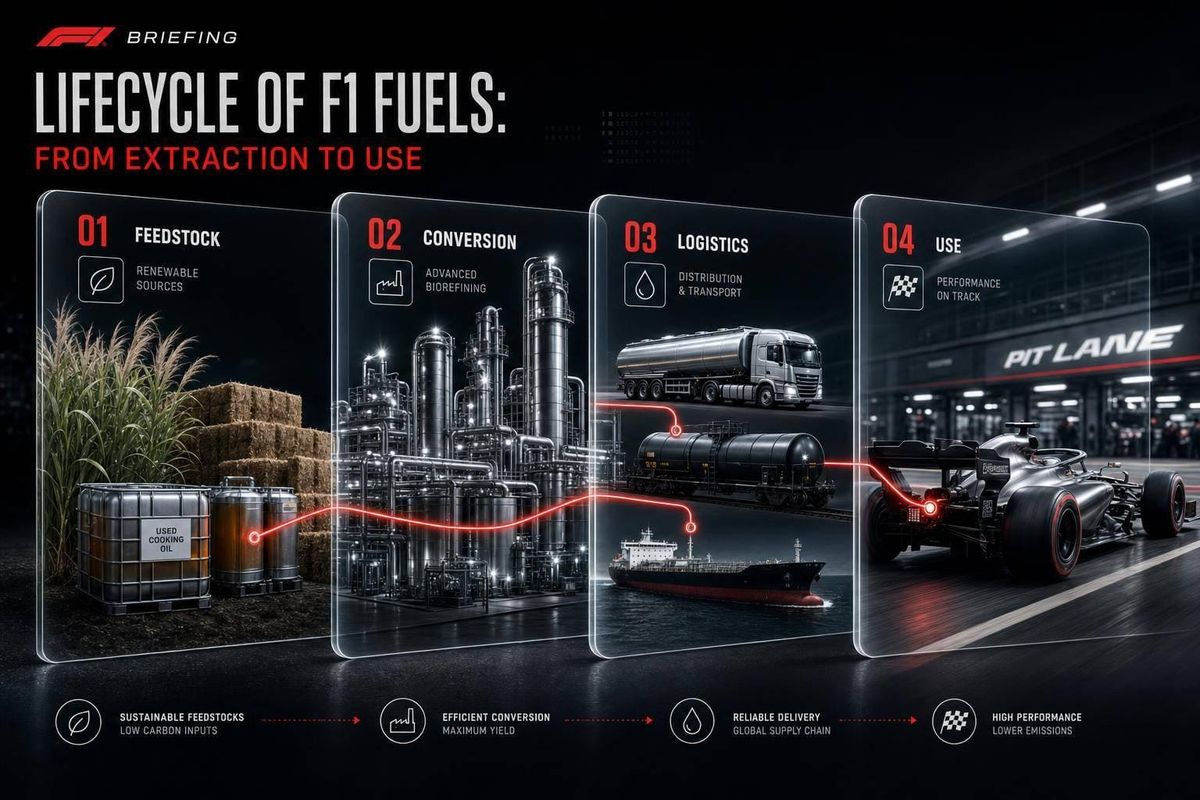
Most of F1 fuel’s climate impact happens before it reaches the car.
If you only look at the exhaust, you miss the main story: feedstock source, fuel making, shipping, storage, and power use upstream do most of the work in the final carbon total.
Here’s the short version:
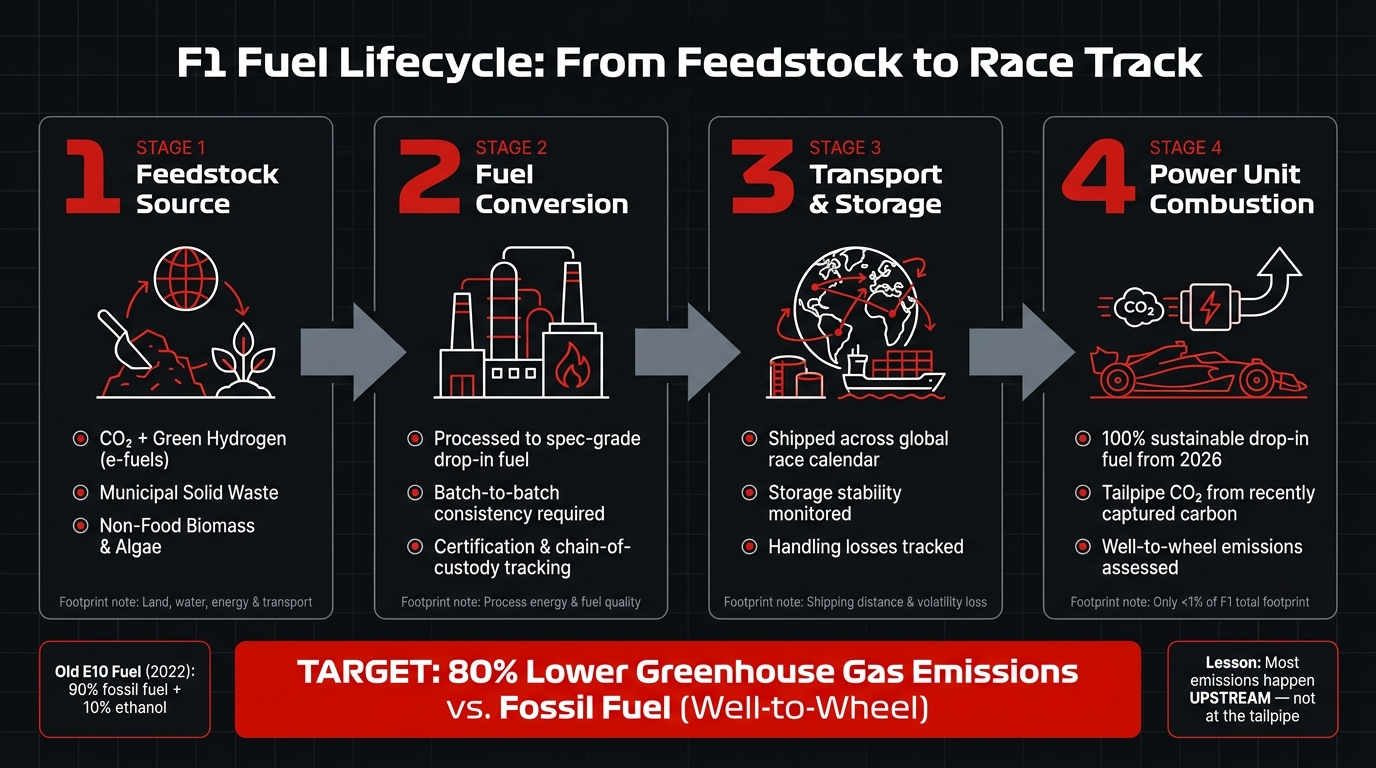
- From 2026, F1 plans to use 100% drop-in fuel that works in current engines without hardware changes.
- The target is about 80% lower greenhouse gas emissions on a well-to-wheel basis than fossil fuel.
- The old E10 fuel used from 2022 was still 90% fossil fuel and 10% ethanol.
- Fuel burned on track is less than 1% of F1’s total carbon footprint, so the bigger lesson is what this fuel could mean for the 1.4 billion combustion-engine vehicles still in use.
- The main feedstock routes are:
- CO2 + green hydrogen for e-fuels
- municipal solid waste
- non-food biomass and algae
- The weak points are usually upstream:
- energy use in fuel production
- land and water use
- waste sorting and contamination
- transport distance
- storage and fuel stability
- chain-of-custody tracking
The bottom line: tailpipe CO2 still exists, but the key question is where that carbon came from and how much energy was used across the whole chain.
| Stage | What matters most |
|---|---|
| Feedstock source | Land, water, power, collection, transport |
| Conversion | Process energy, fuel consistency, batch quality |
| Distribution | Shipping distance, storage, handling losses |
| Use in car | Combustion performance and total well-to-wheel emissions |
If you want the simple answer, it’s this: F1 fuel is judged by its full lifecycle, not just race-day exhaust.
F1 Fuel Lifecycle: From Feedstock to Race Track
From lab to F1 2026 track | The science behind Scuderia Ferrari’s sustainable race fuel
sbb-itb-7c68254
Feedstock Extraction: Where F1 Fuels Start
The footprint starts before refining. It starts where the feedstock is gathered.
For F1, sustainable fuel pathways usually fall into three main routes: captured CO2 with green hydrogen, municipal solid waste, and non-food biomass or algae. Each one needs its own collection system, supply setup, and upstream inputs before fuel production even gets off the ground.
That’s the heart of the issue. It’s not only about what the feedstock is. It’s also about how much land, water, energy, and transport work it takes to get that material ready in the first place.
Captured CO2 and Green Hydrogen for E-Fuels
E-fuels begin with captured CO2 and hydrogen produced with renewable electricity.
Their footprint depends on a few basic things: the energy needed for carbon capture, the power needed to make hydrogen, and the build-out required to secure both inputs at scale. If any part of that chain is energy-heavy or hard to supply, the upstream burden grows fast.
Municipal Waste as a Circular Feedstock
Municipal solid waste sounds simple on paper, but the details matter.
This pathway relies on local collection, sorting, and contamination control before conversion can happen. That means logistics and waste quality have a direct effect on the final footprint. If the waste stream is messy or transport is long and inefficient, the numbers can shift in the wrong direction.
Non-Food Biomass and Algae Pathways
Non-food biomass and algae come with land and water pressure that can push their footprint up pretty fast.
They also face supply risks tied to weather and growing conditions. Heat, drought, and wildfire can interrupt collection and transport, which adds another layer of strain before any fuel is made.
After sourcing, these feedstocks still need to be converted, certified, and shipped through a global supply chain. That sourcing burden sets the terms for the next stage: conversion into a drop-in race fuel.
From Feedstock to Race Fuel: Conversion, Standards, and Logistics
Once feedstocks are sourced, the next step is turning them into race-ready fuel without wiping out the gains made upstream. In Formula One, that means more than making a fuel that burns well. It also has to survive processing, storage, and transport across a global calendar without losing quality or pushing lifecycle emissions back up. The big issue is simple: do those upstream gains still count after conversion and delivery?
How Feedstocks Are Converted Into Drop-In F1 Fuel
After extraction, feedstocks move into processing, where they are turned into a specification-grade race fuel. This is the stage where raw input becomes a drop-in fuel that can work within F1's tight engine and fuel rules. And that bar is high.
The finished fuel has to stay consistent under race conditions. That means teams and suppliers aren't just looking for something usable on paper. They need a fuel that behaves the same way from batch to batch, lap after lap, under heat, pressure, and extreme engine loads. In a sport where tiny margins can change everything, any shift in composition is a problem.
Certification, Chain of Custody, and Lifecycle Accounting
Sustainability claims only mean something if they cover the full lifecycle, not just what comes out of the tailpipe. A fuel can look clean at the point of combustion and still carry a heavy emissions burden from production, handling, or transport. That's why lifecycle accounting matters.
Chain-of-custody records tie each step of the process to the final emissions figure. They show where the feedstock came from, how it was processed, where it moved, and who handled it along the way. That paper trail is a big deal in Formula One, where fuel crosses borders, suppliers, and storage points over the course of a season.
Every handoff is a chance for the record to break. If traceability slips, the emissions figure becomes harder to trust. And in a global championship, that kind of gap isn't a small paperwork issue. It affects whether the fuel's stated carbon profile holds up at all.
Transport and Distribution Across a Global Race Calendar
Formula One doesn't run in one place, so transport and storage become part of the fuel's footprint too. Moving fuel from the production site to race venues adds cost, affects lifecycle emissions, and can alter fuel condition before it ever reaches the car.
A few logistics factors matter most:
- Shipping distance can push emissions higher.
- Storage conditions can affect fuel stability.
- Handling can lead to volatility loss or specification drift.
Those aren't side issues. They shape the fuel's lifecycle estimate and can affect how it performs once it arrives at the circuit. By the time the fuel gets to the garage, the question is no longer just where it came from. It's whether it still meets the same performance standard it had when it left the plant.
Use in the Power Unit: Performance and Lifecycle Emissions
By the time fuel reaches the garage, most of the big calls have already been made. The power unit is where those choices meet the track. It’s the point where fuel has to deliver speed, stability, and clean combustion under brutal conditions. Put simply, upstream decisions shape the carbon tied to every lap.
What F1 Power Units Require From Advanced Fuel
Modern F1 power units are tightly tuned turbo-hybrid systems. They operate within narrow combustion and energy-delivery windows, so even small changes in fuel behavior matter.
That matters even more now because, starting in 2026, Formula One runs on 100% sustainable drop-in fuel. That shift changes the fuel’s chemical makeup and the way it burns inside the engine. So the test isn’t just about power output. The fuel also has to fit the sport’s emissions goals.
Tailpipe CO2 vs. Well-to-Wheel Emissions
Burning advanced F1 fuel still releases CO2 at the tailpipe. The key difference is where that carbon came from. Instead of coming out of fossil reserves, it was recently captured from the atmosphere or biosphere, which means the total lifecycle impact is much lower. Looking only at tailpipe emissions misses a big part of the story.
That’s why well-to-wheel accounting matters here. It looks at emissions across the full chain, not just what comes out of the exhaust. And there’s a catch: the climate upside only works if the energy used upstream is low-carbon. If the electricity used to make green hydrogen or synthesize e-fuels comes from fossil sources, the total footprint goes up.
Conclusion: What the F1 Fuel Lifecycle Tells Us
After extraction, conversion, transport, and use, the lesson is pretty plain: the footprint of F1 fuel is shaped upstream. Feedstock sourcing, conversion efficiency, and logistics do most of the heavy lifting.
Fuel use itself is only a small part of F1's footprint. Logistics and personnel travel account for much more. So the practical issue isn't just what happens in the engine. It's what happens before the fuel ever gets there.
Three points shape the lifecycle case.
Key Takeaways From Extraction to Use
The takeaways are straightforward. The feedstocks behind advanced F1 fuels - captured CO2, green hydrogen, and waste-derived biomass pathways - can vary a lot in land use, water use, and energy demand. No pathway gets a free pass. To judge the carbon path in full, F1 relies on Lifecycle Assessment (LCA).
Certification and chain of custody make that LCA useful in the real world. They show the path from feedstock to finished fuel and help verify where the material came from. Just as important, drop-in compatibility means the fuel must work in current engines and fuel systems without changes.
F1's 2026 move to 100% sustainable drop-in fuel serves as a strong proof of concept, with a target of 80% lower greenhouse gas emissions than fossil fuels. Earlier series have already tested the approach and supplied on-track reliability data before the full changeover.
That step-by-step path is part of what makes F1 such a useful test bench - not only for motorsport, but also for hard-to-electrify sectors like aviation and shipping.
For F1, the message is simple: sustainability depends on the full fuel lifecycle, not just combustion.
FAQs
Why is well-to-wheel more important than tailpipe CO2?
Well-to-wheel matters because it looks at the fuel’s full carbon lifecycle - from extraction or synthesis all the way to final use - not just what comes out of the tailpipe.
That matters a lot in Formula 1. Track activity accounts for less than 1% of the sport’s total carbon footprint, so tailpipe emissions alone don’t tell the full story. A well-to-wheel view gives a more accurate picture of where carbon comes from across the fuel journey.
It also makes sure carbon inputs and production energy are counted the right way. That includes things like renewable electricity used to make synthetic fuels, which can change the fuel’s carbon profile in a big way.
What makes a fuel truly drop-in for F1 engines?
A drop-in fuel for Formula 1 has to work as a like-for-like swap for current gasoline, without major changes to engines, storage systems, or transport.
That sounds simple on paper. In practice, it means the fuel needs to behave much like the gasoline teams already use. It has to match key fuel traits such as energy density, volatility, and flame speed. It also has to meet safety requirements and work with engine materials, including seals and rubber parts.
Which feedstock route has the lowest lifecycle impact?
The lowest lifecycle impact comes from feedstocks that add as little net carbon to the atmosphere as possible. In Formula 1, that means using carbon pulled from the air or sourced from waste and plant-based biomass, so the fuel can support a circular carbon lifecycle.
Both synthetic fuels and advanced biofuels can work within this model. Advanced biofuels made from animal waste, used cooking oil, and other recycled residues stand out because they rely on waste streams that already exist, which can lead to strong sustainability gains.