F1 2026 Rules Guide: Fuel, Batteries, Aero, Weight
2026 F1 rules force teams to trade fuel, battery, aero and weight — winners will be those who best balance all four systems.
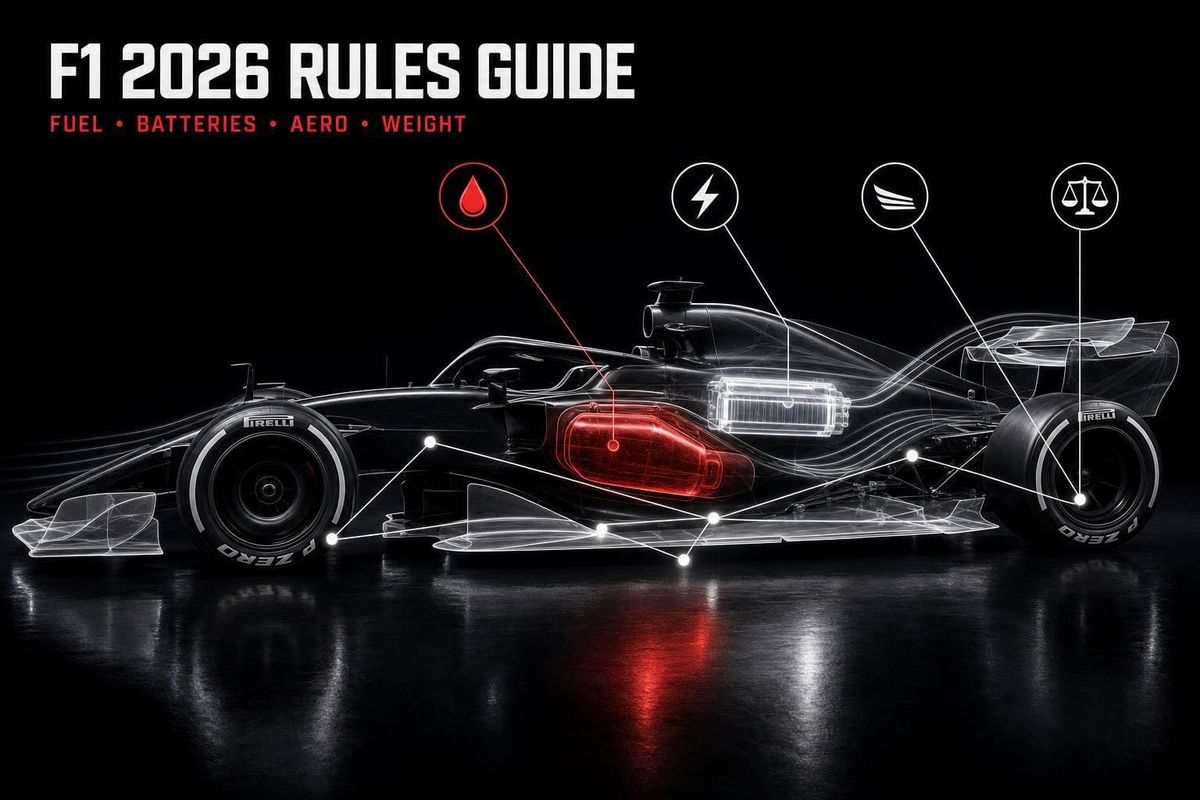
F1 in 2026 is not a small update. It changes the car’s power split, fuel load, aero system, and minimum weight at the same time. If you want the short version, here it is: teams will use less fuel, more electric power, active front and rear wings, and a lighter but smaller car.
In plain terms, I’d sum it up like this:
- Fuel: Race fuel drops to about 70 kg (154 lb), so each lap needs tighter fuel and energy use.
- Batteries: Electric output jumps to 350 kW while the engine drops to 400 kW, so battery use becomes a main pace tool.
- Aero: Old DRS is gone. New active aero switches between low-drag and high-downforce setups.
- Weight: Minimum weight falls from 798 kg to 768 kg (1,759 lb to 1,693 lb), even though teams also need more electrical and cooling hardware.
- Car size: The wheelbase is 200 mm (7.9 in) shorter and width is 100 mm (3.9 in) less, which tightens packaging.
What matters most is simple: none of these changes work on their own. A team can’t just chase top speed, battery output, or low weight by itself. Fuel use, battery charge, cooling, drag, and mass now pull on the same package.
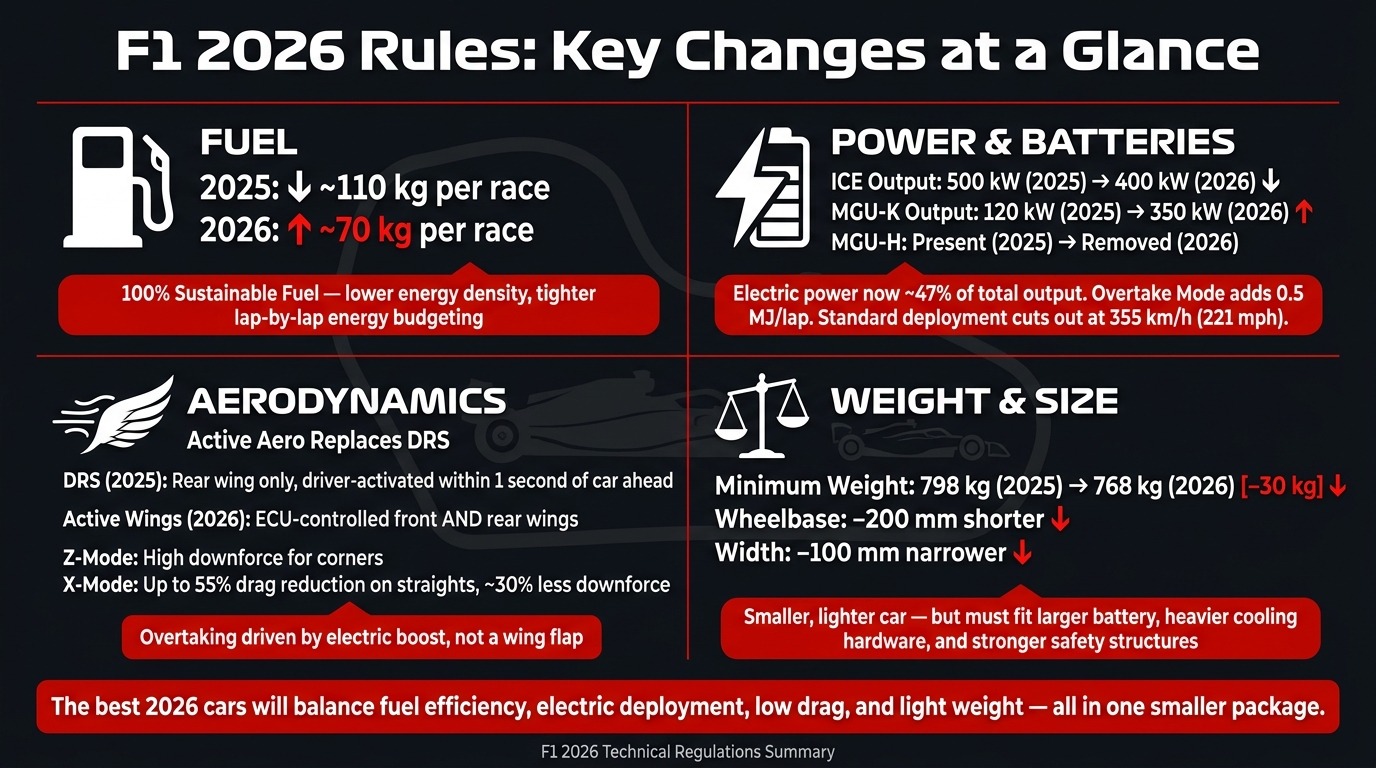
F1 2026 vs 2025: Key Rule Changes at a Glance
Everything You Need To Know About the Formula 1 2026 Regulations

sbb-itb-7c68254
Quick Comparison
| Area | Main 2026 Change | What it means |
|---|---|---|
| Fuel | Around 70 kg (154 lb) per race | More lift-and-coast, tighter lap-by-lap energy use |
| Power | 400 kW ICE + 350 kW MGU-K | Electric power matters much more for lap time |
| Energy Recovery | No MGU-H; more dependence on MGU-K | Braking zones matter more for charge recovery |
| Aero | Active front and rear wings replace DRS | Lower drag on straights, less downforce in low-drag mode |
| Weight | 768 kg (1,693 lb) minimum | Harder packaging job with less room to work with |
| Car Size | Shorter, narrower chassis | Better change of direction, but tighter layout for battery, cooling, and fuel |
If I had to boil the whole article down to one line, it would be this: the best 2026 F1 cars will be the ones that spend energy well, keep drag low, stay light, and still give the driver a stable car to attack with.
Fuel and Power Unit Rules: More Electric Power, Less Fuel Dependence
How the 2026 power split changes engine priorities
The biggest shift for 2026 is the new power split. ICE output drops to 400 kW, while MGU-K output climbs to 350 kW. At the same time, the MGU-H is gone, which means teams have to depend on the MGU-K for all energy harvesting.
That changes the job of the engine builder in a big way. The focus is no longer on turbo heat recovery. Now it's about getting the most out of electrical deployment and dialing in combustion efficiency. Fuel, then, stops being just something the car carries. It becomes part of a tight lap-by-lap energy budget.
What sustainable fuel changes in practice
Fuel matters more in 2026 because energy density now plays into pace just as much as fuel volume. The new 100% sustainable fuel is meant to work with current ICE hardware, but it comes with lower energy density. That forces teams to rethink combustion settings, knock control, and cooling calibration.
In plain English: the fuel may fit the engine, but the engine still has to be tuned around how that fuel behaves.
Why fuel use now connects directly to race execution
The fuel limit falls to about 70 kg per race, so each lap becomes an energy-management problem. The MGU-K harvests under braking and, at times, on straights through "super clipping." Push too hard on deployment, and the battery can run low before the lap is over.
Without the MGU-H, cooling becomes a bigger headache too. Teams need to cool the battery and electrical systems more aggressively to stop derating. So race execution isn't just about saving fuel anymore. It's about balancing three things at once:
- how much energy the car can harvest
- how much it can store
- how much it can spend on each lap
That tradeoff leads straight to the next issue: battery capacity, and how teams manage electric power across a full race distance.
Batteries and Energy Recovery: The New Performance Core
What 350 kW of electric power means for lap time
The MGU-K climbs to 350 kW in 2026. That’s about 470 horsepower from the electric motor alone.
On paper, that sounds huge. On track, the story is a bit more nuanced.
What matters isn’t only how much power the battery can send out. It’s when that power shows up over the lap. The extra electric shove is most useful on corner exit and down long straights, especially when a driver can use Overtake Mode.
There’s also a clear speed window to think about. Standard deployment starts to fade after 290 km/h (180 mph) and cuts out by 355 km/h (221 mph). Overtake Mode pushes deployment farther, up to 337 km/h (209 mph), which gives the chasing car a plain straight-line edge.
So the challenge for teams isn’t just building power. It’s making sure that power is there at the exact moment the lap asks for it.
How harvesting and deployment will change around a lap
Energy recovery still happens mostly under braking. That means stop-start tracks give teams more chances to recharge than fast, flowing circuits.
A track like Montreal, with heavy braking zones, is in a better spot for harvesting. High-speed layouts are tougher. They offer fewer windows to refill the battery, which pushes drivers toward more lift-and-coast. And that has a direct effect on lap pace and race approach.
There’s another wrinkle here: "super clipping". In simple terms, the car may keep harvesting energy even on a straight. The trade-off is obvious: give up a bit of speed now to protect battery charge for later.
That turns battery behavior into more than an engine issue. Suddenly, battery size, cooling, and packaging become chassis questions too. A few centimeters here, a bit more heat there, and the whole car starts to feel the knock-on effect.
Why battery demand affects drivers and strategists
More electric load changes the way the car feels and the way the race is managed.
Under braking, higher MGU-K harvesting creates stronger regenerative resistance. That can change brake feel and consistency, and it may vary with the battery’s state of charge. For a driver, that’s not some abstract engineering detail. It changes confidence on corner entry.
At the same time, drivers have more to juggle with energy modes like Boost, Overtake, and Recharge. Strategists are dealing with the same puzzle from the pit wall, planning recharge laps where the driver gives up pace to build battery charge before an attack.
One detail stands out: in Overtake Mode, the driver gets an extra 0.5 megajoules of electrical energy per lap. That may not sound dramatic at first glance, but in a close fight, it can shape when a pass becomes possible.
And then there’s the software. The systems that decide when to harvest and when to deploy are expected to be a major separator between teams. Two cars can have the same headline power figure, but if one uses its energy at the right spots and the other doesn’t, the stopwatch will tell the truth.
That same battery demand also pushes on cooling, packaging, and bodywork design. Those pressures then spill straight into the aero and weight trade-offs that come next.
Active Aero and Lower Weight: Drag, Downforce, and Packaging Trade-Offs
How active front and rear wings replace the old DRS system
DRS used to be pretty narrow in how it worked. It only opened the rear flap when a driver was within one second of the car ahead.
The 2026 rules scrap that setup and replace it with active front and rear wings controlled by the ECU. In Z-Mode, the wings load up for cornering. In X-Mode, they flatten on approved straights to cut drag. The FIA switches X-Mode off before braking zones, so drivers get full downforce back where they need it most.
Because the front and rear wings move together, the car stays in aerodynamic balance in each mode. That changes how overtaking works too. Passes no longer come from opening a rear wing flap. They come from electric boost instead.
The numbers show how big the shift is. X-Mode can cut drag by up to 55% versus 2025 cars, while downforce drops by about 30%.
That trade-off gets even tighter when the same car also has to hit a lower mass target.
What the 768 kg weight target means for chassis design
Aero is only part of the headache. Teams also need a lighter chassis that can carry more electrical hardware in less space.
On paper, the 768 kg minimum may not look too hard. In practice, it gets tougher once teams add a larger battery, heavier cooling, and stronger safety structures. A team that hits the limit can use ballast and place it lower in the chassis, which helps the car’s behavior. A team that misses the target just carries extra weight with no upside.
How car size and packaging affect handling
The smaller car should feel more eager in slow corners. Wheelbase drops by 200 mm, width drops by 100 mm, and the tires get narrower at both ends.
But that tighter footprint comes with a cost. There’s less room for the fuel tank, battery, cooling, and suspension layout. With a flatter floor and a larger diffuser replacing the old Venturi tunnels, teams get a platform that is less sensitive - but they also lose some of the ground-effect downforce they used to lean on.
So the job gets tougher: less space, less free aero help, and more parts competing for the same area. Every surface has to work harder inside a smaller package.
Those packaging limits feed straight into the full-car trade-offs teams have to solve next.
How Fuel, Batteries, Aero, and Weight Come Together in One Car
Those separate rule changes matter most when they end up in the same chassis.
The main design trade-offs teams must solve
The 2026 car is a systems problem. Cooling, harvesting, drag, and mass are all fighting for the same room and the same energy budget.
Cooling is the first big trade-off. The MGU-K's higher electrical output creates more heat, and that heat has to be managed somehow. Bigger cooling hardware can deal with it, but that comes with a price: more mass and more drag, both of which hurt lap time.
Harvesting brings another compromise. Higher harvest rates can help extend range, but they also change brake feel and rear stability. If a team pushes harvesting too far, the driver can lose confidence on corner entry. And in Formula 1, that loss of trust can cost more lap time than the extra recovered energy gives back.
Then there's the weight-versus-reliability fight. Cutting mass to reach the minimum target usually means using lighter parts, but lighter parts can carry more reliability risk over a full race distance. Miss the target, and the car starts every lap with extra baggage.
Put all of that together, and one thing becomes clear: the teams that get 2026 right won't win by maxing out one area. They'll win by finding the best compromise across all four systems.
The table below sums up what each rule area gives teams, and what it takes away.
Comparison table: What each rule area helps and what it costs
| Rule Area | Design Priority | Expected Benefit | Likely Drawback | Key Race Effect |
|---|---|---|---|---|
| Fuel | Thermal efficiency | Smaller 70 kg fuel load | Sustainable fuels are less calorific | Forces greater reliance on electrical deployment for lap time |
| Batteries | Energy management | 350 kW deployment for acceleration and overtaking | Rapid depletion on long straights | Energy "clipping" at the end of straights if mismanaged |
| Aero | Drag/downforce balance | 55% drag reduction in X-mode | About 30% less downforce | Higher top speeds, harder braking zones, trickier cornering |
| Weight | Mass control | Better agility and balance | Lighter parts raise reliability risk | Teams over the limit carry unnecessary mass every lap |
Conclusion: The 2026 rules reward cars that balance all four systems
2026 rewards cars that make fuel, battery, aero, and mass work as one package.
FAQs
Which tracks will suit the 2026 cars best?
The 2026 cars should work well across many types of circuits. But they may shine most at tracks where teams can lean on low-drag Straight Mode and where a lighter, sharper car helps through slower corners.
That points to a clear split.
Fast circuits like Monza and Baku should get the biggest lift from lower drag and better top speed on the straights. On the other side, tight street tracks like Monaco and Singapore should play more to a lighter, more responsive car when it’s in Corner Mode.
Will active aero make overtaking easier or harder?
Active aerodynamics doesn't directly make overtaking easier or harder. It's a performance tool that every driver can use on every lap, not a feature built just for passing.
Instead, the 2026 rules move overtaking support to a new Overtake Mode. Paired with smaller car dimensions that should help cars follow more closely, that setup is meant to make passing easier.
Why is the lower weight target so difficult?
The lower 2026 weight target (768 kg, down from 798 kg) is tough to hit because the hybrid system adds both mass and complexity. Bigger batteries and a 350 kW MGU-K mean teams have to store and move more energy without making the car heavier.
That extra electrical power also brings more heat, which pushes teams to use heavier cooling parts. On top of that, safety rules and tighter packaging give engineers less space to trim weight.