Effect of halo on driver pace and errors
Crash evidence supports the halo’s protective value; any effect on lap pace or driver errors remains unproven.
I found no controlled comparison showing that the halo changed F1 lap pace or driver error rates after its 2018 introduction. If you compare results before and after 2018, account for tires, weather, car design, and the 2019 aero rules - not just the halo.
Here’s how I separate the findings:
- Pace and errors: No halo-only effect has been measured in the supplied record.
- Starts, close following, and racing choices: Driver feedback does not show that the halo changed these.
- Visibility and cockpit access: The halo changed the cockpit layout, but the record does not measure a resulting performance penalty.
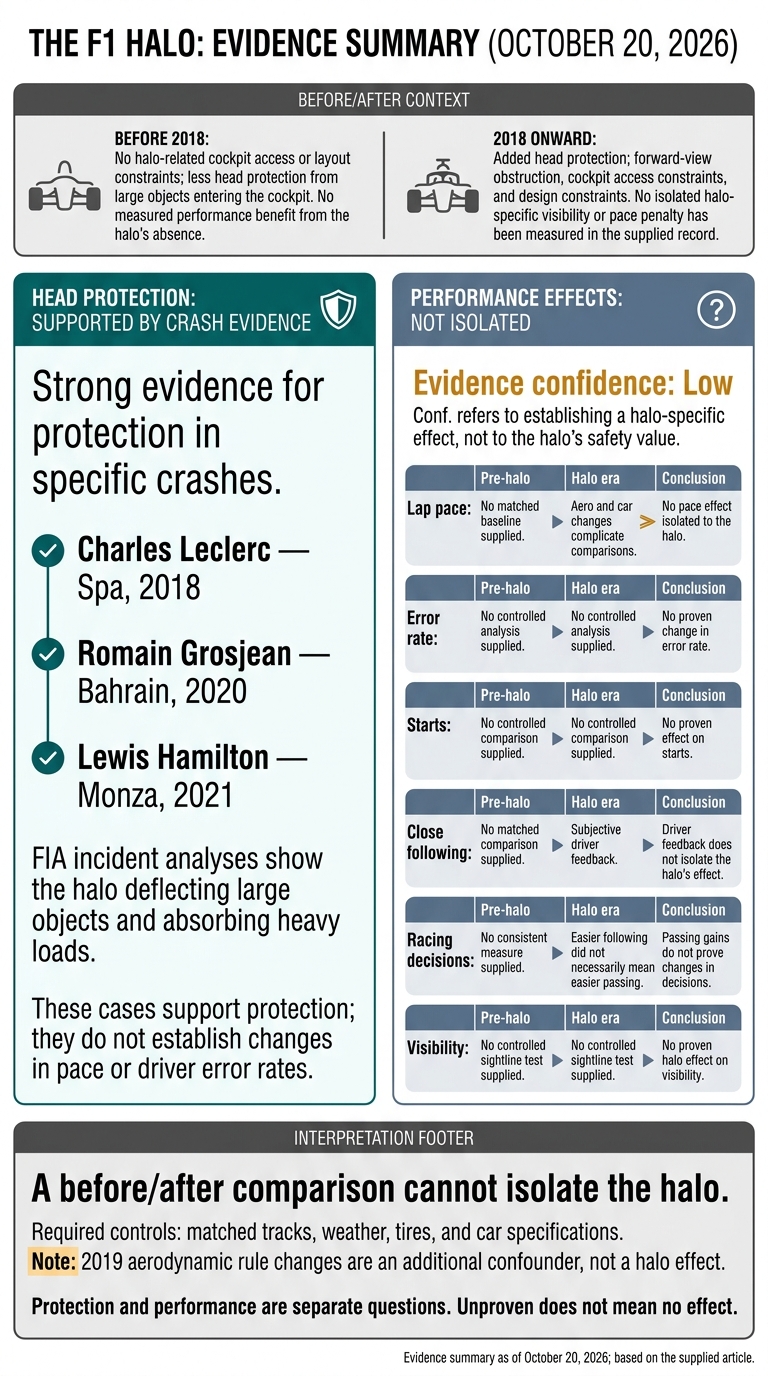
- Head protection: Crashes involving Charles Leclerc in 2018, Romain Grosjean in 2020, and Lewis Hamilton in 2021 support its protective role.
My takeaway as of October 20, 2026: <u>protection and performance are separate questions</u>. The crash record supports the halo’s safety role; its effect on pace and mistakes remains unproven.
F1 Halo: Safety Evidence vs. Unproven Performance Effects
1. Formula One Before the Halo: Before 2018
Lap Pace
Comparing lap pace before 2018 requires matched tracks, weather, tires, and car specs. Even without the halo, dirty air made close following difficult: it stripped front-wing downforce and caused understeer.
Driver Error Rate
Raw error counts need those same controls. Lost front-end grip in dirty air can look like a driver mistake, so pre-halo incidents need to be separated from errors made in clear air.
Starts and Racing Choices
An unobstructed central sightline did not make judging gaps easy. The wide front wing and long overhang made distances hard to gauge, while a loss of front downforce could push the car off the driver’s intended line.
Cockpit Sightlines
Before 2018, no protective structure blocked the central sightline. But drivers still lacked an unrestricted view of the car’s edges and had to judge how much space the wide front wing occupied. The open cockpit also left their heads exposed to debris, including carbon-fiber fragments from broken suspension arms.
sbb-itb-7c68254
2. Formula One With the Halo: 2018 Onward
Lap Pace
The halo alone cannot explain lap-time changes after 2018. The 2019 aero reset also changed how cars followed one another, so pace changes reflect more than one set of rules.
Driver Error Rate
The evidence does not show a halo-specific change in driver mistake rates. Its effect on errors remains unproven, including whether it affected race starts or decisions in close racing.
Starts and Racing Choices
The 2019 aerodynamic reset aimed to help cars follow more closely. It does not, however, establish that the halo changed drivers’ overtaking choices.
Driver feedback was mixed: Raikkonen said closer following improved in some corner phases, while Hamilton said it changed little.
Cockpit Sightlines
The available record contains no halo-specific cockpit test or driver comment showing changed sightlines to start lights or nearby cars. Claims linking visibility to driver errors remain unproven.
F1 Halo Onboard View - Drivers Eye at Spa - Is Visibility a Problem? - Automobilista
Trade-offs: Visibility, Cockpit Access, and Head Protection
The halo added head protection, but it also changed cockpit layout, access, and sightlines. The clearest evidence supports better protection - not a measurable pace penalty.
| Era | Advantages | Disadvantages | Evidence strength |
|---|---|---|---|
| Before 2018 | No halo-related cockpit access or layout constraints. | Less head protection from large objects entering the cockpit. | Clear structural difference; no measured performance benefit from the halo’s absence. |
| 2018 onward | Added head protection; FIA incident analyses show the halo deflecting large objects and absorbing heavy loads. | Forward-view obstruction, plus cockpit access and design constraints. | Strong evidence for protection in specific crashes; no isolated halo-specific visibility or pace penalty. |
Crash records show that protection in action.
The incident record includes Charles Leclerc at Spa in 2018, Romain Grosjean in Bahrain in 2020, and Lewis Hamilton at Monza in 2021. Those cases reinforce the halo’s protective value, but they do not prove a change in driver pace or error behavior.
Drivers generally credited the 2019 aero rules, rather than the halo, when describing easier close following. Those gains in proximity don't establish whether changed sightlines affected starts, braking zones, or close racing. What remains unclear is whether those changes produced a measurable difference in pace or error rates.
Conclusion: What Changed and What Remains Unclear
The evidence does not isolate the halo’s effect on pace, errors, starts, or visibility.
| Measure | Pre-halo evidence | Halo-era evidence | Conclusion | Evidence confidence |
|---|---|---|---|---|
| Lap pace | No matched baseline supplied | Aero and car changes complicate comparisons | No pace effect isolated to the halo. | Low |
| Error rate | No controlled analysis supplied | No controlled analysis supplied | No proven change in error rate. | Low |
| Starts | No controlled comparison supplied | No controlled comparison supplied | No proven effect on starts. | Low |
| Close following | No matched comparison supplied | Subjective driver feedback | Driver feedback does not isolate the halo’s effect. | Low |
| Racing decisions | No consistent measure supplied | Easier following did not necessarily mean easier passing | Passing gains do not prove changes in decisions. | Low |
| Visibility | No controlled sightline test supplied | No controlled sightline test supplied | No proven halo effect on visibility. | Low |
A sound comparison needs matched tests of seating position, start lights, corner sightlines, and time to adjust. Performance remains a separate question from the halo’s proven safety value.
FAQs
How could testing isolate the halo’s effect on lap times?
Testing must isolate the halo’s added weight, aerodynamic drag, and center-of-gravity shifts from tire degradation, fuel load, and driver performance. Engineers use computational fluid dynamics (CFD) and wind tunnel tests to measure how drag affects speed. They then compare on-track braking points, throttle application, and cornering speeds with historical baselines or “halo-off” simulations. These comparisons help separate the car’s physical limits from the driver’s inputs.
How do drivers adapt to the halo’s central pillar?
Drivers get used to the halo’s central pillar through habit and the brain’s ability to filter out objects that block their view. They report adjusting quickly, looking past or around it while racing. As they focus on the track ahead, the pillar becomes less noticeable - much like the bridge of their nose in everyday vision.
How could researchers measure halo-related errors in close racing?
Researchers could combine FIA-simulated crash data, telemetry, and driver feedback to study how the halo affects visibility. Telemetry could show whether drivers change their braking points, throttle use, or cornering lines when the halo blocks their sightline during wheel-to-wheel racing.
Comparing that data with post-race driver comments could help researchers assess how visibility changes affect split-second decisions and how often drivers make errors during crowded race starts and overtaking.