5 Steps to Optimize F1 Aerodynamics with CFD
CFD workflow to optimize F1 downforce and drag using surrogate models, iterative simulations, and wind-tunnel validation.
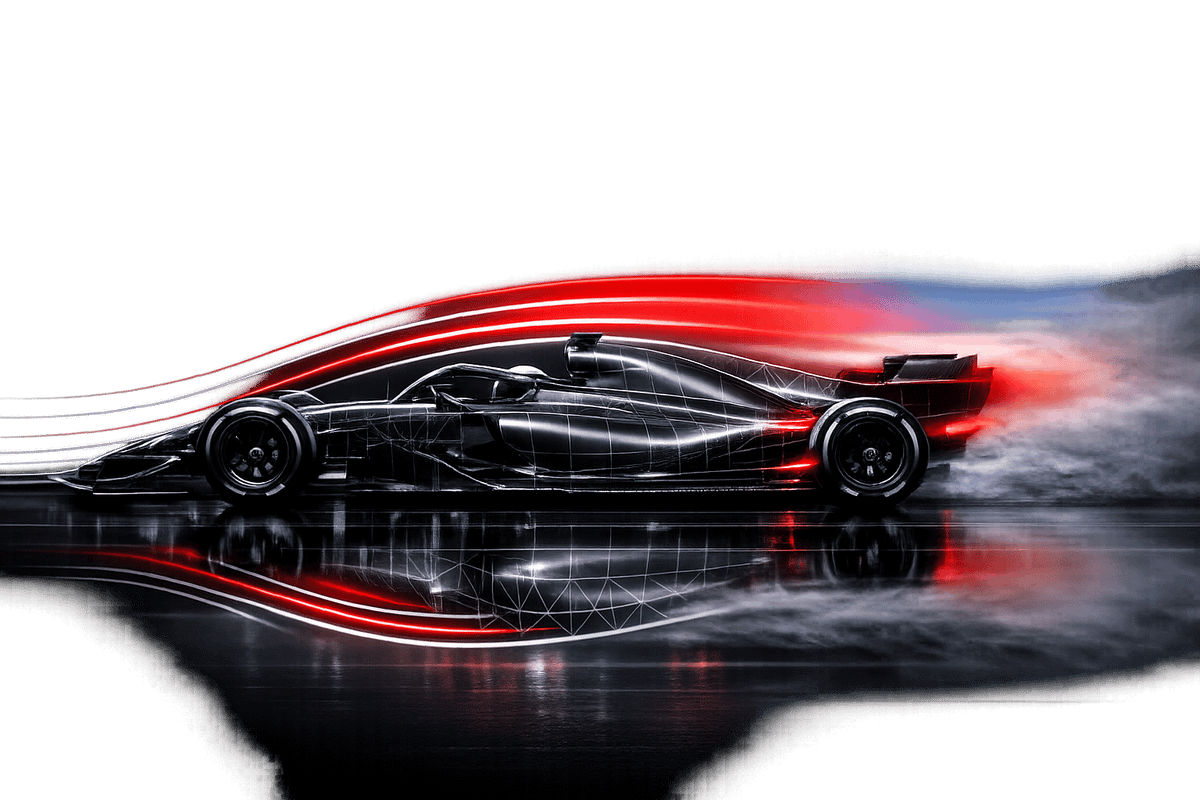
Formula 1 cars rely heavily on precise aerodynamics to maximize performance. CFD (Computational Fluid Dynamics) has revolutionized how teams design and refine these vehicles. Here’s how it works:
- Set Clear Goals: Define aerodynamic objectives and key parameters like drag (Cd) and downforce (Cl). These metrics help measure progress and prioritize design changes.
- Run Initial Simulations: Use high-fidelity CFD models to analyze airflow and establish a baseline for improvement.
- Leverage Surrogate Models: Train machine learning models on CFD data to predict performance quickly, saving time and resources.
- Refine Iteratively: Test and adjust designs through detailed CFD analysis to ensure optimal balance between downforce and drag.
- Validate Designs: Confirm performance with advanced simulations and wind tunnel testing to close the gap between virtual and on-track results.
Key Facts:
- Aerodynamics accounts for up to 20% of F1 team budgets.
- CFD models can simulate meshes with over 500 million cells.
- Surrogate models reduce evaluation time from hours to milliseconds, enabling faster iterations.
These steps help F1 teams push aerodynamic limits while adhering to strict FIA regulations on testing time and budgets.
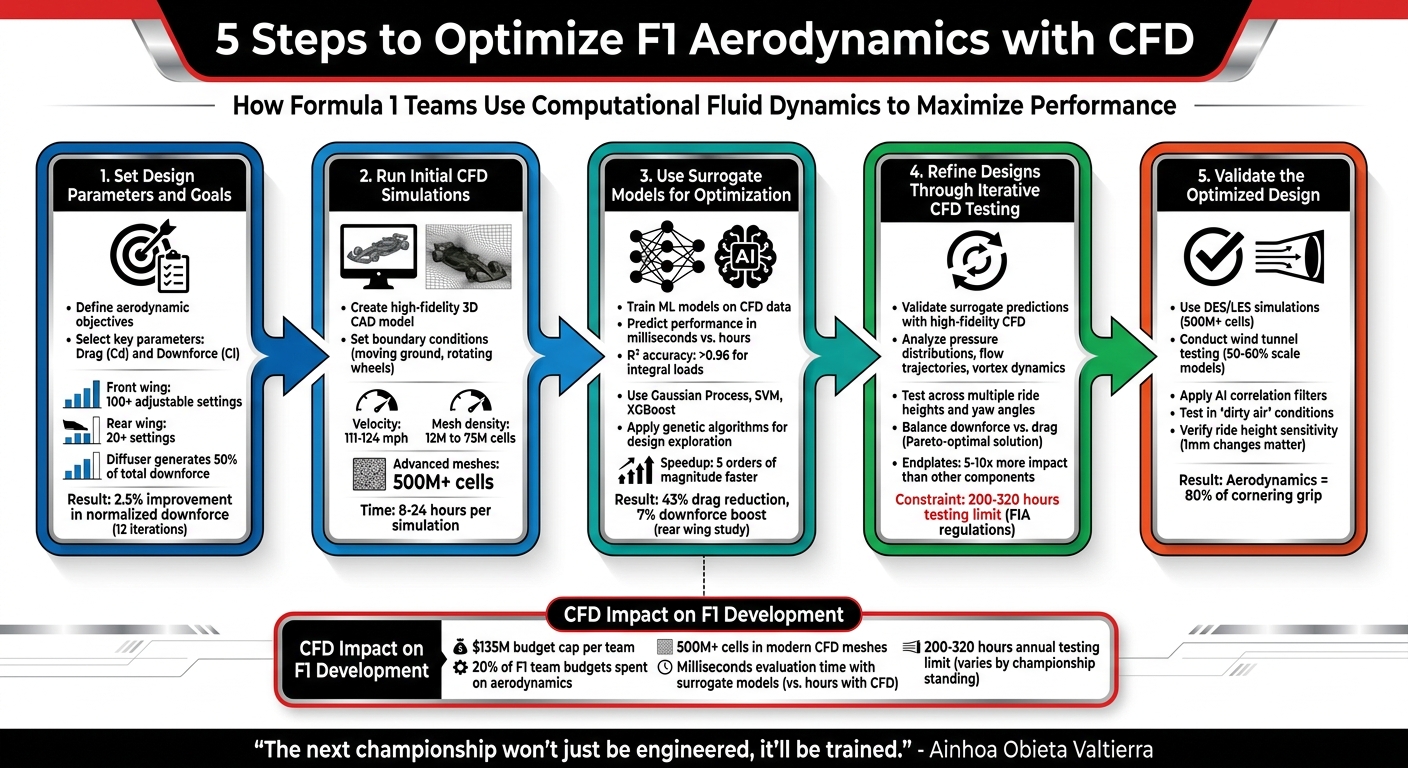
5-Step CFD Optimization Process for F1 Aerodynamics
Formula 1 Race Car Aerodynamics: Simulation in CONVERGE
sbb-itb-7c68254
Step 1: Set Design Parameters and Goals
Before diving into CFD simulations, it's crucial to define your optimization objectives and establish clear success metrics. This involves selecting key aerodynamic parameters and setting performance benchmarks for evaluating each design iteration. Without a clear roadmap, CFD efforts can lack focus and direction.
Once you've outlined your goals, the next step is creating a baseline for comparison. For instance, in a collaboration between an F1 team and AWS Professional Services, a "UNIFORM baseline" front wing design was used. This design was broken down into five key parameters: Leading Edge Height, Minimum Ground Clearance, Third Element Angle, Trailing Edge Angle, and Trailing Edge Height. By adhering to strict constraints and iterating 12 times, this approach achieved a 2.5% improvement in normalized downforce.
Choose Key Aerodynamic Variables
Pinpointing critical variables across the car's components ensures a well-rounded design process. Consider the front wing, which alone offers over 100 adjustable settings, such as flap angles, endplate configurations, dive planes, and splitters. The rear wing adds another 20+ settings, including wing angles, and under the 2026 regulations, it will incorporate active aerodynamic modes.
The underbody and diffuser are just as important. These elements, particularly the diffuser and underfloor Venturi tunnels, are responsible for generating ground-effect downforce. The diffuser alone accounts for roughly 50% of the total downforce. Key adjustable features include diffuser vanes and exit size. Additionally, bodywork elements like sidepod shaping, nose height, and radiator inlet positioning influence airflow to the engine and underfloor. Even operational parameters, such as ride height and rake (the car's angle), play a major role. For example, a 1-millimeter change in ride height can drastically impact vortex structures and downforce.
Set Performance Metrics
Define your performance goals using two critical coefficients: the Coefficient of Drag (Cd) and the Coefficient of Downforce (Cl or Cz). The ultimate objective is to maximize the lift-to-drag ratio (Cl/Cd) for better aerodynamic efficiency.
In March 2024, researcher Ken Cheng demonstrated the power of these metrics in his study. Using a backpropagation Artificial Neural Network trained on 90 CFD-simulated designs, Cheng optimized an F1 rear wing, achieving a 43% reduction in drag and a 7% boost in downforce compared to the baseline. These coefficients - drag and downforce - are the backbone of the optimization process. They enable engineers to measure progress and make informed decisions about which design changes to prioritize. These metrics will continue to guide the iterative CFD process discussed in later steps.
Step 2: Run Initial CFD Simulations
Once your design parameters and performance goals are set, it’s time to dive into baseline CFD simulations. These simulations are crucial - they reveal how your current design performs aerodynamically and set the stage for future optimizations.
To get started, you’ll need a high-fidelity 3D CAD model (STL) and a defined computational domain - essentially, the area where fluid calculations will take place . Key boundary conditions include a moving ground plane and rotating wheels, which are essential for replicating track conditions accurately. Most teams stick to a constant freestream velocity, such as 111 mph (50 m/s) or 124 mph (200 km/h), with air density typically set at 1.225 kg/m³ .
In CFD, the air around the car is divided into millions of cells using a mesh. Regular simulations might use around 12 million cells, while more advanced setups can go up to 75 million, capturing even the smallest vortices and the gaps between wing elements. For example, in September 2025, Naval Shah from Variable Programmers used SimScale CFD data with 12 input features - six related to pressure forces and six to viscous forces/moments. This approach achieved an R² value of 0.981 for lift coefficient predictions while cutting computational time compared to the usual 8–24 hour runs.
Patience is key here. Simulations need to stabilize before you can trust the results. For instance, front wing simulations might take 177 iterations to reach stability. Even small adjustments can have a big impact - shifting downforce gains from 64% to 44% with minor tweaks .
"The front wing design, development, and optimization are not just about adding downforce but, more importantly, about cleaning the airflow toward the rest of the Formula One car." - Ajay Harish, SimScale
The data from these initial runs is invaluable. You’ll get insights into pressure fields, shear-stress distributions, vortex trajectories, and flow separation lines. This baseline data serves as your benchmark, helping you measure improvements as you refine your design in the next steps.
Step 3: Use Surrogate Models for Optimization
After completing your baseline CFD simulations, the next step is to streamline the process of evaluating design changes. While CFD runs provide invaluable data, performing a full simulation for every design adjustment is both time-consuming and resource-intensive. A single full-vehicle simulation can demand tens of thousands of core-hours and take anywhere from 8 to 24 hours to finish. With modern Formula 1 meshes exceeding 500 million cells, testing hundreds of design iterations this way is simply impractical.
This is where surrogate models - also referred to as meta-models - become essential. These models, once trained on your initial CFD data, can predict the performance of new designs in milliseconds rather than hours. Essentially, they act as a computational shortcut, approximating CFD results without needing a full simulation each time.
"Once trained, a surrogate can evaluate a candidate in milliseconds instead of hours, with published R² accuracies beyond 0.96 for integral loads in benchmark contexts."
– Ainhoa Obieta Valtierra
For example, neural-network-based surrogates have shown speedups of five orders of magnitude when applied to transonic airfoil datasets. In a collaboration between Formula 1 and AWS Professional Services, engineers used a stacked surrogate model (integrating Gaussian Process, SVM, and XGBoost) for front wing optimization. This approach reduced the number of iterations needed to find an optimal design from 25 to just 12, effectively tripling CFD throughput and halving turnaround time. The result? A 2.5% relative increase in downforce.
Build and Train Surrogate Models
Creating a reliable surrogate model begins with careful data selection. This is where Design of Experiments (DoE) comes into play. DoE helps strategically sample configurations across your design space, focusing on key variables like front-wing endplate scrolls, diffuser vanes, ride height, rake, and yaw angles. This ensures your model learns from the most informative data points.
Once you've completed high-fidelity CFD simulations (RANS, DES, or LES) for these sampled configurations, you'll have the training dataset you need. Next, you’ll choose a machine learning architecture. Popular options include deep neural networks and Gaussian processes, which map the nonlinear relationships between geometry parameters and aerodynamic performance. Physics-Informed Neural Networks (PINNs) are gaining traction as they embed the Navier–Stokes equations directly into the model's loss function, ensuring predictions align with fundamental fluid dynamics principles like mass and momentum conservation. For instance, in September 2025, Naval Shah from Variable Programmers demonstrated a PINN model achieving R² values of 0.968 for drag predictions and 0.981 for lift coefficients.
Advanced surrogate models go beyond predicting simple metrics like lift (C_L) and drag (C_D). They can provide detailed outputs such as pressure fields, shear-stress maps, and vortex core trajectories, offering a deeper understanding of why a design performs well rather than just confirming that it does. Models with well-crafted architectures have consistently shown R² accuracies exceeding 0.96 for integral loads in benchmark tests. Once your surrogate is ready, you can shift your focus to efficiently exploring the design space using optimization techniques.
Optimize with Genetic Algorithms
With a trained surrogate model in place, you can rapidly explore the design space using genetic algorithms (GAs). Inspired by the principles of natural selection, GAs generate populations of design candidates, evaluate their performance using the surrogate, and evolve the best solutions over multiple generations. The surrogate's speed allows for the evaluation of a vast number of design variations in a fraction of the time. The key is to balance exploration (searching for new design possibilities) and exploitation (refining known high-performing areas).
Formula 1's regulatory environment adds another layer of complexity. Teams must operate within a $135 million budget cap and adhere to sliding-scale restrictions that limit CFD time to 200–320 hours, depending on their championship standing. These constraints make every simulation count. Surrogate models not only compress development timelines but also help uncover unconventional geometries that might be missed through traditional methods - all while staying within strict resource limits.
"The next championship won't just be engineered, it'll be trained."
– Ainhoa Obieta Valtierra
Step 4: Refine Designs Through Iterative CFD Testing
Once the surrogate-generated designs are ready, the next step is to validate and refine them through iterative CFD (Computational Fluid Dynamics) testing. This phase is where the initial predictions meet high-fidelity simulations, ensuring the designs perform as expected. Each of these simulations is a time-intensive process, often taking between 8 and 24 hours to complete.
The refinement process focuses on key aerodynamic metrics. Engineers dive deep into how air flows around the car, analyzing pressure distributions to confirm the generation of downforce. They also track flow trajectories and streamlines to pinpoint areas where turbulence and air separation increase drag. Another critical aspect is studying vortex dynamics, as these swirling air patterns are essential for sealing the underfloor and managing the wake created by spinning tires. This detailed analysis ensures the designs can handle a variety of real-world scenarios.
But it’s not just about raw speed. Reliability is equally crucial. F1 cars are highly sensitive to changes in ride height, which can affect aerodynamic performance dramatically. That’s why engineers test designs across multiple ride heights, yaw angles, and cornering situations. The goal is to ensure that aerodynamic improvements remain consistent under these varying conditions.
This phase also addresses one of the biggest challenges in F1 design: balancing downforce and drag. While maximizing downforce improves cornering speed, it often comes at the cost of increased drag, which slows the car on straights. Engineers focus on high-impact components like endplates, which can have five to ten times more influence on performance than other parts. At the same time, they ensure critical systems like radiators remain unobstructed to prevent engine overheating. The ultimate aim is to find a Pareto-optimal solution - a design that delivers the best possible downforce-to-drag ratio while maintaining reliability and proper cooling.
The top teams excel at correlating CFD results with data from wind tunnel tests and track sessions. This step ensures that the refined designs don’t just work in simulations but translate into real-world gains. With FIA regulations capping wind tunnel testing at 200 to 320 hours depending on championship standings, every CFD iteration must count. As Ainhoa Obieta Valtierra explains:
"Success rests on who can allocate and exploit limited computational and physical resources most intelligently. In this environment, AI becomes a strategic multiplier."
Step 5: Validate the Optimized Design
The final step in the process is validating the optimized aerodynamics through high-fidelity CFD simulations and wind tunnel tests. This stage connects the simulated performance to real-world conditions, aiming to address the "correlation gap" caused by factors like tire deformation, suspension dynamics, and ground-effect variations.
Advanced simulation techniques like DES (Detached Eddy Simulation) and LES (Large Eddy Simulation) are used to capture transient effects that simpler RANS models cannot. These methods are essential for resolving complex phenomena such as wake shedding and vortex interactions. To achieve this level of detail, simulations rely on meshes with more than 500 million cells, but they demand significant computational resources - each full-vehicle analysis takes tens of thousands of core-hours.
Validation goes beyond measuring basic metrics like downforce and drag. Engineers closely monitor vortex core trajectories and separation lines to ensure the design manages airflow as intended. This includes maintaining the "air-curtain" effect, which prevents turbulent wheel wake from disrupting the underfloor airflow. Another critical focus is ride height sensitivity, as even a millimeter's change can dramatically affect how air interacts with the wing, potentially leading to flow detachment and significant downforce loss.
Wind tunnel testing plays a key role in aligning simulation data with real-world performance. However, FIA regulations limit testing to 200–320 hours annually, depending on a team's championship position. Teams typically use 50% or 60% scale models in wind tunnels, with airspeeds reaching up to 164 feet per second. These tests capture physical interactions that CFD alone cannot fully replicate. To optimize this process, teams employ correlation filters, AI-driven models trained on combined datasets from CFD, wind tunnel, and track data. These filters refine future simulations by adjusting them to match empirical results.
Finally, designs are tested for performance under turbulent, "dirty air" conditions to ensure reliability during races. For example, a front wing's downforce can drop from one-third of the car's total downforce to just one-tenth when following another vehicle. Ensuring the design remains effective in these unpredictable scenarios is critical for turning theoretical improvements into on-track success. This validation phase ensures that every refinement brings F1 aerodynamics closer to achieving peak performance where it matters most - on race day.
Conclusion
CFD has transformed the way F1 teams approach aerodynamic optimization, enabling them to explore hundreds of design variations with incredible efficiency. Today, teams allocate up to 20% of their budgets to aerodynamic development, with CFD allowing them to test designs without the expense and time involved in physical prototypes.
In 2022, Formula 1's engineering team collaborated with AWS Professional Services to create a machine learning workflow that delivered a 2.5% boost in normalized downforce in just 12 iterations. By leveraging advanced surrogate models with R² accuracies exceeding 0.96, teams have gained a powerful tool for refining their setups for tracks like Monaco and Monza.
CFD also plays a critical role in visualizing and managing complex aerodynamic behaviors. From controlling vortices to sealing the underfloor and fine-tuning airflow in turbulent race-day scenarios, these simulations provide the precision needed for peak performance. This precision ensures that cars generate approximately 80% of the grip required for high-speed cornering. The ability to simulate and perfect these dynamics has streamlined development and opened doors to future advancements in aerodynamic strategies.
As Formula 1 moves toward active aerodynamics and adapts to increasingly complex regulations, the importance of CFD will only grow. By combining cutting-edge simulations with machine learning and physics-based models, teams are well-equipped to stay competitive and push the boundaries of aerodynamic design with every lap.
FAQs
How accurate is CFD compared with wind tunnel data?
CFD accuracy hinges on how well it aligns with wind tunnel results. Factors such as grid resolution and the choice of turbulence models can lead to variations in outcomes. However, when CFD is carefully validated, it provides dependable insights into aerodynamic performance. These differences are reduced by thorough comparison and calibration efforts.
When should teams use surrogate models instead of full CFD?
Teams should choose surrogate models instead of full CFD simulations when saving time and computational resources is a priority. These models, such as Physics-Informed Neural Networks (PINNs), offer a way to predict aerodynamic coefficients both quickly and with precision. By using surrogate models, simulation times can drop dramatically - from hours to just minutes. This makes them particularly useful for projects involving multiple design iterations, especially when working within tight budgets or adhering to restrictions like limited wind tunnel or CFD hours under FIA regulations.
What causes the CFD-to-track “correlation gap” in F1?
In Formula 1, the "correlation gap" between CFD (Computational Fluid Dynamics) simulations and on-track performance stems from the differences between virtual models and real-world conditions. CFD relies on simplified representations of turbulence, boundary conditions, and airflow, often missing finer details due to limitations in mesh resolution.
To complicate matters, strict regulations on wind tunnel use and CFD simulations limit how extensively teams can test and refine their models. This makes it harder to align digital predictions with actual on-track behavior.
Teams tackle this challenge by validating CFD results through physical testing and making iterative adjustments. By blending simulation data with real-world feedback, they gradually refine their aerodynamic setups for better performance on the track.