Training vs. Productivity: F1 Pit Crew Case Study
How F1 teams use athletic training, role rotation, data and AI to turn pit-stop preparation into consistent, millisecond gains.
In Formula 1, pit crews are the unsung heroes where every millisecond matters. Their performance, shaped by rigorous training, plays a critical role in race outcomes. This article dives into how top teams like Red Bull, Ferrari, and McLaren balance training intensity with race-day productivity. Key insights include:
- Training Methods: From high-volume repetitions to focused, rotational strategies.
- Performance Metrics: Consistency and reliability often outweigh raw speed.
- Modern Techniques: Physical conditioning, biomechanics, and AI-driven tools enhance efficiency.
- Real-World Lessons: F1 strategies, like specialized roles and data-driven feedback, improve team performance in industries like healthcare and manufacturing.
F1 pit crews prove preparation is key, blending human skill with advanced technology for peak results.
How F1 Teams Execute Perfect Pit Stops in Seconds! | What It Takes | Carlyle
sbb-itb-7c68254
How F1 Pit Crew Training Has Changed Over Time
The evolution of pit crew training mirrors Formula 1's journey from simple mechanical tasks to a highly specialized and athletic discipline. This shift highlights the connection between intense preparation and measurable success on race day.
Pit Crew Methods in Earlier F1 Eras
In the early days of Formula 1, pit crews were relatively static teams, with members sticking to the same roles for an entire season unless an injury or emergency required changes. Training revolved around mastering repetitive mechanical tasks, like tire changes, through sheer repetition until the process became second nature. There was no focus on physical fitness, managing fatigue, or understanding biomechanics. As a result, pit stops often took over 10 seconds - an eternity by today’s standards.
Current Training Methods
Modern pit crew training is a completely different ballgame. Teams now treat crew members like professional athletes, incorporating strength training, nutrition plans, and wellness programs into their routines. Training begins early in the year, with objectives defined at the end of the previous season, and is customized to meet the physical demands of specific roles.
Ferrari's 2026 training approach is a prime example of this evolution. In the first three races of the season, they rotated 27 crew members across different positions and maintained a pool of 10 specialized gunmen. Diego Loverno, Ferrari's Sporting Management director, explained:
"A large part of the early season was dedicated to working on slightly different techniques - both in terms of grip and the shoulder and leg movements involved in fitting and removing tires".
Teams today also optimize practice routines. Instead of endless repetitions, they focus on 5–6 high-intensity stops per session and may even cancel practice under extreme conditions - like when the temperature exceeds 140°F (60°C) - to conserve crew energy for race day. This shift prioritizes long-term performance over short-term gains.
How Teams Measure Training Results
Modern pit crew training is guided by detailed performance metrics. Teams evaluate more than just stop times; they track reaction speeds, error rates during practice, and consistency across multiple stops. Charlie Hooper, McLaren's Car Operations & Engineering Director, emphasized this approach:
"It's no good breaking a world record if the next pit stop is five seconds. We make it clear to the crew that meeting our consistency targets set out at the start of the year will ultimately lead to the best on-track performance for the team".
Another key focus is "bench strength", or the ability to rotate crew members without any dip in performance. Cross-training ensures that every crew member can handle multiple roles, which is critical for maintaining performance across a grueling 24-race calendar. Teams also rely on constant feedback from crew members to refine the design of tools like jacks and wheel guns, creating a feedback loop that improves both equipment and training.
This comprehensive approach to training has redefined what it means to be a pit crew member, setting the stage for even greater performance on race day. Next, we’ll explore how these training advancements translate into results on the track.
Case Study: How Training Intensity Impacts Performance
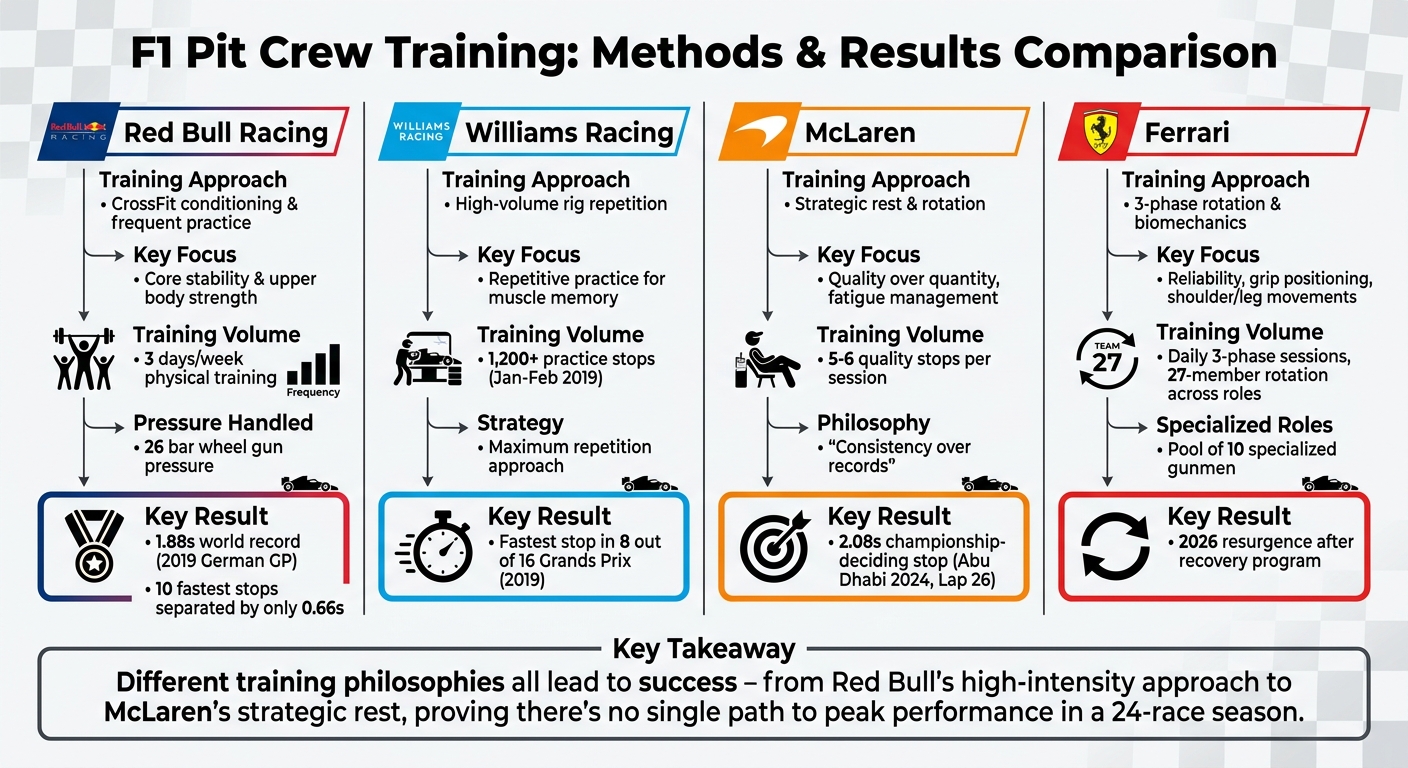
F1 Pit Crew Training Approaches: Comparing Top Teams' Methods and Results
The evolution of F1 pit crew training methods shows just how much preparation can influence race-day outcomes. By examining how top teams train, it becomes clear that more focused and intense regimens lead to faster, more reliable pit stops. These small improvements can mean the difference between winning and losing in a sport where every millisecond counts.
Red Bull Racing: Pushing the Limits for Sub-2-Second Stops

Red Bull Racing has set the bar high with their rigorous training program. Their crew combines CrossFit-style conditioning with frequent practice sessions, focusing on core stability and upper body strength. These skills are crucial for managing wheel guns that operate at an intense 26 bar of pressure. This dedication paid off spectacularly in July 2019, when Red Bull achieved a record-breaking 1.88-second pit stop with Max Verstappen at the German Grand Prix.
What makes this feat even more impressive? The 10 fastest stops that weekend were separated by just 0.66 seconds. This shows how small, incremental gains from consistent training can make a huge impact. As Dave Redding, Williams' Team Manager, put it:
"Going from three to two [seconds] is like going from Division 4 to Premier League!"
Ferrari: Focusing on Reliability Over Speed
After a tough 2025 season, Ferrari decided to shift gears in 2026, prioritizing reliability over sheer speed. The team had missed crucial training sessions early in the year, but they implemented an intensive recovery program that included daily three-phase training sessions and rotating the entire crew. This approach not only improved their techniques - such as grip positioning and shoulder movements - but also ensured that no single team member became a weak link.
Diego Loverno from Ferrari's sporting management highlighted the importance of this recovery:
"This break has been invaluable - it allowed us to recover almost all of the training sessions we weren't able to complete in January and February."
Ferrari also rotated all 27 crew members across various roles during the first three races of 2026, building a more adaptable team and reducing the risk of errors. This strategy helped them regain their footing and aim for championship success.
Data Analysis: Training Hours and Stop Times
The connection between training intensity and pit stop performance becomes even clearer when looking at the numbers. Williams Racing, for example, completed over 1,200 practice stops on their factory rig during January and February of 2019. This preparation helped them achieve the fastest pit stop in 8 out of the first 16 races that season.
McLaren, on the other hand, took a different approach. They limited their practice sessions to 5–6 stops to avoid crew fatigue while maintaining high-quality performance. This strategy paid off during the Abu Dhabi Grand Prix in December 2024, where Lando Norris's 2.08-second pit stop on Lap 26 became a pivotal moment in securing the Constructors' Championship.
| Team | Training Approach | Key Result | Training Volume |
|---|---|---|---|
| Red Bull | CrossFit conditioning & frequent practice | 1.88s world record (2019) | 3 days/week physical training |
| Williams | High-volume rig repetition | Fastest stop in 8/16 Grands Prix (2019) | 1,200+ practice stops (Jan-Feb) |
| McLaren | Strategic rest & rotation | 2.08s championship-deciding stop (2024) | 5–6 quality stops per session |
| Ferrari | 3-phase rotation & biomechanics | 2026 resurgence | Daily 3-phase sessions, 27-member rotation |
These examples highlight how different training strategies can lead to success. While teams like Red Bull and Williams rely on high-volume repetition, McLaren and Ferrari focus on quality and strategic rotation. Both approaches prove effective in navigating the challenges of a demanding 24-race season.
Lessons Learned and Applications Beyond F1
How Specialized Roles Improve Team Performance
F1 teams have mastered the art of specialization, assigning roles based on physical and mental traits rather than general ability or seniority. For example, tasks like tightening wheel nuts demand dexterity, while operating jacks requires strength or quick reflexes. This precise role allocation ensures that every team member performs their task with maximum efficiency, working seamlessly without disrupting others.
This approach has proven effective beyond the racetrack, particularly in healthcare. At Great Ormond Street Hospital for Children in London, cardiac surgeon Martin Elliot and consultant Allan Goldman collaborated with McLaren and Ferrari to improve their processes. By adopting F1 principles - such as clear leadership, choreographed team positioning, and standardized communication - for transferring heart surgery patients to the ICU, the hospital achieved a 67% reduction in technical errors and missed information. Human factors researcher Ken Catchpole highlighted the importance of eliminating variability, stating:
"There is lots of individual variation that creeps into these things... often that creates these uncertainties that increase the opportunities for errors to happen".
Small Improvements Add Up Over Time
F1 teams don’t aim to break records at every race. Instead, they focus on consistency targets, striving for small, steady improvements that eliminate errors and boost efficiency. This philosophy aligns with the Kaizen approach, where incremental changes lead to significant long-term benefits.
A critical part of this process involves reviewing video footage after every practice session to identify and correct inefficient or informal movements. Rather than exhausting the crew with endless practice, teams focus on 5–6 targeted sessions to refine performance without causing fatigue. Over the course of a 24-race season, these small adjustments mean that up to 80% of a car’s components may be different by the final race, showcasing the impact of constant, incremental progress.
Using F1 Training Methods in Other Industries
The training methods honed by F1 teams offer valuable lessons for other high-performance environments. Industries like manufacturing and healthcare can see measurable improvements by adopting similar strategies.
For instance, standardized handovers led by a clear leader can minimize confusion during shift changes. Conducting formal debriefs after major tasks, with input from all team members regardless of rank, creates opportunities for learning and improvement. These practices mirror the precision and accountability seen in F1.
Cross-training employees in multiple roles can also enhance team resilience. McLaren’s Charlie Hooper explained the importance of this approach:
"The majority of the crew are trained up in multiple positions so, while they may have a primary role, they can also jump into a different position and perform at a high level".
This rotation system ensures consistent performance during high-pressure periods, whether it’s a demanding race schedule or a busy hospital season.
Lastly, F1 teams demonstrate how to turn constraints into opportunities. Strategic advisor Kirsty Paine noted that F1 teams use regulation as a catalyst for innovation. This mindset can inspire industries facing compliance challenges to focus on what can be improved, rather than viewing limitations as obstacles.
Conclusion: Training Intensity Drives Peak Performance
F1 pit crews prove that intense, specialized training can deliver extraordinary results. Take Red Bull Racing's jaw-dropping 1.82-second pit stop during the 2019 Brazilian Grand Prix as an example. This achievement wasn’t just luck - it was the product of about 100,000 practice stops completed before the season even started. This kind of dedication turns what seems impossible into something routine.
But training isn’t just about repetition. F1 teams treat their pit crew members like elite athletes, focusing on physical conditioning, strength, and biomechanics. Performance hubs analyze every detail, from shoulder movements to leg positioning during tire changes. Charlie Hooper, McLaren's Car Operations & Engineering Director, highlighted the importance of this approach:
"Human performance is becoming ever more important to the team to ensure that fatigue is minimised and performance is met when it matters".
This comprehensive strategy combines physical preparation, mental rehearsals, and data-driven feedback to create the consistency that wins championships. And now, advanced AI tools are pushing this performance even further.
Building on human expertise, AI technologies refine every detail. For example, pose-estimation AI pinpoints inefficiencies in crew movements during tire changes, while generative AI models simulate millions of race scenarios to perfect pit stop timing. Over a race weekend, modern F1 cars generate around 1 terabyte of data from 300 to 600 sensors. AI processes this data fast enough to guide pit decisions within just a third of a lap. As Dan Keyworth, McLaren's Director of Business Technology, explained:
"What AI allows us to do from a generative perspective is to actually game out more of those actual scenarios and go, 'What will happen?'".
Digital twins enable crews to rehearse for specific track conditions before even arriving at the circuit. Predictive AI analyzes live telemetry to forecast potential component failures, helping crews prepare for repairs before the car even reaches the pit lane. This "human-in-the-loop" approach keeps strategic decisions in the hands of the team while AI handles the heavy data lifting. Together, these advancements enhance the already rigorous training programs, proving how systematic improvements drive peak performance.
Whether it’s a hospital handover, a manufacturing process, or any high-pressure team operation, the F1 model shows that deliberate training, treating team members like athletes, and integrating technology for feedback lead to measurable results. Konstantinos Trantopoulos and Paolo Aversa from IMD summed it up well:
"The future belongs not to the fastest systems, but to the smartest teams that can learn, adapt, and accelerate together".
F1’s blend of intense training and cutting-edge technology offers a powerful roadmap for achieving exceptional performance in any demanding field.
FAQs
Is more pit-stop practice always better?
While practice plays an important role, it's not the sole solution. It needs to be paired with effective training methods and role rotation to ensure success. Overtraining without a clear strategy can actually backfire, leading to reduced efficiency and diminishing returns over time.
Why do teams value consistency over the fastest stop?
Teams focus on consistency because reliable pit stops within tight time frames are essential for winning races. A steady performance helps avoid mistakes that could cost positions or even the race itself. By prioritizing precise execution over raw speed, teams can lower risks and stay competitive during intense, high-stakes situations.
How can non-racing teams use pit-crew training ideas?
Non-racing teams can take a page from pit-crew training by concentrating on structured practice, role rotation, and skill-building. By simulating real-world scenarios, teams can prepare for high-pressure situations, while rotating roles helps members become more adaptable and versatile. Repetition is key to refining skills and boosting overall efficiency. These strategies, inspired by F1 teams like McLaren and Ferrari, have proven effective in industries like emergency services, manufacturing, and logistics, where speed and coordination are crucial for success.