F1 Radio History: Key Innovations Explained
How F1 radio grew from pit boards to encrypted, digital two-way systems with AI monitoring and TETRA networks.
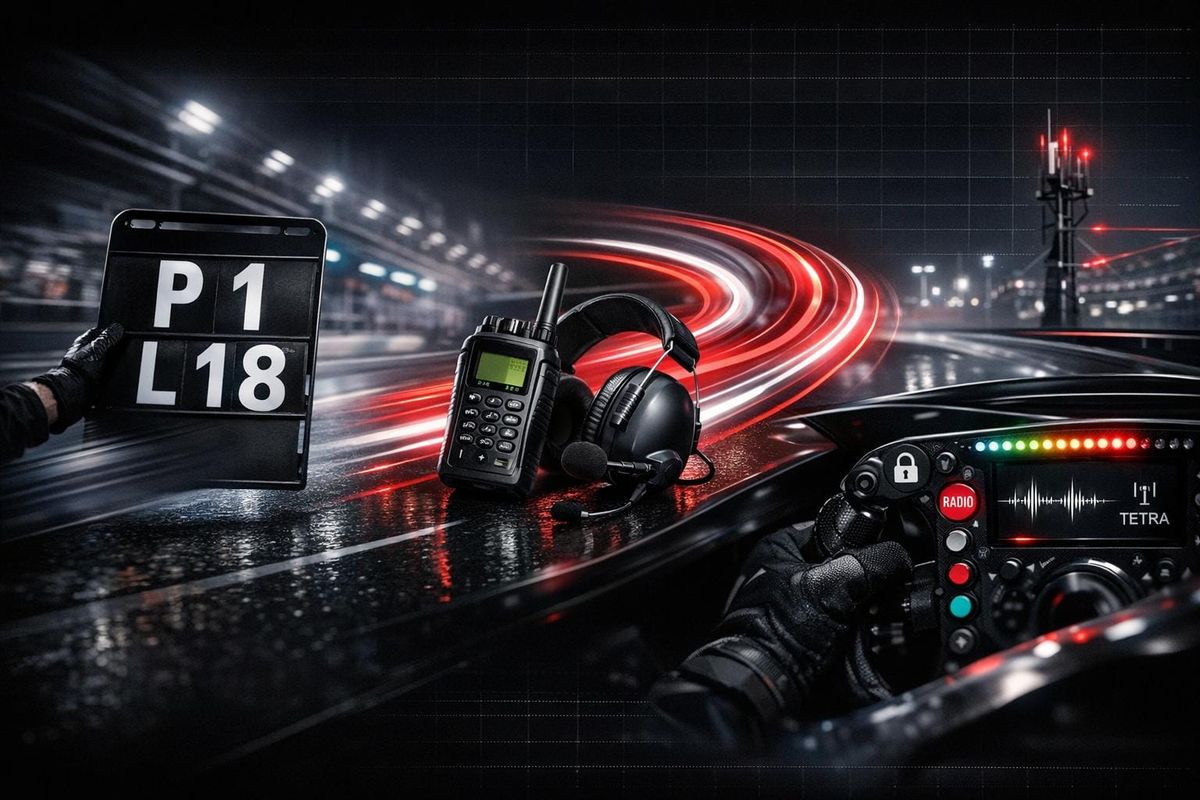
Formula 1 communication has come a long way, transforming from outdated pit boards to cutting-edge radio systems. Here's a quick overview of the journey:
- Pit Boards: Before radios, teams relied on visual boards to communicate. Drivers had one chance per lap to read them, often too late for critical updates.
- One-Way Radios (1980s): Teams began using radios to send real-time messages, but noise, interference, and equipment size posed challenges.
- Two-Way Radios: Drivers could now report back on conditions like tire wear and weather, enabling faster strategy adjustments.
- Encryption: As rivals began eavesdropping, encryption was introduced to secure communications.
- Digital Systems: Improved signal clarity and reliability, even in noisy or interference-heavy environments like urban and forested circuits.
- Fan Access: Radio broadcasts became part of the race experience, starting in 2000, with curated clips adding depth to live coverage.
- AI Monitoring: Modern systems use AI to enforce rules, analyze messages, and monitor track limits with precision.
- TETRA Networks: These ensure stable communication across hundreds of radios, even in challenging race environments.
Formula 1's radio evolution highlights the sport's constant push to improve communication under extreme conditions while balancing speed, security, and regulation.
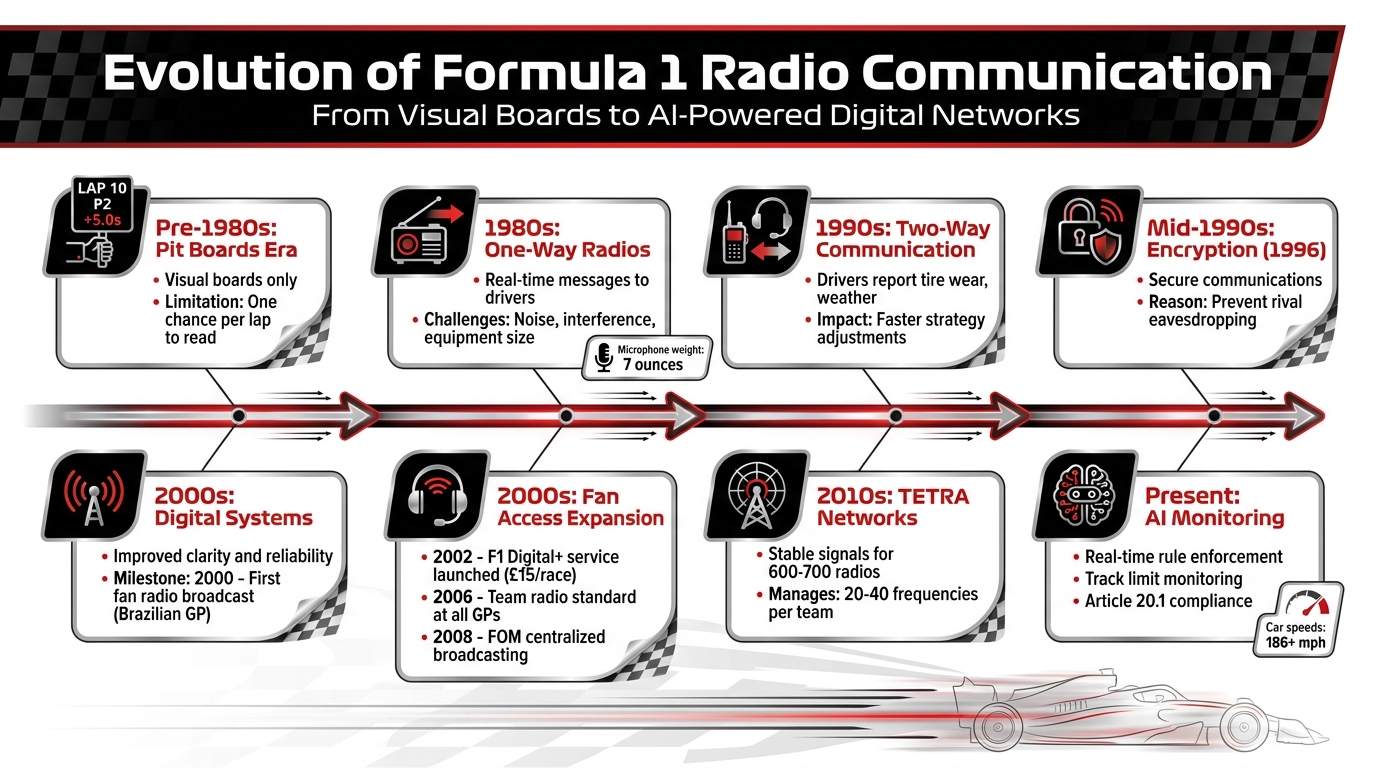
Evolution of F1 Radio Communication Systems from 1980s to Present
From Pit Boards to First Radio Systems
The Pit Board Era
Before Formula One embraced radio communication, teams depended entirely on pit boards to relay messages to drivers. These boards, held up by mechanics as the cars sped past the pit wall, provided critical details like gap times, remaining laps, or occasional strategic instructions. But there was a catch: drivers had just one chance per lap to read the board. This meant any updates - like sudden rain or a competitor's pit stop - often came too late to make an immediate impact.
"If a team wanted to get a message to a driver, he had to physically read it off the pit board, and he only had one chance every lap to do so, by which time it might be too late."
Another drawback? Drivers could claim they never saw the board, leaving teams powerless to enforce certain directives. These limitations made it clear that a better communication method was needed, paving the way for the introduction of radio systems.
First One-Way Radio Systems
By the 1980s, teams began replacing pit boards with one-way radio systems, allowing them to communicate directly with drivers in real time. This was a game-changer, especially during unpredictable conditions like wet races, where quick decisions on tire changes and strategy could make or break a race.
However, integrating radio technology into Formula One wasn’t without its challenges. Jose Santos, a radio communications expert for MF1 Racing, highlighted the extreme conditions inside the cockpit: deafening noise levels and technical complexities required solutions more advanced than even those used in space communication. To overcome this, teams developed specialized noise-canceling microphones with a dual-sided design - one side captured the driver’s voice, while the other blocked out ambient noise.
Another hurdle was the size and weight of the equipment. Everything had to be miniaturized to adhere to the sport's strict weight regulations. On top of that, environmental factors like natural obstructions at circuits such as Spa, Monza, and Hockenheim, or urban interference in places like Monaco and Brazil, pushed the limits of system reliability. Despite these obstacles, the introduction of radio communication marked a turning point, giving teams the ability to adjust strategies instantly and respond to the ever-changing dynamics of a race.
sbb-itb-7c68254
Two-Way Communication and Encryption
Two-Way Radios Change Race Strategy
The move from one-way to two-way radio systems revolutionized how Formula One teams approached race strategy. With two-way radios, drivers could provide real-time updates on critical factors like grip levels, tire wear, and weather changes. This constant flow of information allowed teams to make mid-lap adjustments on the fly. The impact was especially noticeable during wet races, where immediate feedback on track conditions made it possible to time pit stops perfectly. These radios didn’t just connect drivers to their race engineers - they linked them to a whole network of support teams, including IT, electronics, and strategy departments, ensuring a seamless operation at every level.
To manage this intricate communication system, teams operated across 20–40 different frequencies, covering drivers, mechanics, and telemetry. Over time, the need to secure these channels became clear, as the risk of competitors intercepting vital information grew.
Encryption Protects Team Data
As radio communication became an integral part of race strategy, safeguarding team discussions from prying ears became a top priority. Before encryption was introduced, rival teams could potentially gain an edge by listening in on strategic conversations about tire choices or pit stop timings.
To counter this, teams began adopting encryption technology. Gilles Flaire, a military-grade encryption expert who joined Ligier in 1996, later worked with teams like Sauber, McLaren, and Jordan to ensure their communications were secure. For instance, McLaren implemented NXDN 15-bit encryption on its MRTC Nexedge system, while other teams opted for unencrypted TETRA digital trunked systems to maintain a level of security.
The importance of confidentiality in Formula One is summed up by a Williams Martini Racing representative who emphasized:
"Everything in the garage stays in the garage".
Digital Radio Systems and Public Broadcasting
Digital Systems Improve Signal Quality
The introduction of digital radio technology in the 2000s addressed many of the reliability issues that plagued analog systems. These digital advancements allowed for filtering out acoustic, electrical, and mechanical interference, ensuring clearer communication. This was particularly critical in motorsport, where cars often reached speeds exceeding 186 mph, creating an incredibly noisy environment. As Jose Santos, Radio Communications Lead at MF1 Racing, put it:
"It is much easier to talk to a guy on the moon than to talk to a driver during a race weekend".
To combat this, teams adopted advanced noise-canceling technology. Double-face microphones were introduced, capable of isolating the driver's voice from engine noise using dual-capture technology. Despite their sophisticated design, this equipment remained lightweight, with microphones measuring just 0.2 inches by 0.08 inches and weighing around 7 ounces.
The shift to digital also allowed for centralized production through Formula One Management's "Bakersville" facility. This replaced inconsistent local broadcasting with a standardized, high-quality signal across all global venues. By the 2008 season, FOM was managing the broadcast of nearly every race, with only two exceptions. These advancements not only improved communication and broadcasting reliability but also integrated seamlessly into race-day strategies, blending technology with the sport's fast-paced demands.
This leap in digital technology didn’t just enhance team performance; it also opened new doors for fan engagement.
Team Radio Broadcasts for Fans
Digital systems didn’t just revolutionize cockpit communication - they transformed how fans experienced the sport. One of the most exciting changes was the introduction of live team radio broadcasts. Fans got their first taste of this during the 2000 Brazilian Grand Prix. The digital transition made it possible to incorporate these conversations into the "Super-Signal" feed, and by 2006, team radio broadcasts had become a staple of every Grand Prix weekend.
With the FIA receiving all team audio feeds, broadcasters could curate and share clips that showcased everything from tense strategic discussions to raw driver emotions like frustration or excitement. These moments gave fans a deeper understanding of the complexities of race strategy. The result? A viewing experience so synchronized and detailed that some described it as:
"a highly choreographed ballet".
In 2002, the UK saw the launch of the F1 Digital+ service, giving fans even greater access. For $15 per race - or $62 for a six-race package - viewers could enjoy live team communications alongside digital overlays like rev counters and track status indicators, which were introduced in 2004. This service offered a new level of immersion, bringing fans closer to the action than ever before.
AI Monitoring and TETRA Networks
AI Analysis of Radio Messages
In Formula 1, AI plays a critical role in monitoring team communications and ensuring compliance with regulations. The FIA's Remote Operations Centre (ROC) employs AI-powered tools to keep an eye on all team radio audio in real time. This allows them to detect any prohibited exchanges or potential rule violations, especially during race incidents.
For example, during formation laps, AI systems focus on enforcing Article 20.1, which restricts communication to safety concerns or car damage. As a representative from Williams Martini Racing aptly put it:
"Everything in the garage stays in the garage".
AI also steps in to monitor track limits using computer vision. By analyzing pixels and car outlines against set reference points, the system automatically flags violations. Tools like "Every Car All Turns" (ECAT) take this a step further by creating a real-time digital twin of the race. By integrating positioning data with timing information, ECAT provides officials with a detailed view of both driver behavior and team communications.
While AI ensures that every message and action is scrutinized for compliance, the reliability of this system depends on the stable communication provided by TETRA networks.
TETRA Networks for Stable Signals
Behind the scenes, TETRA (Terrestrial Trunked Radio) networks serve as the backbone of modern F1 radio communications, ensuring clear and stable signals even under heavy traffic. On race day, these networks handle an enormous load - with 600 to 700 radios in use by teams, security, broadcasters, and VIP services. Each team alone manages 20 to 40 frequencies dedicated to drivers, mechanics, and telemetry.
One challenge these networks face is the "intermodulation effect", where nearby transmissions can interfere with signals. TETRA systems are specifically designed to resist such interference, maintaining reliable connections even when external devices are in close proximity to the garage.
This stability is particularly crucial at circuits like Spa-Francorchamps, Monza, and Hockenheim, where dense forests can absorb radio waves. Urban tracks such as Monaco and Melbourne present their own challenges, with competing signals from taxis and broadcasters. Modern TETRA systems overcome these hurdles with advanced noise-cancellation technology, ensuring that communication remains clear despite the chaotic and noisy environment of a race.
Communication Rules and Enforcement
Article 20.1 Communication Restrictions
Under Article 20.1 of F1's radio regulations, "the driver must drive the car alone and unaided". This rule ensures that race outcomes are determined primarily by driver skill, rather than by engineers remotely influencing car performance.
While teams are generally allowed to communicate with drivers during races, there’s an exception during the formation lap. At that time, only messages related to safety or damage are permitted. This restriction requires drivers to handle start procedures on their own.
The regulations also prohibit driver coaching, which includes real-time instructions on braking, gear shifts, or optimal racing lines. Although the FIA initially intended to enforce a strict ban starting in 2014, teams demonstrated that some guidance was necessary to manage the complexities of hybrid power units. This led to a softening of the restrictions. FIA F1 Race Director Charlie Whiting commented:
"It was a fairly severe interpretation of the rules, so I think it was perfectly reasonable to limit it to driver coaching".
These communication rules are tightly enforced, with significant penalties for violations.
Rule Violations and Penalties
Breaching radio communication rules can lead to severe penalties, directly impacting race results and championship standings. A notable example occurred at the 2016 British Grand Prix when Mercedes provided Nico Rosberg with excessive technical guidance during a gearbox issue. This violation resulted in a 10-second penalty and a loss of three championship points.
Since 2025, the FIA has introduced harsher financial penalties for radio misconduct, especially when comments are directed at race officials. Fines exceeding $100,000 can now be imposed. For instance, in March 2025, driver Adrien Fourmaux was fined $10,000, with an additional $20,000 suspended fine, for swearing during a televised interview.
La STORIA dei TEAM RADIO in F1 🎧📻 | con @miguf1
Conclusion
Formula One radio communication has come a long way, evolving from basic pit boards to a cutting-edge digital system that connects entire teams in real time. What used to rely on once-per-lap visual signals has transformed into instantaneous two-way conversations, revolutionizing race strategy - especially during unpredictable moments like wet races or safety car periods. This shift hasn’t just changed how teams communicate; it’s reshaped the entire approach to racing under dynamic conditions.
Over the years, teams have tackled major technical hurdles, from shrinking equipment to managing intricate multi-frequency systems across global circuits. The move from analog systems, which were prone to interference, to encrypted digital protocols like TETRA and NXDN has brought the reliability and security that modern F1 demands. As radio specialist Jose Santos aptly put it:
"It is much easier to talk to a guy on the moon than to talk to a driver during a race weekend".
Yet, even with advancements in encryption and interference control, new challenges like spectrum congestion have emerged. With each team juggling 20 to 40 frequencies in an already crowded spectrum, intermodulation effects remain a tricky problem. The future could see solutions like AI-powered noise filtering and more advanced digital protocols to keep pace with the growing complexity of global racing.
Striking a balance between technological progress and regulatory fairness will remain a key factor in shaping the future of F1 radio systems. While teams push for increasingly sophisticated communication tools, the FIA enforces strict rules to ensure that races are won by driver skill - not just engineering ingenuity. This ongoing tension between innovation and regulation has defined the history of F1 communication and will influence how new technologies like 5G and AI are integrated into the sport, ensuring that progress enhances competition without compromising its integrity.
FAQs
When did F1 switch from pit boards to radios?
In the late 20th century, Formula 1 made a significant shift from relying on pit boards to using radio communication. Radios quickly proved to be a game-changer, allowing teams to communicate faster and more efficiently during races. This became especially crucial in tricky situations, like navigating wet track conditions, where split-second decisions could make all the difference.
Why do F1 teams encrypt their radio messages?
In Formula 1, teams use encryption to secure their radio messages, protecting sensitive details like race strategies and car performance data. This prevents rival teams from intercepting and using this information to their advantage. By encrypting communications, teams can keep tactical decisions - such as pit stop schedules and tire selections - confidential, ensuring they stay ahead in the fiercely competitive world of F1.
How does the FIA use AI to police team radio?
The FIA leverages AI technology to oversee and enforce team radio communication rules in Formula One. Using its Racewatch platform, AI processes radio messages in real-time, identifying potential rule violations as they happen. Additionally, the FIA's Remote Operations Centre (ROC) employs AI tools to review and flag any unauthorized instructions or breaches, ensuring teams adhere to regulations and maintain fairness in the high-speed, high-stakes environment of F1.