Public Funding vs Private Investment in F1 Tracks
How public, private and hybrid funding shape F1 circuits — costs, risks, and economic impact of hosting Grand Prix.
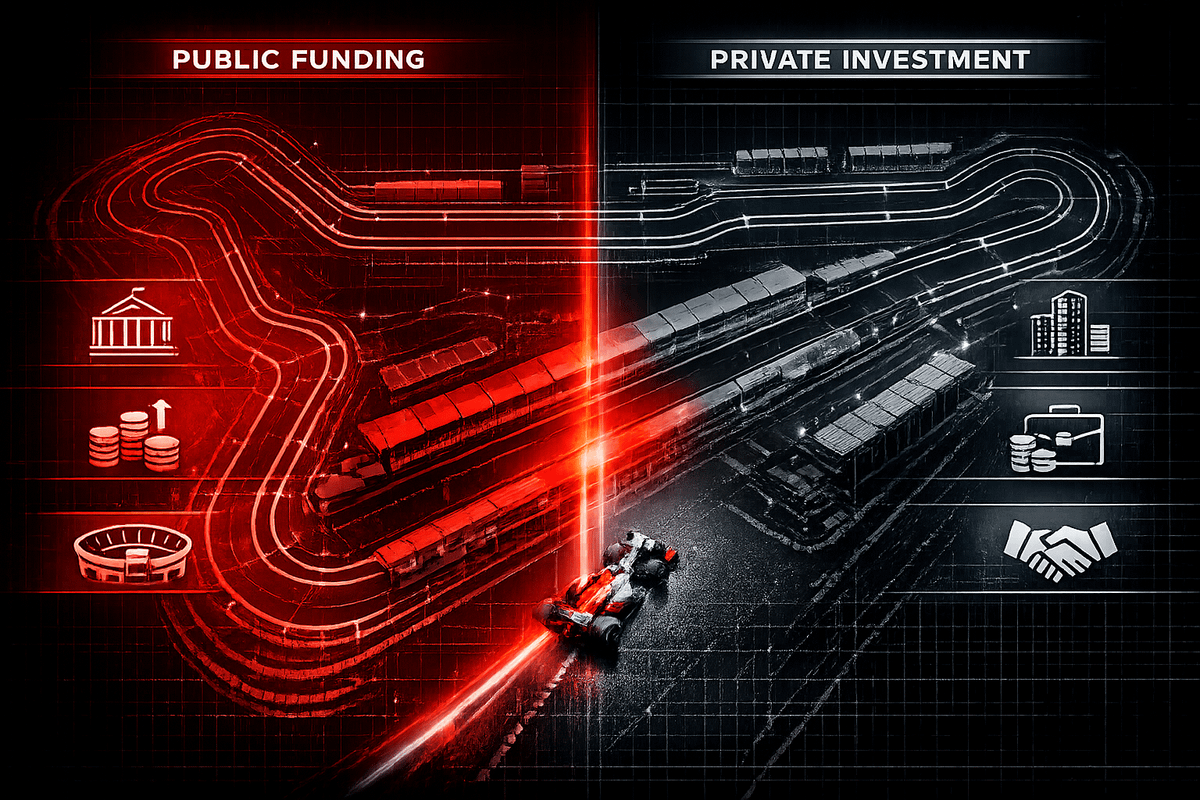
F1 tracks operate on two main funding models: public funding (government-backed) and private investment (corporate or individual-backed). Each approach influences ticket prices, hosting fees, and global race locations. Here's a quick breakdown:
- Public Funding: Governments use taxpayer money to host races, focusing on tourism and global branding. Examples include Abu Dhabi's Yas Marina Circuit and Singapore's night race. While public funding supports infrastructure and economic benefits, it can inflate hosting fees and create financial risks.
- Private Investment: Tracks like Silverstone rely on ticket sales, sponsorships, and private funds. This ensures financial independence but often leads to higher ticket prices and limited access for fans. Private investors prioritize profitability, which can exclude historic venues in favor of lucrative markets.
- Hybrid Models: Combining public and private resources, events like the Las Vegas Grand Prix balance infrastructure investment with tourism incentives, generating significant economic returns.
Quick Comparison
| Aspect | Public Funding | Private Investment | Hybrid Models |
|---|---|---|---|
| Goal | Tourism, global visibility | Profit-driven | Mix of both |
| Funding Source | Taxpayer money | Ticket sales, sponsorships | Shared public-private costs |
| Risk | High (political/budget changes) | Lower (market-driven) | Shared |
| Example | Yas Marina, Singapore | Silverstone | Las Vegas Grand Prix |
Public funding supports broader economic goals but risks uneven competition, while private investment ensures financial discipline but limits accessibility. Hybrid models aim to balance these strengths.
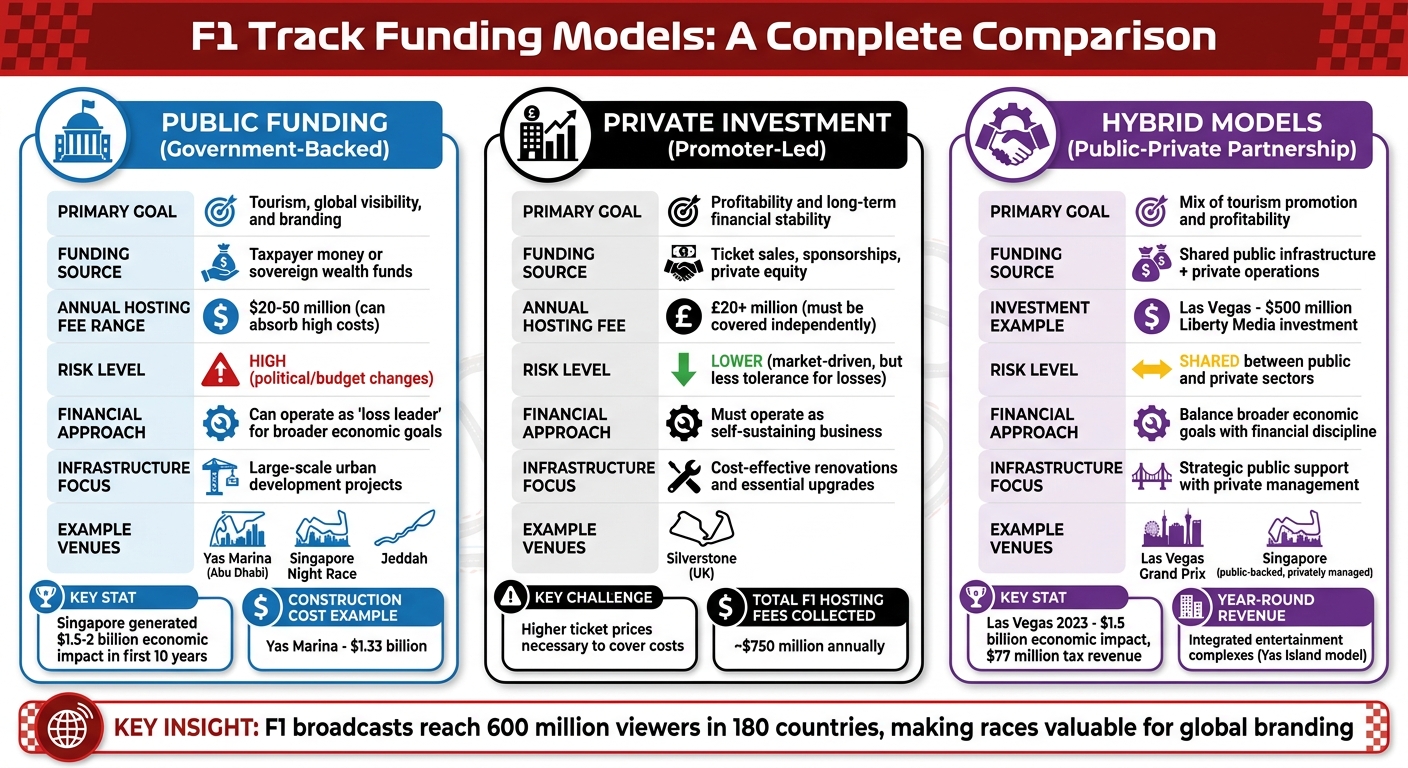
Public vs Private vs Hybrid F1 Track Funding Models Comparison
Public Funding for F1 Tracks
Economic and Social Benefits of Public Funding
Governments often see Formula 1 races as more than just sporting events - they're investments in global visibility and local development. With F1 broadcasts reaching 600 million viewers in 180 countries, hosting a race can spotlight cities on the world stage. Take Singapore, for instance: its government-supported night race generated an estimated $1.5 billion to $2 billion in economic impact during its first ten years.
Public funding doesn't just support a single event; it can leave behind lasting infrastructure. Abu Dhabi’s Yas Marina Circuit, for example, became the centerpiece of Yas Island’s transformation into a year-round entertainment hub. Similarly, Austin, Texas, used its Circuit of the Americas to cement its reputation as a global destination for both technology and culture.
"While few races turn a profit for local promoters, the broader economic ripple effects, such as hotel bookings, retail surges, and infrastructure legacies, often justify public investment".
Motorsport analyst Iskander Shyngyssov highlights how the ripple effects often outweigh the direct financial returns for race promoters.
Challenges and Risks of Public Funding
Despite the advantages, public funding comes with its share of hurdles. One major issue is the potential for market distortions. Governments competing to host races often drive sanctioning fees to staggering levels - ranging from $20 million to $50 million. While some cities can absorb these costs, others find them unsustainable.
"F1's global supremacy is underpinned by a vast subsidy system that tilts the playing field in its favor".
Alan Dove underscores how these subsidies create an uneven landscape.
Additionally, government-led impact studies can sometimes exaggerate the benefits, such as job creation or local spending. The Indian Grand Prix is a cautionary example: despite initial excitement, it folded after a few years due to bureaucratic challenges and insufficient regulatory backing. On top of that, building new Grade 1 circuits can cost upwards of $270 million, posing enormous financial risks, especially when political changes derail long-term plans.
These risks have led to the exploration of hybrid funding models, with the Las Vegas Grand Prix providing a notable example.
Case Study: Public Funding for Las Vegas Grand Prix
The Las Vegas Grand Prix offers a glimpse into how public and private sectors can share the load. For its November 2023 debut, Liberty Media, acting as both promoter and commercial rights holder, made significant investments. Public infrastructure upgrades also played a role, helping the event generate $1.2 billion in tourist spending. Additionally, Formula 1 reduced sanctioning fees for Las Vegas and Miami, prioritizing long-term growth in the U.S. market over immediate revenue.
This approach underscores how a mix of public support, private investment, and strategic compromises can ensure the success of high-profile events like F1 races.
sbb-itb-7c68254
Private Investment in F1 Tracks
Benefits of Private Investment
Private funding shifts the financial responsibility away from taxpayers, requiring circuits to function as financially independent businesses. Take Silverstone, for example. Operated by the British Racing Drivers' Club, it receives no government funding and must cover its annual hosting fee - over £20 million (about $25 million) - through ticket sales, sponsorships, and other private revenue sources. This approach enforces a level of financial discipline often absent when government subsidies artificially inflate prices.
Without subsidies, hosting fees align more closely with actual market value. Formula One Management currently collects about £600 million (around $750 million) annually from circuit hosting fees, with individual circuits paying between $20 million and $50 million each year. Private investors, who demand clear returns, are less likely to overpay, helping to stabilize costs at more realistic levels.
Private funding also allows for flexible commercial strategies. Liberty Media's deals in Las Vegas and Miami are prime examples. Both locations secured spots on the F1 calendar by negotiating reduced sanctioning fees in exchange for long-term growth opportunities. While this model offers clear advantages, it also comes with its own set of challenges.
Drawbacks of Private Investment
Despite its benefits, private investment introduces significant challenges. A focus on profitability often leads to higher ticket prices, restricting access for many fans. As Alan Dove explains:
"Silverstone's exorbitant ticket prices aren't the product of greed but of necessity".
Without government support, circuits are forced to charge premium prices to cover costs, which can alienate casual fans and families.
Private investors also prioritize profitability when selecting locations, often favoring destinations with strong commercial potential over those with rich racing traditions or accessibility for fans. Venues backed by:
"almost unlimited funds" from national governments can spark an "inflationary spiral",
making it harder for privately funded circuits to compete for race slots. This trend has shifted F1 toward wealthy Gulf states and major entertainment hubs, leaving historic European circuits struggling to justify escalating costs.
Case Study: Liberty Media's Investment in Las Vegas Grand Prix

In 2022 and 2023, Liberty Media made a bold $500 million investment to establish the Las Vegas Grand Prix, signaling a major shift in F1's business strategy. This included $240 million for a 39-acre site and $260 million for building the permanent "Grand Prix Plaza" pit facility. Unlike the traditional model, where F1 profits primarily from sanctioning fees, Liberty Media took ownership of the land and directly promoted the event.
The gamble paid off. The race's debut in 2023 generated an economic impact of $1.5 billion, surpassing the $1 billion impact of Super Bowl LVIII in the same city. Even in its second year, the event brought in $934 million, showcasing how this integrated approach can create lasting infrastructure and generate revenue throughout the year, not just during race weekend.
Public Funding vs Private Investment Comparison
Benefits and Drawbacks Comparison Table
Public funding relies on taxpayer dollars to support broader goals like marketing and urban development, while private investment focuses on self-sustainability. Government-funded circuits treat Formula 1 (F1) as a tool for promoting tourism and global branding, whereas privately funded tracks must operate as independent, profit-driven businesses. These differences lead to distinct strategies for financing and management.
| Metric | Public Funding (Government-Backed) | Private Investment (Promoter-Led) |
|---|---|---|
| Primary Goal | Global branding, tourism, and public relations | Profitability and long-term financial stability |
| Funding Source | Taxpayer money or sovereign wealth funds | Ticket sales, sponsorships, private equity |
| Risk Tolerance | High; can function as a "loss leader" to achieve broader goals | Low; unsustainable costs often lead to contract cancellations |
| Infrastructure | Frequently tied to large-scale urban development projects | Focused on essential upgrades and cost-effective renovations |
| Example Venues | Yas Marina, Jeddah, Madrid | Silverstone |
For example, the Yas Marina Circuit in Abu Dhabi, part of a $40 billion island development, cost $1.33 billion to build. In stark contrast, Silverstone operates on land valued at a fraction of Yas Marina's construction cost. This disparity highlights the challenges private circuits face in competing with government-backed venues. Alan Dove aptly describes this situation as:
"a 'welfare state' for motorsport, where government subsidies make it nearly impossible for private entities to compete with the spending power of nations".
This ongoing tension between financial accountability and the pursuit of global recognition continues to shape the landscape of F1 track financing. It has also led to the emergence of hybrid funding models that blend the strengths of both public and private approaches.
Hybrid Funding Models
To address the limitations of purely public or private funding, some circuits have embraced hybrid models that combine public resources with private investment. Singapore’s night race is a standout example. While it benefits from public backing, it is privately managed, striking a balance between financial sustainability and the broader goals of tourism and branding.
Yas Marina offers another example of a hybrid approach. The circuit is part of a year-round entertainment complex that includes attractions like the Yas Hotel, Ferrari World, and Warner Bros World. This massive project involved 14,000 workers and 35 million work hours. Even if the track itself doesn’t generate direct profit, it drives substantial revenue across the entire development.
Liberty Media’s strategy in Las Vegas takes hybrid funding to new heights. The company invested heavily in infrastructure while the city provided regulatory support. This partnership allowed F1 to tap into multiple revenue streams beyond traditional sanctioning fees. Las Vegas showcases how a well-executed hybrid model can maximize both financial returns and broader economic benefits.
Future of F1 Track Funding
Shift Toward Private Investment with Public Incentives
F1 is moving away from its traditional reliance on sanctioning fees, opting instead to take ownership stakes in its venues. A prime example of this shift is Liberty Media's approach in Las Vegas. In 2022, the company purchased 39 acres of land for $240 million and invested close to $1 billion in permanent infrastructure, including a 300,000-square-foot pit building. By assuming the role of race promoter, F1 gains control over multiple revenue streams instead of simply collecting hosting fees.
This model thrives when paired with public support, particularly in tourism promotion and regulatory frameworks. Jeremy Aguero, Principal at Applied Analysis, highlighted the success of Las Vegas:
"The key ingredient for success was public/private partnership... The ability to pull off a global spectacle in 16 months that transformed one of the most iconic locations in the world was just an amazing feat".
In this case, Liberty Media handled the infrastructure costs while the city provided regulatory backing, leading to a $1.5 billion economic impact and $77 million in tax revenue for Southern Nevada.
F1's long-term stability is further reinforced by extended contracts, such as those in Miami and Austria, which run until 2041. Additionally, attendance figures are climbing, with season attendance projected to grow from 4.2 million in 2019 to 6.7 million by 2025. This stability is attracting private investors who see F1 as a dependable, long-term opportunity.
Funding Models Around the World
Different regions are employing distinct funding strategies based on their market conditions. In the U.S., private investors like Stephen Ross (Miami) and F1 itself (Las Vegas) are leading development projects without relying heavily on government subsidies. For instance, Ross privately funded the Hard Rock Stadium circuit, which generated a $449 million local economic boost by May 2023 - a 41% increase over its debut year.
In contrast, developing markets in the Middle East and Asia continue to use public funds to promote their nations on the global stage. Saudi Arabia, for example, pays $55 million annually to host its Grand Prix, while the new Qiddiya Speed Park will feature "The Blade", a dramatic first corner elevated 20 stories above a concert hall. These venues often function as "loss leaders", prioritizing tourism and global branding over direct profitability.
Europe's historic circuits face some of the greatest challenges. Silverstone, for example, operates without state support, relying solely on ticket sales and sponsorships to cover its £20 million+ annual hosting fee. However, newer European projects, such as Madrid's planned 2026 circuit, are finding middle-ground solutions. Madrid's promoter paid nearly €500 million for hosting rights, but the semi-street circuit design leverages existing city infrastructure to cut down on construction costs. These varied approaches highlight the evolving strategies that F1 is employing to ensure sustainable growth across different markets.
Conclusion: Best Funding Strategies for F1's Growth
The most effective funding models combine private investment in core infrastructure with carefully targeted public incentives for tourism and regulatory support. To remain financially viable, tracks must expand their utility beyond race weekends. Austin's Circuit of the Americas exemplifies this by adding "COTALand", a full-scale amusement park that generates year-round revenue.
Liberty Media's willingness to reduce sanctioning fees in strategic markets underscores F1's focus on long-term market penetration rather than short-term profits. Upcoming 2026 regulations emphasizing sustainable fuels are also attracting major manufacturers like Audi, Cadillac, and Ford, which could further strengthen the sport's financial stability. By moving away from state subsidies for unprofitable venues, F1 is paving the way for hosting fees that private investors can manage independently.
High Speed, Higher Returns: Inside The F1 Investment Ecosystem | The Performance Layer
FAQs
Why are government-backed F1 races becoming more expensive to host?
Governments are finding it increasingly expensive to host F1 races, largely due to the steep costs of building and maintaining necessary infrastructure like race circuits and luxury facilities. On top of that, annual hosting fees often surpass $20 million. While these investments are often justified as ways to attract tourism, gain media attention, and enhance international reputation, the growing expenses tied to infrastructure and sanctioning fees are making it a pricier endeavor for host cities and nations.
How do funding models affect ticket prices and fan access?
Funding models have a huge impact on ticket prices and how accessible Formula One events are for fans. Tracks that rely on public funding often transfer hefty hosting fees - sometimes exceeding $20 million a year - directly to fans through higher ticket prices. On the other hand, privately funded circuits or those receiving government subsidies might be able to keep ticket costs lower. That said, the massive expenses involved in building and maintaining F1 tracks mean ticket prices usually need to cover these investments, no matter how the circuit is funded.
What makes a hybrid-funded Grand Prix work long-term?
A hybrid-funded Grand Prix thrives over time by striking a balance between public and private investments while delivering lasting economic advantages. Private investors typically handle significant expenses such as sanctioning fees and infrastructure development. Meanwhile, public funds are often allocated to areas like event promotion and improving accessibility.
The key to long-term success lies in maintaining steady revenue streams, including ticket sales, broadcasting rights, and increased tourism. At the same time, careful cost management ensures the event remains attractive to both financial backers and government stakeholders.