F1 Tire Compounds Explained: Soft, Medium, Hard
Explains how F1 soft, medium and hard compounds trade grip for durability and shape pit-stop and race strategies.
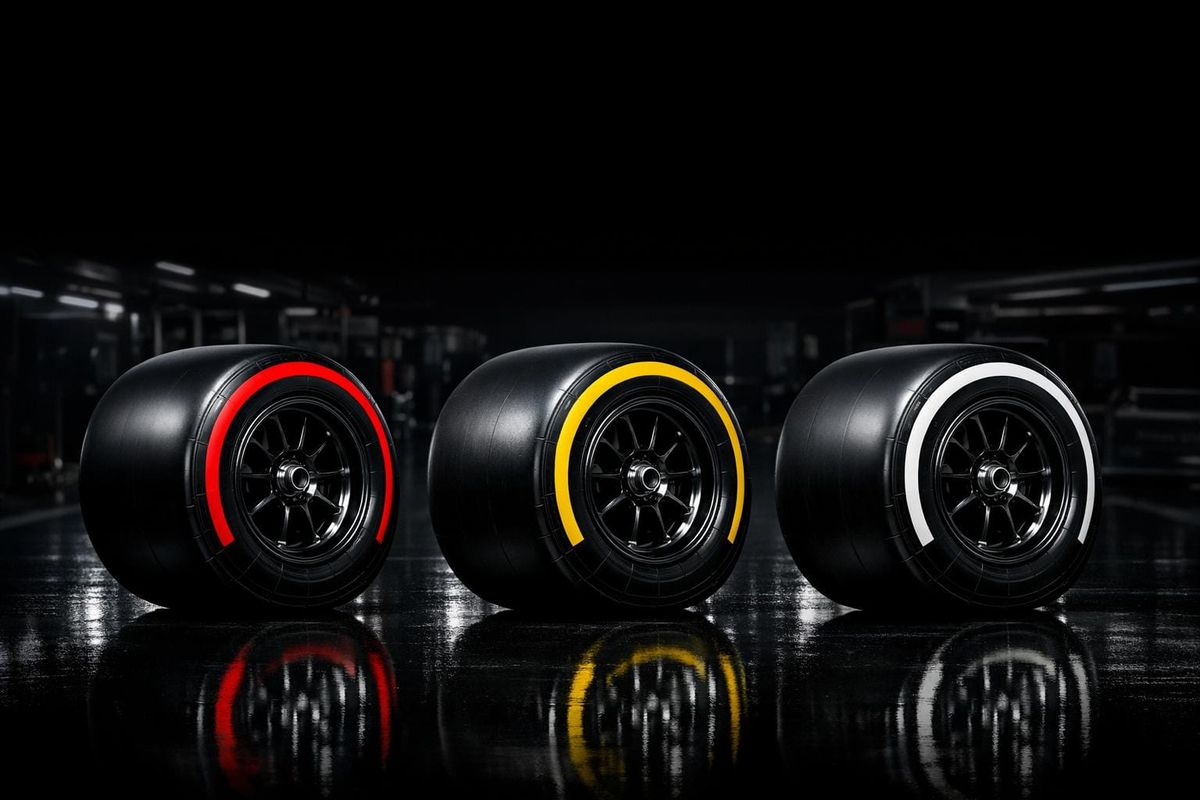
F1 tire compounds directly impact car performance. Pirelli provides five main slick tire compounds (C1 to C5), with three selected for each race weekend and labeled as Soft (red), Medium (yellow), and Hard (white). These labels are event-specific, meaning the same compound (e.g., C3) might serve as Soft at one track and Hard at another.
- Soft Tires: Maximum grip, fast warm-up, but wear out quickly. Ideal for qualifying or short stints.
- Medium Tires: Balanced grip and durability. Suitable for varied race strategies and longer stints.
- Hard Tires: Highly durable, slower to warm up, and best for abrasive tracks or long stints.
Tire choice affects race strategies like pit stops and lap times. Teams must balance grip and longevity to optimize performance under F1's strict rules.
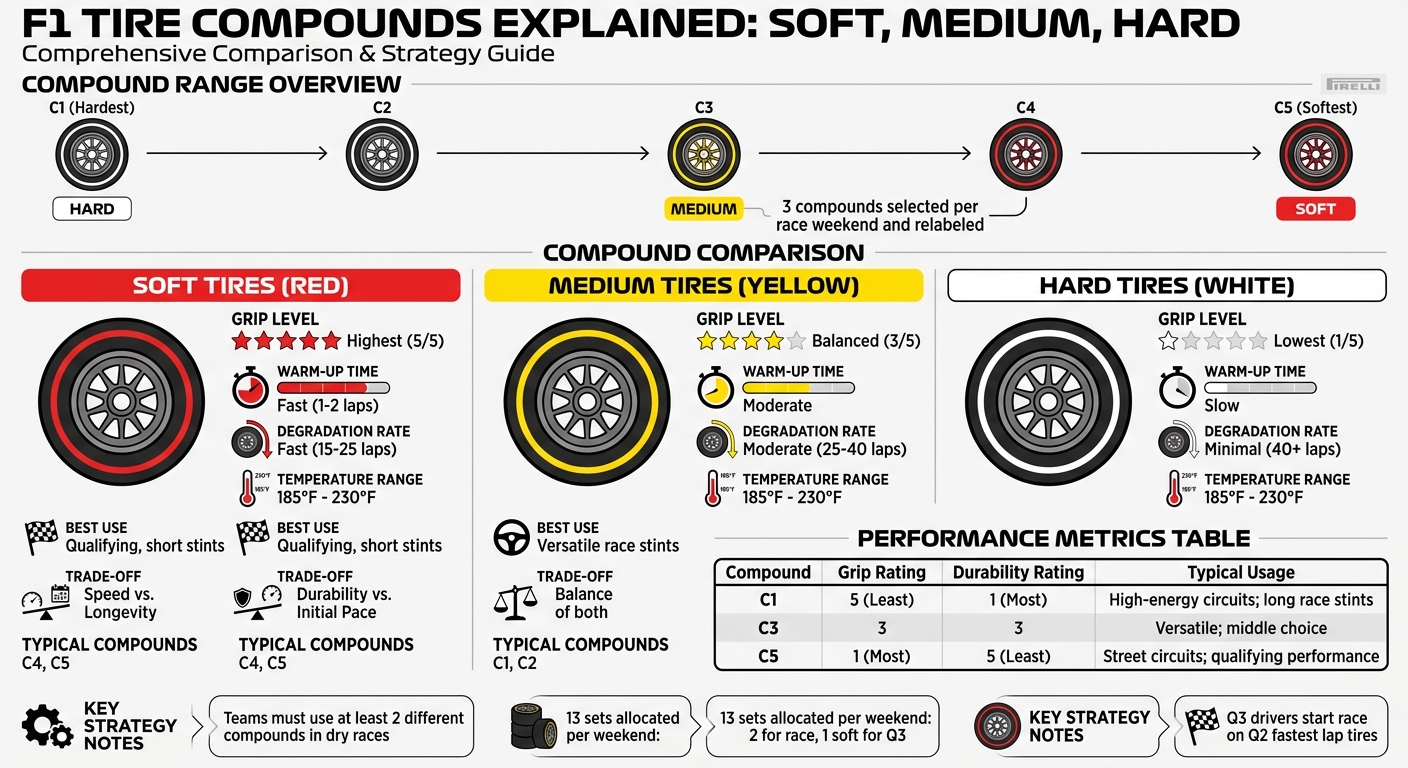
F1 Tire Compounds Comparison: Soft vs Medium vs Hard Performance Characteristics
F1 Tyre Compounds Overview (Updated for 2025!)
sbb-itb-7c68254
Characteristics of Each Tire Compound
Let’s dive deeper into how the specific traits of each tire compound impact performance on the track.
Soft Tires: High Grip, Quick Wear
Soft tires, often represented by the C4 or C5 compounds, are all about maximum grip and rapid warm-up. These tires hit their sweet spot within just a few laps, delivering top-tier performance almost instantly. But there’s a catch - they wear out quickly, making them ideal for qualifying laps or short, aggressive race stints. As Rupesh N. Bhambwani from Formula One Forever puts it:
"The C5 is the softest compound... Cars should be flying on these tires... The tire is only usually selected on extremely smooth surfaces or on street circuits that demand maximum mechanical grip".
Medium Tires: A Middle Ground
Medium tires, typically the C3 compound, strike a balance between grip and durability. They’re versatile, making them a favorite for varied race strategies. Pirelli’s 18-inch tires, introduced in 2022, improved upon their predecessors by offering:
"a wider working range than their 13-inch predecessors, improving the warm-up phase", which means "overheating is limited, and degradation is reduced".
This makes medium tires a reliable choice for longer stints where maintaining a consistent pace is key.
Hard Tires: Built to Last
Hard tires, usually the C1 or C2 compounds, are designed for maximum durability and resistance to heat. They take longer to reach their optimal temperature and provide the least grip of the three compounds. However, they shine on high-energy circuits and abrasive tracks, where long stints are necessary. Pirelli describes them as:
"The C1 is the hardest tire in the range... designed to provide maximum resistance to heat and extreme forces, being capable of running very long stints, but this comes at the expense of peak performance".
| Characteristic | Soft Tires | Medium Tires | Hard Tires |
|---|---|---|---|
| Grip Level | Highest | Balanced | Lowest |
| Warm-up Time | Fast | Moderate | Slow |
| Degradation Rate | Fast | Moderate | Minimal |
| Best Use Case | Qualifying; short stints | Versatile race stints | Long stints; abrasive tracks |
| Primary Trade-off | Speed vs. Longevity | Balance of both | Durability vs. Initial Pace |
This breakdown highlights the strengths and weaknesses of each compound, helping teams make smarter tire choices during races.
Choosing the Right Compound for a Race
Once teams understand the characteristics of each tire compound, the next step is deciding the ideal mix to match the track's demands and the race strategy.
How Pirelli Allocates Compounds
Pirelli determines its tire selections by analyzing several key factors: the circuit's layout, the abrasiveness of the asphalt, historical data on tire degradation, and weather forecasts. For high-speed circuits like Silverstone or Spa, which are tough on tire shoulders, Pirelli typically opts for harder compounds such as C1, C2, and C3. On the other hand, slower street circuits like Monaco or Singapore usually get softer options like C3, C4, and C5.
Once the compounds are chosen, they are rebranded for the weekend as Hard (white sidewall), Medium (yellow), and Soft (red). This means the same compound, like the C3, could serve as the "Soft" at one track and the "Hard" at another, depending on the other compounds selected. Each team is allocated 13 sets of dry-weather tires for the weekend, with two reserved for the race and one of the softest compound kept for Q3 in qualifying.
These decisions are further fine-tuned by considering the specific conditions of the track.
Track Conditions and Tire Selection
The track's surface and layout play a crucial role in determining the best tire choice. Abrasive surfaces can wear tires down quickly, often leading teams to favor harder compounds that can last longer stints. In contrast, smoother or freshly resurfaced tracks allow softer compounds to perform effectively without excessive wear.
Temperature is another critical factor. High ambient and track temperatures increase the risk of tire degradation and overheating. Conversely, cooler conditions can make it challenging for harder compounds to reach their optimal performance window. These variables underscore how track characteristics directly influence tire behavior and race strategy.
Pit Stop Strategy: 1-Stop vs. Multi-Stop
Tire compound selection and track conditions heavily influence pit stop strategies, as teams aim to balance speed with durability.
When Pirelli brings harder compounds compared to previous years, teams often lean toward a one-stop strategy, focusing on tire longevity over outright pace. Alternatively, softer tire allocations encourage multi-stop strategies, where teams trade durability for quicker lap times. Additionally, drivers who make it to Q3 must start the race on the tires they used to set their fastest lap in Q2, linking qualifying performance to the opening phase of the race. This rule adds another layer of complexity to race strategy planning.
Performance Trade-Offs: Soft vs. Medium vs. Hard
Performance Metrics Compared
Tire compounds are all about finding the right balance between grip and durability. Pirelli's C5 compound offers the highest mechanical grip (rated at 1) but wears out the quickest (rated 5 for degradation). On the other end of the spectrum, the C1 compound provides the least grip (rated 5) but lasts the longest (rated 1), making it perfect for circuits with high energy demands and heavy loads. The C3 compound strikes a middle ground, with ratings of 3 for both grip and durability, making it a flexible option for a variety of track conditions. This balance highlights the constant trade-off teams face between speed and tire life.
| Compound | Grip Level | Durability | Typical Usage |
|---|---|---|---|
| C1 | 5 (Least) | 1 (Most) | High-energy circuits; long race stints |
| C3 | 3 | 3 | Versatile; often the middle choice |
| C5 | 1 (Most) | 5 (Least) | Street circuits; qualifying performance |
Speed vs. Longevity Trade-Offs
These metrics reveal a clear pattern: softer compounds provide quicker lap times but degrade faster, limiting their usefulness to shorter stints and often requiring more pit stops. For example, compounds like the C4 and C5 heat up quickly and deliver immediate performance, making them ideal for qualifying laps or aggressive opening phases. However, their tendency to overheat leads to a steep drop in performance over time.
On the other hand, harder compounds like the C1 and C2 are more resistant to overheating and allow for longer stints, which can support one-stop strategies. The trade-off? They take longer to reach their optimal temperature, especially in cooler conditions, which can result in slower lap times early in the race. These dynamics force teams to carefully weigh the benefits of speed against the need for endurance, especially under F1's strict tire rules.
Recent Race Examples
The impact of these trade-offs is evident in race strategies and outcomes. Take the 2026 Miami Grand Prix, for instance. During the race in May, Lewis Hamilton described a "tough" mid-race phase, emphasizing how tricky it can be when tire performance doesn't align with a car's competitive window. This highlights a common challenge: when tire selection or pit stop timing doesn't match changing track conditions, drivers can find themselves at a disadvantage - caught between rivals on fresh tires and others trying to manage worn ones. This example underscores just how critical it is to balance speed and durability when crafting a tire strategy.
Conclusion
Key Takeaways
F1 tire compounds strike a balance between grip and durability. Soft tires deliver maximum grip and fastest lap times but typically last only 15–25 laps. Medium tires offer a middle ground, combining decent grip with endurance for 25–40 laps. Meanwhile, hard tires are built for longevity, lasting 40+ laps under ideal conditions, though they provide less grip and require more time to warm up (185°F to 230°F).
Pirelli selects three compounds from its C1 (hardest) to C5 (softest) range for each race, tailoring them to the track's characteristics. This means the "Soft" compound at one race may behave differently than the "Soft" at another track. Tire labels are specific to each race weekend, so their performance is always relative.
These details are crucial for grasping how tire selections influence race-day strategies.
How Tire Compounds Shape Race Strategy
Tire compounds play a central role in shaping Grand Prix strategies. A key rule requires drivers to use at least two different slick compounds during a dry race, turning pit stops into strategic opportunities. Teams face tough decisions: stick to a one-stop strategy with harder tires to maintain track position, or gamble on a two-stop plan with softer tires for higher overall pace.
The compound choice also affects tactical maneuvers like the undercut, where pitting early for fresh tires can help a driver gain time over rivals. Additionally, teams must manage the risk of hitting the "cliff" - a dramatic drop in tire performance where lap times can suddenly deteriorate by several seconds. These factors make tire strategy a critical part of any race, with every pit stop potentially altering the outcome.
FAQs
Why can the same Pirelli compound be Soft at one race and Hard at another?
Pirelli's tire compounds can be labeled as Soft at one race and Hard at another, depending on the specific demands of each circuit. This classification isn’t random - it’s based on factors like track temperature, surface characteristics, and energy levels. These adjustments help ensure the tires deliver the best performance and durability tailored to the unique conditions of each race.
How do teams decide between a 1-stop and a 2-stop tire strategy?
Teams decide between a 1-stop or 2-stop strategy by evaluating factors like tire durability, track characteristics, and race conditions. Softer tires provide better grip but wear out quickly, often leading to 2-stop strategies. On the other hand, harder tires last longer, making them suitable for 1-stop plans. Additional considerations, such as tire wear rates, track temperatures, and the circuit's layout, play a role in striking the right balance between performance, tire longevity, and maintaining a competitive race pace.
What causes tires to “fall off a cliff,” and how do drivers prevent it?
Tires can suddenly lose performance due to thermal and wear degradation, which directly impacts grip. Thermal degradation occurs when excessive heat weakens the rubber, while wear degradation is caused by the gradual loss of tread over time. Both factors combine to create a sharp decline in a tire's effectiveness.
To combat this, drivers focus on managing both tire temperature and wear. This involves techniques like moderating acceleration and braking to avoid overheating and choosing tire compounds that suit the track surface and weather conditions. These strategies help maintain performance and extend tire life.