F1 Calendar Trends: Lessons from Past Seasons
Regional race grouping, venue deals and weather shifts are reshaping F1 logistics, budgets and race-day setup strategies.
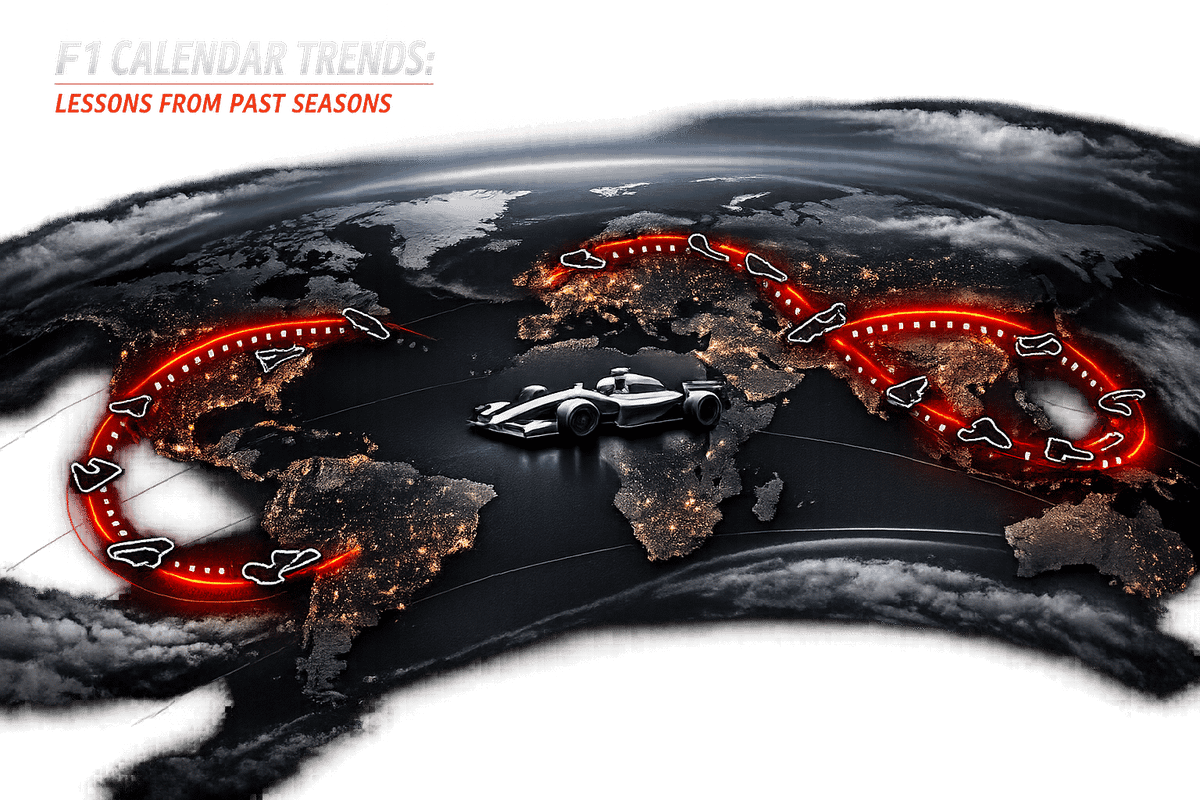
Formula 1's evolving race calendar has become a key factor in shaping team strategies. From logistics to car design, every aspect of preparation is influenced by changes in scheduling. Here's what you need to know:
- Calendar Growth: The number of races expanded to 24 by 2025, pushing teams to optimize logistics and manage personnel under tighter schedules.
- Regional Grouping: Races are now clustered by location, reducing travel distances and aligning with F1's carbon reduction goals. For example, Canada moves to May in 2026 to follow Miami.
- Long-Term Venue Deals: High-paying venues like Saudi Arabia and Qatar dominate, while traditional circuits like Spa face rotating schedules to stay on the calendar.
- Technical Adjustments: Teams must adapt to weather-driven challenges, like cooler conditions in Canada’s new May slot, requiring changes in tire and engine setups.
- Budget Planning: Predictable schedules help teams allocate resources effectively, especially under the $215 million cost cap starting in 2026.
These changes highlight how the F1 calendar impacts team operations, from logistics to race-day performance.
The 2025 F1 Calendar – Does it Make Sense?
sbb-itb-7c68254
Regional Race Grouping and Its Effects on Teams
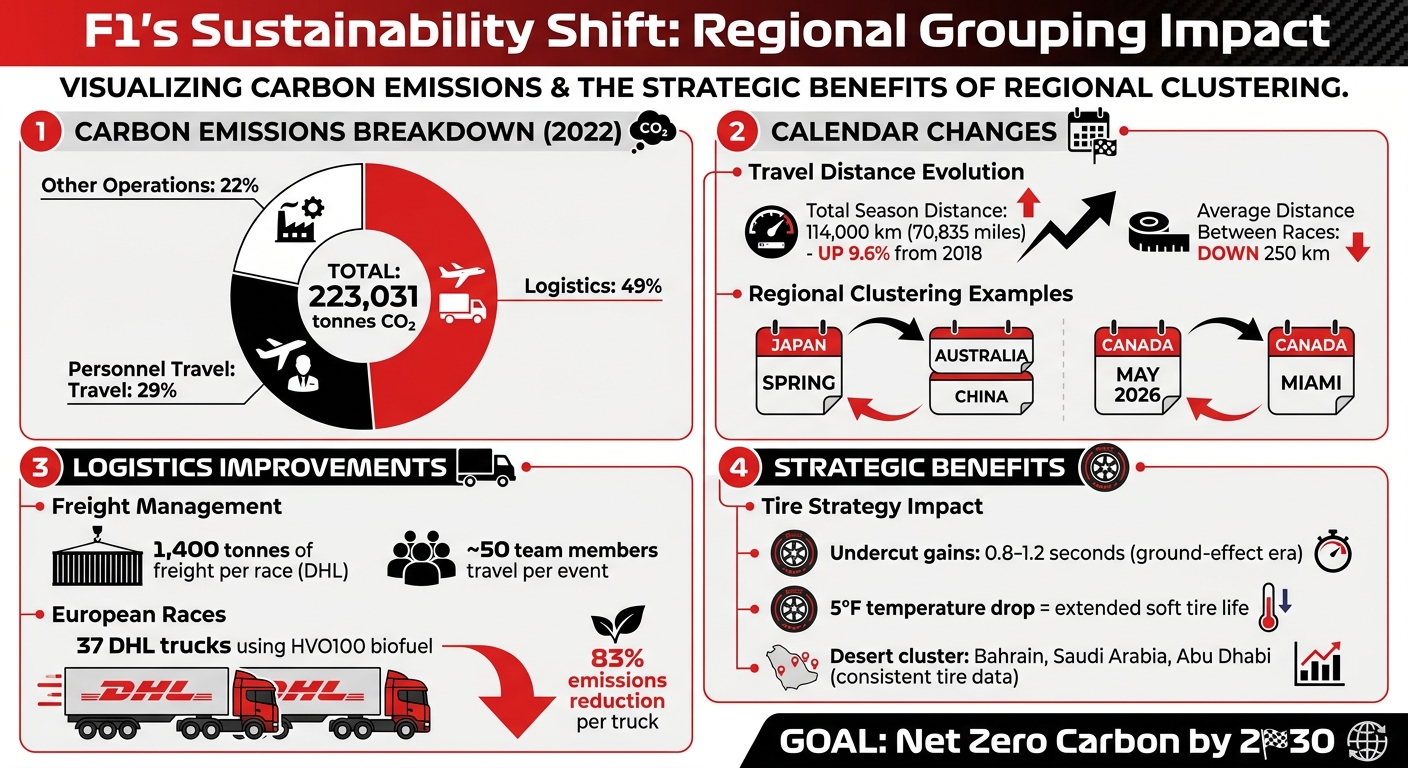
F1 Carbon Emissions Breakdown and Regional Grouping Impact 2022-2026
Advantages of Grouping Races by Region
Organizing races by geographic region plays a big role in Formula 1's goal of achieving Net Zero Carbon by 2030. Logistics alone make up about 49% of the sport's total carbon emissions, which amounted to an eye-opening 223,031 tonnes of CO2 in 2022. On top of that, moving personnel contributes another 29% to the emissions tally.
To address this, the calendar has undergone a major overhaul. For instance, Japan's Grand Prix has been shifted to the spring to align with races in Australia and China, while Canada will move to May in 2026 to follow the Miami event. This eliminates the chaotic "geographical pinball" scheduling, which had teams zigzagging across continents. Formula 1's President & CEO, Stefano Domenicali, explained it best:
"The change will make the future flow of our calendar not only more sustainable, but logistically more sensible for our teams and personnel."
Interestingly, while the total travel distance for the season has grown to over 114,000 km (around 70,835 miles) - a 9.6% increase from 2018 - the average distance between races has dropped by 250 km, making logistics more efficient. DHL, F1's logistics partner, manages about 1,400 tonnes of freight per race, and regional grouping cuts down on the need for intercontinental flights for both equipment and the roughly 50 team members who travel for each event.
Teams are also embracing technological solutions. "Remote garages" at headquarters, used by Ferrari and Mercedes, rely on real-time telemetry to assist trackside operations. This reduces the number of traveling staff and helps shrink their carbon footprint. Additionally, for European races, 37 DHL trucks now run on HVO100 biofuel, cutting emissions by an average of 83% per truck. These changes not only reflect environmental concerns but also give teams more time to fine-tune their race-day setups, providing a competitive edge.
Beyond cutting emissions, these logistical improvements allow teams to gather consistent data across similar circuits, which is essential for optimizing tire strategies.
How Regional Grouping Changes Tire Strategy
Having consecutive races in comparable climates gives teams the chance to refine their tire degradation models with greater accuracy, thanks to consistent environmental conditions. This consistency is especially helpful in managing tire strategies for challenging conditions, such as desert tracks.
Take Bahrain, for example. Its high tire wear often demands a two-stop strategy. By grouping it with other desert races like Saudi Arabia and Abu Dhabi, teams can use setup data and tire insights from one race to inform decisions for the next. In cooler climates, even a small temperature drop - say 5°F - can significantly extend the life of soft tires. This shift allows teams to move from cautious one-stop strategies to more aggressive two-stop plans, such as a Medium-Medium-Soft approach.
That said, regional grouping doesn’t always mean identical conditions. For instance, moving Canada’s race to May required careful coordination with Quebec authorities to ensure the track could be prepped despite lingering winter conditions. But when the conditions do align, teams can quickly build compound-specific data, improving decisions on undercut timing and stint lengths. On modern ground-effect cars, undercut gains can range from 0.8 to 1.2 seconds during low-fuel, cooler track phases, making these data-driven calls crucial in tight battles for track position.
The triple-header finale - Las Vegas, Qatar, and Abu Dhabi - is a prime example of how regional grouping boosts efficiency. However, it comes with a downside: the intense strain on personnel at the season's end. Despite this, teams accept the trade-off, as the streamlined calendar prioritizes sustainability and logistical practicality over the comfort of traditional scheduling.
Multi-Year Venue Contracts and Team Budgets
Key Venue Contracts Through 2025 and Beyond
Formula 1 has locked in several high-value, long-term venue agreements, signaling a shift in its revenue model. Qatar, for instance, committed to a 10-year deal through 2031, paying $55 million annually - matching Saudi Arabia's annual fee through 2025. Saudi Arabia’s deal also includes a $450 million sponsorship package over a decade via state-owned Aramco. Meanwhile, Abu Dhabi secured its spot as the season-ending race through 2030 for $40 million per year, and Miami’s partnership extends through 2031.
These contracts significantly impact F1's financial structure. In 2022, hosting fees alone brought in around $700 million, a sum that feeds directly into prize distributions for teams.
However, there’s a clear divide between state-backed venues and more traditional circuits. While Qatar and Saudi Arabia pay $55 million annually, Monaco - a cornerstone of F1 history - pays just $15 million through 2031. Iconic European tracks like Spa-Francorchamps and Imola face an uncertain future, with discussions of alternating their spots on the calendar to make room for venues offering higher fees. As McLaren CEO Zak Brown explained:
"The future likely holds 20 fixed races and eight races that rotate every other year."
These fixed agreements not only guarantee hosting fees but also provide teams with consistent schedules, which are crucial for effective budget planning.
How Calendar Predictability Affects Budget Allocation
A stable race calendar has a direct impact on how teams allocate their budgets. Knowing the schedule in advance allows teams to plan investments in areas like car development and logistics. The F1 cost cap is linked to the number of races - teams receive an additional $1.1 million for every race beyond 21. This adjustment helps teams balance the high costs of long-haul flyaway races with the more economical European events, where logistics rely on trucking.
Operational costs have also risen significantly. In 2026, team budgets jumped from $135 million to $215 million, reflecting added expenses previously exempt from the cap, as well as inflation adjustments. Additionally, the power unit cap increased to $130 million.
Long-term contracts provide teams with the stability needed for multi-year planning. For example, Ferrari and Alpine have already shifted their focus to developing their 2026 engines and car designs, even at the expense of reduced competitiveness in 2025. This kind of forward-looking strategy is only possible when teams can reliably predict the tracks and dates of future races.
However, unexpected cancellations can disrupt even the best-laid plans. The cancellation of the 2026 Bahrain and Saudi Arabian Grands Prix due to regional conflict reduced the calendar from 24 to 22 races, forcing teams to quickly adjust their logistics without replacement events. European circuits, meanwhile, face increasing pressure to secure state funding or invest heavily in facility improvements to stay relevant. These challenges underscore how critical calendar stability is for teams to execute long-term strategies and manage resources effectively.
Weather Changes and Car Setup Decisions
Case Studies: Weather-Driven Setup Changes
When race dates shift or new tracks are added to the calendar, teams face new weather-related challenges that demand precise setup changes. Take the Canadian Grand Prix in 2026, for instance. Traditionally held in June, it was moved to May 22–24 to follow the Miami Grand Prix on May 1–3. This change required teams to adjust for cooler weather, revising engine cooling systems, tweaking engine maps, and refining tire warm-up strategies to ensure optimal tire performance in the lower temperatures.
Temperature fluctuations have a direct impact on race strategy. For example, when cloud cover unexpectedly cools the track, softer tire compounds tend to last longer, while harder compounds lose their effectiveness. Teams often adjust pit stop windows by about 3–5 laps in these situations. At circuits like Interlagos, where a pit stop costs around 18–20 seconds, this adjustment can determine whether a team opts for a one-stop or two-stop strategy.
In the current ground-effect era, teams often use higher rear ride-heights to manage rear tire temperatures during high-lateral-load corners. While this setup sacrifices some straight-line speed, it helps maintain balance over longer stints - an essential trade-off when track temperatures soar. Additionally, in "dirty air" conditions, soft tires can overheat in as little as five laps when following another car closely, making tire management even more critical.
These examples highlight how even minor calendar shifts can force teams to make swift technical adjustments, showing just how tightly linked scheduling decisions are to race-day performance.
Weather-Related Strategy Adaptations: Data from Past Seasons
Over the years, teams have fine-tuned their strategies to respond to weather-related challenges. Between 2011 and 2016, high tire degradation often led to 2–3 pit stops per race. During the high-downforce era from 2017 to 2021, teams shifted to 1–2 stops as tire degradation became more manageable despite increased turbulence. In the current ground-effect era (2022–2025), 1–2 pit stops remain the norm, with undercut margins typically ranging from 0.8 to 1.2 seconds.
Colder track temperatures amplify the effectiveness of an undercut, making accurate weather forecasts critical. A good example comes from McLaren's experience at Interlagos in November 2025. The team discovered that adjusting rear ride-heights was essential to managing the thermal limits of C4 Soft tires, which were prone to overheating after five laps under intense lateral loads. When unexpected cloud cover improved the durability of soft tires, teams extended middle stints and saved soft tires for a late-race push, gaining a strategic edge.
These evolving strategies show how teams blend logistical planning with technical adjustments to stay competitive, no matter what race-day conditions throw at them.
What Teams Can Learn for 2026 Planning
Improving Logistics for Grouped Race Schedules
The 2026 Formula 1 calendar ditches the old "geographical pinball" setup, opting instead for regional clusters. This shift in scheduling fundamentally changes how teams approach logistics. The season now includes 24 Grand Prix weekends spread across 21 countries and five continents, with races grouped into regional blocks. For instance, the season kicks off with a Pacific leg featuring Australia, China, and Japan, and wraps up with a challenging triple-header in Las Vegas, Qatar, and Abu Dhabi.
To adapt, teams should prioritize sea freight for shipping nonessential equipment well in advance, using regional hubs to streamline operations. For European races, tapping into F1's truck network aligns with the sport's carbon reduction goals, helping teams meet sustainability benchmarks as part of F1's push for net-zero emissions by 2030. For flyaway races, partnerships with logistics giants like DHL will remain crucial to ensure seamless movement of equipment.
The season-ending triple-header presents a unique challenge, with rapid transitions between street circuits and permanent tracks. Formula One CEO Stefano Domenicali summed it up succinctly:
"24 is the limit"
To handle this grueling schedule, teams must fine-tune their logistics to operate at peak efficiency. This logistical precision is the backbone for adapting to the technical demands of 2026.
Designing Cars for Variable Conditions
The diversity of tracks and climates in 2026 will demand cars capable of adapting to a wide range of conditions. Instead of relying on static, season-long plans, teams should adopt dynamic feedback systems. Practice session data can feed into advanced simulations to predict variables like weather changes and tire wear. This data-driven approach allows teams to quickly prototype and produce design tweaks, sometimes within 48 hours, using 3D printing technology.
One of the biggest technical shifts for 2026 is the removal of the MGU-H (Motor Generator Unit-Heat) from the power unit. This change significantly impacts energy recovery and heat management strategies. With the new power unit featuring a 50/50 split between internal combustion (400 kW) and electric power (350 kW), teams will need cooling systems that can handle varying thermal demands, whether it's the scorching heat of Qatar or the cooler conditions in Canada.
Jurriaan Kamer, an F1 strategy expert, aptly described the evolving approach:
"Formula 1 strategy is a living hypothesis, updated every lap, not every year"
Adjustable aerodynamics and a flexible budget - reserving 10–25% for mid-season technical updates - will be essential for teams to respond to unexpected weather or track conditions. This adaptability, paired with the reliable scheduling framework, will be a key factor in maintaining competitive performance.
Using Calendar Stability to Improve Performance
A more predictable race schedule offers teams the chance to focus on long-term planning instead of scrambling to adapt to sudden changes. Regional clustering not only simplifies logistics but also provides more consistent weather patterns for specific parts of the season. This allows teams to fine-tune their setup strategies in advance.
Rather than preparing for every imaginable scenario, teams can rely on historical data to load their playbooks with the most likely variables, such as weather changes or safety car deployments. This approach supports faster decision-making during races and has already been adopted by top teams like Ferrari and Mercedes, which began preparing for the 2026 regulations well before the technical deadline.
Stability in scheduling also helps drivers maintain focus and reduces travel fatigue, especially during critical points in the championship. The move from scattered events to regional blocks enables teams to establish consistent operational rhythms, supporting both technical advancements and human performance across a demanding 24-race season.
Conclusion: Calendar Evolution and Future Team Strategies
Formula 1's shift from a chaotic "geographical pinball" approach to a more regionally clustered calendar marks a major turning point in how teams operate. With the cost cap set at $215 million, teams must now carefully balance operational budgets and long-term technical advancements within this framework. The new structure encourages a more calculated and forward-thinking approach, replacing the reactive strategies of the past.
The introduction of 20 fixed races alongside eight rotating venues brings a level of predictability that teams can use to craft multi-year strategic plans. This stability reduces the unpredictability of annual calendar changes and allows for more consistent competitive planning.
For European circuits, the stakes are higher than ever. Venues like Monza and the Hungaroring have invested heavily in upgrades - such as Monza's paddock enhancements and Hungaroring's new pit complex - to stay competitive against state-backed circuits offering steep hosting fees of around $55 million annually. On the other hand, Zandvoort’s decision to step away after 2026 highlights the challenges venues face without government support.
From a technical perspective, the stability provided by a fixed season finale in Abu Dhabi through 2030 allows teams to fine-tune car designs for specific regional demands. The upcoming 2026 power unit regulations, which will eliminate the MGU-H while increasing the MGU-K output to 470 horsepower, further emphasize the need for precise and focused development strategies.
FAQs
How does regional race grouping change team logistics?
Regional race grouping plays a key role in streamlining team logistics. By organizing the race calendar around geographic locations, freight routes, and local considerations like holidays, teams can significantly cut down on transit times and expenses while boosting overall efficiency. This approach also helps teams handle challenges like customs regulations, varying climate conditions, and staffing needs more effectively. It ensures smoother operations and makes navigating the complexities of a global racing schedule much more manageable.
Why do long-term venue deals affect which tracks stay on the calendar?
Long-term venue agreements play a crucial role in determining which tracks remain on the Formula 1 calendar. These contracts lock in specific slots for races, often for extended periods. Take Abu Dhabi, for instance - it's guaranteed to host the season finale through 2030, thanks to a premium fee arrangement.
Such deals also shape logistical planning, like grouping geographically close races together to streamline operations. However, they reduce flexibility, ensuring the calendar aligns with Formula 1's financial, logistical, and promotional priorities.
How can a race date shift change tire and setup strategy?
A shift in the race date can have a big impact on tire choices and car setups in Formula 1, thanks to changes in weather, track conditions, and logistical planning. For example, warmer weather can lead to higher tire degradation, pushing teams to rethink their tire compounds and stint durations. On the other hand, cooler temperatures might allow for longer stints without excessive wear. The timing of the race within the season also plays a role - early-season races often focus on reliability, while later ones see teams taking more risks with aggressive setups to chase vital championship points.