How Culture Shapes F1 Fan Engagement Worldwide
Cultural norms, media habits, and local heroes shape how Gen Z, women, and regional fans engage with F1.
Formula 1 connects with fans differently across the globe, influenced by regional habits, generational shifts, and interests. Here's what stands out:
- U.S. leads in engagement: 61% of fans interact daily, with 70% of Gen Z using platforms like TikTok and Instagram.
- Women and Gen Z growth: Women now make up 25% of engaged fans, doubling since 2017, while Gen Z accounts for 27%.
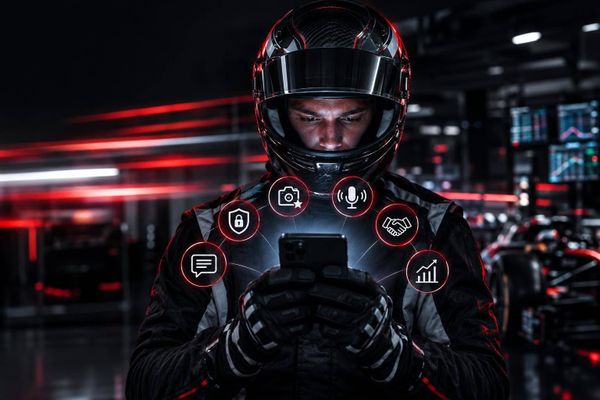
- Media preferences: Older fans stick to TV, while younger ones prefer social media, streaming, and Netflix's Drive to Survive.
- Regional differences: Asian fans focus on tech and sustainability, Europeans value racing heritage, and Americans enjoy the spectacle and style.
- Local drivers matter: 76% of fans are more engaged when there’s a home race or local star.
F1’s global success lies in tailoring experiences to meet diverse fan expectations, from digital content to race-day traditions.
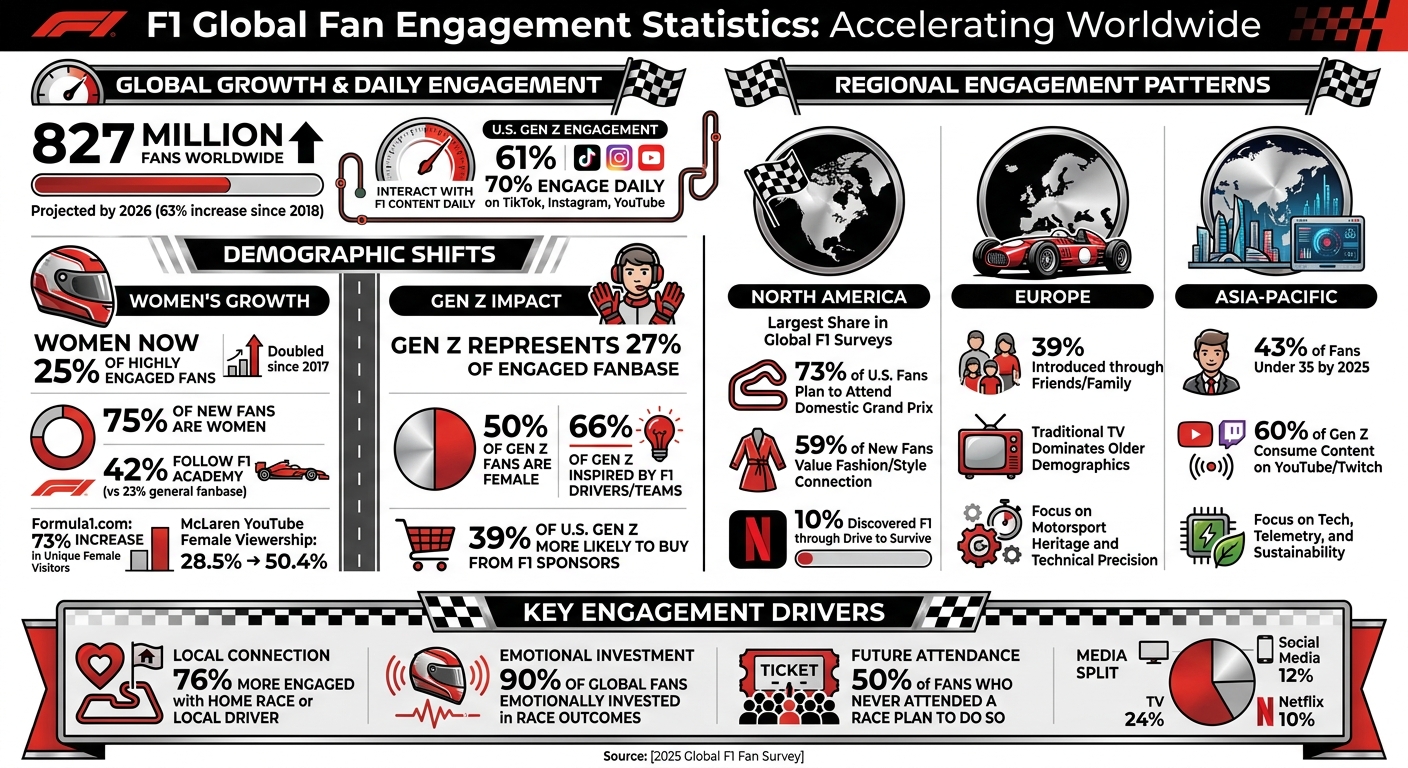
F1 Global Fan Engagement Statistics by Region, Age, and Gender
How F1 Became the Fastest Growing Sport for Young Fans
sbb-itb-7c68254
What Drives F1 Engagement Across Different Cultures
Fan engagement in Formula 1 shifts significantly depending on where people live, their values, and how they interact with content. Beyond regional and generational differences, three key factors shape how fans connect with the sport: race-day traditions, media habits, and the influence of local drivers.
Race-Day Traditions and Regional Customs
Cultural norms play a big role in shaping how fans experience F1, from their behavior at the track to their views on sportsmanship. Take Japan, for example. At Suzuka Circuit, the principle of wa - or collective harmony - creates a one-of-a-kind atmosphere. Fans cheer for all drivers, avoid negative behavior like booing, and even clean up their grandstands as a shared responsibility. During the October 2022 Japanese Grand Prix, fans braved heavy rain and a two-hour red flag, showing their unwavering dedication to the sport.
Japanese fans also stand out with their gift-giving traditions. They wait in long lines to hand over handmade items - like detailed portraits, scale models, and calligraphy banners - to drivers and teams. Max Verstappen highlighted this passion after his 2022 victory:
"I am very pleased to win here but also very happy to see all the fans who stuck around in the rain".
Meanwhile, American fans bring their own flair to race weekends with activities like multi-day trackside camping and tailgating. These unique customs reflect how deeply ingrained F1 has become in various parts of the world. But traditions are only part of the story - how fans consume F1 content also reveals fascinating differences.
How Fans Consume F1 Media Worldwide
The platforms fans use to follow F1 vary by region and age. For older male fans (45+), traditional TV remains the go-to. On the other hand, younger audiences, particularly Gen Z and women, are drawn in by social media and streaming platforms like Netflix. TV accounts for 24% of fan engagement, while social media (12%) and Netflix’s "Drive to Survive" (10%) are rapidly gaining ground.
Fans in Asia often focus on the technical side of the sport. They engage with telemetry feeds, engineering updates, and sustainability efforts, especially in series like Formula E. Western audiences, however, are drawn to the personalities and drama showcased in "Drive to Survive".
Digital platforms are also reshaping the sport’s reach. For instance, Formula1.com saw a 73% increase in unique female visitors. Similarly, McLaren Racing's YouTube channel saw its female viewership jump from 28.5% to 50.4%. This shift calls for a dual approach to content: quick, digestible updates for younger fans and detailed technical breakdowns for older ones. These evolving media habits highlight how F1 is tailoring its approach to connect with fans globally. But the presence of local drivers often adds an extra layer of connection.
Local Drivers and Their Impact on Regional Fanbases
Drivers act as cultural connectors, introducing 12% of fans to F1 and encouraging 76% of fans to follow the sport when there’s a home race.
Local stars can ignite regional enthusiasm. For instance, the United States had the largest share of respondents in the 2025 Global F1 Fan Survey, with 73% of U.S. fans expressing interest in attending a domestic Grand Prix.
Younger fans often see drivers as personal role models. In fact, 66% of Gen Z fans say they feel inspired by F1 drivers and teams. Through social media, drivers have become global icons, sharing behind-the-scenes glimpses of their lives and creating viral moments. From Pierre Gasly’s “El Plan” to Yuki Tsunoda’s colorful radio messages, these off-track interactions keep fans engaged long after the checkered flag drops.
F1 Fandom Across Major Global Markets
F1's global appeal is undeniable, with 827 million fans worldwide projected by 2026 - a massive 63% increase since 2018. However, the way fans connect with the sport varies widely across regions. The United States, Europe, and Asia-Pacific each bring their own cultural influences and media habits into the mix.
North America: F1's Rise in the United States
In the U.S., F1 has seen incredible growth, with American fans now representing the largest share of respondents in global F1 surveys. This surge is fueled by digital-first storytelling that highlights the human side of the sport, particularly through Netflix's Drive to Survive, which introduced F1 to 10% of its fans.
American fans gravitate toward the entertainment and spectacle of F1 rather than focusing solely on technical aspects. For instance, 59% of newer fans value the sport's connection to fashion and style, while 70% of Gen Z fans engage daily through platforms like TikTok, Instagram, and YouTube. Communities like r/formuladank and influencer-driven content also play a big role in simplifying the sport's complexities, making it more approachable for newcomers.
Liberty Media's 2017 acquisition of F1 marked a shift in fan engagement strategies. By loosening copyright restrictions, F1 now encourages user-generated content and meme culture, which has resonated particularly well with younger audiences. As a result, 39% of U.S. Gen Z fans are more likely to buy from F1 sponsors, and 73% plan to attend a domestic Grand Prix, underscoring the impact of races in Miami and Las Vegas.
While the U.S. thrives on digital engagement, Europe remains grounded in its rich motorsport traditions.
Europe: F1's Historic Core
In Europe, F1 fandom is deeply tied to its long-standing history and traditions. For 39% of fans, the sport is a family affair, with friends and relatives serving as their primary introduction - far surpassing the 10% who discovered F1 through shows like Drive to Survive. Traditional TV coverage still dominates, especially among older fans who have followed the sport for decades.
Countries with deep motorsport roots, such as Italy, the UK, and Germany, continue to celebrate their motorsport heritage. Ferrari's legacy, for example, remains a cornerstone of fan loyalty. At the same time, British fans are blending old and new by showing enthusiasm for both race-day traditions and digital innovations like esports. The European approach to fan engagement tends to be more formal and hierarchical, contrasting with the collaborative, influencer-driven culture emerging in the U.S..
Meanwhile, Asia-Pacific is carving its own path with a strong focus on digital platforms and technology.
Asia-Pacific: A Digital-First Approach
In Asia-Pacific, F1 is capturing the attention of younger audiences, especially in countries like China and India. By 2025, 43% of F1 fans in the region were under 35, with 60% of Gen Z consuming content on platforms like YouTube and Twitch. Social media and streaming services have largely replaced traditional TV as the primary way fans engage with the sport.
This region's fans are drawn to technology and innovation, with a strong interest in telemetry feeds, engineering updates, and sustainability initiatives. Bernie Collins, an analyst at Sky Sports, highlighted the shift in how F1 connects with fans:
"For a long time in Formula One, there was no interaction with the outside. It was very closed – you could only see it on TV. Now they've done the best, I think, with social media interaction, with short clips, with trying to get short-form content out there that people can consume really easily."
Fans in Asia-Pacific also prefer indirect, consensus-driven communication with teams and drivers. Their focus on data-driven content and environmental advancements aligns seamlessly with F1's broader push for innovation, positioning the region as a key player in the sport's future growth.
Gender and Age Shifts in F1's Audience
F1's fanbase is undergoing a noticeable transformation. The sport's appeal now stretches far beyond the traditional race-day experience, reshaping its demographic reach and digital influence. According to the 2025 Global F1 Fan Survey, female fans now make up 25% of highly engaged viewers - a figure that has more than doubled since 2017. Interestingly, women account for three out of four new fans identified, highlighting a shift in the sport's audience dynamics and a growing connection with younger generations like Gen Z.
Growing Female Viewership
The rise in female fans has been remarkable. As noted in the 2025 Global F1 Fan Survey, women now represent 25% of F1's highly engaged audience, showcasing a dramatic increase since 2017. This shift has encouraged F1 to focus more on character-driven storytelling, emphasizing rivalries, personal challenges, and human drama rather than just technical aspects. Notably, 42% of female respondents follow the F1 Academy series, a stark contrast to the 23% engagement from the general fanbase.
F1's marketing approach has also evolved, positioning the sport as a cultural phenomenon. For 59% of new fans, elements like fashion and style play a significant role in their connection to F1. Social media platforms like TikTok and Instagram, combined with influencer collaborations and community-driven initiatives, have made the sport more approachable. This is especially true for women, with 39% citing friends and family as their gateway into the world of F1.
Gen Z and Continuous Digital Engagement
Alongside the increase in female viewership, Gen Z is reshaping how F1 is experienced in the digital age. This age group now makes up 27% of the sport's engaged fanbase, with half of these fans being female. Among U.S. Gen Z fans, 70% interact with F1 content daily, consuming race analysis, driver updates, and behind-the-scenes footage. Across all engaged fans, 61% report daily interactions with F1-related content.
Dmitry Avdeev, Web Project Manager at The Influence Agency, highlighted this shift perfectly:
"While Drive to Survive may have introduced millions to the sport, it was the online community - fueled by memes, influencers, and digital content - that sustained and amplified F1's cultural presence."
For Gen Z, F1 is no longer limited to race weekends. The sport thrives as a constant digital conversation spanning platforms like YouTube, TikTok, esports, and even real-time telemetry feeds. This continuous engagement has also caught the attention of sponsors, with 39% of U.S. Gen Z fans being more likely to buy products from F1 partners.
How F1 Can Maintain Global Growth
To keep up with shifting audience demographics and the dynamics of global markets, Formula 1 (F1) needs to keep evolving. Staying relevant means rethinking live events, prioritizing environmental goals, and using cutting-edge digital tools to keep fans engaged.
Live Events and Fan Zones
The classic race weekend has come a long way. Surveys show that 76% of fans are more likely to follow F1 if they have a "home race," and 73% of U.S. fans plan to attend a domestic race in the future. To attract new audiences, F1 is branching out into unexpected spaces like retail stores, fashion shows, and music festivals.
Take the Sephora x F1 Academy partnership for 2024–2025, for example. This collaboration brought F1 Academy branding into Sephora stores and introduced "Glam Bars" in the paddock. It’s a move designed to connect with female fans, especially since 59% of new fans value fashion and style as part of their F1 experience.
F1 is also tailoring its events to regional tastes. Each Grand Prix is designed to reflect its unique vibe - Miami feels entirely different from Monaco or Las Vegas. In Asia, fan zones focus on tech partnerships and environmental efforts, while in the U.S., it’s all about the spectacle, personalities, and social prestige. Notably, 50% of fans who have never attended a race plan to do so, and 41% of those who haven’t visited an F1 exhibition or arcade are eager to try one.
But it’s not just about the events themselves. F1 is working to align its values with its diverse, global fanbase.
Sustainability and Inclusivity Efforts
F1 is tapping into environmental and diversity initiatives to broaden its appeal, particularly in emerging markets. In Asia, for instance, fans are drawn to F1’s focus on sustainability and green engineering - a reflection of growing interest in technological innovation.
Inclusivity is another major factor. Women now make up 75% of new fans, with 42% following the F1 Academy. Representation has also made waves: in 2021, Sarah Moore became the first openly LGBTQ+ driver to stand on a Formula 1 podium during a W Series support race, showing how visibility can fuel progress within the sport. For Gen Z, where 66% feel personally inspired by F1 drivers or teams, these efforts resonate deeply. As Sunaina Biradar put it:
"Formula 1 is no longer just selling races. It is selling belonging."
These efforts not only attract fans but also reflect F1’s commitment to meeting the expectations of its global audience.
Data-Driven Content and Digital Tools
F1 fans are plugged in 24/7. Sixty-one percent of highly engaged fans interact with F1 content daily, and that number jumps to 70% for U.S. Gen Z fans. To meet this demand, F1 relies on advanced digital infrastructure. For instance, Oracle x Red Bull Racing processes over 100GB of telemetry data during each race weekend, turning real-time analytics into fan-friendly dashboards.
Asian fans, in particular, gravitate toward data-heavy content, showing more interest in battery technology, environmental innovation, and telemetry than in traditional race drama. To capture this audience, F1 plans to offer even more in-depth access to real-time engineering and analytics during broadcasts.
Even off the track, F1 uses creative tools to expand its reach. The Brad Pitt-led F1 film became the highest-grossing sports movie ever, serving as a powerful way to introduce new fans to the sport.
F1 is also addressing online challenges. By promoting healthier community interactions and moderating social media toxicity, it aims to create more inclusive digital spaces for the 43% of fans under 35.
Conclusion: Understanding F1's Global Fanbase
Formula 1 has transformed from a niche European sport into a global powerhouse, projected to captivate 827 million fans by 2025. This growth stems from its ability to resonate across vastly different regions like Tokyo, Miami, and Monaco, thanks to its knack for aligning with local preferences. For instance, 76% of fans are more likely to follow F1 when they have a home race. Moreover, the sport engages tech-savvy Asian audiences differently than it appeals to spectacle-loving North American fans. These contrasting approaches highlight the complexity of F1's global appeal.
In Europe, the sport's roots remain tied to traditions, with many fans discovering F1 through friends and family. Meanwhile, women are emerging as the majority of new fans, drawn by social media, Drive to Survive, and partnerships with fashion brands. Gen Z is also taking center stage, now representing 27% of the fanbase, with 70% of U.S. Gen Z fans consuming F1 content daily. These shifts aren't just about demographics - they reveal the cultural nuances that demand tailored strategies.
What sets global sports like F1 apart is their ability to meet fans on their terms. In Asia, fans are captivated by real-time telemetry and advancements in technology. North American audiences gravitate toward driver personalities and the prestige of attending a Grand Prix. In Europe, the focus remains on the sport's technical precision and rich heritage. As Sunaina Biradar aptly put it:
"Formula 1 is no longer just selling races. It is selling belonging".
This localized approach underscores the need for F1 to keep evolving. The real challenge isn't just maintaining its growth but staying relevant in a world of diverse expectations. Stakeholders who embrace Cultural Intelligence (CQ) and adapt to these differences will succeed, while those who don't risk losing their audience. With 90% of global fans emotionally invested in race outcomes, F1 has a strong foundation. The big question is whether the sport can keep pace with its ever-evolving fanbase.
FAQs
Why do F1 fans act so differently at races in Japan, the U.S., and Europe?
F1 fans bring their own flair to races, with behaviors shaped by regional traditions and media habits. Here’s how fans in Japan, the U.S., and Europe stand out:
- Japanese Fans: Known for their respect and unique customs, Japanese fans often engage in organized cheering and display a strong sense of decorum. Their approach reflects the cultural emphasis on harmony and tradition.
- U.S. Fans: American fans take a more expressive route, creating a lively and energetic atmosphere. From enthusiastic cheers to waving flags, they bring a celebratory vibe to the races.
- European Fans: In Europe, fans blend their intense passion for the sport with an appreciation for its history and technical nuances. This reflects the region’s long-standing connection to motorsport and its rich heritage.
Each group of fans adds a distinct flavor to the F1 experience, making races around the world uniquely memorable.
How is social media changing the way people follow F1 compared to TV?
Social media is reshaping how fans connect with Formula 1 by providing instant updates, exclusive behind-the-scenes glimpses, and direct interaction with drivers. Platforms like Twitter, Instagram, and TikTok appeal to younger audiences by delivering fast, tailored content. Unlike the passive experience of watching on TV, social media encourages active participation. Fans can share their thoughts, create memes, and engage directly with teams and drivers, making Formula 1 feel more approachable and emotionally engaging on a global scale.
Why do home races and local drivers boost fan interest so much?
Home races and local drivers ignite fan enthusiasm by tapping into a sense of national pride and emotional connection. When a race takes place on home soil or a local driver competes on the global stage, fans feel a deeper bond with the sport. This dynamic strengthens loyalty and heightens excitement, particularly in emerging markets like the U.S., where regional pride and homegrown talent significantly influence fan engagement.