Teddy Mayer's Impact on McLaren's 1970s Dominance
Mayer professionalized McLaren, secured Marlboro funding, developed the M23 chassis, and led the team to 1970s F1 titles.
Teddy Mayer reshaped McLaren after Bruce McLaren's tragic death in 1970. As managing director, Mayer transitioned the team from a driver-led operation to a professionally managed one, focusing on Formula One as the team's core. His leadership brought McLaren its first F1 Drivers' and Constructors' Championships in 1974, followed by another Drivers' title in 1976 with James Hunt. Key moves included securing Marlboro sponsorship, developing the M23 chassis, and recruiting top-tier drivers like Emerson Fittipaldi and Hunt. Mayer's business-first approach and technical prioritization established McLaren as a powerhouse in the 1970s and laid the groundwork for its future success.
Rebuilding McLaren: Mayer's Management Approach
After Bruce McLaren's passing, Mayer's top priority was to stabilize the team and transition it from being driver-led to a professionally managed organization. By focusing on strategic planning and sound financial management, he laid the foundation for McLaren to challenge established giants like Ferrari and Lotus.
Shifting Resources to Formula One
While McLaren still participated in other racing series, Mayer made Formula One the primary focus for resources and development. He saw F1 as the key to building global recognition and ensuring the team's long-term success. This strategy was centered around the M23 chassis, which became a cornerstone of McLaren's competitiveness. Unlike the Lotus 72, the M23 offered greater consistency and flexibility, giving McLaren an edge throughout the mid-1970s. This technical emphasis also played a crucial role in attracting financial support.
Securing Marlboro Sponsorship
Mayer capitalized on McLaren's technical progress by securing a game-changing sponsorship deal with Marlboro in 1974. This partnership with Philip Morris drastically improved McLaren's financial position, providing the resources needed for advanced technical development and attracting top-tier talent. Marlboro executive John Hogan also played a significant role in shaping the team's strategic direction.
With the backing of Marlboro, McLaren signed Emerson Fittipaldi in 1974, a move that led to the team's first F1 world titles. The financial stability provided by this sponsorship continued to bolster McLaren's success, enabling the recruitment of James Hunt in 1976, who went on to win another Drivers' Championship.
sbb-itb-7c68254
Technical Advancements Under Mayer's Leadership
Mayer understood that achieving success required more than just financial support - it demanded technical precision and innovation. Under his leadership, McLaren became a hub where engineers had the tools and stability to push the boundaries of what was possible, ensuring the team could hold its own against powerhouses like Ferrari and Lotus.
Development of the M23 Chassis
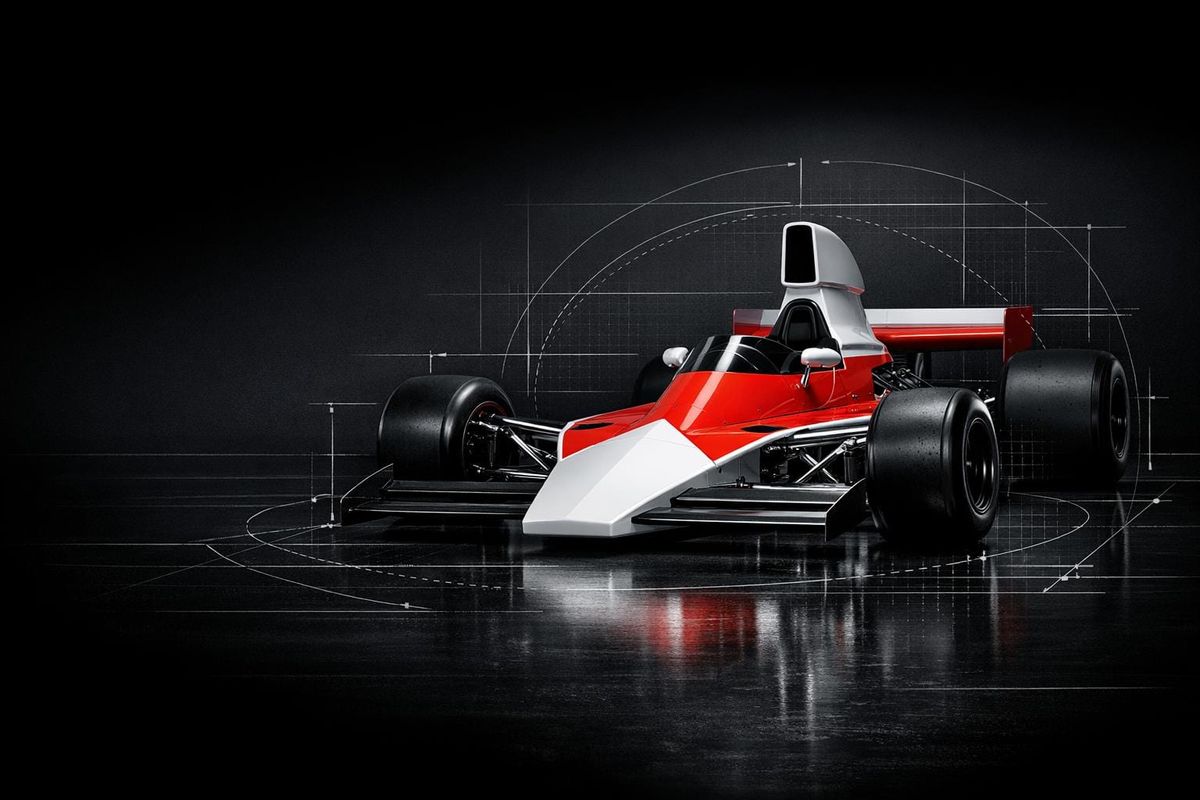
The M23 chassis was a cornerstone of McLaren's achievements in the mid-1970s. Designed by Gordon Coppuck with input from John Barnard, and guided by Mayer's vision, the car took inspiration from the Lotus Type 72. But McLaren didn’t just copy; they refined and perfected the design over time. This approach resulted in a chassis that remained competitive from its 1973 debut through parts of the 1977 season - a rare feat in an era when car designs quickly became obsolete. The M23's durability and adaptability showcased Coppuck’s engineering brilliance and Mayer’s strategy of extracting peak performance from proven designs. Even as the car aged, it was capable of securing pole positions, as demonstrated by drivers like James Hunt.
Optimizing the Ford Cosworth DFV Engine
McLaren relied on the Ford-Cosworth DFV 2,993 cc V8 engine throughout the 1970s. This engine was a popular choice among teams, but Mayer's leadership ensured McLaren made the most of it. By integrating the DFV with the M23's aluminum monocoque chassis and a Hewland 5-speed gearbox, the team created a package that outperformed many rivals using the same engine. Aerodynamic and mechanical tweaks further enhanced the car’s performance. However, the rise of ground-effect aerodynamics in the late 1970s posed new challenges. McLaren struggled to adapt the M23 chassis to these principles, a reminder that staying ahead in motorsport requires constant innovation. Despite this, the technical advancements of the era played a key role in McLaren’s racing successes.
Driver Recruitment and Championship Wins
The success of McLaren's M23 chassis wasn't just about engineering; it also hinged on having the right drivers behind the wheel. Mayer's knack for identifying and recruiting top-tier talent was just as critical as the car's technical innovations. By outmaneuvering competitors like Brabham and Ligier, Mayer brought in drivers who could turn McLaren into a championship-winning powerhouse. These strategic moves set the stage for McLaren's rise to dominance, as outlined below.
Signing Emerson Fittipaldi and 1974 Success
In 1974, Mayer made a game-changing move by signing Emerson Fittipaldi from Lotus. Already a proven champion, Fittipaldi brought a wealth of experience, technical insight, and the racing IQ that McLaren needed to reach the next level. Paired with the Gordon Coppuck-designed M23 chassis, Fittipaldi delivered instant success. That year, McLaren celebrated its first-ever Formula One titles, claiming both the Drivers' and Constructors' Championships.
As F1 historian George Wright observed, "Emerson Fittipaldi and James Hunt both capitalised on McLaren's strength in the mid 1970s, delivering the team two driver's championships in the space of three years".
James Hunt and the 1976 Season
When Fittipaldi left at the end of 1975, Mayer wasted no time finding his replacement. He zeroed in on James Hunt, a driver known for his raw speed and fierce determination. Hunt stepped into one of Formula One's most thrilling championship battles in 1976. Despite relying on the aging M23 chassis, Hunt went head-to-head with Niki Lauda in a season filled with drama. It all came down to the final race, where Hunt clinched the Drivers' Championship by a single point. This victory underscored Mayer's talent for spotting drivers who could push both themselves and their machinery to the limit, even as McLaren began navigating a new technical era.
Mayer's Legacy at McLaren
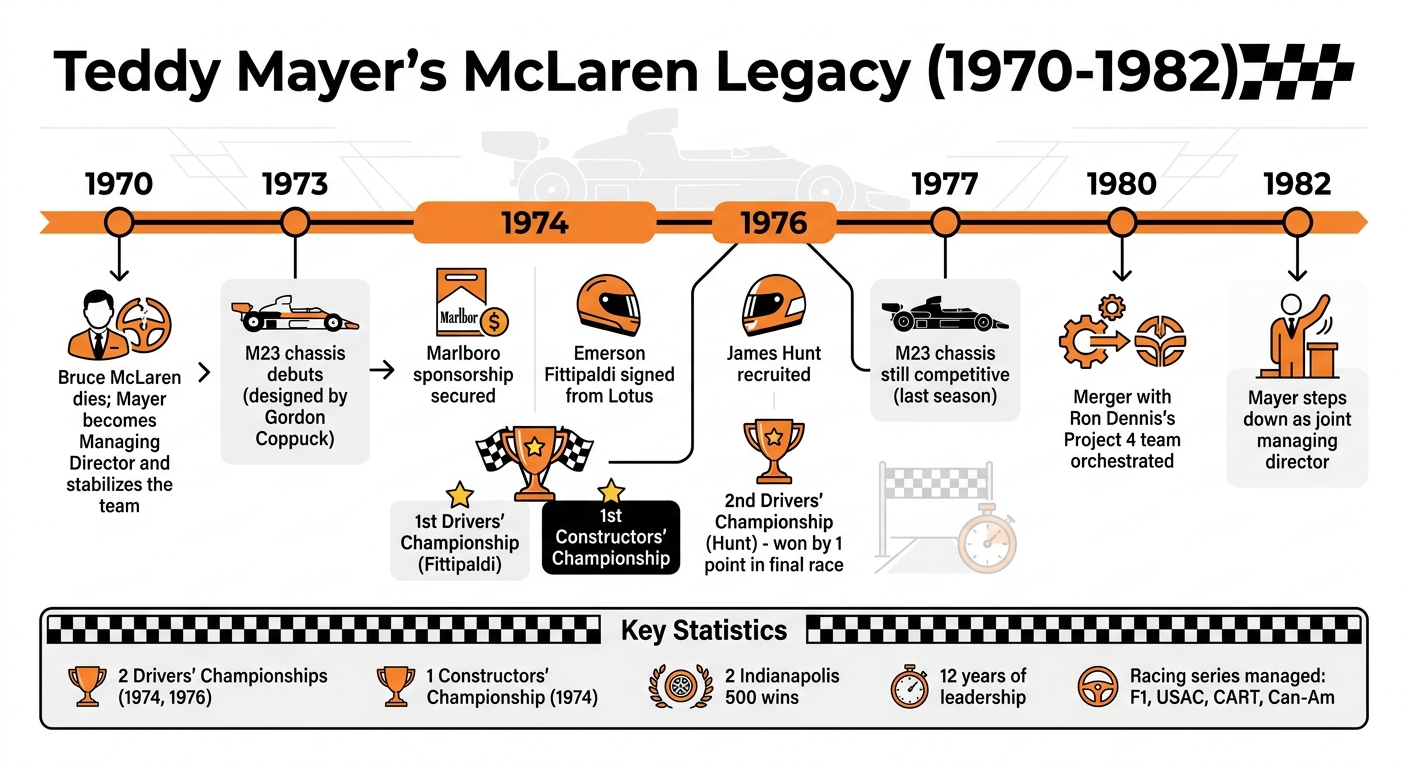
Teddy Mayer's McLaren Achievements 1970-1982
Over 12 transformative years, Teddy Mayer turned McLaren from a modest team into a powerhouse, leaving a lasting mark on its culture and operations. F1 journalist Phillip van Osten described Mayer as "one of the major architects of the outfit's early success".
Performance Statistics from Mayer's Tenure
The numbers from Mayer's leadership paint a vivid picture of success. Between 1970 and 1982, McLaren secured 2 Drivers' Championships (1974, 1976), 1 Constructors' Championship, and even triumphed twice at the Indianapolis 500. What made this even more impressive was Mayer's ability to manage resources effectively across multiple racing series, including Formula One, USAC, CART, and Can-Am. This adaptability helped cement McLaren's reputation as a versatile and competitive racing team.
Perhaps Mayer's most remarkable accomplishment was ensuring the team's survival after the tragic death of founder Bruce McLaren in 1970. While many teams might have folded under such circumstances, Mayer kept McLaren intact and steered it toward becoming a Grand Prix powerhouse. He introduced a professional management structure and secured critical commercial partnerships, providing the stability needed for long-term success.
These accomplishments not only underscored Mayer's leadership but also set the stage for McLaren's continued growth and evolution.
Influence on McLaren's Future
One of Mayer's final pivotal moves came in 1980 when McLaren faced underwhelming results. He orchestrated a merger with Ron Dennis's Project 4 team, a decision that ensured McLaren's future dominance. Rather than clinging to control, Mayer shared leadership as joint managing director until 1982, facilitating a smooth transition. This merger brought in technical expertise and a more clinical approach, which became hallmarks of McLaren's dominance in the 1980s. However, this success was deeply rooted in the commercial stability and winning culture Mayer had built.
Mayer's legacy proved incredibly resilient. The Marlboro sponsorship he secured not only sustained the team but also played a central role in the merger that revitalized McLaren. The professional standards he established became a model for modern Formula One operations. By 2026, McLaren had achieved 13 Drivers' titles and 10 Constructors' titles, a testament to the enduring impact of Mayer's foundational work.
Conclusion: Mayer's Formula One Legacy
When Bruce McLaren passed away in June 1970, Teddy Mayer stepped in to reorganize and stabilize the team. He secured Marlboro as a sponsor, built a professional framework, and led McLaren to claim two Drivers' Championships and one Constructors' Championship during the 1970s.
Mayer's impact extended beyond the trophies. His 1980 merger with Ron Dennis's Project 4 ensured McLaren's long-term stability and set the stage for future triumphs. The commercial foundation and winning mindset he cultivated became cornerstones of McLaren’s enduring success.
"Mayer was instrumental in keeping the team together, steadily building McLaren into a force to be reckoned with in Grand Prix racing." - Phillip van Osten, Journalist, F1i
In the 1990s, Mayer brought his expertise to Penske's motorsports operations, achieving notable success in CART racing. His ability to excel across different motorsport disciplines - Formula One, USAC, CART, and Can-Am - highlighted his rare talent for leadership in a variety of racing environments.
Mayer’s career illustrates that sustained success in motorsport requires resilience, strategic partnerships, and the ability to attract top talent. His leadership not only defined McLaren’s dominance in the 1970s but also set a high standard for Formula One management that endures to this day.
FAQs
Why was the M23 so competitive for so long?
The McLaren M23 stood out as a powerhouse in Formula One during the 1970s, thanks to its forward-thinking design, reliable performance, and the incredible talent of the drivers behind the wheel. This winning combination kept the car at the forefront of the competition for years.
How did Marlboro funding change McLaren’s pace in F1?
Marlboro's financial support played a key role in elevating McLaren's performance in Formula 1. This funding enabled the team to channel resources into cutting-edge technology, research, and development, which gave them a strong competitive advantage during the 1970s.
Why did McLaren struggle when ground-effect arrived?
McLaren faced challenges with ground-effect technology due to their delayed response to the major aerodynamic shifts it demanded. This hesitation to embrace the necessary innovations put the team at a disadvantage, leaving them ill-equipped to perform competitively during the initial phase of this transformative period in Formula One.